Drone Battery Testing for Racing Drones: Qualifying New
Every season, a racing team calls me with the same hopeful question: “We found a cheaper 6S pack that claims 60C — can we just swap it in?” My answer is always the same. A printed C-rating is a marketing number, not a qualification result. On race day, the weakest cell in the weakest pack decides whether you finish the final or watch from the pits. That is why, before any new cell lot or pack design ever reaches a drone, it goes through a fixed qualification gate in our lab. This article walks through the exact drone battery testing racing drones protocol Horizon Power runs to qualify new racing cells and packs — the same discipline that keeps a 180-pack fleet from losing a heat to a bad batch. A qualification gate is not paperwork; it is the cheapest insurance a race program can buy.
Why a Qualification Gate Matters More Than a Spec Sheet
A race-day failure is expensive in a way a bench failure is not. A pack that vents on the workbench costs a few dollars and an afternoon. The same pack that vents at 80 meters over a crowd costs a airframe, a camera, and your reputation with the event organizer. The entire point of pre-adoption qualification is to spend that failure budget in the lab, where it is cheap, instead of on the flight line, where it is not.
When a new drone lithium battery candidate arrives — whether it is a new cell supplier, a new format, or a redesigned pack — we do not trust the label. We run it against a fixed, repeatable test so that “this lot is good” means the same thing every time, for every engineer, on every order. That repeatability is what lets us stock spare packs with confidence and promise customers a consistent custom battery solution rather than a lottery.
Translating Race-Day Failures Into Lab Metrics
The first step of any qualification is mapping real failure modes to measurable numbers. A racing drone does not discharge gently. It pulls 100–200 A bursts for 150–300 ms, rests, and repeats for four minutes. The failures that follow are predictable, and each one maps to a metric we can screen for:
- Mid-event voltage sag and cutout → DCIR at the 10 s 1C pulse and at the actual burst C-rate.
- Lost punch after heat three → capacity retained after a burst-cycling soak and recovery slope between bursts.
- Packs that drift apart across a season → lot-to-lot DCIR spread and capacity binning consistency.
- Heat-induced soft cutoff → surface-temperature rise under load and the thermal signature of the pack.
- Sudden cell reversal on a hard hit → weld-joint and busbar integrity under mechanical shock (screened separately, below).
Every candidate is scored against these five outcomes. A pack that looks wonderful on capacity but fails the DCIR screen never makes it past the gate, because capacity is the metric a beginner reads and DCIR is the metric that ends your run.
The gate also protects the supply chain. When a single approved lot is qualified and documented, purchasing can reorder it for a year without re-testing every shipment — we only re-screen on a change of cell batch code or a supplier process notification. That stability is what lets a small team scale from five packs to fifty without re-learning every failure mode from scratch.
The Standardized Multi-Metric Spec Test
Our core spec test is identical for every candidate so results are comparable across suppliers and across years. For a reference 6S 1300 mAh 45C LiPo — 22.2 V nominal, about 28.9 Wh, roughly 190 g — the screen looks like this:
- Rated capacity at 0.2C to 3.0 V/cell cutoff. We accept within −3% of label (so ≥1261 mAh for a 1300 mAh cell). Anything under that is a reject.
- DCIR at 10 s 1C pulse using Kelvin sense. For this class we expect ≤12 mΩ per cell; a new lot averaging 14.5 mΩ is rejected even if capacity is perfect, because it sags below our 18.0 V race gate under a 150 A burst.
- Pulse power replayed from a logged qualifying lap. We measure the terminal voltage at the worst 1 s of the trace and require ≥18.4 V. A pack that dips to 17.9 V in this test will cut out on track.
- Mass-specific energy. We weigh the pack and divide by usable Wh. Below 145 Wh/kg we question the construction, because mass is the enemy of lap time.
- Recovery slope: voltage rebound +140 mV within 4 s after a burst is the healthy threshold; a slow-recovering pack loses punch late in a heat.
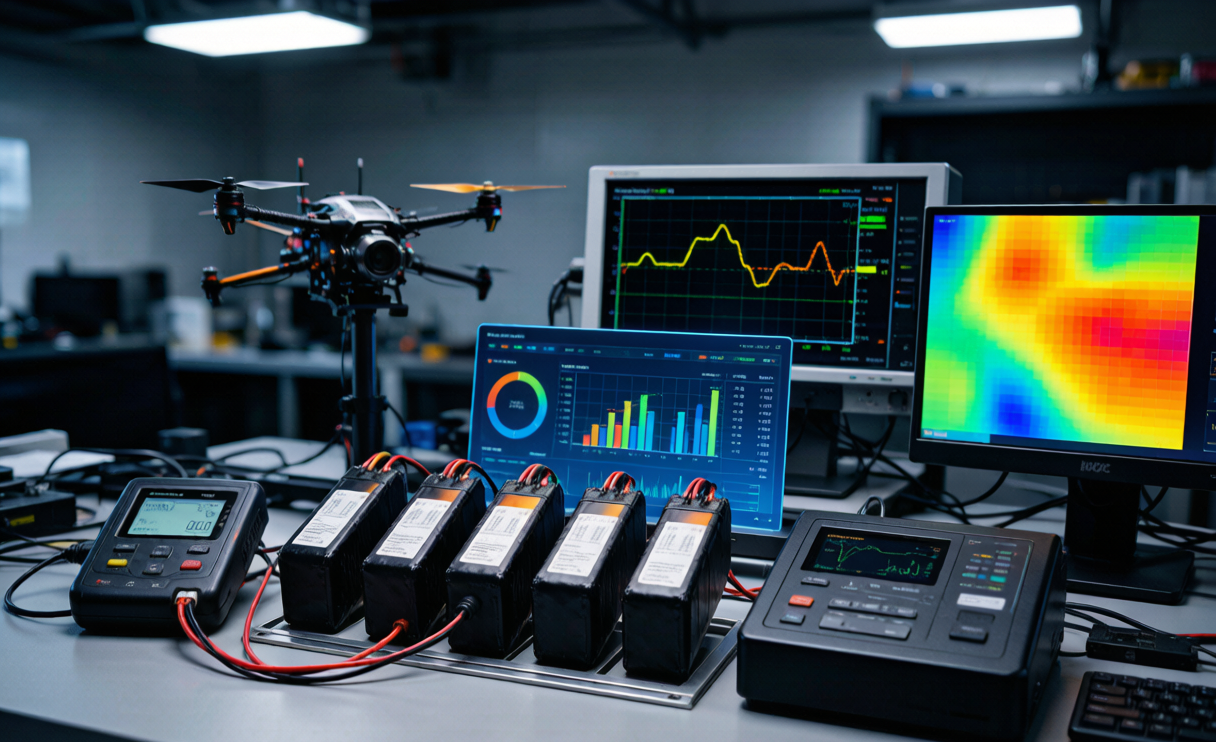
- Thermal signature: surface temperature rise under a representative 4-minute burst profile; we flag anything exceeding 45 °C knee or 60 °C hard limit, matching the de-rate rules we apply in flight.
All of this is logged to a per-pack genealogy record. The standards we precondition against are the same ones the finished pack must clear for transport and sale: UN 38.3 T.1–T.8, IEC 62133-2, IATA Section II at ≤100 Wh per pack, and the FAA/EASA 100 Wh air-transport band. A candidate that cannot meet those baselines is disqualified before we even compare performance.
Building the Head-to-Head Candidate Matrix
The real value of a fixed protocol shows up when we compare two or three candidates side by side. We build a comparison matrix with the same six metrics for every lot, then apply a simple decision rule instead of a gut feel.
In one recent shootout, Candidate A (incumbent) measured 11.8 mΩ/cell DCIR, 28.6 Wh, 150 Wh/kg, +148 mV recovery, 41 °C peak. Candidate B (cheaper, “60C”) measured 14.9 mΩ/cell, 27.1 Wh, 138 Wh/kg, +102 mV recovery, 53 °C peak. On paper B looked faster; on the matrix it failed three of six gates. We kept A and sent B back. That single comparison saved a season of mid-event cutouts.
The decision rule is deliberately boring: a candidate must clear every hard gate (capacity, DCIR, pulse voltage, thermal limit). Among those that pass, we rank by mass-specific energy and recovery, then confirm with a small fleet flight before committing a full order. No single impressive number ever overrides a failed gate.
Charge Acceptance and Fast-Turnaround Validation
Racing is won in the pits as much as in the air, so qualification also tests how a pack takes a fast charge between heats. We validate charge acceptance at 1C, 2C, and 4C and measure three things: the terminal temperature rise during charge, the balancing current the pack demands, and the capacity retained after 50 repeated fast-charge cycles.
A pack that accepts 4C charging but climbs past 50 °C on the bench will thermally de-rate on a hot race day, so we cap our pit-lane practice at 2C for most lots and reserve faster rates only for packs that stay under 45 °C. We also watch balancing stress: if a cell group needs >300 mA for more than a few minutes, the pack will arrive at the next heat with an internal imbalance that hurts burst voltage. Charge acceptance is logged into the same genealogy record so the depot knows the safe turnaround rate for that exact lot.
From Test Data Into a Custom battery solution
Qualification is not the end of the story — it is the input to the product. The measured DCIR becomes the BMS burst-gate threshold; the thermal signature sets the in-flight de-rate temperature; the recovery slope defines the minimum rest between heats; the lot spread defines the grading tolerance we hold at the factory.
Every qualified lot gets a DataMatrix genealogy tag, so a pack that misbehaves at race 14 can be traced back to its test record and its sibling packs quarantined instead of the whole fleet. That is what turns a one-off drone battery purchase into a dependable custom battery solution: the lab work upfront, repeated on every lot, feeding directly into how the pack is built, balanced, and retired. For any lithium battery we ship into a racing program, the qualification report is the first artifact we hand the customer — long before the first flight.
Frequently Asked Questions
How many charge-discharge cycles should a racing battery qualification include?
For a candidate acceptance screen, we do not need a full life test — that is a separate accelerated-life study. Qualification uses a short burst-cycling soak (typically 20–30 representative race-profile loops) to expose weak cells and confirm recovery, plus a 50-cycle fast-charge retention check. Full wear-out life is characterized separately so it does not slow down the go/no-go gate.
What DCIR threshold do you accept for a new cell lot?
For a 6S 1300 mAh class pack we hold ≤12 mΩ per cell at the 10 s 1C pulse using Kelvin sense, and we also require the lot-average spread to stay under about 6%. A lot can have perfect capacity and still be rejected on DCIR alone, because internal resistance — not rated capacity — is what determines whether you clear the 18.0 V race gate under a 150 A burst.
Can a pack pass capacity but still fail on the race track?
Yes, and this is the most common way teams get burned. Capacity tells you the energy tank size; it says nothing about how much voltage the pack holds while you draw 100–200 A. A pack with full capacity but high DCIR will sag below the ESC low-voltage cutoff mid-burst and cost you the heat. That is exactly why our gate screens pulse voltage and DCIR, not just capacity.
How do you test charge acceptance for rapid pit-lane turnaround?
We charge at 1C, 2C, and 4C and measure terminal temperature rise, balancing current demand, and capacity retained after 50 repeated fast cycles. Packs that stay under 45 °C at 2C are cleared for pit-lane fast charging; anything hotter is limited to 1C. The safe turnaround rate is written onto the pack’s genealogy record so the depot charges it correctly.
How does qualification data feed into a custom battery solution?
The measured DCIR sets the BMS burst-gate, the thermal signature sets the in-flight de-rate temperature, and the lot spread sets the factory grading tolerance. Every qualified lot gets a DataMatrix tag linking back to its test record, so a future field issue can be traced to its siblings and quarantined precisely instead of scrapping a whole fleet.