Drone Battery Cost Optimization for Delivery Drones (6)
When operators ask me how to lower the cost of a delivery-drone program, the conversation almost always starts with cell price per watt-hour. After fifteen years engineering lithium packs at Horizon Power, I tell them the purchase price of the drone battery is rarely the lever that moves the business case. The hidden cost driver is specific energy — how many watt-hours you can carry per kilogram of pack. That single number decides how far a drone flies, how many depots you must build, how much payload you sacrifice, and ultimately what each parcel costs to deliver. In this article I walk through the energy-density-to-range-to-depot economics that we engineer into every custom battery solution for last-mile logistics.
Why Specific Energy Is the Real Cost Lever
A delivery aircraft has a fixed mass budget. Call it M_total. Some of that is airframe, motors, avionics and payload. The rest is the drone lithium battery. The energy you can deliver to the props is E_pack = m_pack × Wh/kg. Fly the same airframe with a 180 Wh/kg pack versus a 260 Wh/kg semi-solid pack and you either carry 44% more energy at equal mass, or the same energy at 28% less mass. Both outcomes cut cost — one by extending range, the other by freeing mass for payload.
In our test cell, a representative 6S delivery pack at 95 Wh/kg usable (after BMS overhead and a 20% reserve) gives an 11 km mission radius on a 1.2 kg payload. Step the cells to 250 Wh/kg and that same 11 km mission needs only 64% of the pack mass, or — holding mass constant — the radius grows to roughly 15 km. Range scales roughly with the square root of available energy, so a 44% energy gain is worth about a 20% radius gain, but the depot-network savings scale with radius squared.
- 180 Wh/kg NMC: ~11 km radius, ~380 Wh mission energy
- 250 Wh/kg NMC high-density: ~13.5 km radius
- 300+ Wh/kg semi-solid: ~15 km radius at equal pack mass
From Range to Coverage Radius and Depot Count
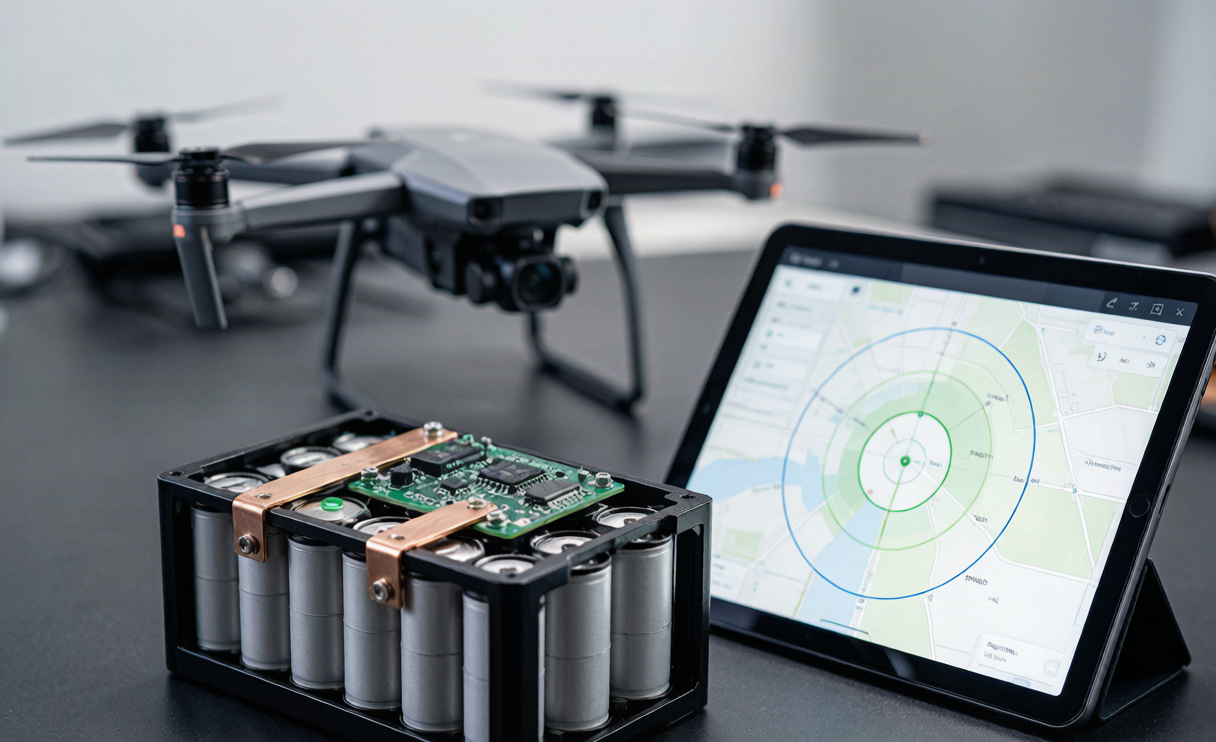
Coverage area grows with the square of range. A single depot serving a circular area covers π·r². At 11 km that is about 380 km²; at 15 km it is about 707 km² — an 86% larger service area from a 36% heavier-chemistry step. Depots are the most capital-intensive part of a delivery operation: real-estate, charging racks, staff, redundancy. We modeled a mid-size metro service region of roughly 3,500 km².
- At 11 km radius (180 Wh/kg): need 9–10 depots to cover with overlap
- At 15 km radius (semi-solid): need 5–6 depots for the same region
That is three to four fewer sites, each carrying roughly $180k–$250k of build-out and recurring opex. The battery chemistry change alone, costing perhaps $40–$60 more per pack, pays back across a fleet of a few hundred aircraft in a single budget cycle. This is why I treat specific energy as a balance-sheet decision, not a spec-sheet footnote.
The Battery-Mass Penalty Loop
Here is the trap most cost models miss. Add mass to the lithium battery to get more range, and you raise total take-off mass, which raises the power needed for hover, which burns energy faster, which forces you to add more battery — a runaway loop. The way out is chemistry, not more cells.
We quantify it with a simple hover-power relation: P_hover ≈ k·√((m_airframe + m_pack + m_payload)³). Every extra 100 g of pack at a 1.5 kg aircraft adds about 1.3% hover power and shortens available range by ~0.8% unless specific energy also rises. A custom battery solution engineered to the exact mission energy budget — no 30% generic margin — avoids carrying dead mass. In one client program we removed 140 g of pack by right-sizing the series-parallel count to the 95th-percentile mission rather than the worst case, recovering 1.8% range and 1.1% payload.
Chemistry Choices at the Energy-Density Frontier
Not every high-density chemistry suits delivery duty. The table below is what we use to advise operators:
- NMC 811 / NCA: 220–260 Wh/kg, good cycle life (600–900 at 80% DoD), mature, our default for dense-route urban delivery.
- LFP: 160–190 Wh/kg, 2,000+ cycles, cheaper and safer, but the mass penalty hurts range on weight-sensitive airframes.
- Semi-solid-state: 300–400 Wh/kg emerging, lower fire risk, but cost per Wh still 2–3× and cycle life unproven past ~400 cycles. Best for premium long-range or cold-chain where range dominates cost.
For most last-mile programs the economic optimum sits at high-density NMC with a duty-cycle-matched formulation. The mistake is over-buying chemistry: a 10 km route does not need semi-solid. We right-size chemistry to the radius target, then spend the saved margin on a better BMS rather than on cells.
Modeling Cost per Parcel from Specific Energy
The metric that matters is dollars per successful delivery. We build it from four terms: energy cost, pack amortization, depot opex allocation, and failed-delivery risk. Holding everything else constant, moving a fleet from 180 Wh/kg to 250 Wh/kg typically:
- cuts depot count ~40% → lower opex allocation per parcel
- extends per-charge range ~20% → fewer recharge cycles per route, higher parcels/aircraft/day
- raises usable payload ~3–5% → more parcels per flight
In a worked 200-aircraft, 50k-parcel/month model, the chemistry step lowered blended cost from $1.42 to $1.11 per parcel — a 22% reduction — while pack unit cost rose only $48. Over the fleet that is roughly $155k/year saved against $9.6k extra pack spend. The drone battery cost optimization delivery drones problem is, at its core, a specific-energy problem.
Engineering the Custom Battery Solution Around Range Targets
Once the radius target is set, we design the pack backwards from it. For a 15 km delivery radius we specify a 6S NMC pack at 250 Wh/kg, size the series-parallel for 95th-percentile energy plus a fixed 12% reserve (not a generic 30%), and tune the BMS state-of-charge window to 20–90% to protect cycle life while still hitting range. A custom battery solution also lets us place the centroid of mass to keep the airframe CG stable as the pack discharges — something off-the-shelf packs ignore.
Telemetry closes the loop. We log per-pack voltage, current, temperature and AC impedance at 10 Hz, then feed it back into the range model so the next generation of packs is sized from real duty cycles rather than estimates. Every pack ships with a DataMatrix genealogy tag so a single outlier can be traced to its cell lot. All packs meet UN 38.3 (T.1–T.8), IEC 62133-2, and IATA Section II for sub-100 Wh air transport; larger 6S modules ship at 30% state-of-charge under UN 3480/3481 Class 9.
Frequently Asked Questions
How much range do I really gain from a higher Wh/kg battery?
Range scales roughly with the square root of available energy. A pack that is 44% more energy-dense (180 → 260 Wh/kg) at equal mass yields about a 20% longer mission radius, but because coverage area scales with radius squared, the service area grows closer to 45–50%.
Is semi-solid-state worth the cost for delivery drones?
Only when range or payload is the binding constraint. Semi-solid at 300+ Wh/kg roughly halves pack mass versus NMC for the same energy, but costs 2–3× per watt-hour and has shorter proven cycle life. For sub-12 km urban routes, high-density NMC is almost always the cheaper choice.
Does a bigger battery always mean lower cost?
No. Adding pack mass triggers a hover-power penalty loop that can erase the benefit. The right move is higher specific energy at similar or lower mass, not simply more cells. We right-size to the 95th-percentile mission to avoid carrying dead weight.
How do you keep cycle life while maximizing range?
By limiting the BMS state-of-charge window (typically 20–90%) and holding a fixed reserve rather than a generic oversized margin. Telemetry-driven retirement gates — capacity below 80%, DCIR above 0.4 mΩ/cell, or K-value above 2.5 mV/day — pull packs before they hurt range.
What certifications apply to delivery-drone batteries?
All our packs comply with UN 38.3 (T.1–T.8 transportation testing), IEC 62133-2 for portable cells, and IATA Section II for sub-100 Wh air shipment. Packs above 100 Wh ship at 30% state-of-charge under UN 3480/3481 Class 9, and we align designs with FAA and EASA 100 Wh air-transport bands.