Drone Battery Performance for Racing Drones: Engineering (2)
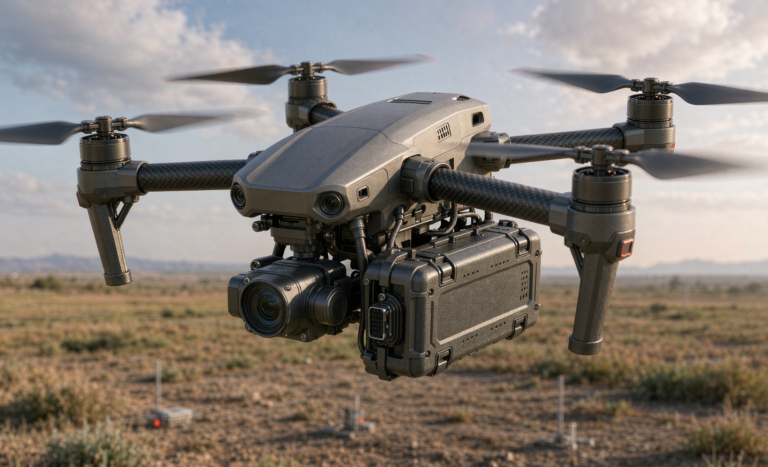
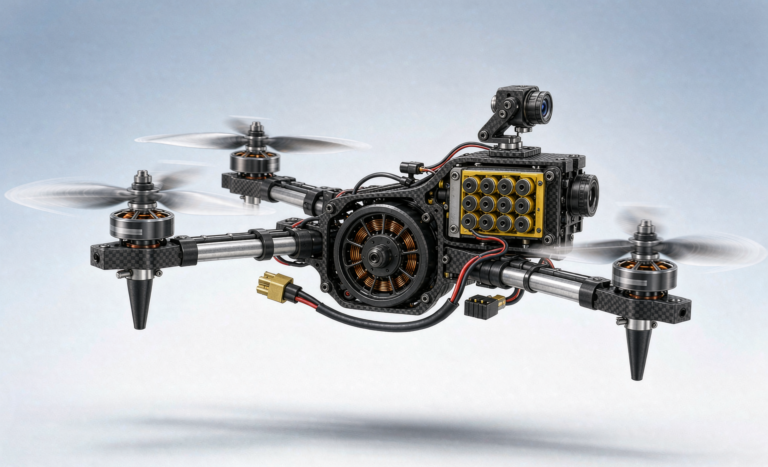
As a senior lithium battery engineer at Horizon Power, I have spent the last eleven years on the test bench with one of the harshest power profiles in the business: FPV racing drones. A 700-gram quad that yanks 110 to 140 A out of a 4S pack during a two-second punch-out is asking its cells to deliver power that most consumer electronics will never see in a lifetime. When I talk about drone battery performance for racing drones, I am not describing a marketing curve. I am describing the hard physics of internal resistance, C-rate, and thermal runaway margin that decides whether a pilot crosses the finish line or watches a pack sag at the worst possible moment.
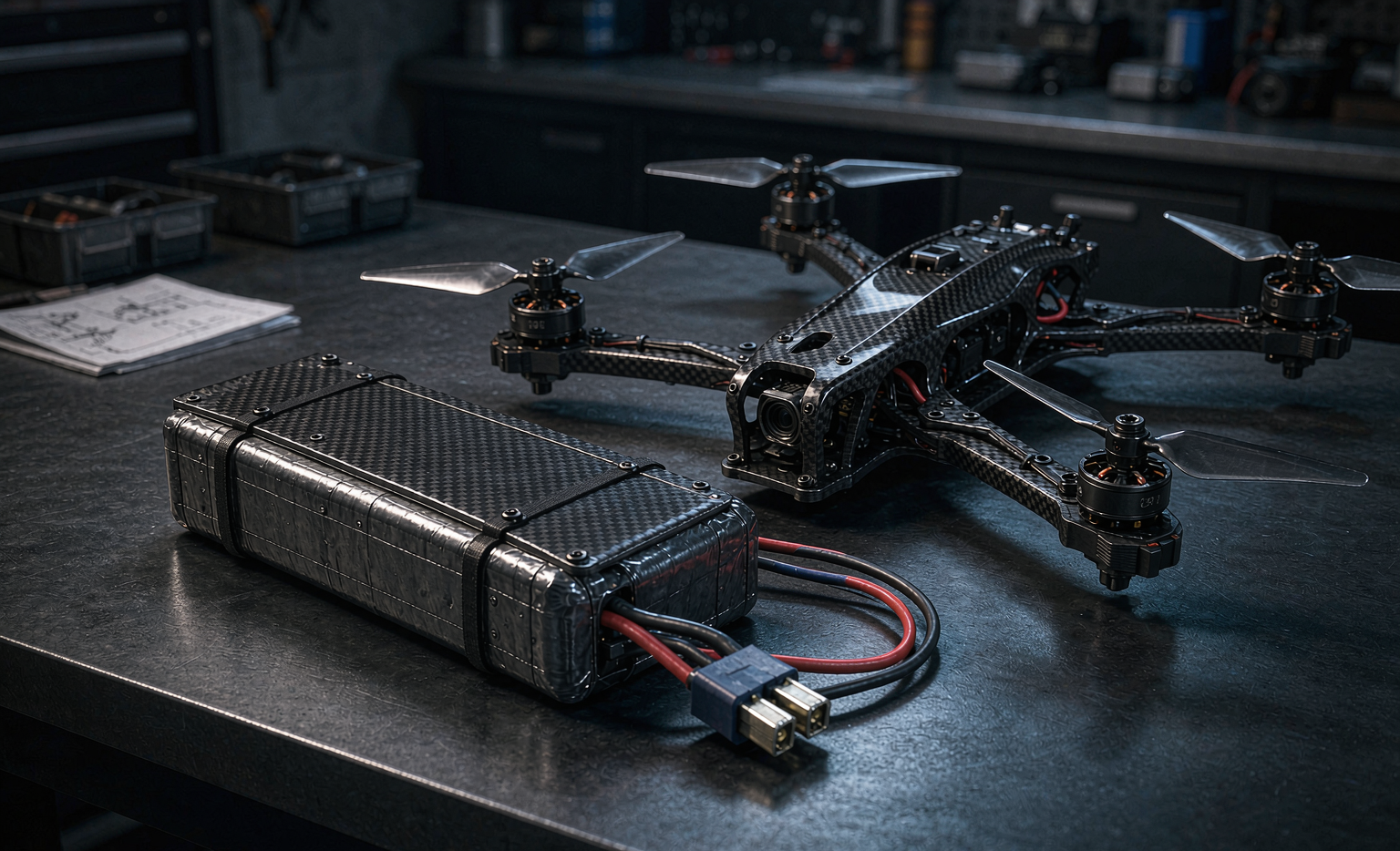
In this article I will walk through how our team engineers high-discharge packs, why a standard lithium battery off the shelf rarely survives a race weekend, and the compliance envelope (UN38.3, IEC 62133, and aviation rules from the FAA and EASA) that every custom battery solution we ship must clear before it ever reaches a track.
Why Racing Drones Break Ordinary Drone Battery Packs
The first thing new pilots learn, usually the expensive way, is that capacity and performance are not the same word. A 1500 mAh pack rated for 5C discharge will deliver about 7.5 A continuously. A racing drone needs 60 to 140 A in bursts. The gap is not subtle; it is the difference between a pack that sits comfortably and a pack that goes into protection-mode cutoff on the first throttle snap.
When we measure drone battery performance for racing drones in the lab, we look at the voltage-under-load curve, not the label. A quality 4S 1300 mAh race pack from Horizon Power holds 14.8 V under a 100 A load with less than 1.2 V of sag. A generic drone lithium battery at the same load often drops below 12.5 V, and that sag is exactly what costs a pilot throttle authority in a turn.
C-Rate and Internal Resistance: The Real Limits
C-rate is the single most abused number in our industry. A 100C label on a toy pack is almost never a true sustained rate; it is a peak marketing figure. In our engineering reports we always specify two numbers: continuous C-rate, what the pack can hold for the full discharge, and burst C-rate, what it can survive for 10 seconds. For a competitive FPV racer, we design around a continuous 25 to 35C and a burst of 60 to 80C, validated on an Arbin cycler rather than a calculator.
Internal resistance (IR) is the quieter killer. As IR climbs through aging, cold soak, or cheap welds, the pack heats faster and sags harder. We hold our race cells to a per-cell IR below 4 mOhms at 25 degrees C. Every drone lithium battery that leaves our line is IR-binned: cells within a 0.5 mOhm band are matched into the same pack so that no single cell becomes the weak link that ends a race early.
Cell Chemistry Choices for Race-Day Performance
For racing, the chemistry decision is almost always between high-discharge NMC, nickel-manganese-cobalt, and the newer silicon-doped lithium battery blends. NMC 811 with a thin electrode and high-porosity separator gives the lowest IR and the highest burst, which is why it dominates the podium. We have run silicon-anode blends that push energy density up by 12 to 15 percent, but they trade a little burst headroom for that weight saving, so we reserve them for endurance-style races rather than 2-minute sprint formats.
A custom battery solution for a specific airframe often means reshaping the cell layout: a flat 2S2P for a narrow X-class frame, or a compact 6S1P for a toothpick class racer. The chemistry stays consistent; the mechanical form factor changes to move the center of gravity where the pilot needs it. We prototype three layouts per airframe and keep the one that posts the best sag-and-weight score on the dyno.
Thermal Management During Sustained Bursts
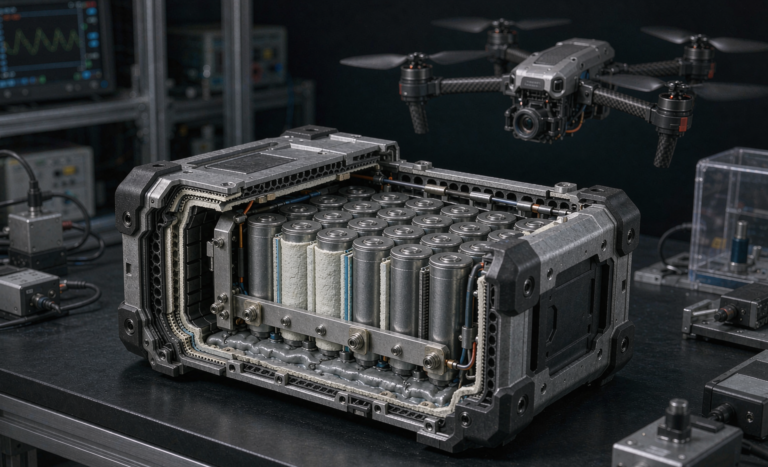
Heat is where drone battery performance for racing drones either holds or falls apart. A pack that starts a race at 28 degrees C can climb past 55 degrees C by the third pack of the day. Above roughly 60 degrees C, LiPo and high-rate NMC begin to lose cycle life rapidly and the risk of venting climbs. We manage this with two tactics: conservative burst ceilings in the BMS, and physical design such as vented shrink wrap, aluminum laminate spacing, and on some custom battery solution builds a thin graphite heat-spreader film between cells.
In the field, the rule we give every pilot is simple: if a pack is too hot to hold against your cheek, it does not fly the next round. That single habit probably saves more packs than any BMS feature we have ever shipped. We also log pack temperature with a pocket IR gun between rounds; a 3 degree C jump session over session is our early-warning sign of a failing cell before it ever sags.
Cycle Life vs. Peak Output: The Engineer’s Trade-Off
There is no free lunch. Pushing a cell to 80C burst every flight accelerates capacity fade. We generally see a race-grade drone lithium battery hold 80 percent of its original capacity for about 180 to 220 full cycles if treated well, and half that if abused. Our advice to teams is to keep two fleets: a qualifying set pushed to the limit, and a race-day set with only a few cycles on it, so the pack in the air is always in its flat, low-IR sweet spot.
This is exactly the kind of trade-off a thoughtful custom battery solution is built to navigate, matching pack count, C-rate, and cycle budget to the event format instead of bolting on the highest number on the shelf. A endurance event and a 2-minute sprint do not get the same pack, and pretending otherwise is how teams end up on the wrong side of a voltage cutoff.
How We Validate a New Race Pack
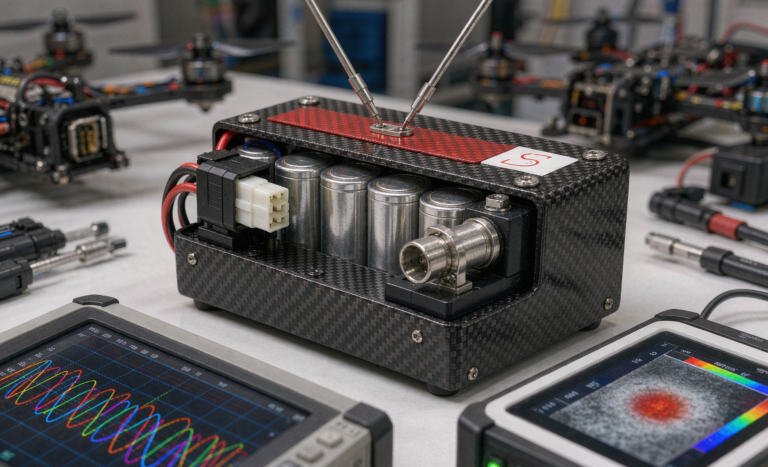
Before any pack wears the Horizon Power label, it runs a 12-step validation: IR binning, a 1C capacity check, a stepped load sweep to 80C, a 48-hour rest for self-discharge, and a UN38.3 impulse and crush sequence. Only packs that pass the full sequence ship. This is the part pilots never see, but it is the reason a drone lithium battery from our line behaves the same on lap one and lap forty. We keep the cycler logs for every batch so a team can trace a pack back to its cell lot if they ever need to.
Safety Compliance: UN38.3, IEC 62133, and Air Transport
No matter how fast the pack is, it cannot ship or fly legally without clearing the safety standards. Every Horizon Power race pack is tested to UN38.3, the UN manual of tests for lithium transport, and IEC 62133 for portable cell safety. For pilots traveling to events, the aviation framework matters: the FAA and EASA both treat loose high-rate packs as dangerous goods, and a pack over 100 Wh needs operator approval. We stamp Wh and serial traceability on every custom battery solution label so a race team can clear customs without a confiscated pit box.
Compliance is not paperwork. It is what lets a pilot show up at a track in another country with a working drone battery instead of a confiscated one. We publish the test summaries on request so event organizers can verify a pack meets their gate rules in minutes.
Conclusion
Engineering drone battery performance for racing drones comes down to a few unglamorous truths: bin your cells by IR, validate C-rate on real cyclers, respect heat, and never confuse a label with a curve. A well-built drone lithium battery or a properly specified custom battery solution turns throttle snaps into climb-outs instead of sags.
If you are building a race program and want packs tuned to your airframe rather than a catalog, that is exactly the kind of custom battery solution our team designs every week. Send us your airframe mass, target burst, and event format, and we will spec the cell count, C-rate headroom, and thermal layout that keep you on the track instead of in the pits. The fastest drone is the one whose battery never makes the highlight reel for the wrong reason.
Frequently Asked Questions
What C-rate do I actually need for FPV racing?
For competitive 5-inch class racing, plan around a continuous 25 to 35C with a verified burst of 60 to 80C. Validate the burst on a load tester rather than trusting the pack label, because the printed number is often a peak figure that the cell cannot sustain for a full flight.
How hot is too hot for a race pack?
Keep packs below about 50 to 55 degrees C between rounds. If a pack is uncomfortable to hold against your skin after a flight, let it cool fully before the next round. Sustained operation above 60 degrees C accelerates fade and raises venting risk.
Is a higher mAh always better for racing?
No. More mAh usually means more weight, and weight costs corner speed and climb rate. The lightest pack that still delivers the required burst without sagging below the ESC voltage threshold is the right answer, which is why a custom battery solution matched to the airframe often beats a heavier off-the-shelf option.
Can I travel by air with racing drone batteries?
Yes, within the dangerous-goods rules. Packs under 100 Wh can generally travel in carry-on with device protection, while larger packs need operator approval under FAA and EASA guidance. Always carry packs at partial charge and in non-conductive cases, and keep them out of checked baggage.
How many cycles should I expect from a race pack?
A well-treated race-grade drone lithium battery typically holds around 80 percent capacity for 180 to 220 cycles. Abused packs fade much faster. Rotating between a fresh race-day set and a practice set is the simplest way to protect performance across a season.
Do I need a custom pack or will a stock one work?
For casual flying, a quality stock pack is fine. For competitive racing where every tenth of a second counts, a custom battery solution that matches C-rate, mass, and center of gravity to your specific airframe usually wins out, because it removes the sag and balance compromises that off-the-shelf packs leave on the table.