Drone Battery Testing for Racing Drones (Guide)
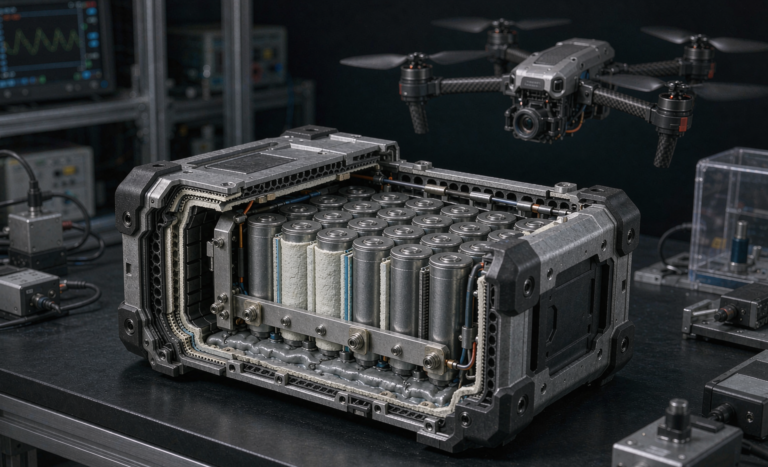
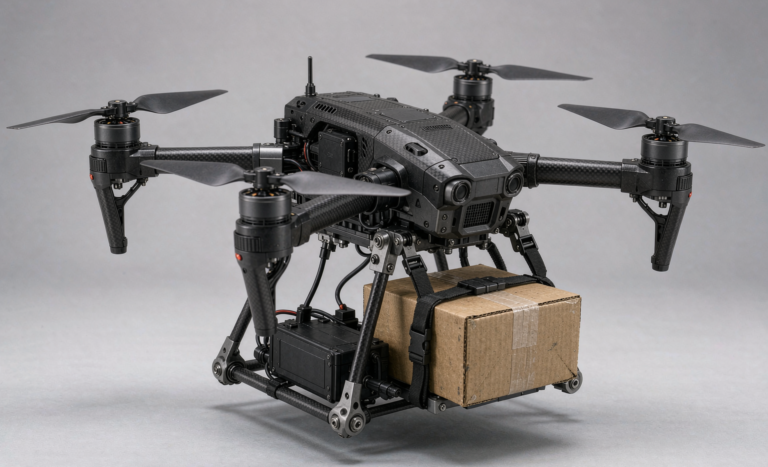
As a senior lithium battery engineer who has qualified hundreds of high-discharge packs for competitive UAV racing, I have learned one uncomfortable truth: a battery that wins on the bench can still lose on the start line. Race day is not a laboratory. It is a 38 °C pit lane one weekend and a 1,800 m alpine venue the next, with dust, vibration, sudden rain, and a pilot who expects full throttle on the first corner. That is why we treat environmental qualification as a separate, non-negotiable phase of drone battery testing for racing drones — distinct from the electrical characterization we run on every cell. In this field handbook I walk through the exact campaign we run: thermal cycling, low-pressure altitude simulation, and ingress protection (IP67). These are the tests that decide whether a drone lithium battery survives the journey from the workshop to the podium.
Why Environmental Qualification Is Different From Bench Performance
Most teams confuse two very different questions. Bench performance asks: how much capacity, how low is the DCIR, how many C can this lithium battery deliver? Environmental qualification asks a harder question: will the pack physically survive the world it is thrown into? A pack that passes a 1C room-temperature discharge profile can still fail a thermal shock from 25 °C to −10 °C in 30 minutes if the electrolyte wetting and separator are marginal. We therefore keep the two phases separate — “does it perform” from “will it survive.” The output of this phase feeds directly into our custom battery solution spec sheet: a pack is only ever rated for the climate envelope we have actually proven it can endure.
Thermal Cycling — From Desert Pit Lane to Alpine Start Line (UN38.3 T.3)
The baseline for thermal robustness is UN38.3 Test T.3: store the cell or pack at 72 ±2 °C for six hours, then at −40 ±2 °C for six hours, repeat the cycle, and require no mass loss, leakage, venting, or fire. For racing we extend the spirit of T.3 into a much harsher thermal-shock profile: a rapid transition (under 30 minutes) between −20 °C and +60 °C, which simulates a pack pulled from a cold storage box and dropped into a hot car at the track. The physics is unforgiving. As temperature drops, the electrolyte viscosity rises and internal resistance climbs, so the same throttle input produces more voltage sag and less available power. We log cell-surface temperature with calibrated thermistors and reject any drone battery that shows more than 8% capacity loss or any sign of venting across the cycle. IEC 62133-2 reinforces this with its own temperature-cycling requirement for portable cells, and we treat both standards as a floor, not a target.
Low-Pressure Altitude Simulation — UN38.3 T.2 and the 2,400 m Problem
UN38.3 Test T.2 stores the pack at a reduced pressure of ≤11.6 kPa (roughly 15,000 m equivalent) for six hours at ambient temperature, with no leak, vent, or fire permitted. That vacuum is designed for air-transport safety, and it is the reason lithium cells are shipping-compliant. But for racing we care about a different number: venues sitting at 1,500–2,400 m where atmospheric pressure is only about 75–80 kPa. That is not a vacuum, yet it is enough to stress every seal and gasket in the enclosure. The less obvious effect is thermal: at altitude, reduced convective cooling means the same 15C discharge dumps more heat into the pack because the air simply cannot carry it away. We run an altitude chamber at 75 kPa while discharging at 15C to confirm the casing does not bulge and the BMS keeps cell balancing intact. Air transport of these packs, meanwhile, follows IATA and the UN Manual of Tests — UN38.3 is the underlying basis — while EASA CS-25 and FAA Part 23 reference battery standards for airworthiness when teams fly packs commercially. A drone lithium battery that passes T.2 on paper but swells at 2,400 m is a liability we simply will not ship.
Ingress Protection — IP67 Qualification Against Rain, Dust and Pit-Lane Grit
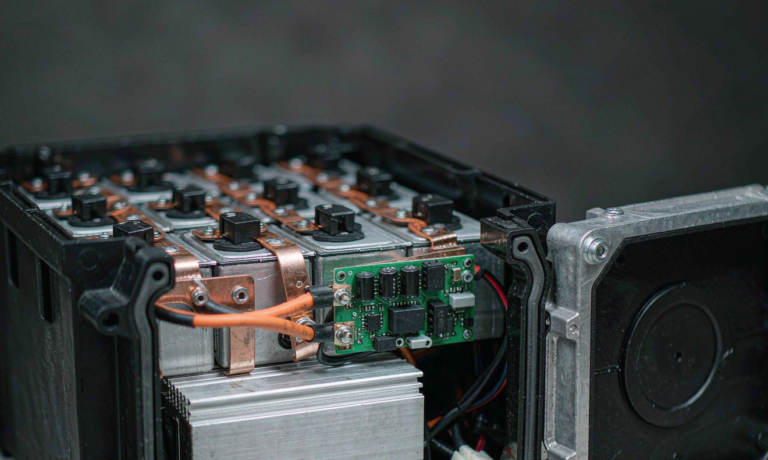
Race weekends are wet, dirty affairs. A pack gets splashed in the pits, rained on during a downpour, and sometimes skidded into a puddle after a hard landing. That is why we qualify every outdoor-rated lithium battery to IP67: dust-tight on the first digit, and immersion-proof to 1 m for 30 minutes on the second. The campaign has two halves. First, an eight-hour dust chamber filled with standardized talc verifies no contaminant reaches the cells. Second, a 1 m immersion for 30 minutes, followed by a full functional discharge to prove the pack still delivers. The engineering behind the rating matters as much as the number: a sealed enclosure, a potted BMS, gasketed connectors, and conformal coating on the protection PCB. A pack that passes every electrical test but lets water reach the cells has failed the only test a pilot cares about on a rainy Sunday. We also insist the connector’s own IP rating matches the pack, because a sealed box with a leaky plug is still a wet box.
Building the Environmental Test Campaign — Instrumentation and Go/No-Go
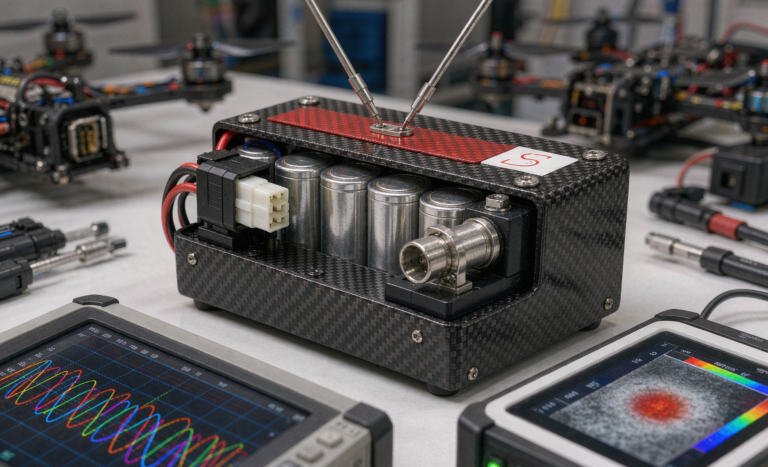
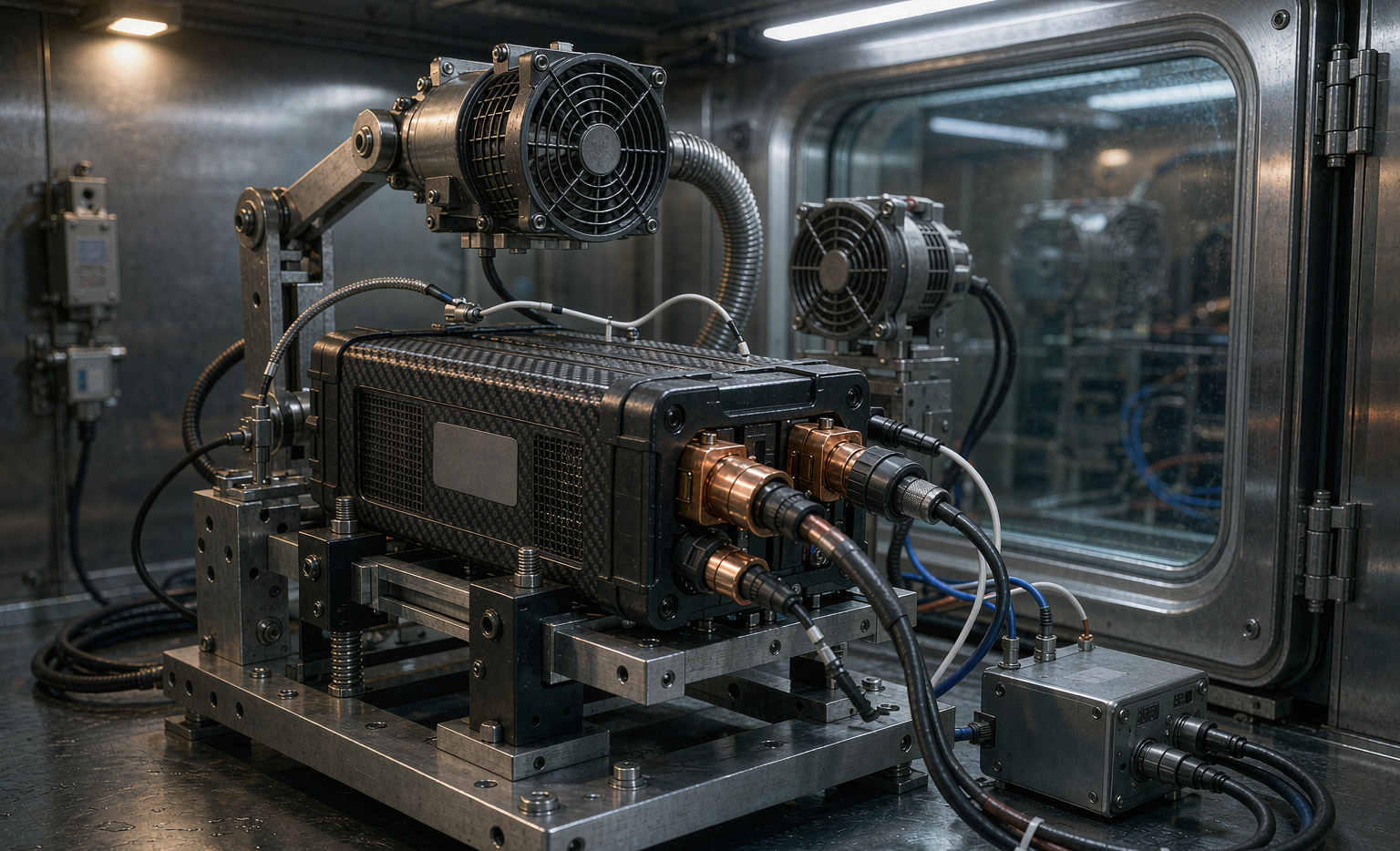
A credible qualification program lives or dies on its rig and its acceptance criteria. Our test bench pairs a thermal chamber and an altitude chamber with a dedicated IP dust and immersion rig, all fed by a data-acquisition system logging thermistor temperatures, pack voltage, per-cell voltage, and discharge current at 1 Hz. Statistically we qualify a sample — typically five packs from a batch of fifty — plus a 100% incoming visual on the rest. The go/no-go gate is explicit: capacity retention at or above 92% after cycling, zero vent or leak, casing dimensional change under 0.5%, BMS still balancing within 10 mV, and a clean IP pass. Every run is written to a traceable record carrying the batch id, cell lot, test operator, and timestamp. That dossier is the backbone of the custom battery solution we hand to a race team, because it lets them see exactly what their pack was proven against rather than what a brochure claimed.
From Qualification Data to a Race-Ready Custom Battery Solution
The real value of drone battery testing for racing drones shows up here, in how the data reshapes the product. If thermal cycling exposes weak cells at −10 °C, we swap to a low-temperature electrolyte or a different cell grade before the pack ever reaches a customer. If the altitude discharge runs hot, we widen the cooling gap and, for that venue, drop the rating from 15C to 12C so the pack stays inside its safe envelope. If an IP test fails, we redesign the gasket and re-qualify rather than ship and hope. The qualification report becomes the foundation of a custom battery solution tuned to a team’s actual calendar of venues — a desert series, an alpine series, or a mixed coastal schedule. After fifteen years of doing this, my rule is simple: environmental qualification is not a checkbox you tick to clear compliance. It is the difference between a DNF and a podium.
I will give one concrete example. A coastal sprint team came to us after two consecutive pack failures at a 2,100 m inland venue they had added late in the season. Their existing drone lithium battery had passed every bench test at sea level, but our altitude chamber immediately reproduced the swell they had seen on race day. The fix was not a new cell chemistry — it was a revised enclosure gasket and a 12C rather than 15C rating for that venue, plus a BMS thermal model recalibrated for thin air. After re-qualification the same cells finished the season without a single thermal retirement. That outcome is the whole point of disciplined drone battery testing for racing drones: the data tells you exactly what to change, and exactly where the pack’s real limits are.
Frequently Asked Questions
How cold can a racing drone battery operate before voltage sag?
In our testing a typical high-rate drone lithium battery begins to show noticeable sag below about −5 °C, with internal resistance climbing steeply under −10 °C. We qualify cold-weather packs with a low-temperature electrolyte and set a conservative minimum operating temperature on the label so pilots do not over-discharge a pack that has simply lost its punch to the cold.
Does altitude really change racing drone battery performance?
Yes, in two ways. The reduced pressure stresses seals (the UN38.3 T.2 concern at extreme altitude, and a real 75–80 kPa issue at 2,000 m venues), and the thinner air removes cooling capacity so the same discharge runs hotter. We always re-run a thermal discharge at the target altitude during qualification.
What IP rating do you recommend for racing drone batteries?
For any pack that leaves the bench and faces a real venue, we recommend IP67 as the minimum. It covers dust ingress and a 1 m / 30-minute immersion, which is more than enough for rain, pit-lane grit, and the occasional puddle landing that ends a hard race.
How long does a full environmental qualification campaign take?
A complete campaign — thermal cycling, altitude simulation, and IP67 testing on a five-pack sample with full data logging — typically runs five to seven working days. We can compress it for prototype loops, but we never skip a phase, because each one catches a different failure mode.
Can a pack pass bench tests but still fail on race day?
Absolutely, and it happens more than teams expect. A pack can look perfect on a 25 °C capacity curve and still vent after a −20 °C to +60 °C shock, or swell at altitude, or drown in a rain shower. That gap between lab numbers and real-world survival is exactly why environmental qualification exists as its own discipline.