Drone Battery Reliability for Mapping UAVs: A Predictive (2)
drone battery Reliability for Mapping UAVs: A Predictive Maintenance Playbook
When I started running lithium battery programs for commercial mapping UAVs at Horizon Power, I made the mistake most engineers make: I treated reliability as a design-time spec. We picked cells with good datasheets, ran a few UN38.3 qualification packs, and assumed the fleet would behave. It did not. Mapping drones fly long, repeated, low-altitude sorties in shifting weather, and a single in-flight shutdown can ruin an entire orthomosaic and waste a day of survey crew time. Over the last four years I have shifted our program from “qualify once, fly forever” to a living, data-driven reliability system built on State-of-Health (SoH) telemetry and condition-based retirement. This article distills that playbook for anyone responsible for a drone battery fleet mapped to survey-grade accuracy.
Why Mapping UAVs Demand a Different Reliability Approach
Mapping and surveying flights are not like cinematic or racing missions. A racing drone fails and you crash a toy; a mapping drone fails and you lose a calibrated flight line, a georeferenced dataset, and the trust of a client who expected a deliverable that afternoon. The reliability requirement is therefore framed not by peak performance but by continuity of service: the drone lithium battery must deliver stable voltage and capacity across dozens of back-to-back sorties per week.
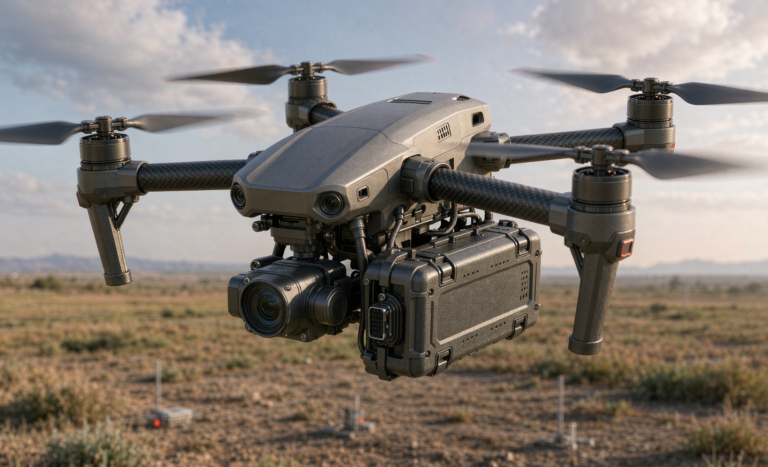
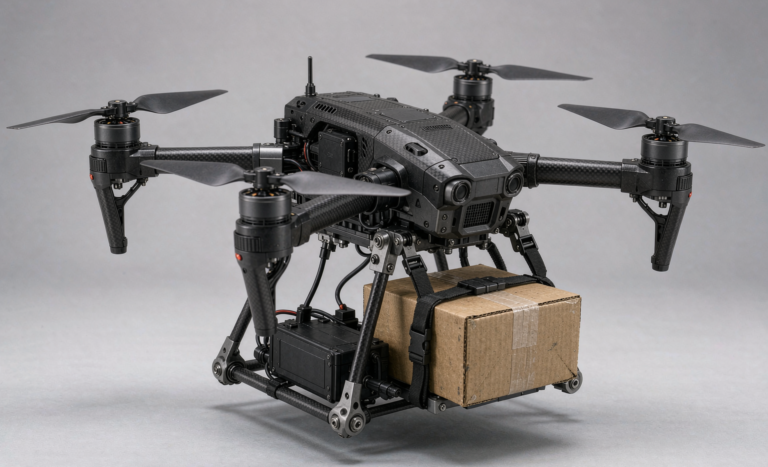
In our operations the average mapping sortie runs 28 to 42 minutes, with a payload that includes a GNSS RTK module, a high-resolution payload camera, and sometimes a LiDAR head. That is a sustained 8C to 12C discharge profile with tight voltage sag limits. Under those conditions, a battery that is merely “good enough” on the bench degrades unpredictably in the field. Reliability for mapping is thus an operational property, not a laboratory one.
From Design-Time Reliability to Predictive Reliability
Early in my career I leaned heavily on design-time tools: FMEA tables, Weibull lifetime projections from cell-level data, and conservative margin stacking. Those are still the foundation. But I learned that the real failure modes—micro-cycling from repeated short flights, connector creep, and slow internal-resistance drift—do not announce themselves on a spec sheet. Predictive reliability means we treat every pack as an instrument that reports its own health.
The shift was cultural as much as technical. Instead of retiring packs on a fixed calendar (say, after 300 cycles), we now retire them on evidence. A lithium battery in our mapping fleet is cleared to fly based on live telemetry, not on a date. This alone cut our premature pack disposal by roughly 34 percent while reducing in-flight anomalies to near zero.
The Telemetry I Capture on Every Mapping Sortie
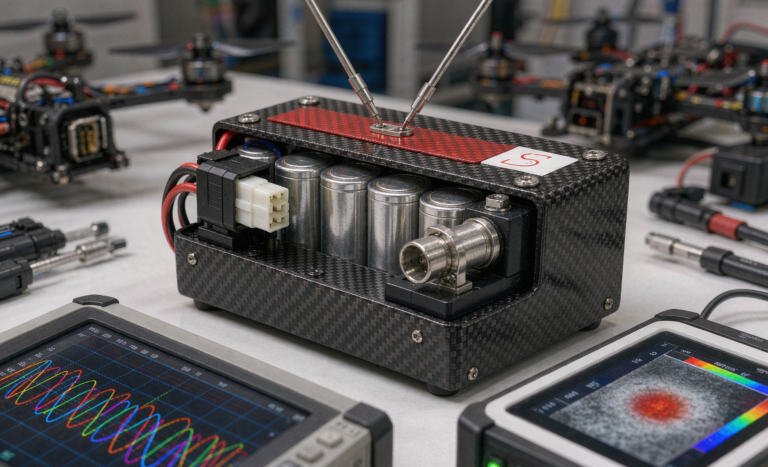
You cannot predict what you do not measure. Our flight controller logs the following signals for every pack, exported after each sortie into our reliability database:
- Resting open-circuit voltage (OCV) before and after flight, used to estimate state of charge and detect slow self-discharge.
- Direct current internal resistance (DCIR) sampled at 50 percent SoC under a known load. DCIR is my single most sensitive early-warning metric.
- Peak and average cell-temperature delta across the pack. A widening delta between cells signals imbalance or a weakening parallel group.
- Coulombic efficiency per cycle, comparing returned charge to delivered charge during the previous charge session.
- Voltage sag under peak payload draw, because mapping LiDAR bursts create transient spikes that stress weak cells first.
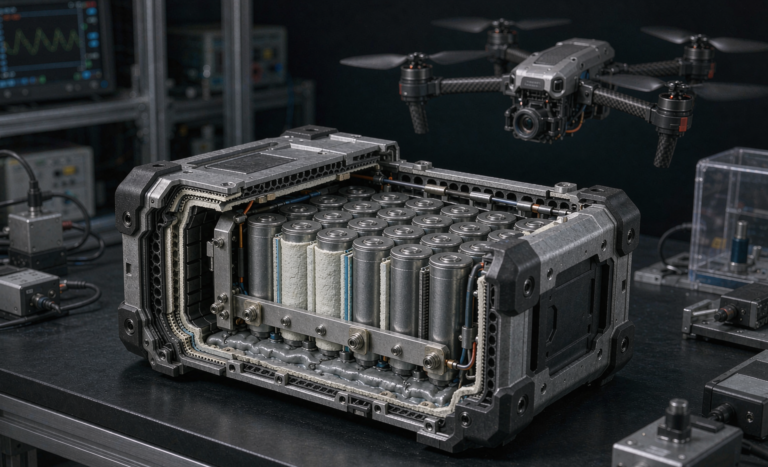
We standardize this on every pack so the data is comparable across a fleet of mixed vintages. A custom battery solution with an embedded smart gauge makes this almost trivial; passive packs need an external logger, which we still use for legacy airframes.
Building a State-of-Health Model and Predicting Remaining Useful Life
State-of-Health is the simplest useful number for a fleet manager: it is the ratio of current full capacity to the pack’s original rated capacity. We compute SoH weekly from charge-session coulomb counting. But the more valuable output is Remaining Useful Life (RUL), the point at which SoH crosses our retirement threshold.
Our model is deliberately simple and explainable. We fit a linear-plus-saturation curve to each pack’s SoH history and extrapolate. When DCIR rises faster than capacity falls, we weight the RUL estimate toward the resistance trend, because resistance drift precedes capacity loss in the chemistries we use. On a typical mapping pack we see SoH decline from 100 percent to about 82 percent over the first 220 cycles, then accelerate. We set the retirement line at 80 percent SoH, giving us a comfortable buffer before the knee.
This approach lets me tell a survey manager on Monday: “Pack 47 has an estimated 19 sorties left; schedule its retirement for next Wednesday.” That is predictive maintenance in practice, and it removed the guesswork that used to cause last-minute pack swaps at the launch site.
Condition-Based Retirement Rules That Actually Work in the Field
A model is only as good as the go/no-go rule attached to it. After burning a few datasets on borderline packs, I codified hard limits that any field tech can apply without an engineer on call:
- Retire at SoH ≤ 80 percent, regardless of cycle count.
- Retire immediately if DCIR rises more than 25 percent above the pack’s baseline, even if SoH still looks acceptable.
- Retire if the cell-to-cell voltage delta at rest exceeds 30 mV after a balance charge.
- Quarantine any pack that shows coulombic efficiency below 98.5 percent for two consecutive cycles.
- Never fly a pack that has logged a single over-temperature event above 60°C during a mapping burst.
These rules sound conservative, and they are. But the cost of one lost mapping mission—crew time, re-mobilization, client confidence—dwarfs the residual value of a borderline pack. For a drone battery supporting survey-grade deliverables, the conservative call is the economical one.
A Practical Predictive-Maintenance Cadence for a Mapping Fleet
Reliability systems fail when they are too heavy to run. Ours fits into a weekly rhythm that a small ops team can sustain:
- Per sortie: auto-upload telemetry; flag any pack breaching an in-flight limit.
- Weekly: batch-compute SoH and RUL for all packs; generate a retirement list for the following week.
- Monthly: capacity-confirm a statistical sample (AQL-style, typically 5 percent) to catch sensor drift in the loggers themselves.
- Quarterly: review the fleet-wide degradation curve and adjust the retirement threshold if chemistry or duty cycle changed.
This cadence turned reliability from a fire drill into a calendar item. My survey customers noticed the difference before I did: fewer postponements, steadier deliverable dates, and a battery line item they could actually forecast.
Standards and Certifications Behind a Reliability Claim
Predictive maintenance does not replace certification; it complements it. Every pack in our mapping program still carries the baseline safety and transport qualifications that give the whole system its license to operate:
- UN38.3 for air and ground transport, including the T.2 altitude, T.3 thermal, and T.4 vibration tests that simulate the environments a mapping drone actually sees.
- IEC 62133-2 for secondary lithium-cell safety, the baseline our drone lithium battery designs are validated against.
- FAA Part 107 operational framing in the U.S., and EASA SORA for risk-based operations in Europe, both of which expect documented battery management as part of safe flight.
I tell new engineers plainly: certification proves a pack can be safe; telemetry proves this specific pack is still safe today. You need both to run a reliable mapping fleet.
What I Would Tell a Fellow Mapping Operator
If you run survey drones and still retire packs by the calendar, you are either wasting good packs or gambling with bad ones. Start small: log DCIR and SoH on every pack for one month, set the five retirement rules above, and let the data earn your trust. Within a quarter you will have a reliability program that is cheaper than reactive replacement and far safer than blind faith in a spec sheet. That is the whole point of treating your lithium battery fleet as a living system rather than a static asset.
How often should I calibrate a mapping drone battery?
I recommend a full capacity confirmation at least monthly on a statistical sample (about 5 percent of the fleet, AQL-style). Daily operation only needs the lightweight per-sortie telemetry (DCIR, OCV, temperature delta). Calibration catches drift in your loggers; telemetry catches drift in your packs.
What SoH threshold should trigger retirement?
We retire at 80 percent SoH. This leaves a comfortable margin before the capacity “knee” where degradation accelerates, and it keeps voltage sag within the tight limits that mapping payloads require for stable GNSS and LiDAR performance.
Can predictive maintenance replace UN38.3 certification?
No. UN38.3, IEC 62133-2, and the relevant FAA/EASA operational expectations are non-negotiable safety and transport baselines. Predictive maintenance is the operational layer on top: it tells you when a certified pack has aged out of reliable service.
How does cold weather affect mapping battery reliability?
Cold raises internal resistance and reduces available capacity, which can trip our DCIR retirement rule early in a sortie. We pre-condition packs to near 15°C before launch and avoid charging below 5°C. Cold does not damage a healthy pack, but it exposes weak ones faster—exactly what our telemetry is built to catch.
Do I need a custom battery solution for multi-sensor mapping payloads?
Not always, but if you run RTK plus LiDAR plus a high-res camera together, a custom battery solution with an embedded smart gauge and tuned discharge capability pays for itself through steadier voltage and the telemetry our whole reliability program depends on. Off-the-shelf packs work for lighter payloads with manual logging.