Drone Battery Testing for Racing Drones: A High-Rate
Why Racing Drones Rewrite the Standard Test Plan
When I first started qualifying packs for FPV racing teams at Horizon Power, I made the mistake every lithium cell engineer makes once: I trusted the consumer-electronics test routine. A phone drone lithium battery is asked to sit at a gentle 0.5C–1C most of its life. A racing quad is the opposite — it is a 1300–1800 mAh LiPo thrown onto a bench that punches from 2% throttle to 100% dozens of times per lap. If your drone battery testing racing drones program treats that duty cycle like a power-bank cycle, you will ship packs that sag, heat, and puff on the third corner.
This article is the playbook I now run for every racing pack we build: a high-rate electrical qualification routine that lives on top of the regulatory baseline (UN38.3, IEC 62133-2) and the aviation-aware references (RTCA DO-311A, FAA Part 23, EASA CS-23). The goal is simple — prove the pack can deliver current without collapsing, lap after lap, and reject the weak ones before they ever reach a pilot.
Continuous High-C Discharge Qualification
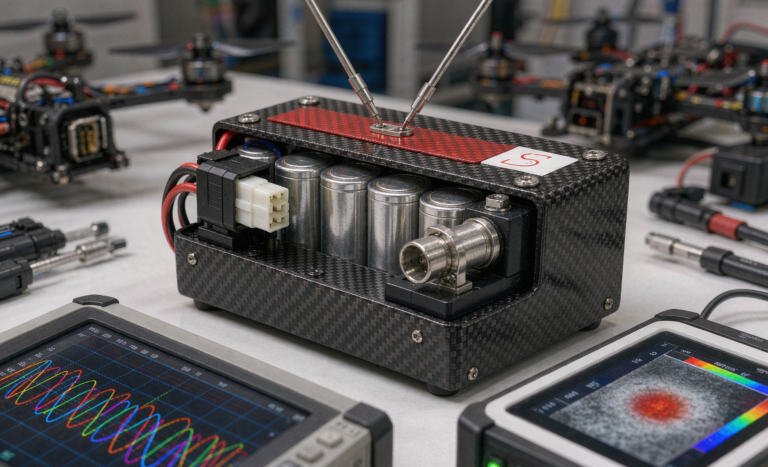
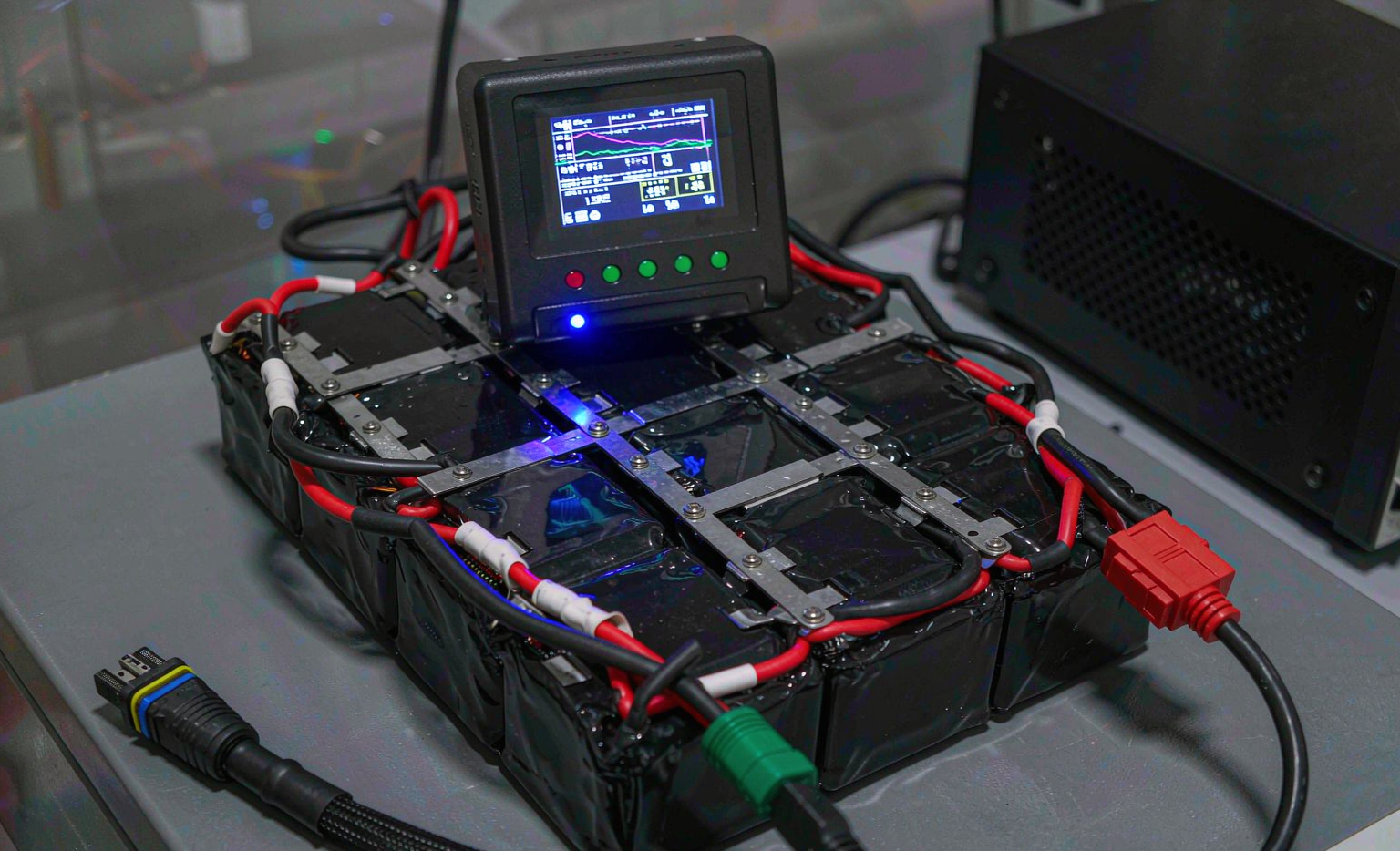
The first gate is the continuous-current test. A racing pack is rated for sustained 15C, and our in-house custom battery solution for 6S quads is specified to hold 15C for the full flight window without exceeding 60 °C surface temperature. I run the pack on a programmable electronic load at a constant 15C (for a 1500 mAh cell, that is 22.5 A) and log terminal voltage, pack temperature, and cell-to-cell balance every second.
A passing pack holds above the cutoff for the rated duration and ends the test with all cells within 20 mV of each other. A marginal pack shows one cell drifting ahead of the others — that is the early signature of an internal defect, and it gets quarantined. I also run a 25–30C pulse window, because a pilot does not fly at a flat 15C; they spike. We verify the pack survives a 30C burst for the specified pulse width (typically 3–5 s) without a protective MOSFET or BMS cutoff triggering.
Pulse Discharge and Voltage-Sag Characterization
Voltage sag is the single number pilots feel in the sticks. Under a 30C throttle punch, a healthy 6S pack at 25.2 V nominal can momentarily sag to roughly 21 V, then rebound as the load eases. I characterize this with a pulse train: 30C for 4 s, rest 10 s, repeated 20 times, logging minimum voltage each pulse. The lithium battery internal resistance is the dominant factor — a good racing pack reads under 10 mΩ total, and I track the IR rise across the pulse train.
What I watch for is drift: if the sag deepens from pulse 1 to pulse 20, the pack is heating internally faster than it rejects heat, and the cooling path or electrode design is wrong. That finding goes straight back to the cell supplier, not the pilot. We set a hard pass limit — sag must not exceed a defined percentage of nominal, and IR must not increase by more than a set threshold across the whole pulse set.
Thermal Management Under Repeated Bursts
Heat is the hidden enemy in drone battery testing racing drones programs, because the failure is cumulative and invisible until it is terminal. During a pulse train the pack generates I²R heat faster than the airframe can shed it, and a racing quad has almost no passive cooling beyond forward motion. On the bench I use a thermal chamber and forced-air rig to reproduce the weak-cooling condition of a hovering or tightly-cornering quad, then measure pack temperature rise per heat.
A well-designed racing pack stays under 60 °C surface at the end of the third simulated heat; packs that climb toward 70 °C are flagged for electrode or separator redesign. I also measure the temperature gradient across cells in a parallel group — a 10 °C spread between adjacent pouches means the current is not sharing evenly, which shortens the weakest cell’s life. For teams flying in hot climates, I qualify at an elevated ambient (40 °C) so the pack is proven where it will actually compete.
Capacity Verification at Rate
Rated capacity is almost always measured at 1C. That number is a fairy tale for racing. I verify capacity at the rates the pack actually sees: 1C, 5C, and 10C. A well-built pack delivers 95–98% of its 1C-rated capacity at 10C; a poorly balanced one drops to 85% and the pilot gets a surprising early “low battery” warning halfway through a heat.
This at-rate capacity check is also how I catch counterfeit or mislabeled cells. If a cell claims 1500 mAh at 1C but delivers 1100 mAh at 10C, the electrode loading or separator is not what the spec sheet promised. Every drone battery that leaves our line carries a recorded at-rate capacity value, not just the nominal label.
Mission-Profile Simulation on the Lab Bench
The most useful test we run is a mission-profile simulation — literally replaying a race on the load bank. I record a real 3–4 minute flight log from a racing pilot (throttle vs. time), normalize it to pack current, and replay it on the bench with the actual pack. A typical heat contains 40–60 throttle punches, sustained 10–15C sections, and a few full 30C bursts on the straight.
Replaying that profile tells me things a steady-state test cannot: how hot the pack gets by lap 3, whether the BMS balancer keeps up during the cool-down windows, and whether the voltage recovery between punches is sufficient for the next corner. I borrow the discipline of RTCA DO-311A mission-profile testing here — it was written for aircraft batteries, but the principle (test the battery the way it actually flies) is exactly right for racing. We require the pack to complete three consecutive simulated heats with surface temperature under the limit and capacity retention above the pass floor.
The replay also exposes a subtle failure mode: recovery. After a hard 30C straight, a pack must rebound to a healthy voltage during the following low-throttle turn, or the next punch starts from a depleted state and the pilot loses punch exactly when they need it. I log the rebound voltage 2 s after each burst and reject packs whose recovery falls below the threshold, because that single number predicts in-air feel better than any average-C specification.
End-of-Line Acceptance Testing
Qualification is not enough; every finished pack needs an end-of-line (EOL) functional test before it ships. This is the step that protects the pilot and our brand. Each pack runs a short 5C–10C discharge, an IR measurement, and a capacity spot-check. We reject any pack whose IR is above the batch ceiling or whose delivered capacity is below 98% of rated.
The EOL test also confirms the connector and harness survive. A racing pack lives or dies on its XT60 or EC5 interface and its silicone leads, so I load the connector to its rated current and verify the crimp temperature stays within limit. A warm crimp is a future in-flight failure, and the EOL gate catches it on the bench, not at 80 km/h two meters off the ground. We cycle the connector five times through a rated-current pulse to confirm the contact resistance is stable — a drifting resistance here is the classic cause of an unexplained mid-race cutoff.
For a drone battery testing racing drones line running at volume, this EOL step is automated: the pack drops into a fixture, the load bank runs the 10C burst and IR check, and a green or red light decides its fate in under 90 seconds. Automation is what lets us keep the rejection standard strict without slowing the line.
Logging, Pass/Fail Limits, and Traceability
None of this matters without data discipline. Every test writes to a traceable record: pack serial, cell lot, load profile, environmental conditions, and the pass/fail verdict. When a pilot reports a sag or a heat issue, I can pull the exact test curve for that serial number and see whether it was a manufacturing outlier or a usage-mode problem.
I keep the regulatory baseline immutable — UN38.3 T.1–T.8 and IEC 62133-2 are pass-required for any pack we ship, full stop — and layer the racing-specific electrical tests on top as our competitive standard. FAA Part 23 and EASA CS-23 references guide how we think about sustained load and failure modes even when a racing quad is not a certified aircraft; the engineering habits transfer directly.
Frequently Asked Questions
What C-rate should a racing drone battery actually be tested at?
I qualify at the continuous C-rate we rate the pack for (typically 15C) and then prove it survives 25–30C pulses matching real throttle punches. Testing only at 1C misses the failure modes that actually end races.
How much voltage sag is acceptable on a 30C punch?
For a healthy 6S racing pack, a momentary sag to roughly 21 V from a 25.2 V nominal under a 30C burst is normal. The real pass criterion is that the sag must not deepen across repeated pulses and IR must stay under our 10 mΩ ceiling.
Why verify capacity at 10C instead of 1C?
1C capacity is what the label shows; 10C capacity is what the pilot flies. A pack that delivers 95–98% of rated at 10C behaves predictably in the air, while one dropping to 85% surprises the pilot with early cutoffs. We record at-rate capacity for every unit.
Is UN38.3 enough for a racing pack?
UN38.3 and IEC 62133-2 are the legal safety baseline and are mandatory, but they do not exercise the high-rate duty cycle a racing drone demands. That is why we add continuous-C, pulse-sag, mission-profile, and EOL tests on top.
What does end-of-line testing catch that qualification misses?
Qualification validates the design; EOL validates the unit. It catches a bad crimp, a mislabeled cell, or a weak weld in one specific pack — the kind of single-unit defect that would otherwise reach a pilot.
Do these tests apply to a custom battery solution for a specific team?
Yes. When we build a custom battery solution for a team with a unique frame or motor set, we record their actual flight log and replay it as the mission profile, so the pack is qualified against the way that specific pilot flies.