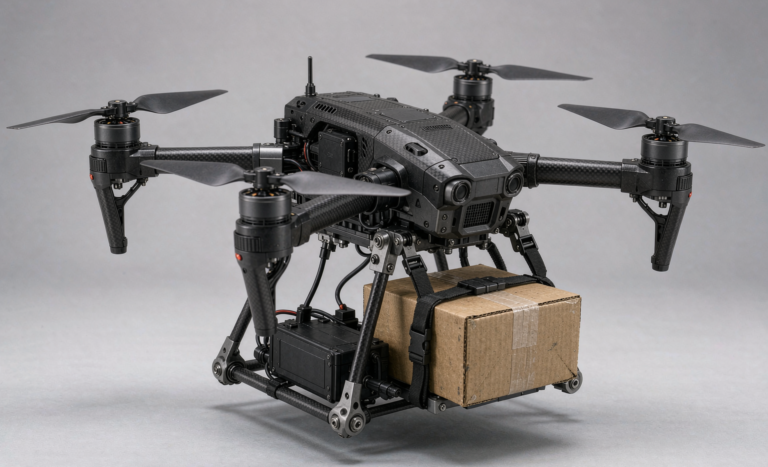
Drone Battery Performance for Racing Drones: Mass
I am Karl Huang, Senior lithium battery Engineer at Horizon Power. Over the past eleven years I have built, instrumented and destroyed more racing drone battery packs than I care to admit, and I have learned one uncomfortable truth: most teams chase C-rating and completely ignore grams. They will argue for an hour about whether a cell is genuinely 120C, then bolt that cell into a pack with 34 g of unnecessary wire, silicone, tape and hardware. On a 5-inch quad flying at a thrust-to-weight ratio near 11:1, those 34 g cost more lap time than a 0.3 mΩ improvement in internal resistance ever gave back.
This article is about the mechanical side of drone battery performance for racing drones: how I build a gram-level mass budget, how pack placement shifts the center of gravity (CG) and changes rotational agility, how to isolate cells from frame vibration without adding weight, and how to make a pack survive the crash that will absolutely happen. These are the same integration rules we apply when a customer asks us for a custom battery solution rather than an off-the-shelf brick.
Why Grams Beat C-Rating on a Racing Airframe
Hover power scales with the 1.5 power of mass for a fixed disc area. In plain terms: if a 650 g race quad gains 30 g, hover power rises roughly 7%, and every acceleration, every vertical pull out of a dive, and every corner exit costs proportionally more current. Higher current means more I²R heating inside the cells, which raises internal resistance, which deepens voltage sag, which forces the ESCs to draw even more current for the same thrust. Mass is the input at the top of that feedback loop.
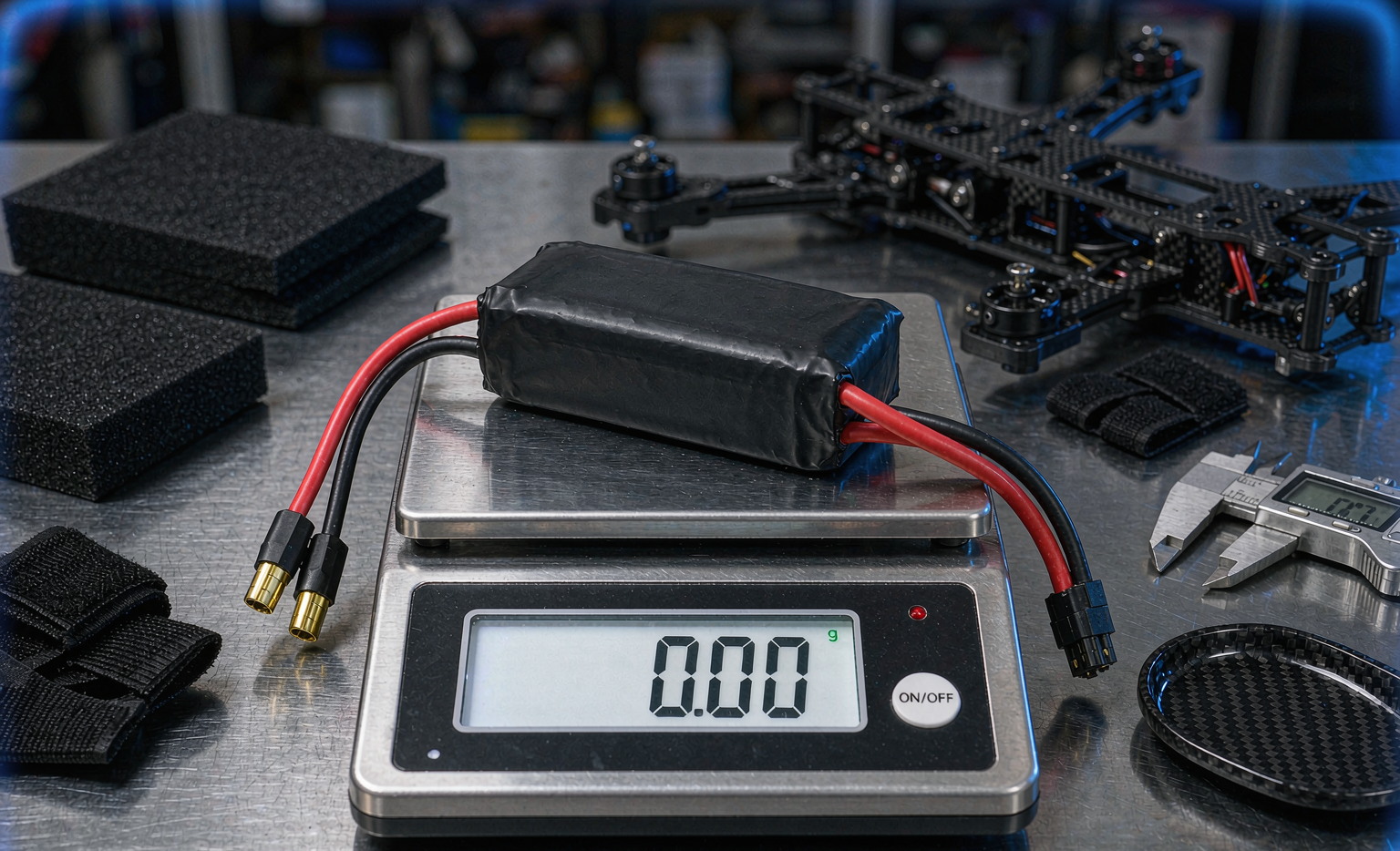
I measure this on the bench with a thrust stand and a calibrated logger rather than arguing theory. A typical 6S 1300 mAh pack we build for a race team lands at 218–226 g. Two packs I benchmarked from the same nominal spec class weighed 241 g and 252 g. Same claimed capacity, same claimed C-rate. The 252 g unit lost 0.9 s over a 40-second technical lap in back-to-back testing, and the delta was almost entirely mass, not electrochemistry. That is why my first review question on any racing drone battery design is never “what C-rate?” but “show me the mass breakdown.”
Building a Gram-Level Pack Mass Budget
Every drone battery we ship has a mass budget spreadsheet, and every line item must justify itself. A representative 6S 1300 mAh high-rate build looks like this:
- Cells (6 pcs, high-rate pouch): 168 g — 76% of total. This is the irreducible core.
- Nickel-plated copper tabs and interconnects: 12 g. Copper-clad tabbing is heavier than pure nickel but cuts interconnect resistance by 40–55%; here the grams buy real performance.
- Main leads: 9 g. Going from 12 AWG to 14 AWG on a 90 mm lead saves 4.5 g and adds roughly 0.35 mΩ. On a 5-inch pack pulling 90 A bursts that is a fair trade; on a 7-inch long-range build it is not.
- Connector: 8–11 g depending on type. This is one of the largest single-component swings available to you.
- Balance lead and JST-XH housing: 6 g. Shortening the harness by 40 mm and removing redundant sleeving reliably saves 2 g.
- Heat-shrink, kapton, corner padding, cell-to-cell adhesive: 11 g. Necessary, but I have seen builds carrying 25 g here.
- Strap interface / mounting plate: 4 g.
Total: 218 g. The discipline is simple — anything that is not a cell, a conductor, or a safety-critical mechanical element gets challenged. I keep a “grams per milliohm” column so trade-offs stay quantitative instead of emotional. When a customer specifies a target all-up mass, that column is how our engineering team decides where to spend. A good drone lithium battery design is a negotiated compromise, documented in numbers.
Gravimetric Power Density: The Metric Racers Should Actually Buy
Energy density (Wh/kg) sells consumer packs. A racing drone battery needs gravimetric power density (W/kg) at the operating temperature and state of charge where the drone actually flies. A cell that reaches 250 Wh/kg but sags 0.6 V per cell at 40 A is useless on a race gate. A high-rate cell at 165–185 Wh/kg holding 3.55 V per cell under the same load will win.
My acceptance test measures usable specific power: apply the real mission profile — 8 A cruise with 1.5-second bursts to 25C — and record the lowest per-cell voltage in the burst, then divide delivered watts by measured pack mass. On our current 6S race builds we hold 3,100–3,450 W/kg at 50% state of charge and 35 °C cell surface temperature. Publishing that number, measured at a stated temperature, is far more honest than a peak C-rating printed on shrink wrap. Any serious lithium battery supplier should be able to hand you that curve.
Center of Gravity: Where the Pack Sits Changes How the Drone Flies
On a 5-inch quad the drone battery is 30–35% of all-up mass, so it dominates the CG and the moments of inertia. Three effects matter:
- Longitudinal CG: Shifting the pack 10 mm rearward on a typical frame moves CG behind the thrust centroid and forces the flight controller to hold constant differential thrust. I have logged 6–9% higher average motor current on a badly balanced airframe with identical batteries.
- Vertical CG (stack height): A tall pack raises CG above the propeller plane and increases pitch/roll inertia. Choosing a 3P-wide, lower-profile cell stack over a tall 2P arrangement at identical capacity reduced roll inertia by about 12% on one customer build and measurably sharpened flip recovery.
- Yaw inertia: Cells spread outward along the roll axis feel sluggish. Keeping the cell block compact and centered over the frame’s geometric center gives crisper rotation.
Practically, I mark the pack’s own CG on the wrap during production. It takes ten seconds on a balance fixture and lets the pilot repeat the mount position exactly, race after race. Repeatability is performance: a pack mounted 8 mm differently between heats will feel like a different pack, and the pilot will blame the cells.
Vibration Isolation and Mounting Without Adding Weight
Racing frames transmit 80–220 Hz propeller excitation plus broadband impact energy directly into the cell stack. Pouch cells tolerate this reasonably well, but tabs, welds and solder joints do not — tab fatigue is the failure mode I see most often in returned racing drone battery packs.
What works in my experience:
- A 1.5–2 mm closed-cell foam interface between pack and frame plate, not a rigid carbon-to-shrink contact. Cost: 2 g. Benefit: measurable reduction in transmitted acceleration at the tab.
- Strap tension tight enough to prevent shear travel but not enough to crush the pouch. I specify strap preload that leaves the pack immovable under 5 G lateral hand load, no more.
- Tab strain relief: a small kapton-anchored service loop in the main leads so lead motion never pulls on the tab weld.
- Internal potting only at the tab root, not across the cell face. Full potting adds 15–20 g and blocks the thermal path.
We validate this against the vibration and shock requirements of UN 38.3 Test T.3 (sinusoidal vibration, 7 Hz–200 Hz) and Test T.4 (shock, 150 g half-sine for small cells) as a baseline, then run an additional airframe-specific random-vibration profile because race quads exceed the transport-oriented assumptions of those tests. IEC 62133-2 covers the cell-level mechanical and electrical safety envelope for portable lithium systems and is the other standard we design to.
Crash-Tolerant Integration and Post-Impact Screening
Racing drone battery packs crash. Design for it, and give pilots a rule for what to do afterward.
Mechanically, I want the frame to absorb energy before the cell block does: sacrificial corner padding, no hard fastener heads bearing directly on the pouch face, and connectors positioned so they cannot be driven into the cells on nose-first impact. I also insist the pack be removable without tools — pilots who need pliers will leave a damaged pack installed.
My post-crash screening protocol, which we hand to every race customer:
- Immediate: disconnect, place in a fire-resistant container, observe for 15 minutes. Any swelling, hissing, or electrolyte smell means retirement — no exceptions.
- Electrical: measure per-cell voltage. A spread above 30 mV after rest that was not there before the crash indicates internal damage.
- Impedance: compare AC internal resistance at 1 kHz to the pack’s factory baseline. A rise above 15% on any cell retires the pack.
- Thermal: after a gentle 0.5C charge, monitor surface temperature for 30 minutes. Self-heating at rest is a latent internal short.
- Documentation: log the event. Three moderate impacts on the same pack is a retirement trigger regardless of test results.
Retiring a pack early costs a fraction of a burned airframe, and vastly less than an incident at an event venue. Under FAA Part 107 in the United States and EASA’s open-category rules in Europe, the remote pilot carries responsibility for airworthiness of the aircraft, and that includes the energy source. Documented battery retirement criteria are part of operating responsibly, not optional paperwork.
Certification and Logistics Constraints That Shape the Design
Mass optimization stops at the point where it compromises shipping and compliance. As a drone battery manufacturer we treat transport rules as a design input, not an afterthought. Every pack we release for international racing must pass UN 38.3 (T.1 altitude, T.2 thermal cycling, T.3 vibration, T.4 shock, T.5 external short, T.6 impact/crush, T.7 overcharge, T.8 forced discharge) so it can legally travel by air, and lithium-ion cells and packs must ship at no more than 30% state of charge under current IATA dangerous goods provisions. That last rule affects pack design directly: the wrap, labeling area and cell chemistry all have to survive long storage at partial charge without capacity fade.
I also keep watt-hour ratings visible in the design record because 100 Wh and 300 Wh thresholds drive packaging class. A 6S 1300 mAh pack is about 28.9 Wh, comfortably inside the simplest category. Teams building 6S 5000 mAh long-range packs cross into stricter handling, and I would rather tell them at the design review than at airport security.
My Drone Battery Integration Checklist Before a Pack Ships
- Measured mass within ±2 g of the design target, recorded per unit.
- Pack CG marked on the wrap; mounting orientation indicated.
- Per-cell voltage spread under 10 mV at 50% state of charge.
- Pack AC internal resistance logged as the baseline for post-crash comparison.
- Specific power verified against the customer’s mission profile, with test temperature stated.
- Tab strain relief and foam interface present; strap slots aligned to the frame.
- UN 38.3 test summary and Wh rating on file; shipped at 30% state of charge.
Seven lines, all measurable. When a team tells me their new pack “feels faster,” I want to be able to point at which of those numbers changed.
Frequently Asked Questions
How much mass reduction is actually noticeable on a 5-inch racing quad?
In my logged testing, a 15 g difference in drone battery mass is the threshold where experienced pilots consistently identify the lighter pack blind. Below 8 g it is within pilot noise. Above 25 g the difference shows in lap times, not just feel.
Is a lighter connector worth the added resistance?
Sometimes. Compute grams saved per milliohm added, then check the burst current. If your peak is under 100 A and the swap saves 4 g for 0.2 mΩ, take it. If you pull 150 A bursts, keep the heavier connector — the extra heating will cost you more sag than the mass costs you thrust.
Should I pot or reinforce the inside of a racing pack?
Only at the tab root. Full-face potting adds 15–20 g, traps heat and raises cell temperature under high discharge, which shortens cycle life. Targeted strain relief gives most of the durability benefit for about 2 g.
How many crashes before a pack should be retired?
Retire immediately on any swelling, hissing, smell, per-cell voltage spread above 30 mV, or internal resistance rise above 15% versus baseline. Absent those signals, I retire after three moderate impacts on the same pack as a conservative fleet rule.
Does pack position really change flight behavior, or is that pilot perception?
It is measurable. Shifting a pack that represents a third of all-up mass by 10 mm changes CG and inertia enough to alter motor current distribution by several percent. Mark the mount position and keep it identical between heats.
Can a manufacturer build to a specific mass and CG target?
Yes, and you should ask for it. Give us the all-up mass budget, peak and continuous current, mission duration, frame mounting geometry and target CG position, and we design the drone battery cell arrangement, tabbing and lead gauge around those constraints. That is what a genuine custom battery solution means — engineering to your airframe, not selling you a catalog part and hoping it fits.
Karl Huang is a Senior Lithium Battery Engineer at Horizon Power, where he leads high-rate pack design and qualification testing for UAV, racing and industrial customers.