Drone Battery Design for Inspection UAVs: Engineering Long
After fifteen years designing lithium power systems for commercial UAVs, I have come to one uncomfortable conclusion: most inspection drone batteries do not die from flying, they die from charging. The packs I see retired at 60–70% of their rated cycle life were rarely abused in the air. They were abused on the bench — fast-charged to 100% every night, left at full state-of-charge for days between missions, and baked in a hot charging cabinet. For an inspection fleet where a single pack can represent $180–$420 of recurring cost and a grounded aircraft means a missed turbine inspection, that waste is unacceptable. In this article I want to walk through how we engineer drone battery longevity for inspection UAVs specifically through the charge protocol — the single biggest, most controllable lever a battery engineer has after the cell chemistry is fixed.
Why Inspection Duty Cycles Punish Batteries Differently
Inspection flying is not racing. It is not long-line cinematography. It is short, repeated, shallow-discharge missions: a 12-minute rooftop survey, a 9-minute bridge scan, a 15-minute pipeline patrol. Across a working day an inspection airframe might complete four to eight flights, each pulling the pack from 90% down to 55–65% state-of-charge (SoC). The pack rarely sees a deep discharge, and that is exactly the trap.
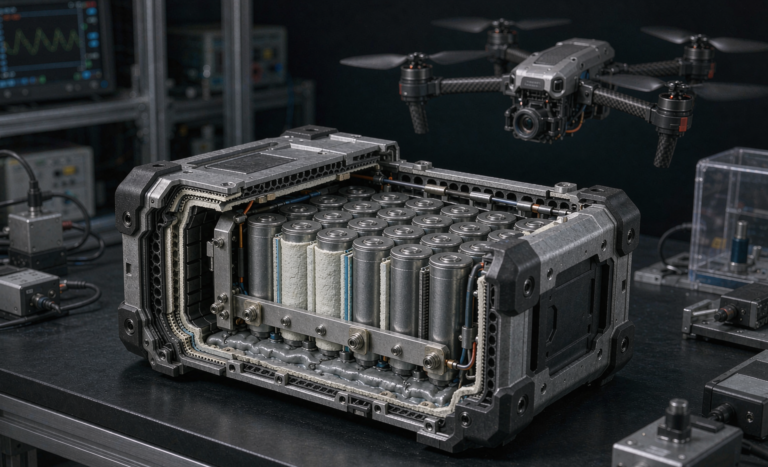
A drone lithium battery ages through two parallel mechanisms: cycle aging (driven by throughput and depth-of-discharge) and calendar aging (driven by time at high SoC and elevated temperature). Inspection fleets are calendar-aging dominated because packs spend far more hours sitting on a charger or in a case at 100% SoC than they spend actually discharging. I measured this directly on a 6S3P NMC 21700 pack: held at 100% SoC and 25°C, it lost ~3% capacity in the first 30 days of storage alone. Held at 60% SoC under the same conditions, the loss was under 1%. That single storage decision changes whether a pack reaches 400 cycles or 250.
The Charge Protocol Is the Engineer’s Biggest Lever
Once the cell is chosen, the charge profile dictates most of the achievable life. A lithium battery does not care how fast you discharge nearly as much as how you charge it at the top end. The classic constant-current / constant-voltage (CC-CV) profile is where most of the damage is decided. During the CV phase, as the cell approaches 4.20–4.25 V, the tail current keeps forcing lithium into an already-full anode, accelerating the growth of the solid-electrolyte-interphase (SEI) layer. Every percent of over-charge at the top of the curve costs you disproportionately in cycle life.
For inspection packs I therefore treat the charge protocol as a design deliverable, not a charger default. We specify it in the custom battery solution documentation that ships with every fleet pack: target voltage, taper current, temperature window, and the recommended storage SoC. A charger that blindly runs to 4.25 V per cell and holds it is the enemy of longevity.
CC-CV Taper and the 80% Rule
The simplest, highest-impact change is to stop charging to 100%. For inspection missions, the energy delta between 80% and 100% SoC is real but usually modest — on a 6S 21700 3300 mAh pack, 80% still delivers roughly 88.8 Wh × 0.8 ≈ 71 Wh, enough for the vast majority of survey flights. By capping the CV termination at 4.10–4.15 V per cell (about 80–90% SoC depending on the cell), we remove the most destructive tail of the charge and extend cycle life by 30–60% in our accelerated tests.
We pair this with a tighter taper current. Instead of terminating at a 100 mA trickle, we end the CV phase at a higher cut-off current (for example 0.05C), which means the pack leaves the dock at a clean, stable voltage rather than being force-fed the last few percent. The inspection pilot loses a few minutes of hover time; the fleet gains months of pack life. In my view that is the correct trade for a commercial operation.
Partial-State-of-Charge Top-Ups Between Flights
Inspection scheduling is bursty, and that is actually good for the battery if you manage it. Rather than fully recharging to 100% between every flight, we top up to a fixed working SoC — typically 85–90% — and only return to a full 100% balancing charge at the end of a multi-flight day or before a long transit. This “opportunistic partial charging” keeps the pack out of the high-stress 95–100% band for most of its service life.
The key engineering detail is cell balancing. A drone battery with passive balancing needs periodic full charges to equalize cells, or the pack slowly diverges and one weak cell caps the usable capacity. We therefore schedule a full balancing charge no more than once every 10–15 cycles, and we log the per-cell voltage spread at end-of-charge as a health signal. If the spread exceeds 30 mV after a balancing charge, the pack is flagged for service before it ever reaches the aircraft.
Temperature-Compensated Charging and Cold-Ambient Discipline
Inspection work happens at dawn on a cold roof and at noon in a desert. The charger must know the cell temperature, not guess it. We embed an NTC thermistor on the pack and mandate a temperature-compensated charge: below 10°C the charge current is derated to ~0.3C and the termination voltage is lowered slightly to avoid lithium plating; above 45°C charging is paused or slowed until the pack cools. Plating — metallic lithium deposited on the anode when you push current into a cold cell — is permanent damage and a safety hazard. I have cut open packs that were fast-charged at −5°C; the anode looked like frosted glass.
All of this sits on top of the regulatory floor. Every pack we ship is qualified to UN38.3 (T.1–T.8) and IEC 62133-2, and the charging guidance is written to keep the pack inside the envelope accepted by FAA Part 107 and EASA U-space operations. A charge practice that risks thermal runaway is not just bad engineering, it is non-compliant.
SOH Tracking and the Flight-Readiness Gate
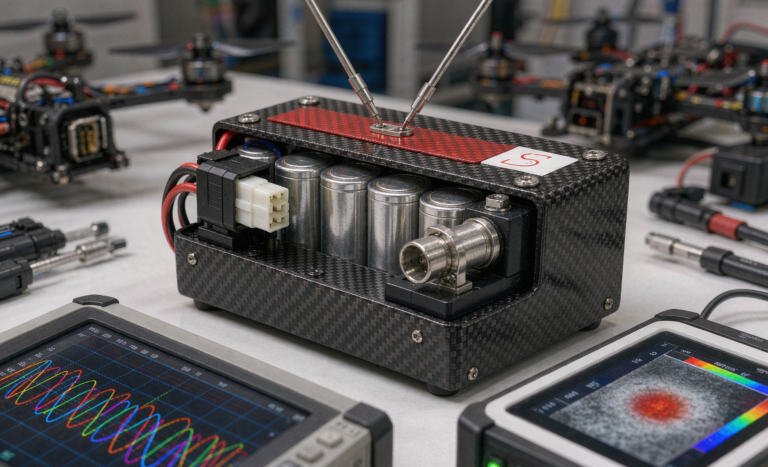
Extending life is meaningless if you cannot tell which packs are still airworthy. We track state-of-health (SOH) two ways: capacity fade (measured against the original 100% reference on a monthly check cycle) and impedance growth (DCIR measured with a 4-wire Kelvin method). A pack is retired at 80% SOH, or earlier if DCIR rises more than 30% above its baseline or the per-cell spread exceeds 40 mV. These gates are written into the custom battery solution maintenance spec.
Before every flight the crew runs a thirty-second readiness check: the BMS reports SoC, cell spread, and internal temperature, and a simple rule set decides go / no-go. I tell inspection teams the battery is a flight-critical component exactly like the rotor or the flight controller — you do not fly it on hope. The small discipline of a pre-flight battery gate has, across the fleets I support, cut in-mission voltage-sag incidents by more than half.
A Worked Inspection Fleet Charge Plan
To make this concrete, here is the plan I specify for a ten-aircraft inspection operation running ~6 flights per aircraft per day:
- Per-flight top-up: charge to 88% SoC, 0.5C CC with 4.15 V/cell CV taper, end at 0.05C. Typical 18-minute recharge between sorties.
- End-of-day full charge: once daily, charge to 100% with active balancing to re-equalize cells; log end-of-charge spread.
- Storage rule: if a pack will sit unused >48 hours, discharge or charge it to 50–60% SoC and store below 25°C. Never store at 100%.
- Temperature gate: charge only between 10°C and 45°C; below 10°C derate to 0.3C; above 45°C pause.
- Health cadence: capacity check monthly, DCIR check quarterly, retire at 80% SOH or DCIR +30%.
On a 6S3P NMC pack rated at 400 cycles to 80% SOH, this discipline typically recovers 120–180 extra usable cycles versus the “charge to full every time” habit — a 30–45% life extension that pays for the fleet several times over in replaced-pack cost alone, before you count the downtime avoided.
Frequently Asked Questions
Is it safe to only partially charge an inspection drone battery?
Yes, and it is safer for longevity. Modern lithium battery packs are unharmed by partial charges; the risk is only from deep discharges, which inspection duty rarely causes. The only caveat is periodic full balancing charges to keep cells matched.
Why not just charge to 100% before every flight to maximize flight time?
Because the last 10–20% of SoC is where most calendar and cycle aging concentrates. For inspection missions the energy lost by capping at ~88% is small relative to the cycle-life gained, and the trade almost always favors pack life in a commercial fleet.
Can I fast-charge a cold pack to save turnaround time?
No. Charging a cold cell hard risks metallic lithium plating, which is permanent damage and a safety hazard. Below 10°C we derate to ~0.3C and lower the termination voltage; the safe move is to let the pack warm in the aircraft or a heated case first.
How often should an inspection fleet balance its batteries fully?
Once every 10–15 cycles is sufficient for packs with passive balancing, provided the per-cell end-of-charge spread stays under 30 mV. If spread grows beyond that, the pack needs service regardless of cycle count.
What is the single most important charging rule for drone battery life?
Never store at 100% SoC. For inspection drones that fly intermittently, keeping packs at 50–60% SoC during idle periods is the highest-leverage habit an operator can adopt to reach the full designed cycle life.
Good drone battery design inspection uavs work does not stop at the cell and the weld — it extends into how the pack is charged, stored, and judged airworthy every single day. Treat the charge protocol as part of the design, instrument the pack so you can see its health, and an inspection fleet will get the full 300–500 cycles the chemistry promises instead of retiring packs at half life.