Lithium Battery Integration for Power Tools
As a senior lithium battery engineer at Horizon Power, I have spent the better part of a decade integrating lithium battery packs into cordless power tools for OEMs across Asia and Europe. When people ask me what makes power-tool integration different from, say, a drone battery, my answer is simple: very few applications punish a cell harder than a brushless impact driver at full trigger. The pack sees violent vibration, instant 30-50 A pulse draws, temperature swings from a frozen job site to a sun-baked roof, and a mechanical interface that gets slammed in and yanked out thousands of times. Get the integration wrong and you do not just lose runtime—you lose the trust of a tradesman who depends on that tool all day.
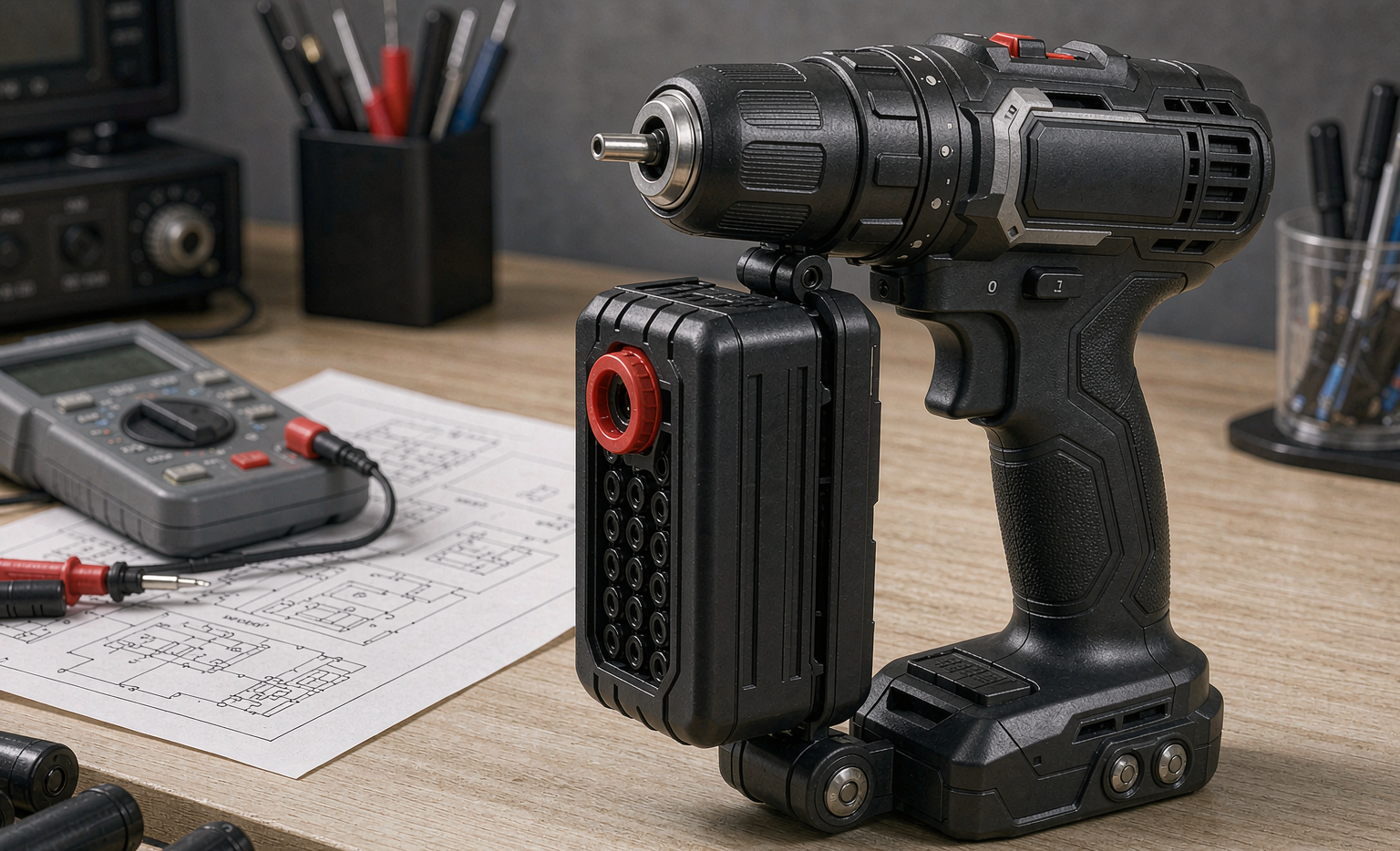
In this field guide I want to walk through the engineering decisions that actually move the needle when you are building or specifying a lithium-ion battery system for cordless tools. We will cover cell format, voltage mapping, mechanical housing, the BMS and pack-to-tool handshake, thermal behavior under pulse load, and the certification stack that lets the product legally ship. The goal is practical: fewer warranty returns, longer pack life, and a tool that does not bog down when the bit meets hardwood.
Choosing the Right Cell Format and Chemistry
The first fork in the road is cell format. For two decades the 18650 dominated cordless tool packs because it was cheap, mature, and available in high-drain grades such as the 20 A continuous INR chemistry cells. Around 2018 the lithium battery industry began shifting many platforms to the 21700. The larger format trades a little mass for a meaningful step in energy density—roughly 20-25% more watt-hours per cell—which is why you now see 21700-based 18V/20V lines that run longer without growing the pack.
Chemistry is the second decision. Most professional cordless tools use NMC (nickel-manganese-cobalt) because it delivers the high discharge C-rate a motor demands. NCA is used by a few brands chasing maximum energy. LFP (LiFePO4) shows up in budget or indoor lines where cycle life matters more than peak power, but its lower voltage plateau and heavier weight make it a poor fit for high-drain impact and saw applications. In my test lab a quality NMC 21700 holds a DCIR around 18-25 mΩ at room temperature, while a comparable LFP cell often lands near 30-40 mΩ—higher internal resistance means more voltage sag under the same load.
For a custom battery solution aimed at a 20V Max class tool, I typically spec a high-drain NMC 21700 rated for at least 30 A continuous and 60-80 A pulse. Capacity per cell around 4.0-5.0 Ah gives a good balance between runtime and heat. Cell grading matters more than the datasheet headline: I insist on tight capacity sorting (within +/-3%) and DCIR matching (within +/-0.5 mΩ) so the series string ages evenly.
Mapping the Voltage Platform to the Tool
Cordless platforms are built around series counts, and the marketing label is not the physics. A “20V MAX” pack is a 5S lithium-ion battery with a 18.0-21.0 V operating window; “18V” and “20V MAX” are the same 5S architecture. Common platforms I integrate:
- 3S (10.8V / 12V) – compact drivers and inspection tools, light duty.
- 5S (18V / 20V MAX) – the workhorse class: drills, impact drivers, circ saws.
- 10S (36V / 40V) – mowers, chainsaws, high-torque gear.
- 15S (54V / 60V) – outdoor power equipment and heavy cut-off tools.
The motor controller is tuned to a specific series count and cutoff voltage, so the pack must hit the exact nominal and full-charge voltages. I set the pack’s over-discharge cutoff at 3.0 V per cell (15.0 V for 5S) and the full-charge at 4.20 V (21.0 V for 5S). A frequent integration mistake is letting the tool pull the cells below 2.5 V under pulse load—that is where capacity and cycle life collapse, and where a proper lithium battery pack protection scheme earns its keep.
Designing the Pack Housing and Mechanical Interface
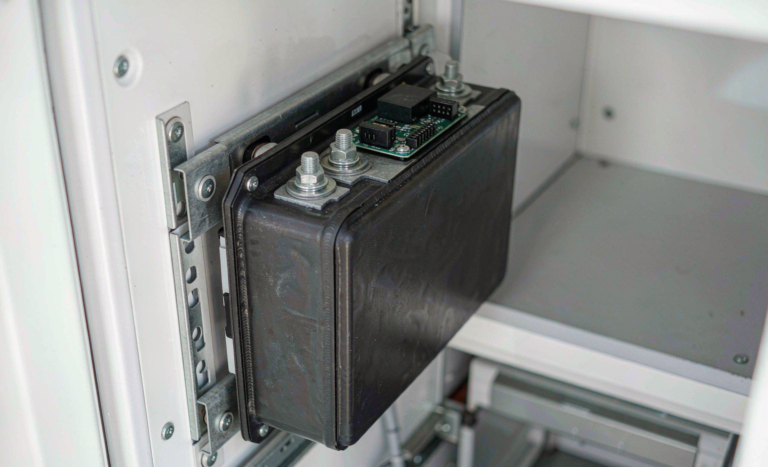
Power tools vibrate. A rotary hammer can impose 10-30 g of broadband vibration, and a loose cell weld or terminal will fatigue fast. I design the internal structure with spot-welded nickel strips over a spot-welded busbar, potted or sleeved cells, and a rigid clamshell housing that physically locks each cell. Floating cells inside a hollow shell are the number-one cause of intermittent shutdowns I see in returned packs.
The pack-to-tool connector is where a lot of runtime complaints originate. Cheap spring contacts develop micro-oxidation and rising resistance; after a few hundred insertions the voltage drop across the terminal alone can exceed 0.3 V at 40 A, which the tool reads as a weak battery. I specify gold-flashed blade terminals with a positive locking detent and design for under 5 mΩ contact resistance at rated current. The interface is also keyed so a 5S pack cannot be forced into a 10S tool—a safety and marketing requirement in every platform I ship.
The BMS and Pack-to-Tool Communication
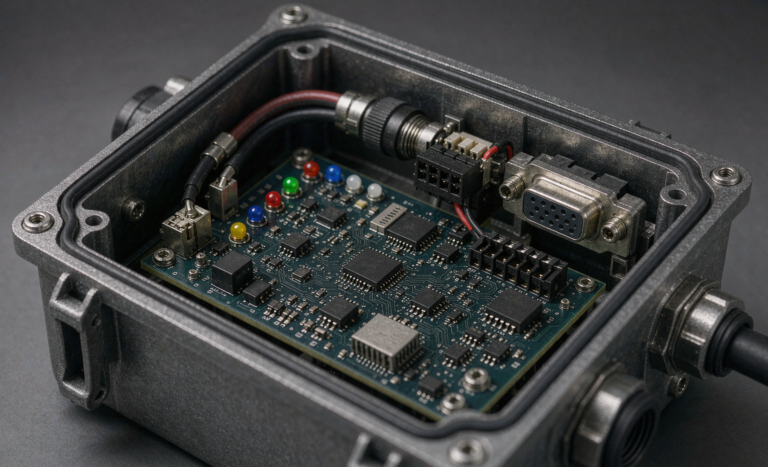
A modern lithium-ion battery for power tools is not just cells; it is a smart unit. The protection board guards against over-voltage, under-voltage, over-current, short-circuit, and over-temperature, with a typical reaction time under 200 ms on a hard short. For fuel gauging I use a coulomb-counting IC with a learned Full Charge Capacity model, because tradesmen judge a pack by “does the bar lie to me.”
The more interesting part is the handshake. Premium platforms embed an ID resistor, a thermistor, and sometimes a one-wire data pin so the tool recognizes the pack, reads its chemistry and health, and limits current on a worn or cold pack. I have reverse-engineered enough competitors to say this plainly: if your custom battery solution omits the communication resistor, the host tool may refuse to spin or may cap you at a fraction of available power. Get the resistor value and the thermistor curve into the spec early.
Balancing is usually passive in tool packs—small bleed resistors that trim the highest cell during charge. With tightly graded cells this is sufficient; aggressive active balancing adds cost a power-tool buyer will not feel. I set the balancing threshold at 30 mV and let the charger do the heavy lifting.
Thermal Behavior Under High-Pulse Load
This is the section I wish more buyers read. A brushless impact can pull a 50 A pulse for a fraction of a second, dozens of times per minute. At a pack DCIR of, say, 25 mΩ per parallel group, that pulse dissipates I²R = 50² × 0.025 = 62.5 W in that instant—concentrated heat that the cells must absorb and shed. Run the tool hard and pack surface temperature climbs past 45°C, where I trigger a soft power limit to protect the cells.
Venting paths matter. I leave a controlled channel so a single cell failure can vent away from the tool grip and the other cells, and I place an NTC thermistor against the central cell to give the BMS a real temperature, not an ambient guess. Cold performance is the other half: below 0°C a lithium-ion battery suffers Lithium plating if charged, and loses usable capacity if discharged. For job sites in winter I program a cold-derate that caps current below 5°C and blocks charging below 0°C, with a clear LED cue rather than a silent shutdown.
Compliance, Certification, and Safe Transport
No integration is finished until it clears the certification stack. Every pack we build is validated against UN38.3 (T.1 altitude, T.2 thermal, T.3 vibration, T.4 shock, T.5 external short, T.6 impact, T.7 overcharge, T.8 forced discharge) before it can ride in a truck or plane. Cell-level safety follows IEC 62133-2, and for the pack as a whole I align with IEC 62619 for the industrial robustness expectations. The tool itself is covered by IEC 62841, and in North America the battery subsystem is evaluated under UL 2595 alongside the host.
We also run the transport documentation—the UN test summary that downstream freight forwarders demand—because a lithium battery that cannot legally ship is a lithium battery that cannot be sold. At Horizon Power we keep these dossiers ready so an OEM client can drop-ship worldwide without a customs surprise. When we adapt a lithium battery platform for a new region, the certification package travels with the design files, not after them.
Field Lessons That Save You Money
Three recurring failures I see in third-party packs: (1) cells graded too loosely, so one weak cell in the series string caps the whole pack; (2) terminals that were not rated for the pulse current, causing voltage sag the user blames on “dead batteries”; and (3) a BMS tuned for e-bikes, not tools, with a short-circuit threshold far above what a stalled motor draws—so the tool melts a connector before the protection ever trips. A purpose-built lithium battery pack for power tools fixes all three by design.
Frequently Asked Questions
How many cells are inside an 18V / 20V MAX power tool battery?
A 20V MAX pack is a 5S configuration. The cell count depends on the parallel groups: a 5S2P uses 10 cells, a 5S3P uses 15, and a 5S5P uses 25. More parallel groups mean more capacity (Ah) and the ability to sustain higher total current, at the cost of size and weight. The series count, not the parallel count, sets the voltage.
Can I use an LFP cell in a high-drain cordless tool?
Technically yes, but I generally advise against it for high-drain tools. LFP has a lower nominal voltage (3.2 V vs 3.6-3.7 V) and higher internal resistance, so a drop-in LFP pack would deliver less power and a different discharge curve than the NMC pack the tool was tuned for. LFP shines in low-drain, long-cycle applications where its 3000-5000 cycle life pays off.
Why does my battery lose power under heavy load?
Almost always voltage sag from internal resistance. Under a 40-50 A pulse, even a good pack dips, but a worn or mismatched pack dips hard—the tool’s controller sees low voltage and cuts out to protect itself. The fix is tight cell grading, low-resistance terminals, and a BMS that does not trip prematurely. A custom battery solution built for the tool’s actual pulse profile eliminates the symptom.
How should power tool batteries be stored and transported?
Store at roughly 30-50% state of charge in a cool, dry place—not fully charged, which accelerates calendar aging. For transport, keep packs below 30% SoC and ship with the UN38.3 test summary; never ship damaged or swollen cells. Label and document per IATA/IMDG lithium-battery rules so freight forwarders accept the shipment.
Is a higher Ah rating always better?
Not for power. A higher Ah pack (more parallel groups) gives longer runtime and can sustain more total current, but it is heavier and may not fit tools designed for slim packs. Match Ah to the work: a 2.0 Ah for overhead light duty, a 5.0-9.0 Ah for all-day cutting. For a drone battery or other weight-sensitive platform the trade rotates toward energy density instead.