Semi-Solid State Battery Design for Aerospace
semi-solid state battery Design for Aerospace: An Engineer’s Field Guide
When a battery leaves the lab bench and goes into an aircraft, a satellite bay, or a high-altitude drone battery pod, every gram and every watt-hour is contested. I am Karl Huang, Senior lithium battery Engineer at Horizon Power, and over the past eleven years I have qualified packs for everything from electric propulsion demonstrators to stratospheric imaging UAVs. The semi-solid state battery design aerospace teams ask for is not a laboratory curiosity — it is the most demanding cell architecture I work with, because aerospace pushes simultaneously on mass, temperature, pressure, and reliability in ways ground applications never do. In this article I will walk through how we actually design semi-solid-state cells and packs for flight, the certification gates we must clear, and the trade-offs I make on the whiteboard before a single cell is built.
Why Aerospace Forces a Different Battery Architecture
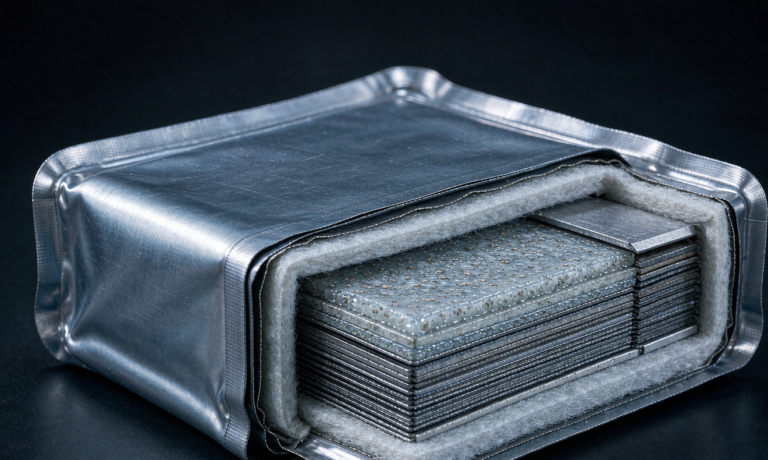
An aircraft does not forgive weight the way a home energy wall does. A rule of thumb I repeat to every new propulsion client: for a fixed mission energy budget, shaving 10% off pack mass can add 6–9% to usable payload or range. That is why the semi-solid state battery matters here. By replacing most of the liquid electrolyte with a gel-like, lithium-rich semi-solid electrolyte and using higher-loading silicon or lithium-metal-lean anodes, we routinely reach 320–400 Wh/kg at the cell level — well above the ~250 Wh/kg ceiling of mature NMC pouch cells and far beyond the ~150 Wh/kg of LFP you would never fly with.
But energy density is only half the story. Aerospace also demands a benign failure mode. A thermal runaway at 11,000 meters is not a warranty event; it is a hull loss. The semi-solid electrolyte’s lower free-liquid content measurably slows the cascading exotherm, which is precisely why regulators and airframers are interested. When I spec a pack, I treat the electrolyte formulation as a safety system, not a chemistry footnote.
Mass-Specific Energy vs. Volumetric Reality
Clients almost always quote Wh/kg first. I push back and ask for the full envelope: the pack-level figure after you add the housing, the thermal plane, the connectors, and the battery management system. A cell at 380 Wh/kg typically lands at 240–280 Wh/kg at the pack level once you account for a flight-rated enclosure and redundancy. That 25–35% conversion loss is normal and must be budgeted on day one.
- Cell level: 320–400 Wh/kg, 700–900 Wh/L for current semi-solid prototypes.
- Module level: 260–300 Wh/kg after compression fixtures and busbars.
- Pack level (flight-ready): 230–280 Wh/kg after enclosure, BMS, and interconnects.
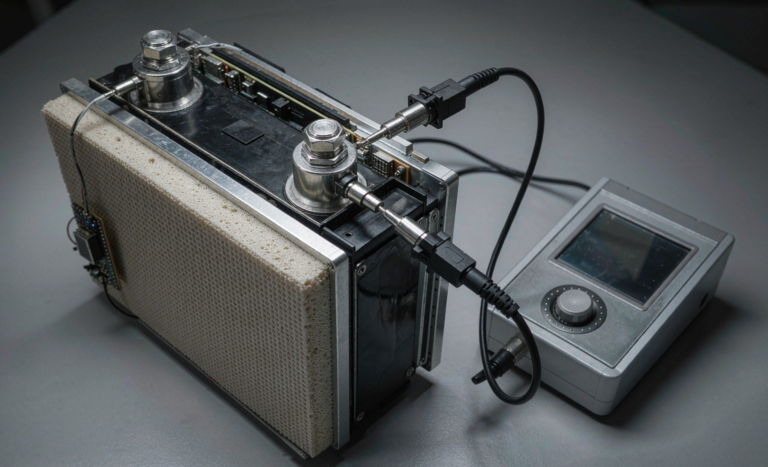
This is where a custom battery solution earns its keep. Off-the-shelf modules rarely hit the mass budget, so we design the enclosure as a structural member — the pack skin carries shear load, removing a separate bracket and its weight. I have saved 1.4 kg on a 9 kg pack just by integrating the mounting into the housing.
Low-Pressure and Thermal Behavior at Altitude
At cruising altitude the ambient pressure drops to roughly 25–30 kPa, and cabin or unpressurized bays swing between −55 °C and +70 °C across a mission. Liquid-electrolyte packs bulge and vent unpredictably under that delta; the semi-solid electrolyte’s constrained solvent budget is far more dimensionally stable. Still, I never assume. We run the UN38.3 T.8 altitude simulation (11.6 kPa for at least six hours at ambient temperature) on every aerospace build before it sees a chamber test.
Thermal management is the harder problem. A semi-solid cell’s ionic conductivity falls at low temperature, so a cold-soaked pack on a dawn launch can deliver only 60–70% of nominal power until it self-heats. My standard fix is a lightweight etched-foil heater laminated to the cooling plane, drawing a few watts to hold the cell stack above −10 °C during pre-flight. The heater energy is trivial against the mission budget but prevents the dreaded “cold brick” launch abort.
Shock, Vibration, and the DO-160 Gauntlet
The single most humbling test for aerospace batteries is environmental qualification. I design to RTCA DO-160 section categories that match the installation: random vibration profiles of 0.01–2.0 g²/Hz across three axes, sinusoidal sweep, and crash shock up to 20–40 g depending on whether the pack sits in a manned airframe or an expendable drone battery pod. For military-procurement variants we also map to MIL-STD-810H method 514.8.
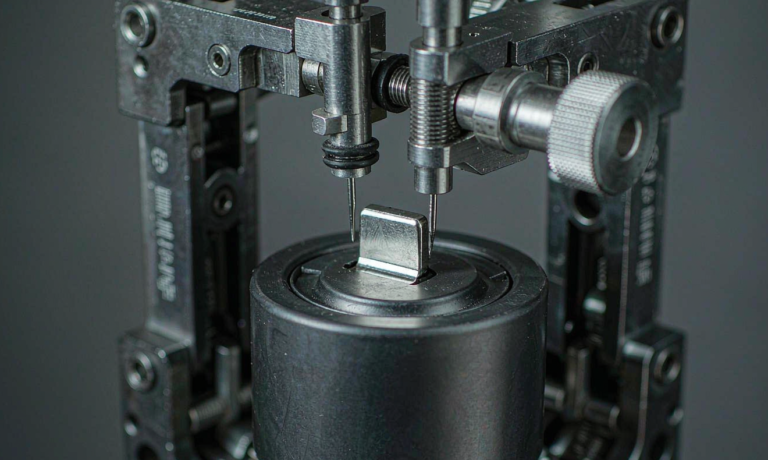
Mechanically, the failure mode I see most is not the cell — it is the interconnect. A busbar weld that passes a bench pull test can fracture after 8 hours of random vibration. My team uses laser-welded nickel-plated terminals with strain-relief potting at every joint, and we validate with a vibration endurance run followed by a four-point resistance check. If contact resistance drifts more than 5% post-vibration, the design goes back to the board.
Certification Gates: UN38.3, IEC 62133, and the Airworthiness Path
No aerospace energy storage reaches a wing or a fuselage without clearing transport and equipment safety standards. I treat these as non-negotiable gates:
- UN38.3: the eight-test transport safety suite — altitude, thermal, vibration, shock, external short, impact, overcharge, and forced discharge. Mandatory before the pack is allowed on any aircraft as cargo or equipment.
- IEC 62133-2: the cell and pack safety standard for portable sealed secondary lithium cells, covering abnormal charging, forced discharge, and internal short simulation. Airframers frequently reference it as a baseline even when a bespoke standard applies.
- FAA / EASA alignment: for installed aircraft batteries we work toward the special conditions and Advisory Circular guidance each authority publishes, and for larger aircraft packs the RTCA DO-311A minimum operational performance standard for rechargeable lithium batteries is the document our test plan is built around.
I tell clients plainly: budget six to nine months for the qualification dossier, not three. The chemistry is the easy part; the paperwork and the repeated test failures are where schedules die. A lithium battery that passes UN38.3 but has not been through the environmental and operational qualification relevant to its mounting location is not flight-ready in my book.
Pack Architecture I Actually Specify
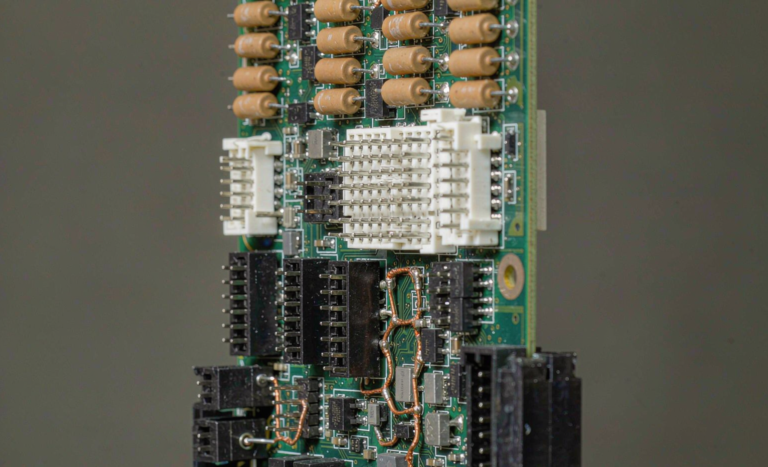
For a typical aerospace semi-solid build, my default topology is a 6s or 12s module using prismatic semi-solid cells, compression-fixtured in a milled aluminum or carbon-skinned enclosure, with a two-tier BMS: an analog front end for cell balancing and a separate flight-rated controller handling state-of-charge, state-of-health, and isolation monitoring. I add redundant temperature sensing — a minimum of two thermistors per module in different thermal zones — because a single sensor failure must never blind the aircraft.
Current interrupt devices and a vented, flame-arresting enclosure round out the safety chain. For high-altitude long-endurance platforms we often parallel two modules so a single cell fault degrades performance rather than ending the mission. This redundancy costs mass, but the customer who flies a $2M payload does not negotiate on that point.
Lessons From the Flight Line
The most valuable engineering lessons came from failures. On one stratospheric drone battery program, our packs passed every bench test yet showed a 12% capacity spread after a single pressurized cycle. Root cause: slight cell-level pressure relaxation in the semi-solid separator under repeated altitude swings. The fix was a pre-conditioning protocol — three pressure-thermal cycles before final formation — that closed the spread to under 3%. Today that protocol is mandatory in our aerospace line.
Another lesson: do not over-specify cycle life at the expense of the mass budget. Aerospace packs are rarely cycled more than a few hundred times in a service life; designing for 2,000 cycles you will never use is wasted kilograms. I match the cycle target to the mission and pour the saved margin into reliability instead.
FAQ
Is a semi-solid state battery safer than a conventional lithium-ion cell for flight?
In the dimensions that matter for aerospace, yes. The reduced free-liquid electrolyte slows thermal runaway propagation and the cells show better dimensional stability under low pressure. But “safer” is not “safe” — it still must clear UN38.3, IEC 62133, and the relevant airworthiness qualification before I will sign off.
What energy density can I realistically expect at the pack level?
For a flight-ready semi-solid pack, budget 230–280 Wh/kg after the enclosure, thermal plane, BMS, and connectors. If a vendor quotes you 380 Wh/kg “at the pack,” ask whether they are counting the cell or the complete installed article — the gap is where programs get surprised.
How long does aerospace battery qualification take?
Plan for six to nine months for the full dossier covering UN38.3 transport safety, environmental qualification to DO-160, and the operational tests mapped to your mounting location. The chemistry build is weeks; the certification is the long pole.
Can the same pack serve both drones and crewed aircraft?
Architecturally similar, but the qualification differs. A drone battery pod may follow a lighter, performance-optimized path, while a crewed installation demands redundant sensing and stricter airworthiness evidence. I design the core cell and BMS once, then tailor the enclosure and certification package to each platform.
Why does cold weather hurt semi-solid packs so much?
The semi-solid electrolyte’s ionic conductivity drops at low temperature, cutting available power until the cell warms. We counter it with a lightweight embedded heater and conservative pre-flight warm-up, which restores performance without meaningfully denting the mission energy budget.
When should I choose a custom battery solution over an off-the-shelf module?
The moment mass or envelope is a constraint, as it almost always is in aerospace. A custom battery solution lets the enclosure become a structural member and lets us match cycle life, pulse power, and redundancy exactly to the mission — savings a catalog part cannot deliver.