Battery Solution Maintenance for Vehicles

I have spent enough time under vehicles and enough time in cell labs to know that most fleet battery failures are not chemistry failures. They are maintenance failures with a chemistry flavour. The pack did not die because the cells were bad. It died because a busbar joint loosened at month nine, nobody had a re-torque interval, the resulting local heating pushed one module twenty degrees above its neighbours, and eighteen months later that module was the reason a van was off the road for a week.
This article is the maintenance playbook I wish every fleet operator had before their first ten vehicles turned into their first fifty. It is written for commercial and industrial vehicles — delivery vans, yard tractors, terminal trucks, municipal refuse trucks, mining and construction support vehicles, airport ground support equipment, and the light utility vehicles that quietly electrify first at almost every site I visit. The focus is battery solution maintenance for vehicles: what to check, how often, what the numbers mean, and which checks are worth the labour hour.
One framing note before we start. A maintenance programme for a vehicle battery solution is not the same document as one for a stationary lithium battery pack. A home energy storage system sits in one place at a stable temperature, sees a shallow and predictable duty cycle, and gets visited by a technician who can take his time. A vehicle pack is thermally abused by definition, mechanically shaken for eight hours a day, exposed to water and salt, charged by whoever is on shift, and diagnosed at 6am because the van has to leave at 7. If you copy a stationary checklist onto a fleet, you will spend your budget on the wrong items.
1. Why Vehicle Battery Maintenance Is a Different Discipline
Stationary storage fails slowly and politely. Vehicle packs fail at the interfaces. When I open a warranty return from a fleet, the failure is overwhelmingly at one of five places: a mechanical joint, a seal, a connector, a coolant path, or a software/charging behaviour. The cells themselves are the least likely culprit, and when they are the culprit, it is usually because something upstream let them get hot.
That has a direct consequence for programme design. Your maintenance hours should be weighted toward mechanical and environmental inspection far more heavily than toward electrical characterisation. Capacity testing every three months feels rigorous and is mostly waste. Re-torquing and re-sealing feels mundane and prevents most of what actually breaks.
The Four Stressors a Vehicle Adds
- Vibration and shock. Random vibration across a broad spectrum, plus discrete shock events from potholes, kerbs, load bed impacts and, on off-road sites, continuous rough terrain. Fasteners relax. Crimp joints fatigue. Potting compounds crack at the lead exit.
- Thermal swing. A pack that sits at 5°C overnight and is fast charged at 45°C every afternoon sees a larger daily thermal excursion in one winter week than a stationary pack sees in a year. Differential expansion is a mechanical load, not just a chemical one.
- Environment. Pressure washers, road salt, de-icing brines, dust, mud, fertiliser and, on mining sites, conductive ore dust. Ingress protection is not a one-time spec sheet claim; it is a gasket that ages.
- Operator variance. Ten drivers produce ten different duty cycles. Opportunity charging at every break, deep discharge to zero, leaving the vehicle parked at 100% in the sun — the human layer dominates the statistical spread of fleet degradation more than any design parameter.
The practical conclusion: a vehicle maintenance programme must be built around trends per vehicle, not around a single fleet-wide number. Averaging across a fleet hides exactly the outlier that is about to strand a vehicle.
2. Duty Cycle First: The Vehicle Defines the Interval, Not the Datasheet
The single most common mistake I see in fleet documents is a maintenance interval copied from a cell datasheet. A datasheet says cycle life at 25°C, 0.5C, 100% depth of discharge, in a lab with a calibrated charger. Your vehicle does none of those things. So before you set any interval, write down the actual duty profile.
Build the Profile From Data, Not From the Brochure
Pull two weeks of BMS logs per vehicle and extract:
- Energy throughput per day in kWh and equivalent full cycles
- Peak and sustained C-rate, and how long the sustained part lasts
- Depth of discharge distribution — not the average, the histogram
- Time spent above 40°C and below 0°C, at cell level
- Charging events per day, and the SoC window each one covers
- Idle and parking temperature, including overnight
Then classify vehicles into duty classes. In one municipal fleet I worked with, refuse trucks and supervisor pickups were on the same maintenance schedule. The trucks were doing four equivalent full cycles per day with a compactor hydraulic load that produced 3C pulses every few seconds; the pickups were doing 0.3 cycles a day and spending their lives at 80% SoC in the sun. Their failure modes were completely different and always would be.
Three classes is usually enough:
- Heavy cyclic (delivery, refuse, terminal shunt, mining support): inspect mechanically every quarter, characterise electrically every six months.
- Moderate (service vans, utility, ground support): mechanical every six months, electrical annually.
- Light / seasonal (supervisor vehicles, backup units, seasonal agricultural kit): inspect at season change in and season change out; the dominant risk here is storage, not cycling.
3. The Mechanical Half: Torque, Vibration and Ingress
If I could only keep one maintenance task on a vehicle fleet, it would be a disciplined mechanical inspection of the high-current path and the enclosure. Here is what that involves.
Fastener Re-Torque
New packs settle. Joint surfaces embed, gaskets compress, and threaded fasteners lose preload in the first few hundred hours. Every vehicle programme I write includes a first re-torque at 500 to 1,000 operating hours (or three months, whichever comes first), then annually thereafter. Use a calibrated torque wrench, log the value, and mark the fastener with a paint pen so a visual walk-round can spot movement without tools.
Two rules I enforce. First, torque to the pack manufacturer’s value, not to a generic table — a copper busbar on a plastic-overmoulded terminal has a very different limit than a steel bolt into an aluminium boss. Second, never re-torque a fastener that has been disturbed by corrosion or that shows any sign of galling; replace it. A seized M8 that “feels tight” at 12 Nm can be at 4 Nm of real clamp load, and that is a heater.
For reference, a typical module-to-busbar joint might specify 8 to 12 Nm; a pack-to-chassis mount might specify 45 to 80 Nm depending on stud size and grade. What matters is not the number, it is that the number is written down, the tool is in calibration, and the result is recorded.
What High Resistance Looks Like Before It Fails
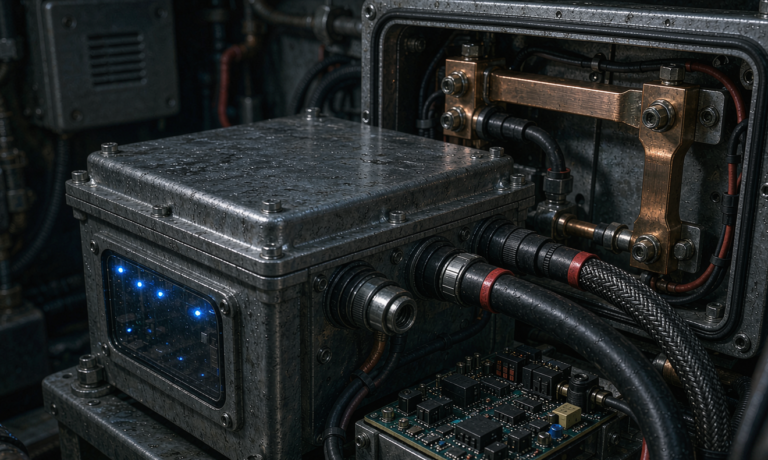
Every loose or corroded joint in the high-current path is a local heater. The physics is unforgiving: power dissipated is I²R. At 300 A, a joint that has gone from 0.2 mΩ to 2 mΩ dissipates 180 W in a space the size of a sugar cube. You can find these before they become events.
- Infrared scan under load. Scan the pack interior, busbars, contactor terminals and service disconnect after a full-power run or a fast charge. You are looking for deltas, not absolutes. A terminal 15 K above its neighbours on the same current path is a finding. Ten K is a watch item. Thirty K is a work order today.
- Millivolt drop test. With a known current flowing, measure the voltage drop across each joint in the series path. Compare joints in the same string. A joint more than 20 to 30% above the median drop of its peers is a finding, regardless of what the absolute number says.
- Visual cues. Discolouration of plating, heat-affected insulation that has gone brittle or glossy, a faint sweet-acrid smell near the pack, or any powdery deposit at a terminal.
Do the IR scan with the cover off and the vehicle in a safe state, following your lockout procedure. An enclosed scan through a steel lid tells you nothing.
Seals, Gaskets and Ingress
Enclosure ratings are specified as IP66 or IP67 on a new part in a test lab. On a three-year-old vehicle that has been pressure washed weekly, the meaningful number is the condition of the gasket and the glands. Inspect:
- Cover gasket for compression set, cracking, and correct seating (look for a continuous even impression line)
- All cable glands for tightness and for the cable jacket having pulled or twisted
- Breather or vent membranes — these clog with dust and brake dust, and a clogged membrane turns a sealed enclosure into a pressure vessel through thermal cycling
- Drain paths, if the enclosure design has them — mud wasps and road grime block them effectively
- Any sign of water tracking: white corrosion bloom on aluminium, rust staining at a steel fastener, or moisture visibly inside a connector
A quick, cheap and very informative test is a water ingress check after washing: open the connector bay and look. If you find moisture, you do not have a maintenance problem, you have a design or repair-quality problem, and every vehicle in the batch needs the same inspection.
Coolant Paths on Liquid-Cooled Packs
Higher-power vehicles often use liquid cooling or a refrigerant chiller. That adds a whole maintenance domain:
- Coolant level and condition — degraded glycol becomes conductive, and a conductive coolant loop inside a high-voltage pack is a serious fault, not a nuisance
- Coolant conductivity or pH per the manufacturer’s window; log it
- Leak inspection at every quick-connect and at the cold plate seams
- Pump and fan function and noise; a failing coolant pump often announces itself acoustically weeks before it trips
- Air-side fouling — a cold plate loop is only as good as its radiator, and on refuse trucks and agricultural vehicles the radiator lives in the worst air on the machine
4. Thermal: The Biggest Lever You Actually Have
Ask me for the highest-return maintenance action on a vehicle fleet and I will not say “capacity test.” I will say “keep it cool.” Calendar ageing roughly doubles for every 10 K increase in cell temperature, and the hottest 200 hours of a battery’s life can cost more capacity than the coolest 2,000. On vehicles, heat is not an unfortunate side effect — it is the default state, and fighting it is a maintenance task.
Practical Thermal Maintenance
- Keep the air path clear. On air-cooled packs, the intake filter and the fan are the maintenance item. A clogged filter worth four dollars can cost you twelve degrees.
- Park in shade, or specify a reflective cover. A black vehicle parked outdoors in summer can put the pack at 55 to 70°C before it moves. That is pure calendar ageing with zero productive output.
- Charge in the cool part of the day where the duty cycle allows. A night charge at 20°C and a midday fast charge at 45°C are not the same event for the cell, even at identical current.
- Respect the cold-charge limit. Charging a lithium battery below 0°C plates metallic lithium on the anode. That damage is permanent, it is cumulative, and it creates dendrite nucleation sites that raise internal short risk for the rest of the pack’s life. A cold-weather preconditioning strategy is not a comfort feature; it is a safety feature. Budget the energy — warming a 10 kWh pack from -20°C can take 1 to 2 kWh of its own capacity before it will accept charge.
- Watch the delta, not just the max. Cell-to-cell temperature spread is one of the best early indicators of a cooling problem, an airflow blockage, or a developing internal fault. A spread that has grown from 3 K to 9 K over two service intervals is a trend worth chasing even if the absolute maximum is still inside spec.
Opportunity Charging Is a Maintenance Topic
Fleet operators love opportunity charging because it extends shift availability. Done carelessly, it is the most expensive convenience on the site. The problem is not the number of partial cycles — lithium chemistry handles partial cycles well. The problem is that opportunity charging tends to push the pack into the top of the SoC band repeatedly, in a warm state, and hold it there.
The maintenance-relevant rules:
- Set a fleet charging window. For most duty cycles, a daily operating band of roughly 15 to 85% SoC gives up very little usable energy and dramatically reduces time spent at high SoC and high temperature.
- Charge to 100% only when the next duty cycle genuinely needs it, and schedule that charge to finish close to departure rather than sitting full overnight.
- Cap charge current as a function of temperature, and verify the BMS is actually enforcing it rather than just logging it.
- If drivers are choosing, they will choose full and fast every time. Make the default configuration the healthy one.
5. Electrical Checks That Actually Predict Failure
Now the electrical characterisation. The key principle is that a single measurement is nearly useless; a series of measurements taken the same way, at the same temperature and SoC, is one of the most powerful diagnostic tools you own.
The Four Numbers
- Capacity, as a percentage of beginning-of-life. Measured by a controlled full discharge to the manufacturer’s cut-off, or estimated by coulomb counting on a representative duty cycle. Do it at a controlled temperature and a controlled rate, or the number is noise. Trend: a well-managed fleet vehicle might lose 2 to 3% per year; a hard-worked fast-charged one might lose 6 to 10%. A vehicle dropping more than its peers by a wide margin is an outlier to investigate.
- DC internal resistance, from a standardised pulse. Not the manufacturer’s 1 kHz AC value — a DC pulse test you can repeat: rest, apply a known current for a fixed 10 to 30 seconds, record the voltage change, divide. Normalise to 25°C. As a working heuristic, roughly 1.15× the commissioning baseline is worth investigating, 1.3× is worth planning a replacement, and 1.5× means take it out of service. Those thresholds shift with chemistry and application, so set your own at commissioning, in writing.
- Cell balance: resting voltage spread. Measure after a defined rest period, not at end of charge. A spread that grows between service intervals points to a weak cell, a balance circuit problem, or a parasitic load on one module. Record the number in millivolts, not as “balanced/unbalanced.”
- Insulation resistance. The check most fleets skip and the one that catches the scariest faults. With the pack isolated and using an insulation tester at the correct voltage for the system, measure from each HV pole to chassis. Take a baseline at commissioning and trend it. A downward trend toward the manufacturer’s minimum is a fault to find before it becomes a shock hazard or a ground fault trip at an inconvenient moment.
Standardisation Is Everything
Every one of these numbers is temperature and SoC dependent. A DCIR reading taken at 15°C and 70% SoC is not comparable to one taken at 38°C and 40% SoC. Write the conditions into the procedure: rest period, ambient range, SoC window, current, duration, and instrument. If your procedure does not specify those, your trend line is fiction.
BMS Data: Cheap, Continuous, and Underused
The BMS already records most of what you need. The maintenance task is to get it off the vehicle and into a system that trends it. Minimum useful record per vehicle per trip: min and max cell voltage with timestamps, peak current and duration, max cell temperature and delta T, start and end SoC, charge energy and charge duration, any alarm code with a parameter snapshot at the moment of the alarm, and insulation resistance if the BMS measures it.
Keep the full history, not a rolling window. When a pack fails in year five, the question that matters is what it looked like in year one, and a 90-day rolling buffer will not answer it.
6. Charging Infrastructure Is Part of the Maintenance Programme
I have traced more “battery problems” to chargers than to packs. Chargers are assets, and they need the same discipline.
- Firmware configuration control. A charger firmware change that silently reduces output current can strand a fleet at 60% SoC overnight with no alarm. Treat charger firmware as a controlled configuration item: version logged, changes approved, and a functional check after any update.
- Calibration. Chargers drift. If a charger’s current measurement is 5% high, every vehicle it serves is being charged 5% harder than the BMS thinks. Put charger verification on an annual calibration schedule.
- Connector and cable condition. DC connectors are consumables. Inspect for pitting, carbon tracking, cracked strain relief, and pin retention. On a high-power site, a connector that has been dropped in a puddle and plugged in anyway is a genuine fire risk.
- Thermal management of the charger. Chargers derate when hot. A charger cabinet in a sealed, sun-facing enclosure will derate every afternoon in summer and nobody will connect the slower charging to the cabinet’s location.
- Communication health. Log handshake failures and aborted sessions. A pattern of aborted sessions on one post, across many vehicles, is a post problem. A pattern across all posts, on one vehicle, is a vehicle problem. The pattern is the diagnosis.
7. Damage, Crash and Thermal-Event Protocol
Every site needs a written, rehearsed procedure for a damaged pack, and it needs to be more specific than “isolate and call the supplier.”
The Written Protocol
- Stop, isolate, do not charge. A physically damaged lithium battery must not be put on a charger. That single rule prevents a large fraction of secondary incidents.
- Quarantine outdoors, on a non-combustible surface, with clearance. Not in the workshop, not next to the parts store, not under the eves. Thermal events in a damaged pack can be delayed by hours or days.
- Monitor temperature. An IR camera or a spot IR thermometer, checked on a defined schedule. A rising trend in a quarantined pack is the trigger to escalate.
- Define the escalation trigger. Any of: cell temperature above a defined threshold, visible swelling, smoke, hissing or a sharp solvent smell, or a temperature rising faster than a defined rate per minute. At that point, evacuate the quarantine area and call the fire service, and tell them it is a lithium-ion battery.
- Water is the right extinguishing medium for exposure control, and it takes volume. Coordinate with your local fire service before an event, not during one. Give them the pack chemistry, capacity, voltage and location.
After a Minor Impact
Not every impact is a write-off, but the decision must be evidence-based. After a kerb strike, a load-bed impact or a deep pothole event, I want: an external inspection, an insulation resistance check, a full BMS fault-code download, and a controlled functional test with cell voltages and temperatures monitored under load. If data is ambiguous, a pack-level X-ray or CT inspection is cheap compared to guessing.
8. HV Safety and Personnel Competency
Maintenance on a vehicle battery solution is high-voltage work. This is not a place for general mechanical curiosity.
- Define who is authorised. Written roles: an “aware” level for drivers and yard staff, and an “authorised” level with the training to de-energise, verify and work on the pack. Everyone else stays out.
- Lock-out, tag-out and prove-dead. Physically isolate, lock it, then measure and confirm zero energy at the work point with a meter that has been proven on a known source immediately before and after. The prove-before-and-after step is the one people skip.
- PPE matched to the hazard. Arc-rated clothing and face protection appropriate to the incident energy at the work point, plus insulated gloves of the correct class, inspected and date-stamped, with leather over-gloves.
- Insulated tools, in good condition. Inspected, not just owned.
- Rescue plan. What happens if someone is being shocked or is unconscious inside a vehicle? Who calls, who disconnects, who starts CPR, where is the AED. A plan on paper that has never been walked through is not a plan.
- Stored-energy awareness. A pack can be electrically isolated at the contactor and still hold hundreds of volts at the terminals. Capacitors in the inverter hold charge after the pack is disconnected. Your procedure must name every stored-energy source and how each is discharged.
Recurrent training matters more than initial training. The technician who did the course three years ago and has not performed a de-energisation since is not an authorised person in any meaningful sense.
9. Records, Warranty and the Evidence Trail
Warranty claims on commercial battery solutions are won and lost on records. When a supplier asks for data, “the van was sluggish” will not get you a pack. This will:
- Commissioning baselines: capacity, DCIR at defined conditions, cell voltage spread, insulation resistance, torque values, firmware versions
- The duty profile: monthly energy throughput, equivalent full cycles, and the temperature histogram
- Every service record: what was checked, by whom, with which calibrated instrument, and the measured value — not just “OK”
- Every alarm and fault code with its parameter snapshot
- Charging records: sessions, energy, peak temperature, aborted sessions
- Any deviation from the operating envelope, with the operator’s account of what happened
A note on the temperature histogram, because it is the most valuable single artefact and the least commonly kept. Under Arrhenius behaviour, time at temperature is what consumes calendar life. A histogram of cell temperature versus accumulated hours lets you argue, quantitatively, that a pack which spent 300 hours above 45°C aged far faster than its cycle count suggests. It also tells you whether your next procurement should specify better thermal management.
Keep retired or replaced packs until the warranty period expires. A replaced module that gets scrapped in month three cannot be analysed when the failure recurs across the batch in month twenty.
10. Retirement Criteria and Second Life
Set the retirement threshold before you need it. The standard fleet criterion is capacity falling below 70 to 80% of beginning-of-life, but capacity alone is the wrong single test. I use a package:
- Capacity below the defined floor (commonly 70 to 80% of BOL)
- DCIR above the defined ceiling
- Cell-to-cell spread above the defined maximum after a proper balance cycle
- Insulation resistance trending toward the minimum
- Any history of physical damage, ingress, or thermal event
- Pack no longer supported: no spare modules, no firmware support, no documentation
Any one of those can be disqualifying even if capacity is fine. A pack with excellent capacity and a history of water ingress is not a second-life asset; it is a liability.
For second life, the honest guidance is that a retired vehicle pack is a poor candidate unless you have the data history, the module-level granularity to build a balanced unit, and a real test protocol. Stationary second-life applications are tolerant of lower energy density and are a genuinely good fit for packs retired for capacity fade — the same cells that can no longer deliver 3C for a refuse truck will happily do a 0.2C home energy storage duty for a decade. What makes second life work is data: a pack with a documented history can be graded and warranted; a pack without one is scrap with unknown behaviour.
11. Chemistry Matters — Match the Maintenance to the Cell
Maintenance is not chemistry-neutral. A few notes that change what you do.
- LFP (lithium iron phosphate). The default for most commercial vehicles today, and for good reason: long cycle life, strong thermal stability, and a flat voltage curve. That flat curve is a maintenance problem — it makes SoC estimation from voltage unreliable, so you need periodic full charges for the BMS to calibrate, and your coulomb counter needs to be cross-checked against a rested open-circuit voltage regularly. If your estimated SoC and your rested-OCV-derived SoC diverge by more than about 10 to 15%, the estimator needs attention.
- NMC and other high-nickel chemistries. Higher energy density, which is why they dominate where range or shift length is the binding constraint. They need tighter thermal control and tighter top-of-charge discipline. The maintenance implication is simply that all the thermal and SoC-window rules above stop being optional.
- sodium-ion battery. Genuinely attractive for vehicles in cold climates and for stationary-adjacent vehicle duties — better low-temperature charge acceptance than LFP and no lithium supply exposure. The trade-off is lower energy density, which matters a lot in a vehicle and not much in a building. In my experience the right answer is usually “sodium-ion for the cold-climate yard vehicles and the site storage, LFP for the road fleet,” rather than one chemistry everywhere.
- semi-solid state battery. Reduced free electrolyte improves abuse tolerance in principle, but “in principle” is not evidence. Two maintenance items are specific to this family: stack pressure, because the mechanical preload that makes the cell work in a fixture on a test bench has to be maintained by the pack structure through years of vibration and thermal cycling; and low-temperature power, because reduced electrolyte volume can make rate capability and cold-cranking more sensitive. Cold-soak preconditioning stops being a nice-to-have.
Whichever chemistry you run, the maintenance fundamentals in Sections 3, 4 and 5 do not change. Cells fail; joints fail more often.
12. When a custom battery solution Pays Off on a Fleet
A catalogue pack is the right answer more often than suppliers like to admit. Standard voltage platforms, standard form factors, standard communication protocols: if your duty cycle is normal, buy the standard product and spend your money on maintenance instead.
A custom battery solution earns its engineering cost when at least two of these are true:
- The duty cycle includes sustained or repeated high-rate pulses that a catalogue pack’s thermal design cannot absorb
- The mechanical envelope is genuinely constrained, or the mounting points are dictated by a load path rather than by convenience
- Operating temperature range sits outside the catalogue window in either direction, permanently
- The environment is corrosive or combustible-dust classified, requiring specific materials, coatings and ingress approach
- The BMS must integrate with your specific telematics, charger control, or fleet management logic, and that integration is the difference between a managed fleet and a guessing game
- Serviceability constraints dominate: module weight and handle geometry determine whether a two-person swap is realistic on your site, and connector orientation determines whether the service disconnect can actually be reached
- You need guaranteed module supply and firmware support on a defined horizon, in writing, with a last-time-buy buffer
That last point is underrated. On a fleet, the second-worst outcome after a fire is a vehicle parked for eleven weeks waiting for a module that no longer exists. Ask the supplier to commit, in the contract, to module availability and firmware support for a defined number of years, and to a last-time-buy notification period. Then maintain to that.
A final word on mechanical design, because it determines whether all this maintenance actually happens in year eight. battery pack design that requires three people, a ladder and a contortionist to reach the service disconnect will not be maintained. Handles you can grip with gloves, connectors that face the technician rather than the firewall, a service disconnect that is reachable without removing anything else, and covers you can take off in under five minutes — those are not cosmetic choices. They decide whether the programme on paper becomes the programme in the workshop.
13. A Twelve-Point Commissioning and Periodic Checklist
Every item here is something I have seen cause a real vehicle-off-road event.
- Record commissioning baselines: capacity, DCIR at defined conditions, cell spread, insulation resistance, firmware versions.
- First re-torque at 500 to 1,000 operating hours, with calibrated torque wrench, values logged, fasteners marked.
- Annual re-torque and torque-mark inspection thereafter; more often on rough-terrain duty.
- Infrared scan of the full high-current path under load every service interval; chase deltas of 10 to 15 K and above.
- Millivolt drop comparison across series joints, trended, same procedure each time.
- Enclosure inspection: gasket compression set, gland tightness, breather membrane not clogged, no water tracking, drain paths clear.
- Coolant loop: level, condition, conductivity or pH in window, leak check, pump and fan function, radiator or heat exchanger clean.
- Electrical characterisation on schedule: capacity, standardised-pulse DCIR at controlled temperature and SoC, resting cell spread, insulation resistance.
- Charger fleet: firmware versions logged and controlled, annual functional and calibration check, connector and cable condition, derating behaviour understood.
- BMS data pipeline verified: records are actually leaving the vehicle, arriving in a system, and are being trended — check a specific vehicle end-to-end, not the dashboard.
- Damage and thermal-event protocol rehearsed, quarantine location real and available, local fire service briefed on chemistry and pack data.
- Personnel competency current: authorised-person list, training dates, glove inspection dates, rescue plan walked through in the last year.
FAQ: Battery Solution Maintenance for Vehicles
How often should a commercial vehicle battery be inspected?
Mechanically, quarterly for heavy cyclic duty and every six months for moderate duty, with a first re-torque at 500 to 1,000 operating hours. Electrically — capacity, DCIR, cell spread and insulation resistance — annually for most fleets, every six months for heavy cyclic or severe thermal duty. Storage-dominated seasonal vehicles should be inspected at each season change rather than on a calendar interval.
Is capacity testing worth the downtime?
Full capacity testing is expensive because it takes the vehicle out of service. I recommend a full controlled discharge annually on a rotating sample — say 20% of the fleet per quarter — and rely on BMS-derived coulomb counting plus standardised-pulse DCIR for the rest. That gives you a real calibration of your estimates without grounding a fifth of your fleet every quarter.
What is the single highest-return maintenance task?
Thermal management. Keeping cells out of the top of the temperature band — through clear air paths, clean filters, shaded parking, and charging during cooler hours — does more for life than any other action you can take. It is also the cheapest.
Can we fast charge every break without damaging the pack?
Modern packs are designed to accept opportunity charging, and partial cycles are not inherently harmful. The risks are thermal and SoC-related: repeated fast charging into the top of the SoC band while the pack is already warm. Set a fleet charging window of roughly 15 to 85% for daily use, charge to full only when the next duty cycle requires it, and let the BMS enforce temperature-dependent current limits.
What should we do with a physically damaged pack?
Stop using the vehicle, do not charge it, and move the vehicle or pack to an outdoor quarantine area on a non-combustible surface with clearance from buildings and other vehicles. Monitor temperature on a schedule. Escalate on any defined trigger — rising temperature, swelling, smoke, or a sharp solvent smell — by evacuating the area and calling the fire service with the chemistry and capacity information ready. Thermal events in damaged lithium cells can be delayed by hours.
Do we need high-voltage training to do basic checks?
Yes, for anything that involves opening an enclosure or working near exposed conductors. Establish two levels: an aware level for drivers and yard staff covering what to look for and what not to touch, and an authorised level with formal training in de-energisation, proving dead, and PPE. Visual walk-rounds, exterior inspection and charging behaviour are fine for the aware level; anything electrical is not.
Why does one vehicle in the fleet degrade so much faster?
Usually the driver. Opportunity charging habits, parking location, load weight, route profile and aggressive acceleration account for more fleet degradation spread than any hardware difference. Pull the per-vehicle temperature histogram and charging records before you blame the pack — in my experience, roughly half of “bad pack” investigations end up being a duty-cycle finding.
Is it worth keeping replaced packs for warranty claims?
Yes, and keep them until the warranty period expires. A replaced module that is scrapped early cannot be analysed when the same failure appears across the batch two years later. Retaining failed parts is also usually a condition of the warranty itself — check the wording.
Should we switch the whole fleet to sodium-ion or semi-solid state?
Not as a blanket decision. A sodium-ion battery makes real sense for cold-climate site vehicles and stationary-adjacent duties where energy density matters less than low-temperature charge acceptance and supply stability. A semi-solid state battery makes sense where you can genuinely use the energy density and where your programme can manage stack pressure and cold-soak preconditioning. For a mainstream road fleet today, LFP with a well-run maintenance programme is very hard to beat on total cost.
When is a custom battery solution worth it for a fleet?
When at least two of these hold: sustained high-rate duty beyond catalogue thermal capability, a constrained mechanical envelope or load-path-driven mounting, operation permanently outside the standard temperature window, a corrosive or combustible-dust environment, BMS integration requirements your telematics actually depend on, serviceability constraints driven by module weight and access, or a contractual need for guaranteed module and firmware support. If none apply, buy the catalogue product and spend the difference on maintenance.
Does a vehicle battery need the same maintenance as a home energy storage system?
No, and this is a common and expensive assumption. A home energy storage system sees a stable environment, shallow predictable cycling and careful access. A vehicle pack sees vibration, thermal swing, water and salt, and variable operator behaviour. Vehicle programmes must weight mechanical inspection, ingress checks and thermal management far more heavily, and stationary programmes can weight electrical characterisation more heavily. The shared items — baseline data, standardised trending, temperature history — apply to both.
How long should we keep battery maintenance records?
For the full service life plus the warranty period, and ideally longer. The comparison you need in year five is against the year-one baseline, and a rolling 90-day buffer cannot provide it. Keep commissioning baselines, duty profiles, service measurements with values rather than “OK”, all fault codes with snapshots, and charging records. Full-history retention is what turns a fleet from reactive into predictive.