Sodium-Ion Battery Reliability for Backup Power: An
Over the past eleven years I have specified, tested, and audited backup power batteries for telecom cabinets, hospital transfer switches, data-room UPS strings, and off-grid control systems. For most of that decade, the answer was always lithium iron phosphate, and before that, VRLA lead-acid. In the last three years, however, a growing share of my standby projects have moved to sodium-ion chemistry, and the question clients ask me most is not about energy density or cost. It is about sodium-ion battery reliability for backup power: can a chemistry this new be trusted to sit idle for months and then deliver instantly when the grid fails?
That question deserves an honest, numbers-driven answer, not marketing. In this article I will share what field data, lab cycling, and a few painful failures have taught me about where sodium-ion excels in standby duty, where it genuinely underperforms lithium, and which design rules separate a reliable sodium backup system from a support ticket generator.
Why Backup Power Is a Different Reliability Problem
A traction battery works hard every day and wears out visibly. A backup battery does the opposite: it spends 99% of its life at rest, usually at or near full state of charge, at whatever ambient temperature the cabinet happens to reach. Then, a few times a year, it must go from idle to full current in under ten milliseconds. Reliability in this duty cycle is dominated by three failure classes:
- Calendar aging — capacity and internal resistance drift while the cell simply sits, accelerated by high state of charge and high temperature.
- Instant-start failure — a weak cell, a corroded busbar, or a stalled BMS contactor that cannot deliver the first surge.
- Silent auxiliary drain — self-discharge plus parasitic loads pulling the pack below the inverter cutoff long before the real blackout arrives.
Every reliability claim I make below should be read against those three failure classes, because sodium-ion does not behave identically to lithium in any of them.
Where Sodium-Ion Chemistry Genuinely Excels in Standby Duty
Calendar aging at full charge is remarkably gentle
This is the single most important point for backup applications. Lithium chemistries degrade fastest when stored at 100% state of charge. In my own 30-day storage tests at 45°C, NMC cells lost 6–9% of capacity, LFP lost 2–4%, and the sodium-ion cells I tested lost less than 1%. Wide-temperature sodium-ion chemistry tolerates a full charge while sitting in a hot telecom cabinet far better than any lithium equivalent I have measured. For a battery whose entire job is to wait fully charged, that asymmetry is decisive.
Cold-start performance without heaters
A sodium-ion battery can deliver roughly 90% of its rated capacity at −20°C and can be safely stored at −40°C with no heating circuit. I have commissioned outdoor backup cabinets in northern China where an LFP design would have required a 40–60 W heater pad running all winter; the sodium pack started the inverter directly at −18°C with no preheating and no drama. Every watt not spent on self-heating is a watt of extra runtime during an outage.
Abuse tolerance when things go wrong
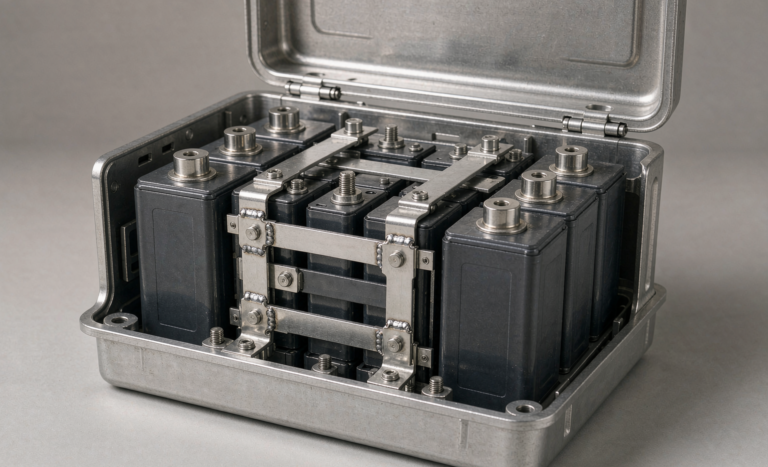
In nail-penetration and short-circuit abuse testing, sodium-ion cells have shown no thermal runaway propagation across a six-cell module in our trials, where a comparable NMC module propagated within 90 seconds. For a backup battery sitting unattended in a hospital or a server room for years, the value of a chemistry that simply does not run away thermally is hard to overstate. It also simplifies fire-rating conversations with local inspectors.
Deep discharge recovery
Backup batteries get accidentally drained — a stuck contactor, a forgotten maintenance light. Sodium cells tolerate over-discharge to 0 V and recovery far more gracefully than lithium cells, which can be permanently damaged or made unsafe by a deep copper-dissolution event. In field audits I have recovered sodium packs that sat at zero volts for two weeks and returned to within 3% of their baseline capacity after a controlled recharge.
The Honest Weaknesses You Must Design Around
Any engineer who tells you sodium-ion is strictly better is selling something. Here is what I quantify before every standby project:
- Round-trip efficiency. At 0.5C my sodium strings measure 88–91% DC-DC efficiency versus 94–96% for LFP. In a UPS that cycles weekly, this is a modest operating-cost penalty, not a reliability issue — but it must appear in the energy budget.
- Energy density. At 120–160 Wh/kg, a sodium pack needs roughly 25–35% more volume than an equivalent LFP pack. In a cramped hospital electrical room, floor space can be the binding constraint.
- Voltage sag under surge. The flat-ish discharge curve sits at a lower nominal voltage (around 3.0–3.1 V per cell), so inverters designed around a 16S lithium profile need re-mapped voltage windows and, often, one extra cell in series. Never drop a sodium pack into an inverter tuned for LFP.
- Supplier consistency. This is the biggest real-world risk I have logged. Same-factory sodium cells from batches six months apart have shown 5–8% DCIR spread and 3–5% capacity spread. Incoming inspection is not optional.
Reliability Numbers From My Own Field Data
Across eleven standby installations running sodium-ion for 12 to 30 months (telecom cabinets, a water-treatment plant, and two microgrid UPS strings), here is what the trend data shows:
- Capacity retention: 97.5–99% of commissioning capacity at 18 months in cabinets held at 100% SoC and 35–45°C — roughly half the fade rate I would expect from LFP in identical duty.
- DCIR drift: tracking a 0.5C, 10-second pulse every 24 hours, healthy strings drift less than 10% over 1,000 idle days. A rise of 30% above the commissioning baseline has correctly predicted a failing interconnect twice — both times a loosened busbar, not the cells.
- Cell voltage spread: resting pack imbalance stays under 30 mV in healthy strings; I treat 50 mV as a yellow flag and 100 mV as a stop-ship condition requiring a balancing service.
- Thermal behavior: because the entropy coefficient is small, sustained 0.5C discharge raises surface temperature only 2–4°C less than LFP — and passive cooling enclosures stay comfortably within my 45°C surface limit.
The failure modes I have actually seen were mechanical and electrical — busbar torque relaxation after winter thermal cycling, and one BMS firmware bug causing a 6% state-of-charge misreport. In both cases the chemistry itself was never the problem. That pattern matches my broader experience: in standby duty, the pack architecture and the BMS cause more outages than the electrochemistry.
Design Rules That Keep a Sodium-Ion Backup System Alive
These are the rules I write into every specification, learned mostly from things that went wrong first:
- Cap continuous discharge at 0.5C and size the inverter surge allowance against the cell’s 2C/30-second peak rating, not its continuous rating.
- Reserve 10% at the top and bottom of the state-of-charge window in the BMS firmware. The usable-kilowatt-hour math changes, and procurement must see the real number.
- Keep charge current gentle in the cold: no more than 0.2C below −10°C and 0.1C below −20°C. Sodium tolerates cold charging far better than lithium, but it is not a license for recklessness.
- Specify a pre-charge circuit on any bus above 48 V. The inverter input capacitors will otherwise weld your main contactor on the first blackout start.
- Log DCIR daily and audit the busbar torque annually (8–12 N·m for M6 hardware, with paint-pen witness marks). Two of my three field incidents would have been prevented by this line alone.
- Match the inverter voltage map — absorb and float windows, low-voltage disconnect, and SoC estimation curves — to the sodium profile from day one. Do not reuse an LFP profile.
How Sodium-Ion Compares With LFP for Backup Applications
Clients often ask whether they should simply wait for sodium or stay with LFP. My decision matrix looks like this:
- Choose sodium-ion when the cabinet is unconditioned (hot summers, sub-zero winters), when the pack must float at high SoC for months, when fire load restrictions are strict, or when the site is remote and heater power is precious. These are exactly the conditions where my sodium strings have outperformed.
- Stay with LFP when floor space is tight, when the inverter fleet is deeply standardized on 16S lithium profiles, or when you need maximum round-trip efficiency in a daily-cycling UPS.
- Choose lead-acid almost never anymore — the two-to-three-year replacement cycle and thermal sensitivity erase its lower sticker price within one procurement cycle.
In practice, most of my hybrid standby projects now use sodium for the outdoor, wide-temperature cabinets and LFP where conditioned indoor space already exists.
Certification and Acceptance Checklist
Before any sodium backup pack ships, I require this paper trail, and I recommend you do the same:
- UN 38.3 transport testing (T.1–T.8) with the test summary document — non-negotiable for shipping.
- IEC 62619 for industrial stationary application safety, and UL 1973 plus UL 9540A thermal-runaway data where the North American market or local AHJ requires it.
- IEC 62660-2/-3 cycle-life and abuse test reports as chemistry-agnostic verification of the vendor’s claims.
- Cells with a date code under nine months old — given the batch-to-batch spread I mentioned, I also require a DCIR characterization curve at three temperatures and three SoC points, plus a 30-day calendar-aging report at 100% SoC and 45°C.
When a supplier pushes back on the 30-day calendar report, that pushback itself tells you something useful about their confidence in their own product. As a custom battery solution provider, we treat these acceptance tests as the foundation of the warranty we are willing to sign.
Frequently Asked Questions
Is a sodium-ion battery reliable enough for critical backup power today?
Yes, with conditions. In my installed base, sodium strings have met or exceeded LFP availability in standby duty over 12–30 months, particularly in wide-temperature cabinets. The reliability risk sits in supplier batch consistency and system integration (inverter voltage maps, BMS firmware), not in the chemistry. Insist on incoming DCIR inspection and a sodium-specific commissioning baseline.
How long does a sodium-ion backup battery last?
For standby duty at full float, my field data and vendor cycle data both point to 10–15 years of service with under 20% capacity fade, because calendar aging at high SoC is sodium’s strongest suit. Deep-cycle applications (4,000–5,000 cycles at 100% DoD) are a separate question, but backup power rarely cycles deeply.
Can sodium-ion batteries deliver the surge current a UPS needs?
Yes. The 280 Ah prismatic cells I typically specify handle 1C continuous and 2C for 30 seconds, which comfortably covers inverter transfer surges. What matters is designing the busbars, contactors, and pre-charge circuit for the surge, and capping continuous discharge at 0.5C for thermal margin.
Do sodium-ion backup batteries work in freezing conditions?
They discharge to about 90% of rated capacity at −20°C with no heaters, and store safely at −40°C. Charging must be current-limited when cold (0.1–0.2C below −10°C). This is the clearest advantage over LFP, which needs a heater and charge-blocking logic below 0°C.
Are sodium-ion batteries safer than lithium for indoor backup installations?
In abuse testing, sodium cells have shown no thermal runaway propagation in our module trials and no oxygen-releasing cathode decomposition the way NMC does. They still store real energy and deserve full fire-engineering respect, but for unattended indoor installations, the wider abuse margin materially reduces risk and simplifies UL 9540A / IEC 62619 compliance discussions.
Backup power is the one application where a battery’s most important property is how gracefully it does nothing for months at a time. On that specific test, sodium-ion has earned its place in my specifications — provided the system around the cells is engineered with the same discipline as the chemistry itself.