Sodium-Ion Battery Formation and First-Cycle Efficiency
Formation is the first controlled charge and discharge a sodium-ion cell receives after assembly. I have run formation lines for both lithium-ion and sodium-ion cells, and the difference is not subtle. sodium-ion battery formation sets the passivation layers on the hard carbon anode and the cathode-electrolyte interface, locks in first-cycle capacity, and decides whether a cell ships at 80 percent yield or 98 percent. In this guide I walk through what happens inside the first cycle, the efficiency numbers buyers should expect, gas handling, and the factory validation we use at Horizon Power before a cell earns its batch release.
What Formation Actually Does to a Sodium-Ion Cell
After the cell is filled with electrolyte and sealed, the active materials have never been electrochemically conditioned. The first charge drives sodium ions from the cathode into the hard carbon anode. A fraction of those ions is consumed permanently to build the solid electrolyte interphase, or SEI, on the anode surface. On the cathode side, a thinner cathode-electrolyte interphase, or CEI, forms as well. These layers are essential because they stop continued electrolyte breakdown, but they lock away sodium inventory that never returns. That irreversible loss is the heart of first-cycle efficiency, and it is the single biggest lever a manufacturer controls on the formation floor.
Hard carbon is the reason sodium-ion behaves differently from a lithium-ion cell. Unlike graphite, which stores lithium in ordered layers, hard carbon is a disordered carbon with random stacking and a web of nanopores. Sodium ions wedge into both the layers and the pores, and a meaningful share of them bind irreversibly on the first insertion. That is why the same formation step that costs a lithium cell only 8 to 10 percent of its inventory can cost a sodium cell 12 to 20 percent. Understanding that gap is the first step to controlling it.
The First Cycle Step by Step
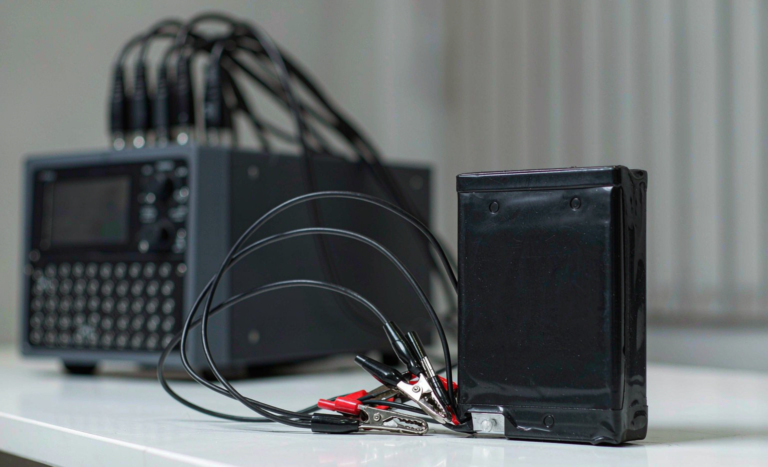
A complete formation sequence follows a fixed order. First, an initial charge at a low rate, typically 0.05C to 0.1C, up to 4.0 to 4.1 volts for layered oxide chemistries. Second, a short hold so the SEI can stabilize. Third, a discharge to the lower cutoff, often 2.0 volts. Fourth, one or two additional formation cycles at 0.1C to 0.2C to mature the interfaces. Fifth, capacity grading by measured discharge capacity. We keep the formation room at 23 to 25 degrees Celsius because a temperature swing of more than 3 degrees Celsius across a rack shifts the SEI thickness and the measured efficiency from one cell to the next.
The cutoff voltage itself depends on the cathode. Layered oxide cathodes form near 4.0 to 4.1 volts, while polyanionic cathodes such as sodium iron manganese phosphate peak closer to 3.6 to 3.8 volts. If you run the wrong upper limit, the cathode over-delithiates on the first charge and the cell loses reversible capacity it can never get back. We store the chemistry-specific profile in the formation program and lock it per cell format so an operator cannot accidentally select the wrong curve.
First-Cycle Coulombic Efficiency Numbers
First-cycle coulombic efficiency, or FCE, is the ratio of first discharge capacity to first charge capacity. For sodium-ion with hard carbon, expect 80 to 88 percent on a well-tuned line; immature processes land near 70 percent. Each point of FCE lost below 85 percent means roughly 1.5 to 2.0 percent of total capacity is stranded as irreversible loss. A cell that leaves 12 percent of its sodium behind in cycle one will show lower usable capacity and a visibly higher internal resistance at shipment. We target FCE above 85 percent for commercial grade and above 87 percent for automotive-qualified cells, and we reject batches that cannot hold that floor.
There are two practical ways to lift FCE. The first is process control: slower formation and a stabilized electrolyte raise the number by a few points. The second is materials: pre-sodiation, where a thin layer of sodium is deposited on the anode or a sacrificial sodium source is built into the cell, can recover much of the irreversible loss. The trade-off is cost and a more demanding line, so we reserve pre-sodiation for cells where every percent of usable capacity is bought and paid for by the application.
Gas Generation and Degassing
Hard carbon and certain electrolytes release gas during the first charge. The gas is mostly hydrogen and small hydrocarbons from electrolyte reduction at the anode. If it is trapped, the cell bulges and the internal pressure raises contact resistance at the tabs. Our sodium-ion battery formation process includes a degassing step: after the first charge, we puncture the temporary vent, evacuate the headspace, and reseal under dry air with a dew point below minus 40 degrees Celsius. Cells that still generate more than a set volume threshold after degassing are quarantined for root-cause analysis rather than shipped, because trapped gas almost always points to an electrolyte or anode defect.
The gas volume scales with anode surface area and with how aggressively the first charge is run. A fast 0.2C first charge can evolve noticeably more gas than a patient 0.05C step, which is one more reason the slow profile pays for itself. We measure headspace volume per cell format and feed that data back into the formation recipe so the degassing window is timed to the actual gas peak rather than a fixed guess.
Formation Current, Temperature and SoC Ramping
Slower is safer. A formation at 0.05C costs more line time but raises FCE by 2 to 4 points versus 0.2C because the SEI grows denser and more uniform. We ramp the state of charge gradually rather than jumping to full voltage. For sodium-ion, holding at 3.9 to 4.0 volts for several hours during the first charge improves interfacial stability more than a fast push to 4.1 volts. The trade-off is throughput, so we tune the rate per cell format and per cathode chemistry, balancing line cost against the efficiency the application demands.
Two more variables matter. One is wetting time: we soak the filled cell for 12 to 24 hours before the first charge so the electrolyte fully penetrates the hard carbon pores. Forming a dry cell produces a patchy SEI and a permanently higher resistance. The other is ambient stability; formation below 15 degrees Celsius yields an uneven SEI, so the room is actively conditioned rather than left to the building HVAC. These details are unglamorous, but they are where yield is won or lost.
How We Validate Formation at the Factory
Every formation batch is sampled for capacity, FCE, internal resistance at 50 percent state of charge, and thickness. We correlate FCE with 200-cycle retention in an ongoing study; batches below our FCE floor are either reworked or scrapped. Finished cells still carry UN38.3 and IEC 62133-2 marks, and stationary packs follow IEC 62619 and UL 1973. Formation data is logged per cell so a custom battery solution we build for a client can be traced back to its formation record if a field issue ever appears. That traceability is part of how we stand behind the cells we ship.
We also grade cells by their formation curve, not just by final capacity. A cell that reaches its knee voltage late, or that shows a noisy voltage trace during the first hold, is sorted to a lower grade even if its capacity looks acceptable. The formation signature is the earliest honest signal of how the cell will age, and we use it to keep grade A product in the applications where reliability is non-negotiable.
Frequently Asked Questions
What is battery formation?
Battery formation is the initial charge and discharge cycle applied to a freshly assembled cell. It creates the protective SEI and CEI layers, grades the cell by capacity, and stabilizes the electrode interfaces before the cell is shipped or built into a pack.
Why is first-cycle efficiency lower in sodium-ion than lithium-ion?
Sodium-ion uses a hard carbon anode whose structure traps some sodium irreversibly during the first charge, and the larger sodium ion stresses the SEI more than lithium does. Mature lithium-ion graphite anodes have lower first-cycle loss, so sodium-ion FCE typically lands a few points lower until the electrolyte and anode are optimized.
How much capacity is lost in the first cycle?
On a tuned sodium-ion line, irreversible first-cycle loss is 12 to 20 percent of charge capacity. Well-optimized cells hold that near 12 to 15 percent. The lost capacity becomes the permanent SEI and is not recoverable through later cycling.
Does formation quality affect cycle life?
Yes. A dense, uniform SEI formed at a low rate extends cycle life because it resists continuous electrolyte breakdown. Poor formation leaves a porous SEI that keeps consuming electrolyte, which shows up as faster capacity fade after a few hundred cycles.
Can a sodium-ion cell be repaired after poor formation?
Not economically. The irreversible loss is structural and tied to the SEI that already formed. The only practical fix is to scrap or rework the batch, which is why we gate shipments on FCE and internal resistance rather than waiting for field returns.
How do you measure first-cycle coulombic efficiency?
We charge the cell at a controlled rate to cutoff, record charge capacity, then discharge and record discharge capacity under the same conditions. FCE is the discharge capacity divided by the charge capacity, expressed as a percentage. We repeat on a sample per batch and track the distribution to catch drift early.
Further Reading
References