Lithium Battery Performance for Power Tools: An Engineer’s
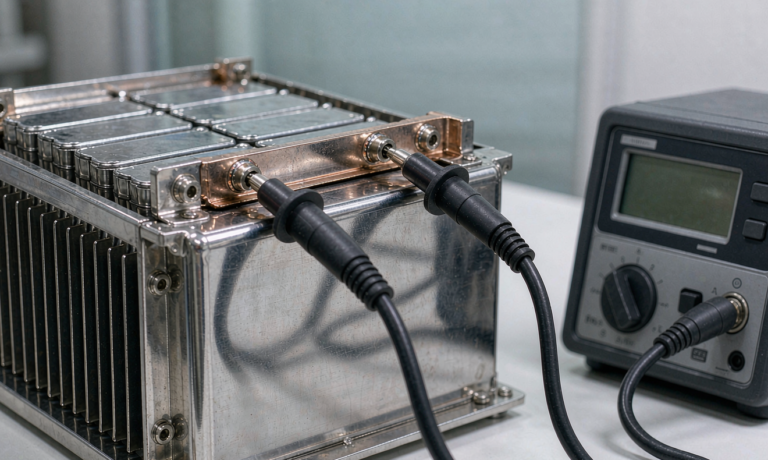
Two packs sit on my bench this morning with the same label: 18 V, 5.0 Ah, 90 Wh. One rips thirty cuts through 2x lumber on a 6-1/2″ circular saw before the protection board cuts out. The other gives up after eleven. Same nominal voltage, same amp-hour stamp, same tool. The difference is not magic — it is internal resistance, cell grade, thermal headroom and weld quality, all measurable in an afternoon with a multimeter, an electronic load and a thermocouple.
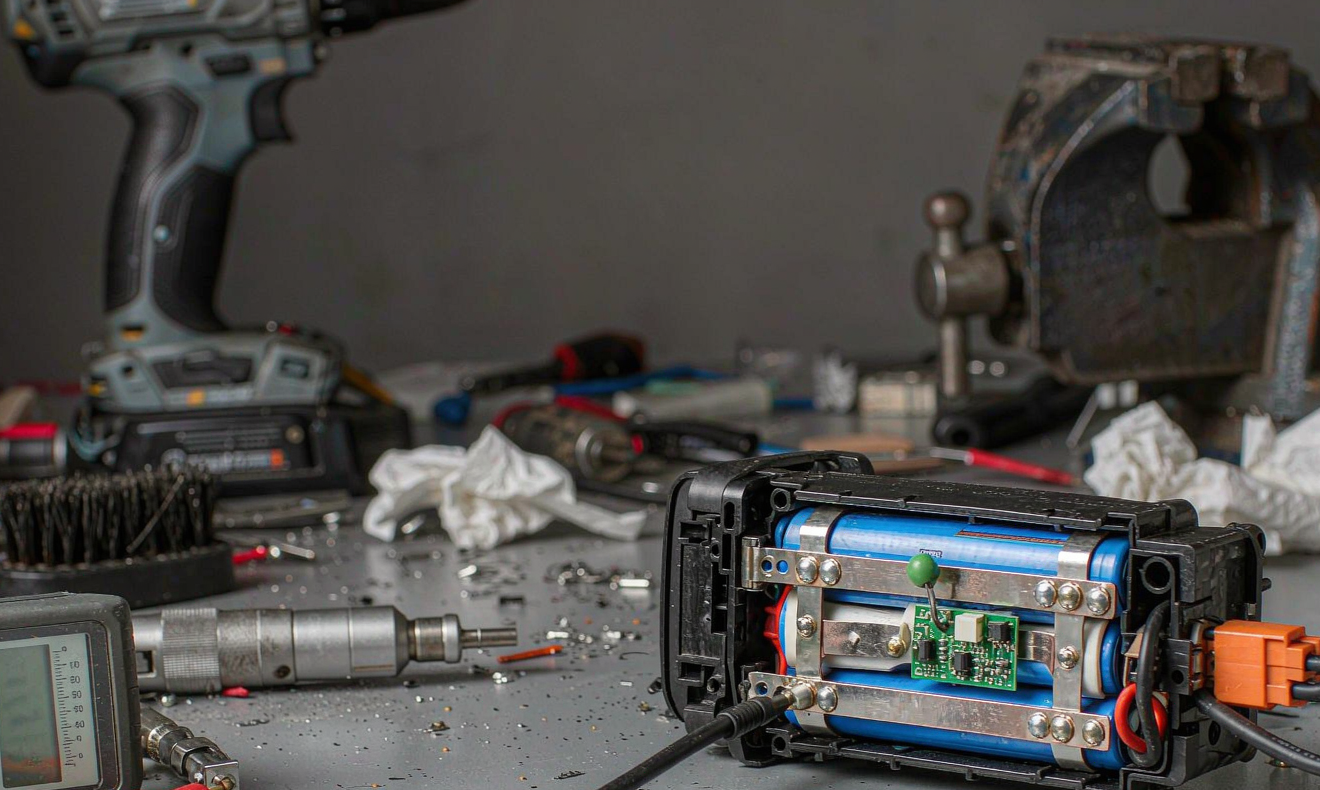
I have spent fifteen years specifying lithium battery packs for hand-held tools, from 12 V screwdrivers to 60 V demolition breakers. This is the measurement protocol my team uses, the numbers we actually see on the bench, and the six questions I ask before signing off any tool pack design.
What “Performance” Means in a Power-Tool Lithium Battery
The retail label gives you two numbers — voltage and amp-hours — and neither of them tells you whether the pack will survive a morning of framing. When I evaluate a lithium battery for tool duty, I measure six quantities:
- Peak current (3 s) — the burst before the BMS trips. Quality 5S2P packs sit at 90–140 A; cheap 5S1P builds collapse at 45–60 A.
- Sustained current — the draw held continuously until the low-voltage cutoff or the thermistor fires, whichever comes first. This is the number that matters for saws and grinders.
- Usable capacity at load — amp-hours delivered at the tool’s real current, not at the 0.2 C rate used for the label. A pack stamped 5.0 Ah may deliver 4.3 Ah into a 40 A saw.
- DC internal resistance (DCIR) — the best single predictor of sag and heat. Good 21700 tool packs measure 12–20 mΩ at pack level; 18650 builds typically 25–40 mΩ.
- Thermal headroom — minutes of heavy load before cutoff, plus the heat-soak rise after the trigger is released.
- Charge acceptance — time to 80 % SoC and the temperature window allowed at full rate.
One clarification that trips up almost every buyer: “20 V MAX” and “18 V” describe the same pack. A 5S lithium-ion pack is 5 × 3.6 V nominal = 18 V, and 5 × 4.2 V fully charged = 21 V, which is where the “20 V max” marketing figure comes from. Energy, not amp-hours, is the honest comparison: 18 V × 5.0 Ah = 90 Wh, while a 12 V 4.0 Ah pack is only 48 Wh — barely half the work capacity, despite similar amp-hour numbers.
Cell Format and Chemistry: 18650, 21700 and the Tabless Question
Most tool packs are built from cylindrical cells, and the format choice drives everything downstream.
18650 — still the volume workhorse
High-power 18650 cells run 2.0–2.5 Ah with 15–25 A continuous ratings and 15–25 mΩ DCIR at 25 °C, 50 % SoC. They are cheap, widely sourced, and adequate for drills, impact drivers and oscillating tools averaging 8–15 A.
21700 — the default for high-draw tools
High-power 21700 cells carry 3.0–4.5 Ah with 30–45 A continuous ratings and DCIR of 8–14 mΩ — roughly 35–45 % lower than a comparable 18650. Because resistive heating scales with I²R, the same 40 A draw generates about a third less heat inside the cell. For saws, grinders, rotary hammers and breakers, 21700 is where I start every design now.
Tabless and large-format cells
Tabless (full-tab) current collection removes the single-path bottleneck at the electrode tab. Published teardowns and our own sampling show internal resistance dropping a further 20–35 % versus a single-tab cell of the same chemistry and format — less sag, less heat, faster charging at equal cycle life. Supply is thin, but fleet buyers should track it.
Chemistry: high-power NMC/NCA versus LFP
Hand tools are a power-density game, so the default is a high-rate nickel-based cell (NMC or NCA) at 150–220 Wh/kg. Lithium iron phosphate (LFP) trades energy density for durability: 15–25 % more volume for the same watt-hours, but three to four times the cycle life and a thermal-runaway onset roughly 200 °C higher. LFP’s lower nominal voltage (3.2 V vs 3.6 V) puts a 6S LFP pack at 19.2 V — close enough to an 18 V platform that some makers now ship dual-chemistry tools. For fleet tools that live on a jobsite charger, LFP is increasingly the better economics.
Measured Capacity versus Discharge Rate
Lithium cells are not perfectly rate-independent, and the effect is easy to quantify. Here is a representative curve from a 2.5 Ah high-power 18650 at 25 °C ambient, discharged to a 2.5 V cutoff:
- 0.5 C (1.25 A): 100 % of rated capacity, cell surface peaks at 29 °C.
- 3 C (7.5 A): 96–98 % delivered, surface peaks at 44 °C.
- 8 C (20 A): 91–94 % delivered, surface peaks at 62 °C.
- 10 C (25 A): 87–90 % delivered, surface peaks at 72–78 °C — beyond what I will allow in a sealed pack.
The lost capacity is not lost energy; it is energy converted to heat inside the cell and energy stranded below the cutoff by voltage sag. That brings us to the number that actually stops tools in the field.
Voltage sag and early cutoff
A fresh 5S pack sits at about 20.5 V open-circuit at mid-charge. Pull 60 A from a well-built 21700 pack and terminal voltage drops to roughly 17.5–18.0 V. Pull the same 60 A from a 5S1P 18650 build and you will see 15.8–16.6 V — right at the tool’s 3.0 V-per-cell cutoff. The tool shuts down with a quarter of the pack’s energy still in the cells. Users call that “the battery died too fast.” Engineers call it DCIR.
A jobsite audit example: a 6-1/2″ circular saw ripping SPF 2x stock draws 30–45 A continuous with 70–90 A spikes at knots. A 5S1P 2.5 Ah pack hit thermistor cutoff in 5–7 minutes at 74 °C. The same saw on a 5S2P 5.0 Ah 21700 pack ran 14–18 minutes, peaking at 61 °C. Doubling parallel cells did not just double runtime — it halved current per cell, cut resistive heating to a quarter, and moved the failure mode from thermal cutoff to genuine energy depletion.
Thermal Behaviour: The Actual Ceiling
In power-tool duty, heat is the limiter, not capacity. Every high-rate cell datasheet I work from specifies a maximum continuous cell surface temperature — typically 60 °C — and an absolute ceiling around 80 °C. Pack protection boards implement this with a thermistor on the cell stack: 60–70 °C triggers a warning or power reduction, and 75–85 °C is a hard cutoff that persists until the pack cools below roughly 55–60 °C.
Two thermal behaviours catch people out. First, heat soak: the pack keeps climbing 5–10 °C for two to three minutes after the trigger is released, because the heat is inside the cell and has to migrate out. The temperature you read ten seconds after stopping is not the peak. Second, hot-charge rejection: a responsible charger will not start a fast-charge cycle above about 45–50 °C. Crews who slam hot packs onto a fast charger get a pack that sits there doing nothing for fifteen minutes — which they read as a “broken charger.”
On the design side, headroom comes from lower DCIR cells, more cells in parallel, thicker collection tabs, and a housing that moves air. Vent slots, 1–2 mm cell spacing and conductive potting under the stack typically buy 4–8 °C — often the difference between a pack that cuts out and one that does not.
Pack Construction: Welds, Busbars and Protection
I have torn down more failed tool packs than I can count, and the single most common mechanical failure is not the cell. It is the tab.
Welding
For currents under about 10 A per strip, 0.15–0.20 mm pure nickel with three to four spot welds per tab is standard. Above 25 A per branch you need nickel-plated copper or a copper sandwich on a capacitor-discharge welder with proper pulse shaping — a cheap AC welder will not bond copper reliably. We destructively pull-test a 1 % sample of every run: a good weld survives at least 20 N tensile and 5 N peel, with the base metal failing before the nugget.
Tool packs live in a vibration and drop environment. A one-metre drop onto concrete in six orientations, followed by a vibration sweep, should not move pack DCIR by more than 15 %. If it does, your tabs are fatiguing and the field will find out in about three months.
Protection and balancing
A tool pack BMS is deliberately simple, but four functions are non-negotiable: two-stage overcurrent (a 2–3 second peak window then a hard trip), short-circuit protection firing in under 500 microseconds, per-cell over- and under-voltage monitoring, and thermistor thermal cutoff. Passive balancing at 30–60 mA is typical; a fuel gauge should combine coulomb counting with voltage correction to stay within ±3–5 % SoC.
Series matching is where cheap packs fail quietly. If five series cells differ by 8 % in capacity, usable capacity is set by the weakest cell, and 50 mA of balancing will never catch up across a ten-minute discharge. Acceptance rule: DCIR within 5 % and capacity within 3 % across the string, verified at incoming inspection.
Cycle Life at Tool Duty
Laboratory cycle-life claims assume gentle duty. Tool duty is not gentle. What we see on our test racks and in fleet telemetry:
- Heavy tool duty (5–8 C average, 80 % DoD, high-power NMC): 400–700 cycles to 80 % capacity.
- Moderate duty (2 C average, 50 % DoD): 800–1,200 cycles.
- LFP under the same heavy duty: 1,500–2,500 cycles.
- Fast-charge penalty: charging at 3–4 C to reach 80 % in 15 minutes costs 25–40 % of cycle life versus a 1 C overnight charge in our side-by-side testing.
- Calendar ageing: stored at 100 % SoC and 35 °C, NMC loses 4–6 % per year; the same pack at 30–50 % SoC and 20 °C loses 1.5–2.5 %.
Translated into field terms: a professional crew running two packs a day will see 18–30 months of useful life from a high-power NMC pack. A homeowner using the same tool ten minutes a month will get six to ten years, and will lose the pack to calendar ageing long before cycling.
Storage behaviour matters more than most people think. Store at 30–50 % SoC, 10–25 °C, and top up every 90 days. Never store a lithium-ion tool pack at 100 % SoC in a hot van — that is the fastest way I know to destroy a good lithium battery, and it happens while the pack is nominally “not in use.”
How to Specify a Power-Tool Pack (or Audit One You Are Buying)
Whether you are writing a specification for a custom battery solution or evaluating a pack off the shelf, these are the questions I ask, in order:
- What is the real current profile? Not the nameplate — the measured one. Put a data-logging clamp meter on the tool for a full shift and record RMS continuous current, 95th-percentile current, and peak-spike amplitude and duration.
- How many watt-hours, not amp-hours? Convert the runtime requirement to Wh, then divide by pack voltage.
- How many minutes of continuous load before the tool must stop? This sets parallel count and thermal design.
- What is the ambient range? Below 0 °C you must lock out charging; below −10 °C you lose substantial discharge capacity.
- What charge time is actually required? Every halving of charge time has a cycle-life cost.
- Which markets? Certification drives cell selection and pack construction, and is far cheaper to design in than to retrofit.
In tool duty the real limiter is not chemistry choice alone — it is whether the pack was built around the measured load profile. That is the entire argument for a custom battery solution over a generic catalogue pack: a purpose-built lithium battery pack sized to your actual RMS current and duty cycle outlasts an off-the-shelf unit of the same nameplate rating by a wide margin.
On cell sizing, my rule is simple: the cell’s continuous current rating times the parallel count must be at least 1.5× the measured RMS pack current. If the profile peaks at 90 A and you are running 2P, you need cells rated 68 A continuous — which means 21700 high-power, not 18650.
On sourcing, insist on four things from any lithium battery manufacturer: cell date codes under nine months old, DCIR and capacity data for the actual batch rather than a generic datasheet, X-ray or weld-sample evidence from the line, and the full certification file. The standards that matter are UN38.3 for transport, IEC 62133-2 for cell and pack safety, UL 2054 for North American pack approval, IEC 61960 for performance characterisation, IEC 62841-1 for the tool system, plus RoHS and REACH.
Finally, the half-day acceptance test I run on every incoming batch: a 0.2 C capacity check, a one-second DCIR measurement at 50 % SoC (accept only within 5 % cell to cell), a weld pull sample, a drop-and-vibration sequence with a DCIR recheck, and a thermal cutoff verification. Five tests, and you will reject virtually every bad batch before it reaches a jobsite.
Frequently Asked Questions
Does a higher amp-hour pack give my drill more power or torque?
No. Amp-hours are runtime, not power. Torque and sustained output come from the pack’s ability to deliver current without sagging — a function of cell C-rate, parallel count and DCIR. That said, a larger pack spreads the load across more cells, runs cooler and sags less late in a cut, so it feels more powerful even though motor peak torque is unchanged.
Can I use a 6.0 Ah pack on a tool that shipped with a 2.0 Ah pack?
Yes, provided it is the same voltage platform. The tool draws what it draws; a bigger pack supplies it for longer. The only real trade-offs are weight — a 6.0 Ah pack can be 300–400 g heavier, which matters overhead — and balance on compact tools.
Why does my pack lose power so dramatically in cold weather?
Electrolyte conductivity falls and internal resistance roughly doubles to triples between 25 °C and −10 °C. Expect 75–85 % of room-temperature capacity at −10 °C and around 65 % at −20 °C, plus far deeper sag that trips the low-voltage cutoff early. Keep packs in the cab overnight, and never charge a cold pack: below 0 °C lithium plates onto the anode instead of intercalating, and that damage is permanent and invisible.
Is fast charging actually damaging?
It is a trade, not a defect. Charging at 3–4 C to reach 80 % in fifteen minutes costs roughly 25–40 % of cycle life in our testing versus a 1 C overnight charge. My practice: fast-charge on the jobsite when you have to, standard-charge overnight when you can, and never fast-charge above 45 °C.
How do I know when a tool pack is at end of life?
Three objective tests: capacity below 80 % of the original Wh rating on a 0.2 C discharge, pack DCIR more than 50 % above its commissioning baseline, or sag that trips the cutoff on a load the pack used to handle. Any one of the three means it is done for professional duty, even if it still runs a low-draw inspection lamp.
I am considering third-party or rebuilt packs. What should I check?
Five things, in order: cell date code (under nine months), DCIR spread across the string (under 5 %), weld quality (three or more clean nuggets per tab, no heat-discolouration of the cell can), thermistor placement (bonded to a cell, not floating in the housing), and genuine certification markings rather than a printed lookalike. A pack failing any one of these is not a saving — it is a liability.
Should I choose LFP or NMC for power-tool packs?
Choose high-rate NMC when runtime per kilogram and peak current are the priority — most hand-held applications. Choose LFP when a fleet is charged on a fixed schedule, weight is not critical, and you are optimising five- to eight-year total cost: three to four times the cycle life and a far better thermal margin more than offset the 15–25 % volume penalty.