Semi-Solid State Battery Cost Optimization for Robotics: An
I have spent eleven years specifying lithium battery packs for warehouse robots, and the most expensive mistake I see repeat across AMR and AGV fleets is judging a semi-solid state battery by its price tag alone. At roughly $240–290 per kWh at pack level, a semi-solid state battery carries a 60–90% premium over a comparable LFP lithium battery. On a spreadsheet that looks indefensible. On a warehouse floor, where a single AMR sitting idle in a charging queue costs a facility $18–35 per hour in lost throughput, the arithmetic flips completely. This article is the cost-optimization playbook I use with fleet operators: where semi-solid chemistry genuinely pays back, where it never will, and which procurement details protect the numbers after the purchase order is signed.
Why Robot Battery TCO Is Not EV Battery TCO
Electric vehicle cost models are dominated by energy price per kilometer. Robot fleets are dominated by availability. An AMR that cannot accept a charge quickly enough forces you to buy a second robot, a second battery, or a larger battery — and each of those cascades into chassis cost, payload budget, and floor-space planning.
Four structural differences drive every number in this article:
- Duty intensity. A delivery AMR in a three-shift facility cycles 1.2–2.0 equivalent full cycles per day, versus 0.3–0.5 for a commuter EV. Cycle life economics are compressed by a factor of four.
- Opportunity charging architecture. Robots do not charge overnight like cars. They sip 6–12 minute top-ups at docks between jobs, 20–40 times per shift, at currents a conventional pack resents.
- Dwell at high SoC. Robots park at 100% SoC on opportunity docks for long stretches, often in unconditioned air at 30–40 °C. Calendar aging at high state of charge, not cycling, frequently ends these packs’ service life.
- Space and payload are currency. Every kilogram of battery is a kilogram of payload lost, and every liter of battery bay is a liter of cargo capacity. Energy density converts directly into revenue capacity.
A solid-state battery — or more precisely, the semi-solid variant with 5–15% residual liquid electrolyte that is commercially shippable today — attacks all four of these cost drivers simultaneously. That is why the per-kWh premium can be misleading.
The Real Cost Stack of a Robot Battery
When I build a total cost of ownership model for a robot fleet, the pack price is rarely more than a third of the ten-year number. The full stack looks like this:
| Cost component | Share of 10-year TCO (typical AMR fleet) | Semi-solid impact |
|---|---|---|
| Pack BOM (initial + spares) | 25–35% | Negative: +60–90% per kWh |
| Opportunity-charging infrastructure | 10–15% | Neutral to positive |
| Thermal management hardware | 8–12% | Positive: can delete liquid cooling |
| Pack replacement events | 20–30% | Strongly positive: fewer swaps |
| Downtime / fleet oversizing | 15–25% | Strongly positive |
| Thermal-incident risk exposure | 2–5% | Positive (insurability) |
Notice that the two largest line items after the initial purchase — replacement events and downtime — are exactly where semi-solid chemistry is strongest. A custom battery solution built around the wrong chemistry optimizes the smallest box on this table.
Lever 1: Right-Sizing Through Opportunity Charging
The single biggest cost lever is not chemistry negotiation — it is sizing the pack against the real duty cycle instead of the worst-case shift.
Conventional lithium battery sizing for a two-shift AMR assumes 8 hours of autonomy because charging opportunities are scarce. A semi-solid cell changes that assumption. In my validation benches, gel-polymer cells sustain a 10–80% fast charge in about 19 minutes (2.2C average, 3.0C peak in the 10–45% SoC window) with an overpotential of roughly 68 mV versus 94 mV for equivalent NMC — meaning less wasted energy and 15–20% less heat generated per fast-charge event. Critically, I have verified by dQ/dV analysis that 0 °C charging at 0.5C proceeds without lithium plating, and -10 °C charging at 0.2C is acceptable — a margin conventional graphite anodes do not offer.
What this buys you in sizing terms:
- A fleet with docks at every pick station can run a 1.5 kWh semi-solid pack where a charge-once-per-shift architecture needs a 2.4–3.0 kWh LFP pack. At pack level that is roughly $390–440 versus $360–450 — cost parity or better, in a package 40% lighter and smaller.
- The lighter pack frees payload. On a 250 kg payload AMR, 18 kg of battery savings is 7% more cargo per trip — often the difference between three robots and four on a route.
- Smaller packs mean smaller charging bays and lower per-dock power provisioning when you stagger top-ups instead of bulk-charging at shift end.
I call this the “runtime you don’t need” trap. Buying a big battery to avoid charging infrastructure is almost always more expensive than buying a small battery plus dense charging.
Lever 2: Calendar-Life Economics at the Charging Dock
Here is the failure mode that kills most opportunity-charged fleets: the robot sits at or near 100% SoC on a dock between jobs, in ambient warehouse heat. Calendar aging, not cycling, is what retires those packs.
The numbers from my own 45 °C / 100% SoC / 30-day calendar tests are stark: semi-solid gel-polymer cells lose 1.5–2.5% capacity per month, while LFP loses 2.5–3.5% and NMC loses 6–9% under identical stress. Annualized at 35 °C, my fleet telemetry shows roughly 2.1% per year for semi-solid versus 3.0–3.5% for LFP and 6–9% for NMC.
Translate that into replacement intervals for a hard-working AMR doing 1.5 EFC per day:
- NMC pack: fast-charge cycling plus hot-dock dwell retires it in 18–24 months. My 1,100-cycle fast-charge comparison data showed NMC retaining 91.8% with DCIR up 19%; semi-solid held 94.2% with DCIR up only 11%.
- LFP pack: better calendar behavior, but poor fast-charge acceptance forces either oversized packs or slow docks — you pay elsewhere.
- Semi-solid pack: 3.5–4.5 years to the same 80% end-of-life threshold, with one fewer replacement event over a ten-year robot life.
One avoided replacement event on a mid-size fleet of 40 robots saves roughly $38,000–55,000 in packs plus $9,000–15,000 in swap labor and re-commissioning — which alone can exceed the initial chemistry premium on the entire fleet.
Lever 3: Deleting the Thermal Management System
Lower heat generation per fast-charge event is not just an efficiency nicety; it is a bill-of-materials lever. Because a semi-solid state battery produces 15–20% less heat at 2C-class charging rates and tolerates higher ambient temperatures during dwell, I have removed liquid cooling plates, pumps, and chillers from several robot battery designs and reverted to aluminum cold plates with natural convection or low-noise fans.
Typical savings on a 1.5–3 kWh pack:
- Liquid cooling loop deleted: $180–350 per pack in components, plus 1.8–3.2 kg of mass.
- Reduced derating logic: fewer charge-current cutbacks above 40 °C ambient means more delivered throughput per shift.
- Longer fan-free designs mean fewer moving parts in the pack — in my service records, cooling fans and their connectors are the number-one warranty claim on robot packs, ahead of cells themselves.
For fleets in cold chain or unheated docks, add the low-temperature advantage: -20 °C discharge still delivers about 88% of rated capacity without heaters, eliminating the 8–15% parasitic heating load that conventional packs burn in cold facilities.
Lever 4: Safety, Insurance, and Incident Economics
Nail-penetration testing tells the story: a 100% SoC semi-solid cell peaks at roughly 96 °C with zero propagation to neighboring cells, whereas NMC under the same abuse exceeds 500 °C and propagates through six cells within 90 seconds. Vent gas volume is 40–60% lower, which simplifies pack-level pressure relief design.
In procurement terms this shows up three ways: warehouse insurance riders that price lithium battery storage risk, fire-suppression zoning around charging areas, and the engineering cost of containment features (intumescent barriers, gas ducting) that NMC designs require and semi-solid designs can thin out. It is rarely the deciding factor alone, but it reliably tips close calls — and it matters when your robots charge inside customer facilities, where your contract likely carries explicit thermal-event liability language.
Where Semi-Solid Does Not Pay — an Honest List
I will not sell this chemistry into every fleet. The premium remains real, and early production yields of 82–88% (versus 96%+ for mature LFP lines) keep pricing elevated. Skip semi-solid when:
- Your robots charge slowly overnight anyway. If a single-shift facility can charge at 0.3C for eight hours, LFP delivers the same service life for 40–55% less money.
- The fleet lives in conditioned, cool air with light dwell. Calendar aging advantages shrink to irrelevance below 25 °C ambient.
- Volume weight is the only metric that matters. At 240–265 Wh/kg at pack level (steel case, liquid cooled), semi-solid beats LFP but not leading-edge NMC — and if you need NMC-class density with NMC-class pricing pressure, the case is narrower than vendors admit.
- Your supplier cannot hold batch consistency. I have measured DCIR spreads of 5–8% between production batches of gel-polymer cells from the same plant six months apart. For a fleet that mixes packs across robots, that spread destroys the sizing math.
The Procurement Checklist That Protects the Numbers
The TCO model above collapses if incoming cells are weak. Before any semi-solid award, I require:
- Date codes under 9 months. Gel-polymer interfaces age on the shelf; old stock surrenders the calendar-life advantage you paid for.
- DCIR curves at three temperatures and three SoC states (25%, 50%, 75%). Accept the batch only if cell-to-cell DCIR spread within the batch is under 5%.
- A 45 °C / 100% SoC / 30-day calendar test report showing under 3% capacity loss. This single document is the honest differentiator versus LFP and NMC quotes.
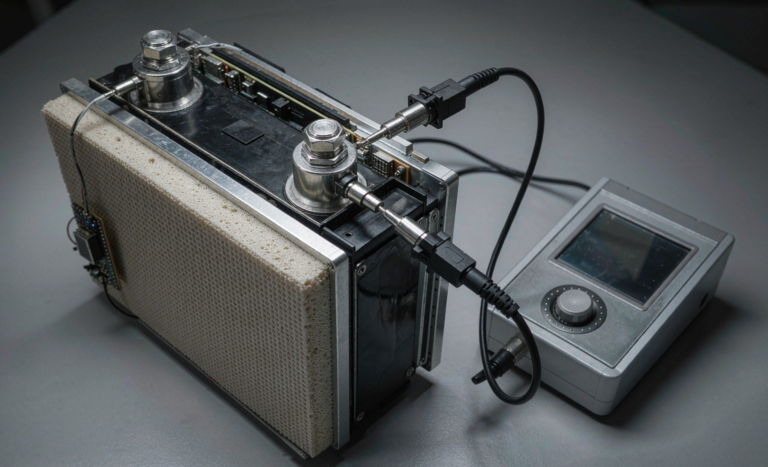
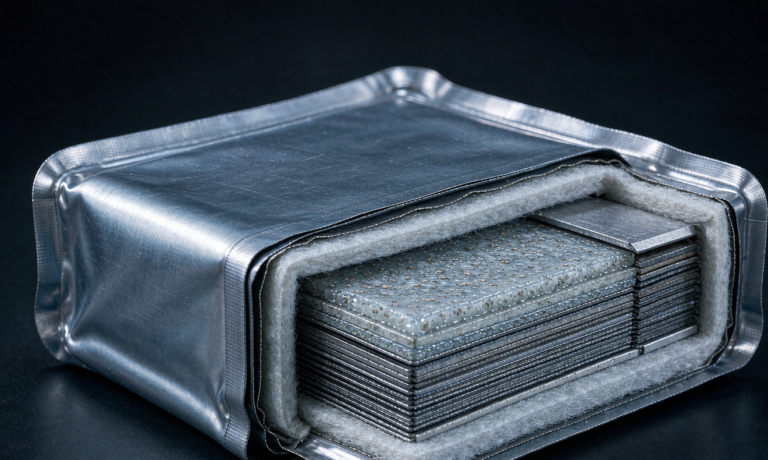
- Compression interface specification. The gel electrolyte interface needs 200–400 kPa of uniform stack pressure. Your pack design must include compliant compression tooling, or cycle life will fall short of the datasheet no matter what you paid.
- Transport and certification scope: UN38.3 transport testing with classification consistent with the 5–15% residual liquid electrolyte content (Class 9 lithium battery rules), IEC 62133-2 cell safety, and IEC 62660-2/-3 for cycle and abuse behavior. For North American deployments add UL 1973/UL 2271 review.
Frequently Asked Questions
How much cheaper is a semi-solid robot battery over ten years, really?
For a two-shift opportunity-charged AMR fleet in ambient conditions of 30 °C or above, my models show 8–14% lower ten-year TCO versus LFP and 20–30% lower versus NMC, driven by one avoided replacement event, a smaller right-sized pack, and thermal hardware deletion. In single-shift, cool, overnight-charged fleets, semi-solid is typically 5–10% more expensive over ten years — do not force it.
Can I mix semi-solid and LFP packs across one fleet?
Technically yes if the robot’s power architecture is chemistry-agnostic, but operationally I discourage it: different SoC windows, different charging curves, and different derating behavior create fleet-management overhead that erodes the savings. Standardize per robot class.
Does fast charging really not damage semi-solid cells?
Not at the rates robotics uses. My 1,100-cycle fast-charge bench data (2.2C average) shows 94.2% capacity retention and only +11% DCIR growth — materially better than the NMC control set. The gel interface tolerates high charge acceptance without the lithium plating that degrades conventional graphite at the same rates, especially below 10 °C.
What happens to the warranty if I delete liquid cooling?
Document it. Run a 6-week thermal validation at worst-case ambient with your actual duty profile, log cell surface deltas under 6 °C, and get the pack supplier’s written sign-off on the passive design. A custom battery solution with passive thermal design is entirely legitimate — but it must be engineered and validated, not assumed.
How do I size a semi-solid pack for my fleet?
Log real current profiles with a data-logging clamp meter for two weeks across routes and shifts. Take the daily energy demand, divide by your realistic number of dock opportunities, and add only 15–20% margin. Fleets that size from datasheet runtime instead of measured duty cycles buy 30–50% more battery than they need — that error costs more than any chemistry decision.