Home Energy Storage Performance for Apartments: An (2)
Apartment owners ask me a different question than house owners do. A house owner asks, “How big should my home energy storage system be?” An apartment owner asks, “Will this thing actually pay for itself in a two-bedroom flat with no garage, no roof, and a strata committee that has opinions about everything?” After twelve years of specifying and commissioning residential battery systems — including several hundred apartment installations across high-rise blocks — I can tell you the honest answer depends on five numbers, and almost none of them appear on the brochure.
Performance in an apartment is a harsher test than in a house. There is no garage to absorb heat, no roof for a 6.6 kW array, and usually no export meter. The battery has to earn its keep on tariff arbitrage and outage ride-through alone, inside a cupboard designed for a vacuum cleaner. That changes what “performance” means, and it changes which numbers I log during commissioning.
What “Performance” Actually Means in an Apartment
Suppliers sell nameplate kilowatt-hours. Engineers buy usable kilowatt-hours, round-trip efficiency, power capability and calendar life. The gap between those two lists is where almost every apartment disappointment is born.
1. Usable capacity, not nameplate
A 10 kWh nominal LFP pack does not deliver 10 kWh. The BMS reserves buffers at both ends and the inverter needs headroom, so a well-designed residential battery delivers 90–95% of nameplate as usable energy — 9.0–9.5 kWh from a 10 kWh unit. The difference between 85% and 95% usable is a full kilowatt-hour every day: at a $0.24 peak-to-off-peak spread, roughly $88 a year, or close to $900 over ten years.
2. Round-trip efficiency at the AC terminals
LFP cells are efficient: 94–96% DC round-trip at 0.2C and 25 °C. But you consume AC. After the DC-DC stage, inverter and wiring losses, a good system delivers 88–92% AC-to-AC. Anything below 85% deserves an investigation, and in apartments the culprit is almost always parasitic draw rather than conversion loss.
3. Continuous and surge power
Energy answers “how long”; power answers “what can I run.” An induction hob zone is 2–3.5 kW and two zones is 7 kW. A split-system air conditioner draws 1.5–3.5 kW running, but compressor inrush is 2–3× that for 200–500 ms. I specify a continuous rating at or above the maximum simultaneous load and a 3–10 second surge rating of at least 1.5× continuous. Undersized power is the most common apartment sizing error, because people size by energy and never check the power column.
4. Parasitic or standby draw
This is the number that separates apartments from houses. A battery-inverter pair idling draws 40–70 W continuously — 1.0–1.7 kWh per day. On a 10 kWh house system that is 10–17% of nameplate: noticeable but survivable. On a 5 kWh apartment system the same draw is 24–34% of nameplate. I have measured installs where standby consumed more energy than the load-shifting saved. If you take one measurement from this article, take this one.
5. Outage transfer time
A whole-home or dedicated-loads transfer should complete in under 20 ms — fast enough that computers and routers never notice. Cheaper units transfer in 0.5–2 seconds, which is fine for lights and refrigerators but drops your internet. I test with a logging multimeter and record the actual millisecond figure, not the marketing claim.
The Apartment Constraint Stack
Apartment installations are not small house installations. Five constraints are structurally different, and each moves the performance numbers.
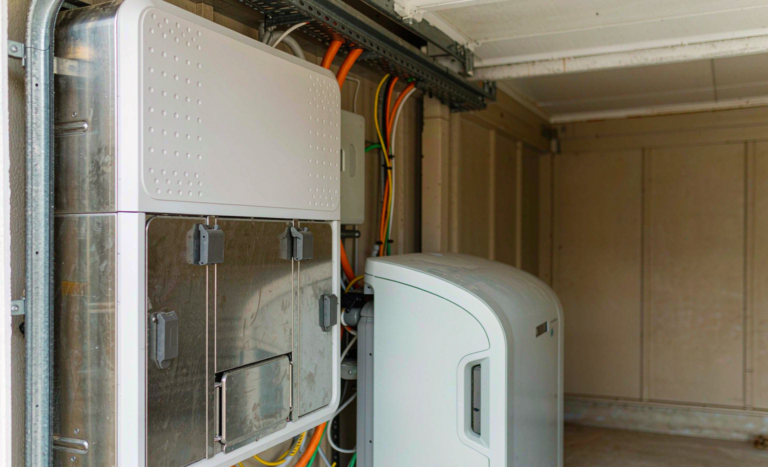
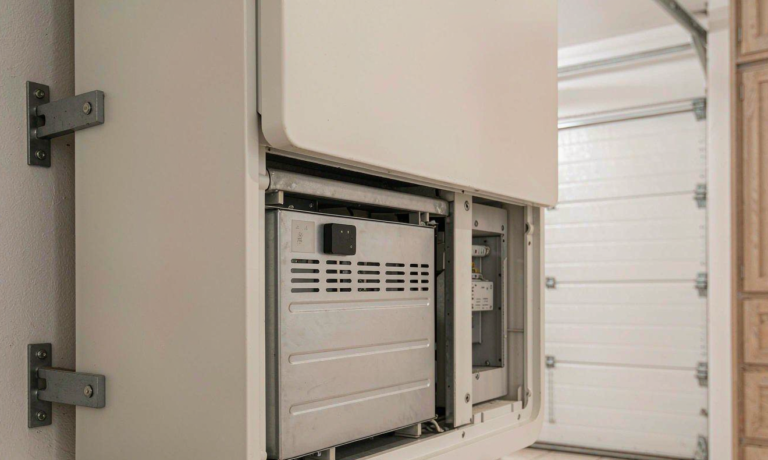
- Space and structure. A 10 kWh wall-mounted cabinet is 800–1,100 mm tall and weighs 90–140 kg. On concrete, M10 sleeve anchors are straightforward. On a stud wall — most internal apartment walls — I will not sign off without 18 mm plywood spanning at least three studs, plus a bracket rated 3× the static load.
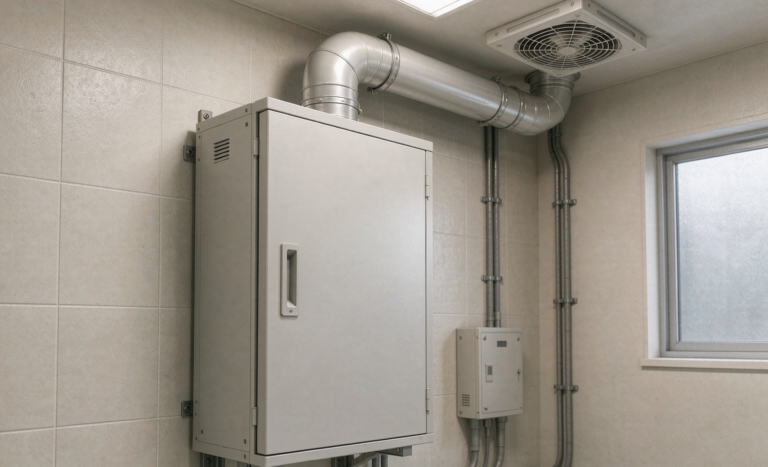
- Ventilation and ambient temperature. A utility closet is 0.5–1.5 cubic metres, and a battery cycling at 0.3C rejects 15–40 W of heat into it. Without designed convection, closet ambient runs 6–12 °C above the room. Every 10 °C above 25 °C roughly halves LFP calendar life, so a closet at 30 °C can turn a ten-year design life into six or seven. This is the quietest performance killer in apartments.
- Acoustics. Where the closet shares a wall with a bedroom, specify fanless natural-convection designs and under 35 dB(A) at one metre.
- Fire and insurance rules. Most strata and insurer frameworks require a recognised installation standard, clearance from egress paths, and often a heat detector in the enclosure. A non-compliant installation is a real insurance-void risk.
- Metering. Apartment meters are usually single-point with no export, and the CT often has to clamp a shared riser needing access approval. Confirm metering before you buy — without it, tariff arbitrage is impossible.
Sizing an Apartment Battery From Measured Load
I never size from a rule of thumb; I size from interval data. Export 12 months of 15- or 30-minute smart-meter data and work through four steps.
Step 1 — Find your base load and evening block
Identify the always-on base load — 300–600 W for a modern two-bedroom flat — then the evening block, typically 18:00–22:00, where cooking, cooling and laundry push load to 2–4 kW. In my dataset, a two-bedroom apartment using 3,000–4,500 kWh per year has an evening block of 6–10 kWh.
Step 2 — Convert block energy into usable capacity
Usable kWh needed ≈ evening block × 1.1, the extra 10% covering inverter losses. An 8 kWh evening block means roughly a 9.5–10 kWh nominal pack at 90–95% usable.
Step 3 — Check power, then check it again
List every load on the worst evening, add running watts, then add the largest single surge. If that exceeds the inverter’s continuous rating, either size up or use contactor-based load shedding — I prefer explicit shedding because it is cheaper and makes behaviour predictable.
Step 4 — Run the money model honestly
Worked example with a $0.32 peak / $0.08 off-peak tariff, a $0.24 spread:
- Nominal pack 10 kWh, usable at 92%: 9.2 kWh.
- Delivered energy at 89% AC round-trip: 8.19 kWh/day.
- Gross arbitrage: 8.19 × $0.24 = $1.97 per day.
- Less parasitic draw of 55 W × 24 h at the off-peak rate: −$0.11 per day.
- Net: about $1.86 per day, roughly $679 per year.
Now stress it: if the closet runs at 32 °C and calendar degradation costs a third of the ten-year life, effective annual savings drop to $450–500. Ventilation is a line item in the business case, not a nicety.
5 kWh or 10 kWh?
A 5 kWh unit delivers about 4.1 kWh usable after efficiency — enough for base load, refrigeration and lighting for eight to twelve hours, which is what most people actually want in an outage. A 10 kWh unit covers an air-conditioned evening, but costs 1.7–1.9× more and the extra energy only earns its keep if your evening block genuinely consumes it. My rule: evening block under 5 kWh, buy 5 kWh; 6–10 kWh, buy 10 kWh. Do not buy 15 kWh for an apartment — parasitic draw and space cost overwhelm the benefit.
The Six Numbers I Log on Every Commissioning
1. Usable capacity test
Charge to 100% and hold until the CV phase tapers below 0.05C, then discharge at 0.2C to the BMS cut-off and integrate watt-hours. A new pack should deliver 95–100% of specified usable energy; under 90% on day one is a warranty conversation. The industry end-of-life threshold is 80% of original usable capacity, per UL 1973 and IEC 62619 practice.
2. AC round-trip efficiency
Measure grid-side energy in and load-side energy out over one full 0.2C cycle. Expect 88–92%. Below 85%, split the measurement: if DC round-trip at the battery terminals is 94–96% but AC is 84%, your loss is in the inverter or standby draw, not the cells.
3. Parasitic draw
With no loads connected, measure grid import over a full 24 hours. Above 1.5 kWh/day on a system under 10 kWh is a design problem. I have resolved 20% performance complaints simply by enabling eco-idle mode or moving a module out of a hot closet so the fan stops running.
4. Cell voltage delta
After a four-hour rest at 50% SoC, record every series group voltage. Under 30 mV spread is healthy; 30–50 mV is a yellow flag that a full 0–100% balancing cycle usually clears; above 50 mV at rest is a red flag for a weak cell or a high-resistance connection. On a 16S LFP pack, 50% SoC should read 52.8–53.6 V at the terminals.
5. DC internal resistance
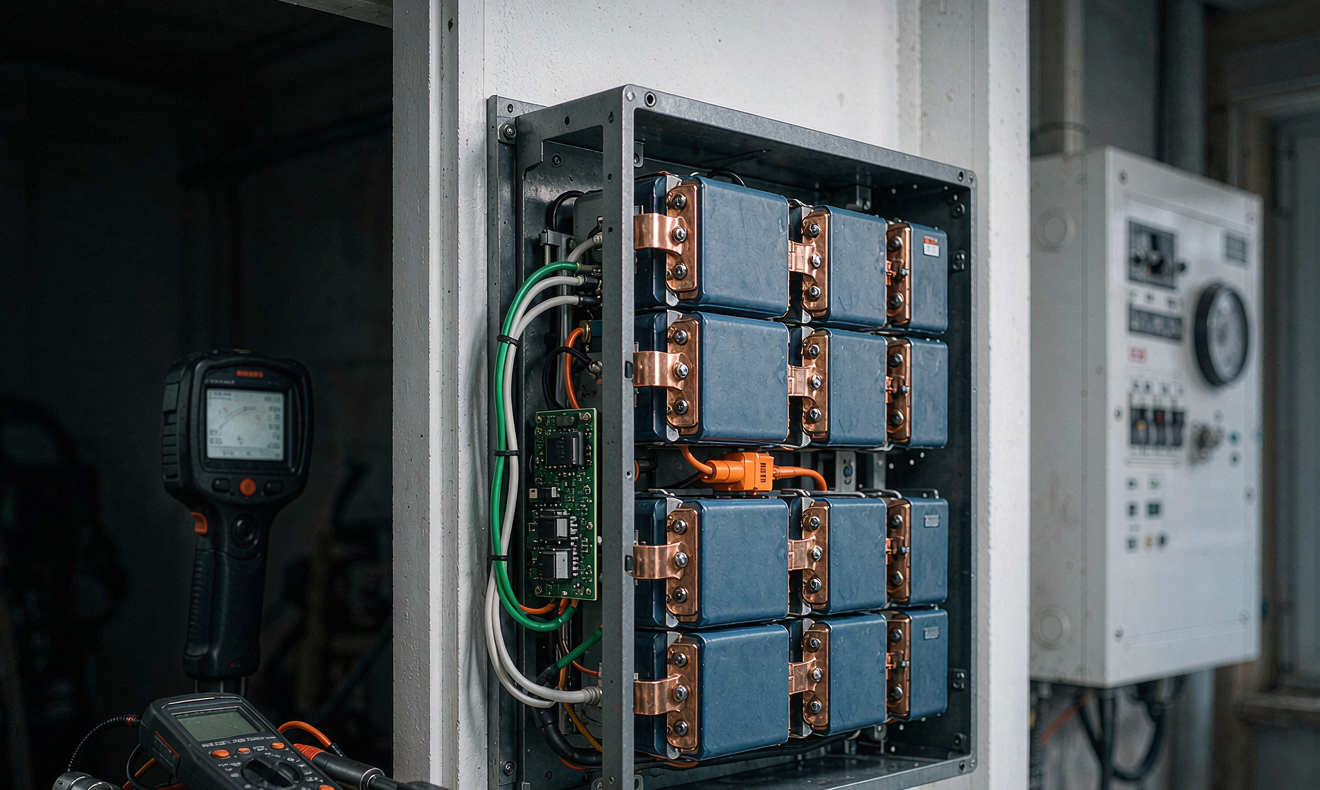
Apply a 0.5C load pulse for 10 seconds from a rested 50% SoC and compute ΔV / ΔI. A healthy 100 Ah prismatic LFP cell sits at 0.8–1.5 mΩ, scaling to roughly 18–22 mΩ at a typical 16S module level including busbars. Trend beats absolute value: 30% rise from your own baseline is the early-warning threshold, 50% means plan a replacement. In about half the cases I investigate, a 30% “cell” rise turns out to be a loose busbar or degraded connector plating — a $40 fix rather than a $4,000 one.
6. Thermal gradient
Log cell-surface temperatures through a full 0.5C discharge. Pack spread under 6 °C is normal; any single cell more than 4 °C above the pack median is a red flag. Also log closet ambient — if it exceeds 35 °C anywhere in the cycle, you need ventilation before anything else.
Five Things That Quietly Destroy Apartment Battery Performance
- Parasitic draw dominating a small battery. A 55 W standby on a 5 kWh unit is 26% of nameplate per day — the number one reason small apartment systems disappoint. Fix: eco-idle mode and an inverter sized to the load, not the battery.
- Heat soak in a sealed closet. 30–32 °C halves calendar life versus a 22 °C room. Fix: louvered door top and bottom, 100 mm clearance all round, and a thermostatic extract fan that only runs above 30 °C.
- Sizing by energy and ignoring power. A 10 kWh pack behind a 3 kW inverter cannot run an induction dinner. Fix: build the simultaneous-load list before buying.
- Tariff drift. Arbitrage only works when a spread exists. I have seen owners moved onto flat tariffs lose 70% of savings for eight months unnoticed. Fix: re-check the tariff annually and re-run the model.
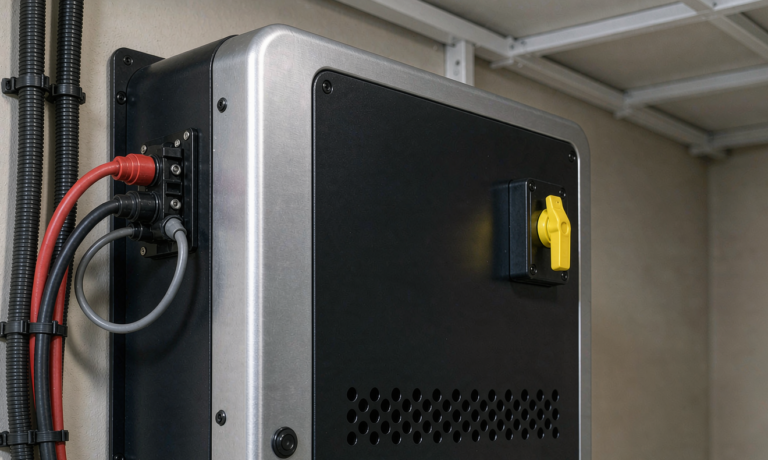
- Never re-torquing anything. Stud walls settle and thermal cycling works fasteners loose; a busbar that gains 2–4 mΩ shows up as voltage sag and phantom low-SoC warnings. Fix: a six-month torque audit, M6 at 8–10 N·m and M5 at 4–6 N·m, with a paint-pen witness mark on every fastener.
Standards, Chemistry and What to Demand From a Supplier
For any stationary residential lithium battery over 1 kWh, the certification stack I expect is unambiguous: UN38.3 for transport (the first document I ask for — no matching cell model in the test summary, stop the conversation); IEC 62619 as the primary safety standard for stationary systems above 1 kWh; IEC 62133-2 at cell and small-pack level; UL 1973 as the North American benchmark, including the 80% end-of-life definition; UL 9540 / UL 9540A and NFPA 855 for system-level and thermal-runaway propagation — increasingly the gatekeeper in multi-unit buildings, because propagation is exactly what a strata committee and an insurer care about; and IEC 63056 for residential storage safety.
On chemistry, LFP is the apartment default, and the reason is thermal behaviour rather than cycle count. A fully charged LFP cell driven to thermal runaway peaks around 180–250 °C and, in a well-designed module, does not propagate. NMC under the same abuse reaches 500–700 °C and can propagate through a module in roughly 90 seconds. In a building where six other apartments share your walls, that difference is not academic. I will specify NMC only when volume is genuinely hard-constrained, and only inside a certified enclosure with a documented propagation test.
Documentation I insist on before purchase: cell date codes under nine months old; a DCIR curve measured at three temperatures and three states of charge; and a 45 °C, 100% SoC, 30-day calendar-aging report showing under 3% capacity loss. That last document is the single best predictor of how the pack behaves in a warm closet, and it is the one most suppliers try to skip. If you need a custom battery solution for an unusual closet geometry or a strata-mandated enclosure, demand these three reports as part of the design package — a credible lithium battery manufacturer will have them ready.
Frequently Asked Questions
How much usable energy do I actually get from a 10 kWh apartment battery?
Plan on 9.0–9.5 kWh usable before inverter losses, and about 8.0–8.5 kWh delivered to loads after a realistic 88–92% AC round trip. If a supplier quotes only nameplate, ask for the usable figure in writing.
Can a home battery run my apartment air conditioner?
Yes, if the inverter’s continuous rating covers the running load and its surge rating covers compressor inrush. A 3.5 kW split system needs at least 3.5 kW continuous and 7–10 kW short-term surge. Budget 1.0–1.4 kWh per hour of cooling, so a 10 kWh pack gives roughly six to eight hours.
Do I need solar panels to make an apartment battery worthwhile?
No. Without solar, your entire return comes from tariff arbitrage plus outage protection, which works when the peak-to-off-peak spread exceeds about $0.20/kWh. A 600–800 W balcony array, where permitted, typically improves payback by 15–30%.
How loud is it, and can it go in a hallway closet?
Specify under 35 dB(A) at one metre for anything adjacent to a habitable room. Fanless natural-convection designs in the 5–10 kWh class are the right choice; where a fan is necessary, ensure it is temperature-triggered rather than always-on.
What round-trip efficiency should I expect?
88–92% AC-to-AC at 0.2C and 25 °C. Below 85%, investigate parasitic draw first and inverter conversion loss second — the cells themselves deliver 94–96% DC round-trip and are rarely the problem.
How long will it last in an apartment closet?
Two independent limits apply. Cycle life of 6,000–8,000 cycles at 60–80% depth of discharge is 16–20 years at one cycle per day. Calendar life at 25 °C is roughly 15–20 years to 80% capacity; at 35 °C in a sealed closet it collapses to 7–9 years. Apartment systems fail on heat, not cycles. Ventilate the closet.
A Practical Closing Note
Apartment energy storage performance is dominated by two numbers that never appear on a brochure: parasitic draw and closet ambient temperature. Get those right and a correctly sized residential battery delivers a decade of predictable service. Measure your load before you buy, demand the three documents above, log the six commissioning numbers on day one so you have a baseline to trend against — and when the installer leaves, put a paint-pen mark on every terminal fastener. In six months, that mark will tell you more about your system’s health than any app notification.