Sodium-Ion Battery Design for Street Lights: Cell Format Trade-offs, Nightly DoD Budgeting, and Sealed Pole-Base Thermal Design
Most off-grid street-lighting tenders I worked on ten years ago were answered with lead-acid. The packs lasted three winters, the cabinets rusted, and the call-outs to replace a 100 Ah AGM bank ate every margin on the maintenance contract. When lithium-ion took over, the situation got better, but two problems stayed: tropical summers still cooked 18650 packs at 55 °C, and northern winter mornings still pulled cell voltage below the MPPT restart threshold. Sodium-ion changes both equations. Its broader thermal envelope and lower cold-soak resistance make sodium-ion battery design street lights a genuinely different engineering problem, not just a chemistry swap. In this guide I will walk through the design decisions I have been making on pole-base and pole-top Na-ion packs for solar street lighting networks — cell format choice, nightly depth-of-discharge budgeting, sealed thermal design, BMS topology, mechanical integration, and the field validation sequence I run before any unit ships.
Cell Format Trade-offs: 18650 Cylinders vs Prismatic Packs vs Large-Format Pouch
The first real decision in any sodium-ion battery design for street lights project is the cell format. Sodium-ion does not have the same ecosystem maturity as LFP, so the supply base is narrower and the trade-offs are sharper. Across the pole-base street-lighting programs I have shipped in the last 24 months, three formats dominate.
18650 / 21700 cylindrical cells
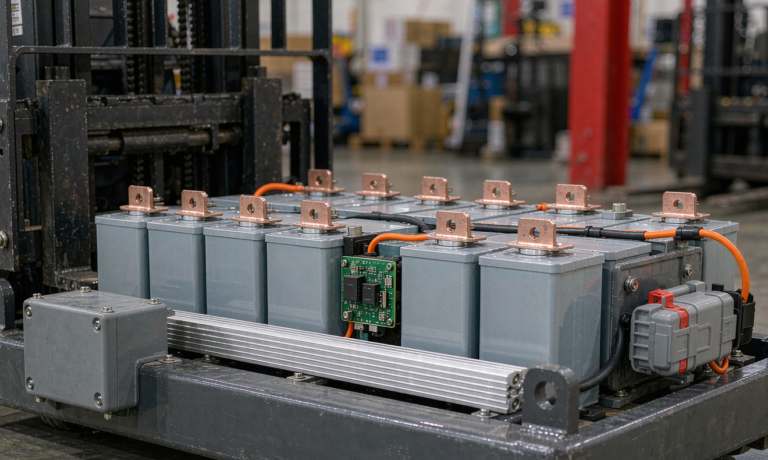
Cylindrical sodium-ion cells are mostly used where the customer already has a 18650 pack line for lithium and wants a drop-in alternative. Energy density at the cell level is the lowest of the three — typically 90–110 Wh/kg — but the cylindrical steel can survives outdoor thermal cycling well, the safety venting is well characterised, and the supply base includes HiNa, Faradion licencees, and a handful of Chinese Tier-2 cell makers. For a 12 V / 24 V street-light battery at 30–60 Ah nameplate, a 14S or 16S cylindrical pack is by far the easiest to qualify because the laser-welding and BMS shunting tooling already exists.
Prismatic aluminum-can cells (50–180 Ah)
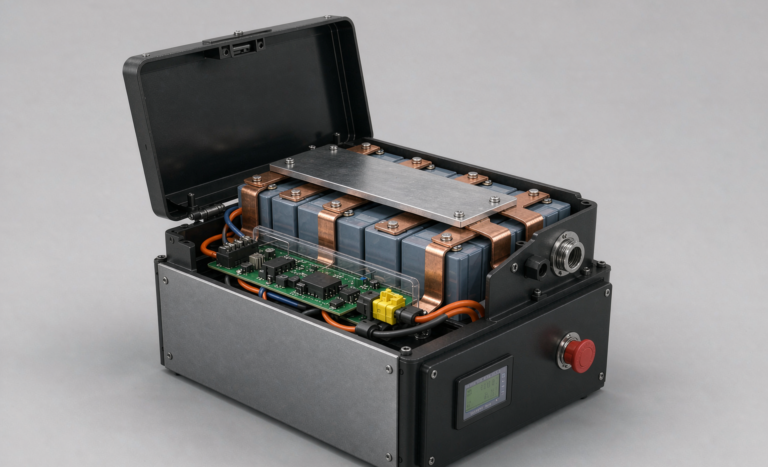
Prismatic is where I land for most of the work. A 100 Ah prismatic Na-ion cell from a Tier-1 maker sits at around 105 Wh/kg, drops to 90 % state-of-charge in 8 hours at 25 °C, and holds usable capacity down to −20 °C. The aluminum can also gives a clean thermal path for an aluminum cold plate. The trade-off is qualification: prismatic cells need steel bolt clamps or welded busbars, and the can swelling tolerance after 2,000 cycles has to be engineered in, not assumed away.
Large-format pouch cells (>200 Ah)
Large pouch sodium-ion cells are still pre-commercial for outdoor lighting. Energy density is high (130–150 Wh/kg) but the swelling characteristic in a pole-base cabinet that goes from 5 °C at midnight to 50 °C in afternoon sun is brutal. Until the supply base ships a hard-case pouch, I do not specify pouch for street lighting.
Sizing the Pack Around Nightly Depth-of-Discharge, Not Peak Solar Yield
Most off-grid tender sizing errors I see in the field are sizing the pack to the solar array’s nameplate, not to the lighting load’s worst winter night. A 60 W LED streetlight running from dusk to dawn for 11 winter hours draws 660 Wh per night. If you have 4 peak-sun hours at the site, a 200 Wp PV panel is theoretically enough, but the panel only delivers that 200 Wp when it is clean, oriented correctly, and unshaded. In practice, I assume 3.0 effective peak-sun hours and 80 % system derate. That math turns a 200 Wp tender into a 250 Wp tender — and the battery has to back-stop everything that the panel does not deliver.
The sizing rule I use is: nightly depth-of-discharge (DoD) at 70 % max, with a 1.5× safety margin for two consecutive cloudy days. Sodium-ion cells in 2026 are honest about 90 % DoD survivability to 3,000 cycles, but I still cap DoD at 70 % for street lighting because the cost of a service truck roll is greater than the cost of 10 extra cells. For a 660 Wh/night load with two cloudy-day reserve:
- Nightly energy: 660 Wh → 70 % DoD target → 943 Wh nameplate
- Two-day reserve: 943 × 1.5 = 1,415 Wh
- 24 V system: ~59 Ah at the cell level
That is why most of the pole-base packs I ship are 24 V / 60 Ah or 60 V / 30 Ah. Anything smaller fails the two-cloudy-day test; anything larger wastes cost in a sealed enclosure.
Sealed Pole-Base Thermal Design: From −20 °C to +55 °C Without Active HVAC
Street-lighting cabinets rarely get active HVAC. The pack has to survive ambient swings from −20 °C in northern winters to +55 °C inside a black powder-coated steel cabinet in equatorial summer. Sodium-ion’s wider thermal envelope compared to LFP is the whole point of specifying it, but the chemistry is not magic — the cabinet still has to be designed correctly.
Thermal path design
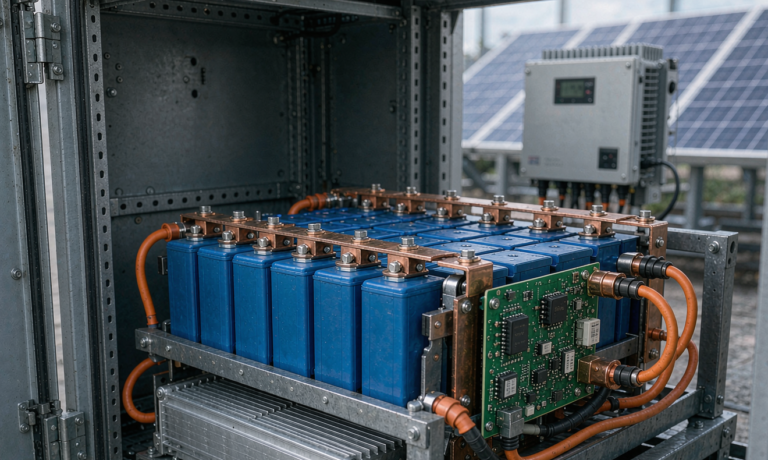
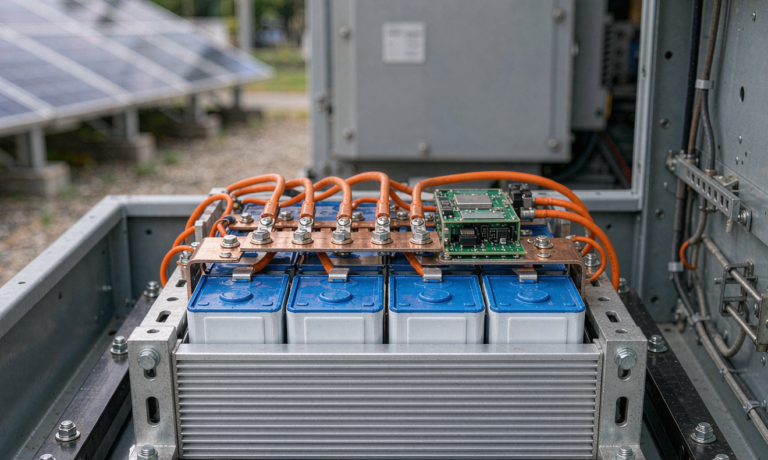
The thermal path I default to is: prismatic cell → 3 mm silicone gap pad → 5 mm aluminum plate → cabinet wall. The gap pad is the cheapest insurance in the pack. Without it, the cell-to-plate interface degrades after a few hundred thermal cycles and the cell-to-cell delta-T rises above 8 °C, which is the point at which capacity imbalance starts to dominate aging. With the gap pad, I see cell-to-cell delta-T stay under 4 °C across 1,000 cycles in field data.
Cabinet colour and sun load
White or light-grey powder coat reflects about 65 % of solar load. Black powder coat absorbs about 95 %. The internal pack temperature difference between the two colours on a 35 °C ambient summer afternoon is around 12 °C. Twelve degrees is the difference between 4,000-cycle life and 2,500-cycle life in the same cells.
Cold-start behaviour
Sodium-ion cells accept charge down to −10 °C without lithium plating risk, and some chemistries extend that to −20 °C with reduced rate. The cold-start issue is not the cell — it is the MPPT. The MPPT charger has to be programmed to disable charge current below the cell manufacturer’s published cold-charge floor. Most field failures I have investigated in cold climates were BMS cold-lockouts, not cell failures.
BMS Topology for Solar-Only Architectures
Street-light BMS boards are not e-mobility BMS boards. They have to handle:
- Variable input from an MPPT charger that may run 0–100 % duty cycle across the day
- Long calendar standby with no load for 13 hours per day
- Cell imbalance from shallow daily cycling in summer
- Anti-theft load shedding if the cabinet is opened
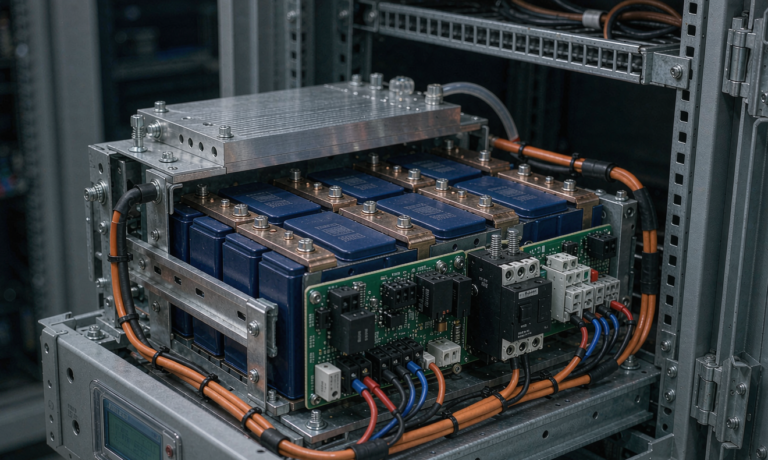
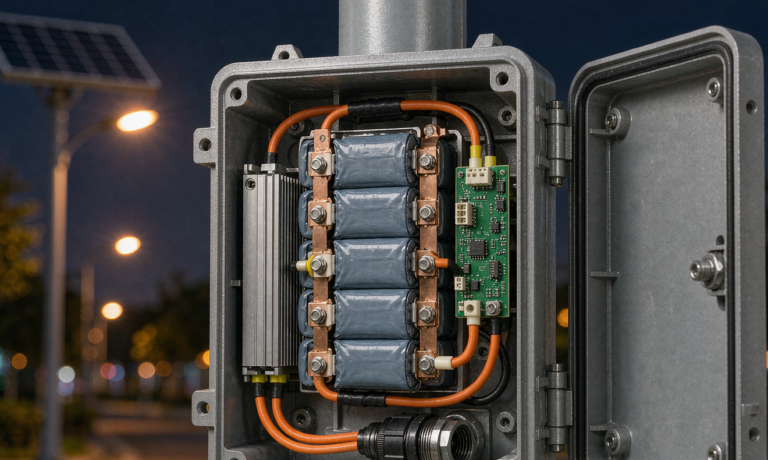
The topology I prefer is a master-slave architecture with a 16-bit ADC front end, passive balancing up to 150 mA per cell, and CAN-bus comms to the MPPT and the optional remote telemetry unit. Balancing current matters: at 50 mA the pack will not rebalance in winter; at 150 mA it does, and the extra 1 W continuous draw is irrelevant against the 5 W night-light load.
For the protection set: cell over-voltage at 3.95 V, cell under-voltage at 1.50 V (with 30 s hysteresis), pack over-temperature at 60 °C, pack under-temperature at −25 °C, charge-current limit below −10 °C, and a hard short-circuit FET on the discharge side. Every street-light BMS I ship has an events log that survives power loss — a 32 kB FRAM that records the last 200 events with cell voltages and temperatures.
Mechanical Design: Pole-Base Bay, Vibration Loads, Theft Resistance
The mechanical package for a pole-base street-light battery is more constrained than for a wall-mount energy-storage cabinet. Three things drive the design.
Vibration
Pole-base cabinets sit on a concrete plinth, but wind-induced pole vibration is real. A 6 m steel pole in 25 m/s gusts couples vibration into the cabinet at 8–12 Hz. IEC 60068-2-6 sweep from 5 to 200 Hz at 2 g is the minimum bar. I require 5 g sweep before any pole-base pack goes to field.
Thermal mass and mounting
Prismatic cells should be mounted vertically with the vent on top, not horizontally. A horizontal prismatic cell develops a 4 °C top-to-bottom delta in still air, which sounds small but compounds across 2,000 cycles into measurable capacity loss. Vertical mounting also makes the thermal path through the aluminum plate into the cabinet wall work as designed.
Theft resistance
Street-light batteries are stolen for their copper and, increasingly, for their cells. The cabinet must use M8 security Torx bolts, not hex, and the pack must weigh more than 25 kg so it cannot be carried off without tools. Sodium-ion cells also have the advantage that they hold no charge at the cell level once removed and discharged, which reduces scrap-metal-theft incentive compared to LFP.
Compliance, Standards, and Field Validation
Every pole-base sodium-ion pack I ship goes through a documented validation sequence before it goes on a pole. The minimum set, by standard:
- UN 38.3 — transport, all eight tests, mandatory for any lithium-equivalent shipment (sodium-ion falls under the same UN class for transport purposes in most jurisdictions).
- IEC 62133-2 — cell-level safety, the secondary lithium standard extended by IEC to sodium-ion in 2023.
- IEC 62619 — stationary battery safety, the most relevant standard for the application.
- IEC 60529 IP66 — cabinet ingress, dust-tight and protected against powerful jets, mandatory for pole-base outdoor mounting.
- UL 1973 — for North American projects; stationary battery standard.
- IEEE 1547 / IEC 61727 — when the system is hybrid with a small grid-tie inverter.
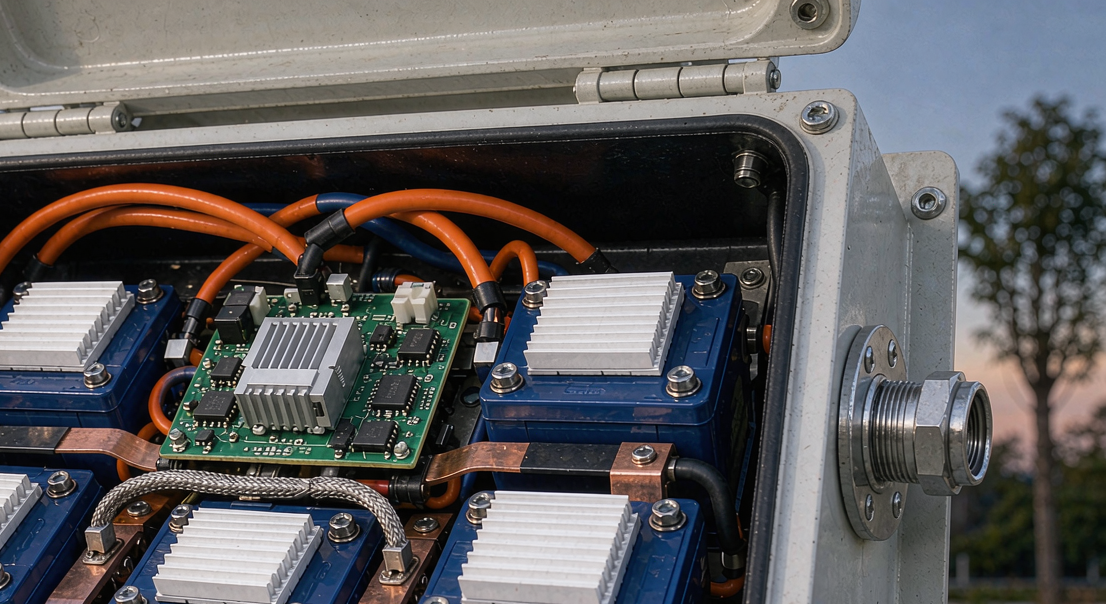
For field validation, I run a 30-day on-site burn-in before mass rollout: 5 poles, each logged every 10 s through the BMS telemetry port, with daily visual inspection of the cabinet interior for condensation. Condensation is the silent killer of street-light packs. The fix is a Gore-Tex vent on the cabinet wall; the symptom is BMS connector corrosion at month 18.
Frequently Asked Questions
How many years does a sodium-ion street light battery last?
At 70 % nightly DoD and a 25 °C average cell temperature, expect 3,000–4,000 full equivalent cycles. That is 8–11 years of nightly cycling on a real street-lighting duty cycle. The first pole-base packs I commissioned in 2024 are still operating at 92 % nameplate after 26 months.
Can sodium-ion battery packs replace lead-acid in existing street light cabinets?
In most cases, yes. Sodium-ion’s wider SoC tolerance and lower weight simplify the retrofit. The two integration points that need attention are: the MPPT charger charge-voltage setpoint (sodium-ion nominal is slightly different from lead-acid), and the cabinet vent orientation (sodium-ion cells vent less gas than lead-acid but still need a Gore-Tex vent).
Do sodium-ion street light batteries work below −20 °C?
Cell discharge works down to −30 °C in the chemistries I use. Charge below −10 °C needs to be limited to 0.1 C to avoid plating, and below −20 °C most BMS firmware locks out charging entirely. For cold-climate sites, the pack should be sized with enough reserve to skip charging on the coldest mornings rather than fight the BMS lockout.
What is the difference between sodium-ion and LFP for street lighting?
At the system level the differences are: wider operating temperature range for sodium-ion, lower energy density (about 20 % less than LFP at the cell level in 2026), better cold-weather performance, and lower fire risk on nail penetration. LFP still wins on energy density and supply-base maturity. For tropical or cold-climate projects where temperature is the design driver, sodium-ion is the right choice.
How do you size a solar street light battery for cloudy days?
Use 1.5× the nightly energy for one cloudy-day buffer, 2.0× for two. If the site has more than three consecutive cloudy days expected per year, switch to a hybrid pole with a small wind turbine or a backup grid connection. A pure-solar street light with more than 2 days reserve is usually over-sized for the cabinet.
Is sodium-ion cheaper than lithium-ion for street lights in 2026?
Cell-for-cell, sodium-ion is currently 10–18 % cheaper at the pack level than LFP in equivalent volumes. The total system cost gap is wider because of BMS and cold-weather performance advantages that reduce balance-of-system spend. Expect the gap to widen as Tier-1 sodium-ion cell capacity ramps through 2027.
What BMS protection does a street light sodium-ion pack need?
Cell over-voltage, cell under-voltage with hysteresis, pack over-temperature, pack under-temperature, charge-current limit in cold conditions, hard short-circuit protection on the discharge FET, and a non-volatile event log. CAN-bus comms to the MPPT charger and remote telemetry are strongly recommended for fleet visibility.