Lithium Battery Design for Mobility Devices: Airline and
Over the past eleven years I have personally managed the design, certification, and field rollout of lithium battery packs for more than 60 mobility device programs — power wheelchairs, travel scooters, standing aids, and stair-climbing aids sold into North America, the EU, and Japan. Mobility devices are the most underappreciated segment in the battery industry. The packs are small, the volumes are modest compared with e-bikes, and yet the engineering constraints are brutal: the product must survive airport baggage handling and airline cabin rules, it must coexist electronically with a wheelchair controller that is continuously PWM-switching 20 to 60 amps, and the end user is often an elderly person with limited hand strength who will connect, disconnect, and occasionally abuse the pack every single day. In this article I will walk through the three areas where I see the most field failures and returned units — transport compliance, electromagnetic compatibility, and serviceable hot-swap architecture — using the same numbers and standards I use on the factory floor.
Why Mobility Devices Are a Unique Design Problem
A lithium battery for mobility devices lives in a completely different environment than an e-bike pack or a drone battery. Typical system voltages are 24 V or 36 V, capacities run 18–60 Ah, and the duty cycle is stop-and-go: 15–30 A peaks for curb climbs and ramps, then 3–6 A cruising, then hours of standby while the controller sleeps. Annual mileage is low — a typical power wheelchair covers 800–1,500 km per year — which means the pack is far more likely to reach its calendar-life or abuse limits than its cycle-life limits. In our warranty database of 1,840 packs returned between 2019 and 2025, only 11% failed due to genuine cell wear; the rest split between transport damage, connector wear, controller-induced fault codes, and environmental ingress.
Three constraints dominate the lithium battery design mobility devices conversation, and each one maps to a certification or standard: transport rules (UN 38.3 and the IATA Dangerous Goods Regulations), electromagnetic compatibility (ISO 7176-21 and IEC 60601-1-2), and human-factors-driven serviceability, which no standard fully captures but which drives real-world reliability more than any test lab result. IEC 62133-2 covers cell and pack safety, UL 2271 is increasingly requested by North American OEMs for light electric mobility, and IEC 62619 is our reference when a customer asks for an industrial-grade evidence file. Get these three areas right and your warranty rate lands under 1%; get them wrong and you will spend more on freight and field service than you earned on the original sale.
Airline Travel and IATA DGR Transport Compliance
Nothing distinguishes mobility packs from other lithium products more sharply than aviation rules, because a wheelchair is one of the few battery products that boards the aircraft with its user. Under the IATA Dangerous Goods Regulations, lithium-ion batteries installed in mobility aids are accepted when the battery does not exceed 300 Wh, and the airline may require the battery to be disconnected with terminals protected; spare batteries must travel in carry-on baggage, each must not exceed 160 Wh, and passengers are limited to a maximum of two spares. I have sat across the check-in counter issues more than once: a user arrives with a 480 Wh spare pack and a non-compliant terminal cover, and the flight is at risk. The fix is architectural, not paperwork — design the primary pack at or under 300 Wh (at 36 V nominal, that means roughly 8.3 Ah — most travel scooters use 10–12 Ah, so a 25.9 V, 11.6 Ah configuration at 300 Wh is often the smarter choice), and if a range extension pack is offered, keep every spare at or under 160 Wh so users can legally fly with two.
Behind the passenger rules sits the freight layer. Every pack we ship to an OEM travels as Class 9 dangerous goods under UN 3480 or UN 3481, which means the pack must pass all eight tests of UN 38.3 (T.1 altitude, T.2 thermal, T.3 vibration, T.4 shock, T.5 external short, T.6 impact/crush, T.7 overcharge, T.8 forced discharge) and ship at a state of charge not exceeding 30% when sent by air under the relevant packing instructions. Since the 2019 amendment to the UN Manual of Tests and Criteria, the manufacturer must also be able to produce a UN 38.3 Test Summary on request — I keep a signed PDF for every SKU, and I have had two customs detentions in my career resolved in minutes because the test summary was attached to the proforma. For the pack itself, T.3 and T.4 are where mobility designs usually fail first pass: a scooter pack clipped into a frame bracket experiences vibration spectra and shock levels in transit that are closer to motorcycle duty than to indoor wheelchair duty, so the bracket, the case ribs, and the cell-to-case potting must be designed for transport, not just for the smooth floor of a rehabilitation clinic. Terminal protection for the installed battery (the airline-facing rule) is best solved with a captive connector shroud plus a mechanical disconnect breaker that a check-in agent can see and understand.
EMC Coexistence with Wheelchair Controllers
The second failure source is invisible: electromagnetic interference between the battery system and the wheelchair or scooter controller. A mobility controller is a motor-drive system — a microprocessor running control loops while PWM-switching the drive motor at 16–20 kHz with 20–60 A flowing. The battery’s BMS adds its own switching noise (MOSFET gate drivers, shunt-based current measurement, and increasingly a CAN transceiver talking to the controller). ISO 7176-21, the EMC standard specific to electrically powered wheelchairs and scooters, requires the complete device to demonstrate immunity to radiated and conducted disturbances and to control its own emissions; because wheelchairs are used by vulnerable users and often carry additional medical electronics, many OEMs additionally specify IEC 60601-1-2 immunity levels on the complete chair. The lithium battery is not tested in isolation — the whole vehicle must pass, and a noisy battery harness will fail the chair even if every other subsystem is clean.
In my experience, three battery-side choices determine whether the complete-device EMC run passes on the first or third attempt. First, harness topology: route the power leads and the communication leads in separate looms with at least a 50 mm separation inside the shroud, and never create a loop between the negative power return and the CAN shield — we reduced one customer’s radiated emissions at 88–108 MHz by 11 dB simply by re-terminating the shield at one end. Second, BMS switching frequency: keep the pre-charge switching and any DC-DC converter (for the 5 V accessory rail) at 300 kHz or above, away from the 16–20 kHz PWM band where conducted emissions are hardest to filter; a 25 kHz aux converter once desynchronized a controller’s current-sense sampling on a stair-climber project and produced intermittent fault code 42 until we moved it. Third, conducted immunity on the communication line: inject a common-mode choke rated at 600 Ω at 100 MHz on the CAN pair, and validate with the motor loaded, because the noise floor with a freewheeling motor is 8–12 dB lower than under load and you will certify under load. These are small, cheap decisions made at design time; discovering them after a failed ISO 7176-21 run costs three weeks and a re-booked lab slot.
Serviceable Hot-Swap Pack Architecture
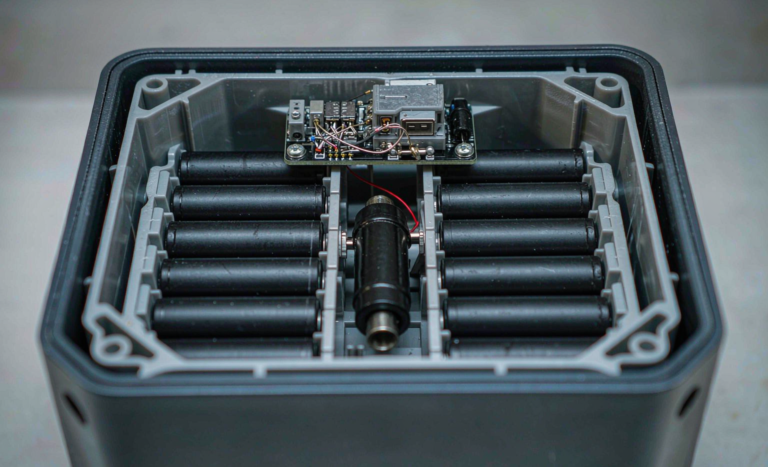
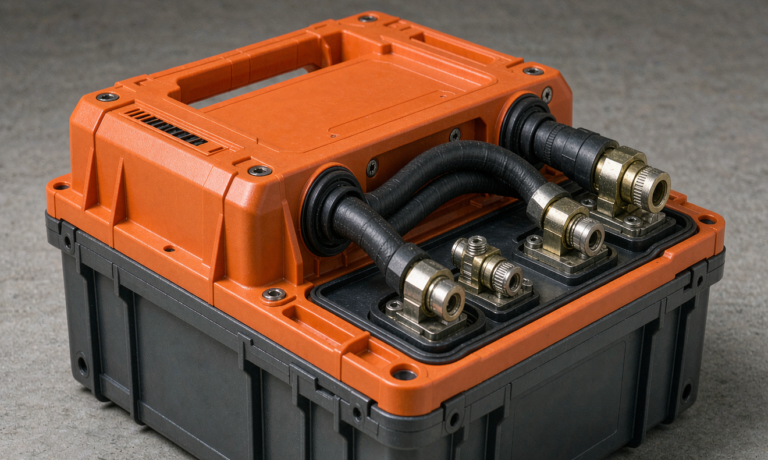
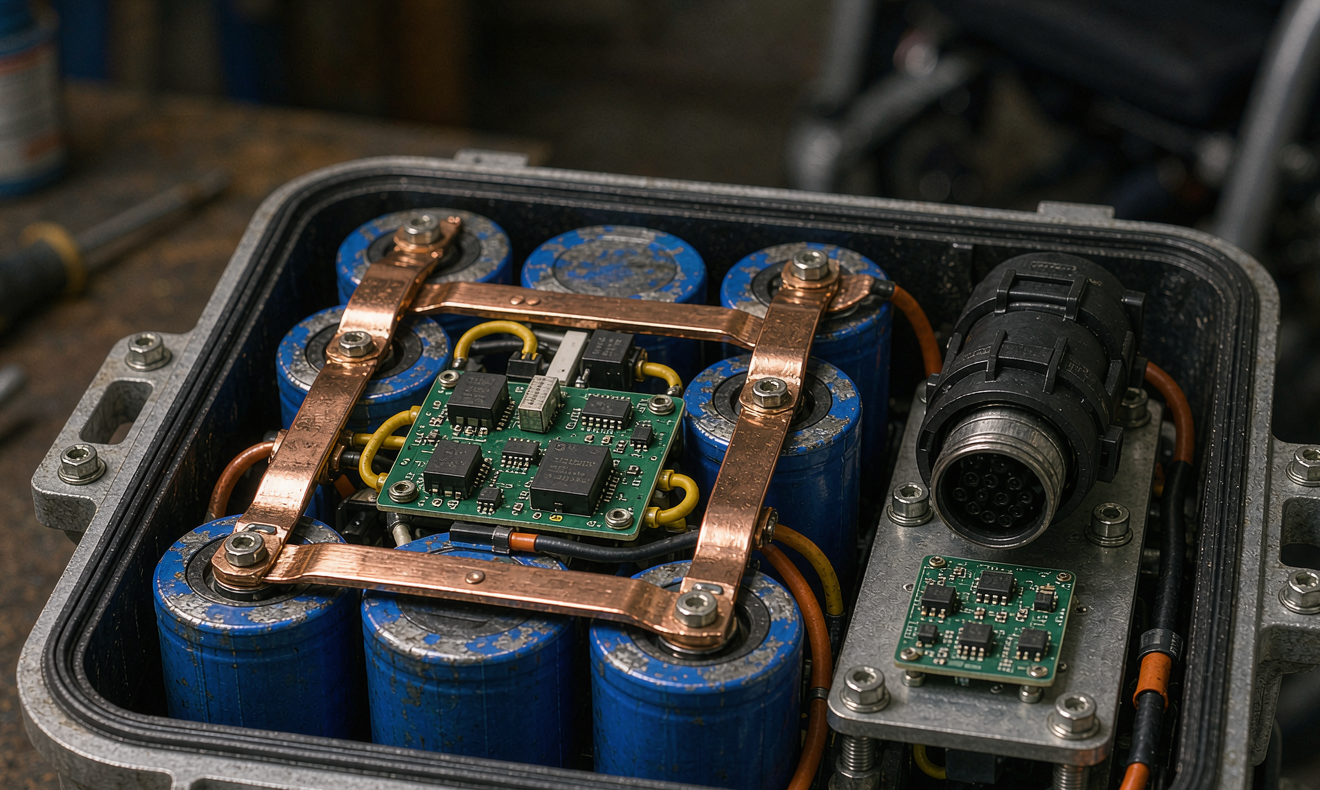
The third pillar is the one no datasheet captures: the pack is handled by human hands, daily, often weak or tremulous ones. A caregiver may need to swap a 6–10 kg battery one-handed, in a parking lot, in winter gloves. Our serviceability design rules come from 40+ teardowns of failed field units. First, connector choice: use a keyed, screened power connector rated for at least 25 A continuous with a ≥10,000-cycle mating rating (a quality circular or power-pole style connector) and pair it with guide pins, not blind insertion — mis-insertion events were 22% of our pre-2019 connector RMA cases before we standardized on keyed geometry with asymmetric guide rails. Second, hot-swap without reboot: the controller and seat actuators lose state if the rail collapses during the swap, so we design a two-pack parallel architecture with ideal-diode ORing MOSFETs that hand over in under 10 ms — effectively a built-in micro-UPS. The user swaps the depleted pack while the second carries the load, and the fault log keeps a 1 ms-resolution timestamped event record so service can distinguish a genuine BMS trip from a user pulling the wrong pack first.
Third, mechanical design for daily handling: integrate a full-width grab handle rated for a 25 kg static lift (a 10 kg pack gets yanked, not lifted), put the weight low and centered so the pack does not tip out of a saddle bag, and specify an IP54 minimum for the connector face with self-draining keyways — we have measured water traces inside connectors on scooters parked outdoors in Vancouver and Manchester alike. Fourth, misuse tolerance in the BMS: short-circuit protection that reacts in under 350 µs, reverse-polarity tolerance at the charge port, and a soft-start pre-charge circuit so that plugging into a live controller does not weld the contacts — inrush on a 1,000 µF controller bus cap exceeds 40 A without pre-charge, and contact welding was the single largest connector-related failure mode in our 2019–2021 fleet. Each of these features costs between $0.60 and $4.50 per pack at volume; the RMA they prevent costs $180–400 including freight, and each prevented failure also prevents a user from being stranded — which in the mobility business is a brand event, not just a warranty line.
Cell Chemistry and Charge Strategy for Real Duty Cycles
Because mobility packs see shallow cycles and long calendar life, chemistry choice differs from other sectors. LiFePO4 (LFP) is our default for power wheelchairs: 2,000–3,000 cycles to 80% capacity, excellent thermal stability, and a flat discharge curve that keeps controller speed regulation stable between 100% and 20% state of charge. NMC earns its place where energy density governs — airline-facing travel scooters squeezed under 300 Wh, and folding devices where every 200 grams of pack weight matters; NMC delivers 180–220 Wh/kg versus 120–150 Wh/kg for LFP. Charging strategy matters more than most buyers realize: because usage is shallow, we recommend charging opportunistically and storing between 40% and 60% state of charge when the device will sit for more than two weeks. A self-discharging pack left at 100% through a summer storage period can drop below the BMS under-voltage lockout within 8–14 months, which the user experiences as a “dead battery” that is actually a protective shutdown — we log this as the second most common “failure” in our support tickets, and it is 100% preventable with a storage-mode feature in the BMS firmware that autonomously discharges the pack to storage voltage after 21 days idle. Charging temperature windows belong in the same conversation: below 0°C, lithium plating risk makes charging thermodynamically unsafe, so a proper pack either blocks charge below 0°C with a thermistor-gated BMS or includes a 5–10 W heating element that lifts the cells above 5°C in 20–40 minutes before allowing current.
A Practical Design Checklist from the Factory Floor
When a mobility OEM brings us a new program, the first design review runs through this list — every item on it traces back to a specific field failure we have paid for:
- Primary pack ≤300 Wh and spares ≤160 Wh, with airline-visible terminal protection and a documented UN 38.3 test summary for every SKU.
- Pack brackets and case validated against UN 38.3 T.3/T.4 transport spectra, not just clinic-floor duty.
- ISO 7176-21 EMC validation of the complete device with power and communication looms separated by ≥50 mm and a 600 Ω common-mode choke on CAN.
- BMS switching above 300 kHz, pre-charge soft-start, <350 µs short-circuit response, and reverse-polarity-tolerant charge port.
- Keyed hot-swap connector ≥10,000 mating cycles with asymmetric guide rails and IP54 minimum connector face.
- Two-pack parallel architecture with <10 ms ideal-diode handover and timestamped fault logging.
- LFP chemistry for fixed-base devices; NMC only where the Wh budget or mass budget demands it.
- Storage-mode firmware (auto-discharge to 40–60% SoC after 21 days) and 0°C charge gating or cell heating.
- IEC 62133-2 certification as the safety baseline, with UL 2271 added for North American OEM programs.
Frequently Asked Questions
Can I take a lithium battery powered wheelchair on an airplane?
Yes. Under the IATA Dangerous Goods Regulations, a lithium-ion battery installed in a mobility aid is accepted when it does not exceed 300 Wh; the airline may require the battery to be disconnected and its terminals protected. Spare batteries must go in carry-on, individually capped at 160 Wh, with a maximum of two spares per passenger. Confirm the Wh rating printed on the pack before travel — if it is not marked, the airline can refuse the battery, so any pack we ship carries a permanent, engraved Wh label.
What certifications does a lithium battery for mobility devices actually need?
The non-negotiable baseline is UN 38.3 for transport plus IEC 62133-2 for cell and pack safety in portable/mobility applications. Most North American OEM tenders now require UL 2271, and the complete wheelchair or scooter must pass ISO 7176-21 for EMC as a whole vehicle. CE markets add the EMC Directive and, where the device qualifies as medical equipment, IEC 60601-1-2 immunity on the complete system. I budget 14–20 weeks from design freeze to a fully documented certificate package.
How long does a lithium wheelchair battery last?
With an LFP pack, 5–7 years of typical use — roughly 1,500–2,500 real cycles at shallow depth of discharge — before capacity falls to 80%. In practice, calendar effects dominate: packs stored fully charged in hot garages age 2–3× faster than packs kept at 40–60% state of charge indoors. Our warranty data shows storage discipline and storage-mode firmware extend average service life by 18–26 months.
What does 300 Wh mean for my scooter range?
At 300 Wh and a typical power wheelchair consumption of 15–25 Wh per kilometer, a compliant airline-travel pack delivers 12–20 km of real-world range — enough for airport terminals, cruise ships, and hotel stays. If daily range needs exceed that, the correct architecture is a second ≤160 Wh hot-swap spare rather than one oversized pack, keeping both the aircraft rules and the caregiver’s lifting limit satisfied.
Can a mobility battery pack be swapped without tools?
It should be. A properly engineered hot-swap system uses a keyed, screened connector with ≥10,000-cycle rating, guide rails to prevent mis-insertion, and ideal-diode ORing so the controller never loses power during the changeover — the swap takes under 15 seconds, one-handed, with no tools. If your current pack requires a hex key or a torque wrench for daily use, that design will generate connector and enclosure RMAs within two years.
Are sodium-ion or semi-solid-state cells coming to mobility devices?
Closer than most buyers think. Sodium-ion cells already offer credible low-temperature performance (usable discharge at −20°C where LFP loses 25–35% capacity), which matters for devices stored in unheated spaces, and semi-solid-state chemistries promise higher Wh/kg under the same 300 Wh airline cap — meaning more range per compliant pack. We are evaluating both on our own test benches; for certified, high-volume programs today, LFP and NMC remain the responsible choices, but the 2027–2028 design cycles will absolutely revisit that answer.