Sodium-Ion Battery for Rural Water Pumping
I have spent more than a decade specifying battery systems for sites where the grid is weak or absent, and few loads punish a battery bank the way rural water pumping does. The pump runs hard for a few hours, draws brutal starting currents, and often lives in a building with no climate control. A battery that looks fine on a datasheet can fail in its second dry season if the duty cycle was never engineered. Over the past three years I have been moving a growing share of these projects from lithium iron phosphate to the sodium-ion battery, and the reasons are practical rather than fashionable. This article walks through how I size, specify, and install such systems, from hydraulic demand through starting surges to cold-weather derating and transport compliance. The numbers come from commissioned systems, not brochures.

What Makes Water Pumping a Different Battery Load
Most backup loads are either steady or sporadic: lighting draws a flat trickle, refrigeration cycles on and off. A water pump is neither: it is a short-duration, high-power, mechanical load with a hard hydraulic deadline behind it. If the battery cannot deliver, the community gets no water, a failure that is visible within hours.
Three characteristics separate pumping duty from generic backup work. First, the power draw is concentrated: a typical village borehole pump sits between 0.75 kW and 7.5 kW, taken in one or two long blocks per day. Second, the load includes a mechanical start whose current spike reaches four to six times running current on a direct-on-line start. Third, demand peaks in the hottest, driest months, exactly when chemistry ages fastest, though conveniently when solar input peaks.
The Daily Duty Cycle of a Village Pump
The pump rarely runs continuously: a typical schedule is two to four hours split across a morning block and a late-afternoon block, feeding an elevated tank that gravity-feeds the taps. That tank decouples water demand from pumping, letting me size the battery for energy rather than peak power. Eliminate the tank and pump on demand, and the battery and inverter both grow by a factor of two to three, where the project usually dies in the budget review.
Sizing the Bank From Hydraulic Demand
Sizing starts with water, not batteries. From daily water demand, total dynamic head, and the pump’s wire-to-water efficiency, the daily electrical energy is simply the mass of water times 9.81 times head, divided by 3,600,000 and by that efficiency.
From Liters to Kilowatt-Hours: A Worked Example
A village system serving 400 people at 80 liters per person per day moves about 40 cubic meters daily. A 55 meter borehole plus an elevated tank gives a total dynamic head of 70 meters including friction, and at 45 percent wire-to-water efficiency the daily electrical energy works out to about 1.7 kWh, covered by a 1.1 kW pump running roughly two hours. I then add 3 to 5 percent controller losses and 20 percent demand growth, rounding up to an electrical budget of about 2.2 kWh per day.
Days of Autonomy and Depth of Discharge
Next comes autonomy. Remote water systems routinely face two or three consecutive days of heavy cloud or generator downtime, so I design for two days as a baseline, three where no alternative source exists. At a planned 85 percent end-of-life depth of discharge with 20 percent capacity fade, that demands a nominal bank of about 6.5 to 7 kWh, or one or two 48 V rack modules of 2.5 to 3.5 kWh each. Power rating is the other half, and it is governed by the pump’s starting method.
Why Sodium-Ion Chemistry Suits Pumping Duty
The case for sodium-ion in rural water pumping rests on three engineering properties, none of which require exotic conditions to matter.
First, temperature tolerance. Pump houses in the regions I serve swing from 45 degrees Celsius in the shade to minus 15 degrees Celsius on winter nights, with no heating or cooling. LFP loses usable capacity and charging ability quickly below freezing, and lead-acid is worse still once a deeply discharged electrolyte freezes. Sodium-ion cells retain roughly 85 to 92 percent of room-temperature capacity at minus 20 degrees Celsius in my acceptance tests, and they accept charge at low current below freezing with modest derating.
Second, cycle life under deep daily cycling. Current-generation sodium-ion cells deliver 3,000 to 6,000 full cycles to 80 percent residual capacity depending on the manufacturer. On a one-cycle-per-day schedule that is eight to sixteen years, comfortably exceeding the typical seven-year pump refurbishment interval.
Third, supply-chain robustness. Sodium-ion cells use aluminum current collectors on both electrodes, no lithium, no cobalt, no copper, and no graphite in most hard-carbon designs. For procurement officers who watched lithium prices quadruple in 2022, that raw-material story is a genuine decision factor.
Cold-Weather Behavior at Remote Sites
Cold kills more rural battery projects than any other single cause, and the failure is subtle: the bank works all autumn, then the first hard freeze arrives and charge is refused or the inverter trips on undervoltage. I confirm the cell’s charge-current derating below 0 degrees Celsius, typically 0.1 to 0.2C, and program it into the controller. I mount the bank at least 150 millimeters above the floor, because floors sit several degrees colder than the air, and I measure, not guess, the worst-case morning temperature before finalizing power derating. On one site the January dawn reading was minus 18 degrees Celsius, twenty below what the client had promised, and the bank still started the pump because we had derated to the measured number.
High Ambient Temperatures and Thermal Headroom
The opposite extreme matters equally: calendar aging roughly doubles for every 10 degrees Celsius of sustained cell temperature above 25 degrees Celsius, so a bank idling at 40 degrees Celsius in a tin-roofed shed ages four to five times faster than the datasheet assumes. Sodium-ion tolerates elevated temperature better than LFP, but I still insist on the basics: shade the building, ventilate above the bank, and never mount the bank against the pump motor, a 60-degree-Celsius heat source.
Pump Starting Surges and the Inverter Question
The most common specification failure I audit is an inverter rated for running current but not starting current. A 1.1 kW submersible pump on a direct-on-line starter draws four to six times nameplate, a momentary draw well above 5 kW on a 48 V system from a bank sized for 2.2 kWh per day.
The cheapest is to reduce the surge at the source. A variable frequency drive or soft-start pump controller ramps voltage and frequency, holding starting current to roughly 1.1 to 1.5 times running current; modern solar pumping controllers integrate it. The mid option is an inverter with genuine surge headroom: at least twice continuous rating for three seconds, verified against the manufacturer’s surge curve rather than the marketing headline. The expensive option is oversizing the bank purely for surge, which wastes money compared with a soft start. My default is a soft-start controller plus a hybrid inverter with a two-times, three-second surge rating, and in five years of commissioning it has produced no start-failure callbacks.
On a generator-fed site, inrush is absorbed by an alternator, so direct-on-line starting is free. On a battery-fed site, every ampere of inrush must come through the inverter’s semiconductors at the end of a two-day autonomy stretch, when internal resistance is highest. Sizing for direct-on-line inrush typically triples the system cost; a soft-start controller costs a few dozen dollars. It is the highest-leverage decision in the design.
Coupling Sodium-Ion Batteries With Solar Pumping Arrays
Most rural pumping projects now arrive as hybrid designs with a photovoltaic array, a battery bank, and often a small generator. Two integration details deserve attention.
Voltage window matching comes first. Sodium-ion cells run at a nominal 3.0 to 3.1 volts, about 55 to 62 volts for a 20-cell string, with a discharge curve that slopes more gently than LFP’s flat plateau. The controller and inverter must offer a sodium-ion or user-programmable profile, with absorption near 3.6 to 3.8 volts per cell and float around 3.3 to 3.5 volts per cell. I never rely on an overlapping LFP setting; I program the profile explicitly and lock it.
Charge acceptance is the second detail: sodium-ion accepts bulk current from empty, pairing well with an array that floods the bank at midday after a cloudy morning. Whether a battery is needed at all is the final question: pure solar pumping is the cheapest configuration where an elevated tank provides buffering, and I add a battery when the client needs pressurized distribution on demand, evening watering, or resilience through multi-day clouds.
Pump House Installation Practice
Installation quality decides whether the chemistry gets to show its strengths, and rural pump houses are dusty, damp, and rodent-populated. My standard has converged on a short list.
Dust, Ventilation and Enclosure Selection
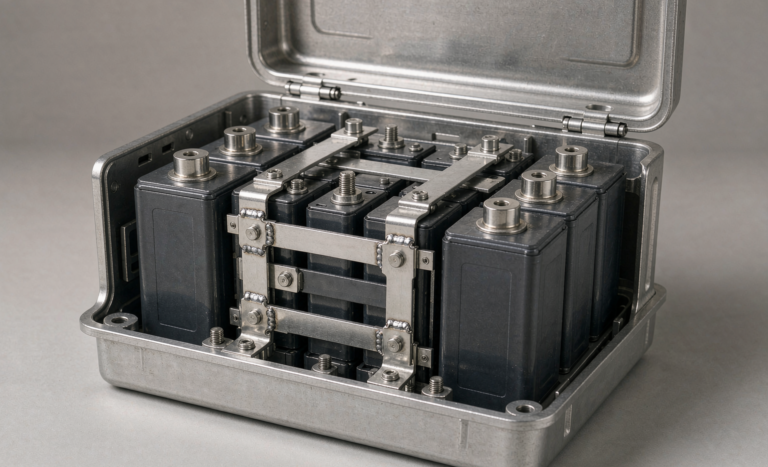
I specify an enclosure of at least IP54, preferring IP55 where windblown dust or seasonal flooding is a risk, mounted 300 millimeters off the floor and anchored against tipping. Ventilation serves the electronics, not the chemistry: sodium-ion needs none of the hydrogen dilution airflow that flooded lead-acid demands, so modest louvred ventilation sized for the inverter’s heat output is enough. With no electrolyte topping and no separate battery room requirement, the bank can often live inside the existing pump building, saving the cost of a dedicated structure.
Cabling, Protection and Lightning
I hold voltage drop under 2 percent on the main DC run, with overcurrent protection on every positive conductor leaving the bank. Remote sites are lightning-prone, and elevated tanks, borehole casings, and long fence lines make excellent strike collectors, so I fit surge protection on the DC and AC sides, bond the array frame and tank to a ground electrode, and keep the bank clear of any down-conductor wall. Theft is part of the threat model in many districts, so enclosures get keyed locks.
Transport, Standards and Compliance
Rural sites are reached through logistics that make compliance matter: the battery rides a truck for two days over rough roads and arrives at a building with no loading dock. Every sodium-ion battery I ship is certified to UN 38.3, covering altitude, thermal, vibration, shock, short circuit, impact, overcharge, and forced discharge. Units ship at or below 30 percent state of charge per air-transport rules, with documentation alongside, because the last hundred kilometers are often handled by a driver who has never heard of the regulation.
On the product side, cells should carry IEC 62133-2 conformity and stationary packs IEC 62619, with the system evaluated against local wiring codes that govern the pump panel. I also request the manufacturer’s low-temperature charge-acceptance data and a cycle-life report at the actual depth of discharge the site will run, not a glossy 70 percent figure; when a water authority audits the installation years later, that paperwork stands between the project and a forced replacement.
Total Cost of Ownership Against Lead-Acid and LFP
On energy density sodium-ion does not compete: packs run 90 to 115 watt-hours per kilogram against 120 to 160 for LFP. Rural pumping is not weight-critical; the bank sits on a floor and never moves. What this duty buys and pays for is cycle life under deep daily cycling, cold-charge capability without heaters, elevated-temperature tolerance without air conditioning, and transport without lithium-class handling penalties. Against flooded lead-acid, a sodium bank costs roughly two to two and a half times more up front but delivers three to five times the cycle life and no replacement logistics in year three, where lead-acid projects quietly double their budget. Against LFP, sodium-ion wins the cold and hot margins, and my total cost of ownership models have favored it on most sites with seasonal swings above 25 degrees Celsius or winter nights below 0 degrees Celsius.
Frequently Asked Questions
Can a sodium-ion battery run a submersible pump directly?
Yes, provided the inverter and bank are rated for the starting surge. A direct-on-line start draws four to six times running current, so I either fit a soft-start controller, which holds the surge near 1.5 times running current, or specify an inverter with a verified two-times, three-second surge rating. Sodium-ion’s moderate internal resistance at low state of charge helps the start happen even near the bottom of the charge window.
How many cycles will a sodium-ion battery last in daily pumping duty?
Current cells deliver 3,000 to 6,000 full cycles to 80 percent residual capacity. At one cycle per day, that is eight to sixteen years. I derate to the conservative end of the published range and confirm testing at the site’s actual depth of discharge.
Do sodium-ion batteries work in freezing winters at pumping sites?
They discharge and, with modest current derating, charge at temperatures where most other chemistries need heaters. Sodium-ion cells retain 85 to 92 percent of capacity at minus 20 degrees Celsius in my acceptance testing. I verify the charge-current derating curve below 0 degrees Celsius, program it into the controller, and mount the bank off the cold floor, a combination that has carried pump starts through winters at minus 18 degrees Celsius.
How do I size a sodium-ion battery bank for a village water system?
Start from hydraulics: daily water volume, total dynamic head, and wire-to-water efficiency give the daily electrical energy, typically 1.5 to 3 kWh for a village system. Multiply by days of autonomy, usually two, divide by the planned depth of discharge around 85 percent, and add end-of-life fade. Most village systems land on a 6 to 10 kWh nominal bank of one or two 48 V modules, sized for power by the starting method rather than by energy.
Are sodium-ion batteries safe to install inside a pump house?
Yes, and the building context is exactly why. Sodium-ion cells pass nail penetration, overcharge, and short-circuit abuse testing with higher thermal runaway onset and lower released gas energy than most lithium chemistries. I still apply standard practice: an IP54 or better enclosure, mounting clear of the hot pump motor, DC overcurrent protection, and surge protection on lightning-prone sites. No hydrogen ventilation, acid containment, or dedicated battery room is required.
Can I retrofit sodium-ion batteries into an existing solar pumping system?
Usually yes, with one gate: the charge controller and inverter must support a programmable or native sodium-ion profile, with absorption near 3.6 to 3.8 volts per cell and float near 3.3 to 3.5 volts per cell. If the existing electronics are hard-locked to a lead-acid profile, I replace the controller rather than compromise the chemistry. After that, the retrofit is housekeeping: cable sizing, overcurrent protection, and confirming the pump surge.
A rural water system is a promise made to a community, and the battery is the component most likely to break that promise silently. Sized from hydraulic truth, paired with a soft-start controller, and given an enclosure that respects dust and temperature, it is the most forgiving bank I have commissioned at the edge of the grid. That, and not chemistry enthusiasm, is why my default specification changed.
Further Reading
References