Sodium-Ion Battery Fire Suppression and Detection Design
Fire protection for a battery room is usually specified by someone who has never watched a cell vent. I have, twice, in abuse testing, and both times the sequence that mattered was gas first, smoke second, flame last. Sodium-ion changes the numbers inside that sequence but not the architecture of the answer. I am Karl Huang, a senior lithium battery engineer, and this guide covers how I design sodium-ion battery fire suppression and detection for stationary rooms: what the chemistry buys you, what the codes still demand, and the interlock failures I keep finding on commissioning day.
What Sodium-Ion Actually Changes About Fire Risk
Vendor decks exaggerate this, so let me be precise. The sodium-ion cells I have put through accelerated rate calorimetry use a hard carbon anode with either a layered oxide or a Prussian blue analogue cathode. There is no nickel-rich lattice releasing oxygen the way an NMC cathode does, and measured onset temperatures land in a wide band, roughly 150 to 250 degrees Celsius depending on cathode and state of charge. Total heat release per cell tends to be lower than a nickel-rich lithium cell of the same capacity, and that is a real margin.
Transport is the second advantage. Several sodium-ion designs tolerate a full rundown to zero volts without the copper dissolution that destroys a lithium-ion cell, so the cells can move at essentially no stored energy. For air freight under UN 38.3 and ICAO rules, that removes most of the risk package that FAA and EASA inspectors care about.
Neither advantage changes your code path. NFPA 855 does not hand out a chemistry discount, and the authority having jurisdiction will still want a hazard analysis, gas detection, suppression and often explosion control. The vent gas is also closer to lithium than the marketing suggests: hydrogen, carbon monoxide, carbon dioxide, hydrocarbon fragments and electrolyte solvent vapor, with hydrogen fluoride possible when the salt is fluorinated, as sodium hexafluorophosphate is. The electrical hazard is identical too: a 1000 volt DC string with a partially charged module is a stranded-energy problem no matter which alkali metal sits in the anode.
Off-Gas Detection Is the Layer That Buys Time
Every cell event I have instrumented produced detectable gas well before visible smoke. Internal pressure builds, the vent opens between a few hundred kilopascals and about one megapascal, and out comes solvent vapor, then hydrogen and carbon monoxide. A photoelectric smoke detector at a six meter ceiling sees that plume after dilution and transport delay; a sensor at the cabinet face sees it in seconds. That difference is the entire point of the detection layer.
The sensor mix I specify
- Cabinet-level combination sensors reading hydrogen, carbon monoxide and total volatile organic compounds, mounted in each unit’s exhaust path rather than on the room ceiling.
- Room-level addressable smoke detection, with aspirating detection where air changes per hour are high or the ceiling exceeds six meters, so sampling points see the plume before dilution wins.
- An electrochemical hydrogen fluoride channel on larger rooms, slow and poisoning-prone, but it is the one that tells you what responders will face.
Threshold staging matters more than sensor count. First stage notifies and logs at around ten percent of the lower explosive limit for hydrogen or a modest rise above the adaptive VOC baseline, second stage disables charging and starts high-rate exhaust, third stage releases suppression. A single-stage system either cries wolf or releases agent on a cleaning-solvent plume.
Placement rules that survive an audit
Keep sampling points at least one meter from supply diffusers, because dilution is the enemy. Put the first detection point at the height where the cell actually vents, not where the building code prefers to drill, and in cabinets put a sensor in the exhaust plenum so a single module event is caught before the room detector responds. Bump test every channel quarterly, replace electrochemical cells on a 24 to 36 month cycle, and keep VOC baselines adaptive so maintenance solvent vapors do not trip your first stage.
Clean Agent Versus Water Mist: Choosing the Right Suppressant
This is where I see the most expensive mistakes, because clean agent is familiar and easy to specify, and it does not put out the fire that matters. A gaseous agent such as HFC-227ea at roughly seven to eight percent by volume, or FK-5-1-12 at about four and a half to six percent, discharges in ten seconds and holds for ten minutes under NFPA 2001. That protects the room and the adjacent assets, but it does not arrest a cell already at four hundred degrees Celsius internally. When the agent dissipates the module re-ignites, because the energy never left.
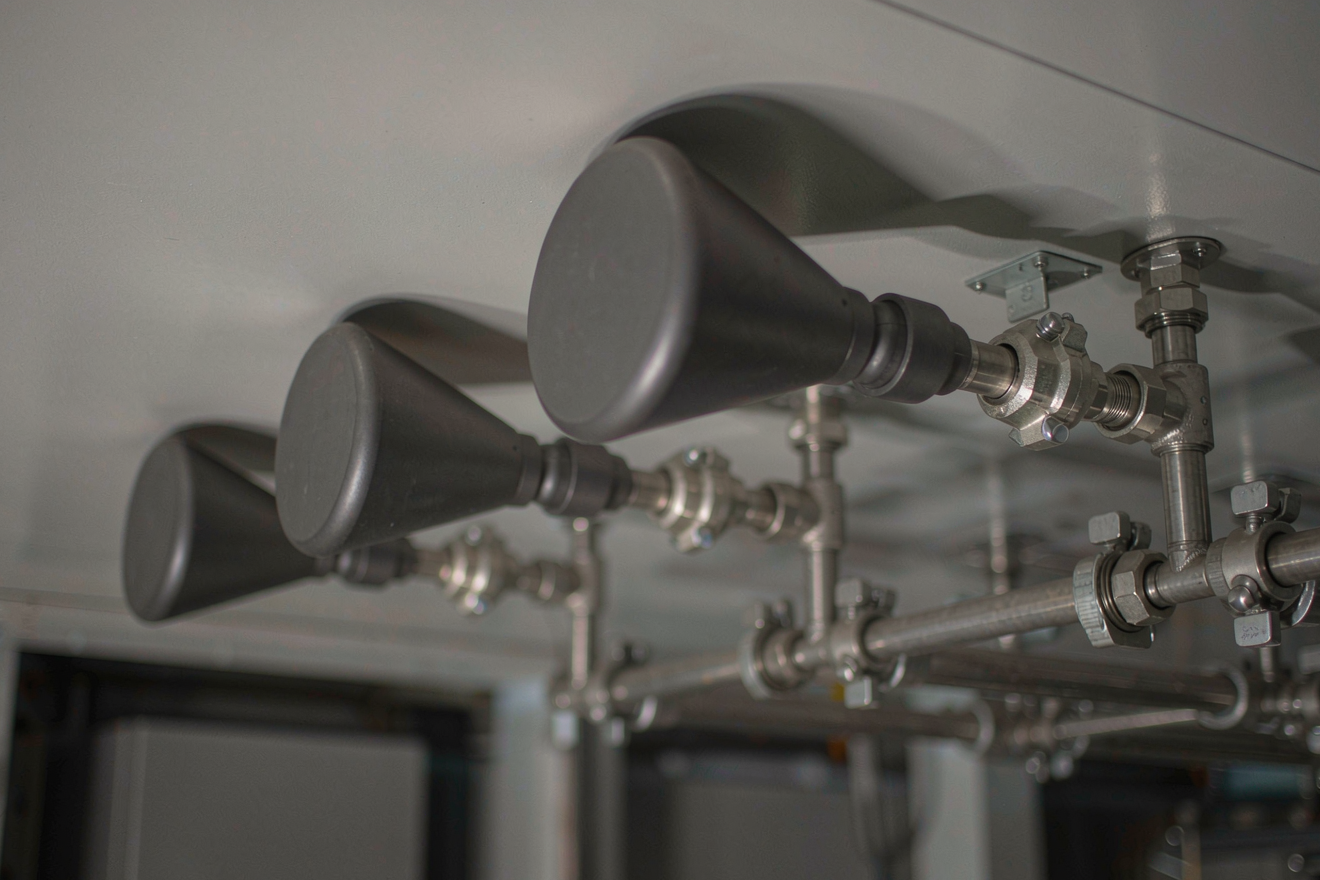
Water is the only suppressant that removes energy. Heating one kilogram of water from twenty-five degrees to steam absorbs about 2.6 megajoules, roughly the entire electrochemical energy of a 700 watt-hour cell. That is why my default cabinet-level protection for stationary storage is open-nozzle water mist or deluge under NFPA 750, with drainage designed in and the DC contactors opened before the water lands. Equipment below the spray envelope must be rated for wet locations, and busbar covers must not shadow the module faces; a spray pattern that misses the cells is decoration.
Sodium-ion sites are often cold-climate sites, which is usually why the chemistry was chosen, and wet pipe systems freeze, so specify dry pipe or preaction with listed antifreeze and check freeze protection on the detection tubing too.
How I layer it
- Cabinet level: water mist, sized to wet every module face, released only after charge disable is confirmed.
- Room level: clean agent or water mist depending on volume, plus code-required sprinkler protection.
- Enclosure: deflagration venting per NFPA 68 and explosion prevention per NFPA 69 wherever vent gas can accumulate in a sealed volume. Never fully seal a cabinet, because a sealed cabinet is a pressure vessel with a fuel supply.
- Condensed aerosol units: I do not use them on battery cabinets, because they cool essentially nothing and leave residue that complicates the investigation.
One compliance point for every design review: sodium-ion modules are still industrial batteries, so IEC 62619 and UL 1973 apply, portable cells fall under IEC 62133-2, transport is UN 38.3, and the installation is NFPA 855. Air transport adds the ICAO technical instructions that FAA and EASA enforce.
Stopping Propagation, and the Numbers That Decide It
Everything above is secondary to the question of whether one module can ignite its neighbor, and that question has a test answer. A unit-level UL 9540A test showing no propagation from the initiating unit to adjacent units is the most valuable document in the project, and every distance in the layout should be traceable to it. Without that report you are designing on chemistry assumptions, and I have watched that fail.
NFPA 855 gives baseline separations, commonly around 0.9 meters between units and three meters from walls with openings, exits and lot lines, with tighter rules as capacity grows. Treat those as a floor, not a design. My own check is simpler: keep the radiant heat flux at the surface of an adjacent unit below roughly ten to twelve kilowatts per square meter, using temperature data from the propagation test. Where the geometry cannot deliver that, I add a barrier rather than argue with the code.
Practical barriers are vermiculite board, ceramic fiber blankets and steel bulkheads between cabinets. Vent direction is part of the same decision: a cabinet that vents into a walkway or into the face of the next unit has failed the layout review, whatever the spacing number says on the drawing.
Do not shrink spacing on chemistry alone
The hard carbon anode in a sodium-ion cell will not release lattice oxygen, and our measured heat release rates run lower than nickel-rich lithium. Lower is not zero, so until you have propagation data for your exact cell, module and cabinet, keep the separations and the barriers.
Interlocks, Commissioning and the Failures I Keep Finding
A detection system that is not interlocked to the charger is a data logger with extra steps. I write the cause and effect matrix before I write the equipment list, and I test it with a logger on the DC contactor and the HVAC controller. Charging must stop before suppression releases, and on any release the recirculation dampers close so the agent is not carried out of the room in ten seconds.
The failure list below is not hypothetical.
- Suppression released but charging was never disabled. The interlock existed on paper and not in the wiring schedule.
- Detection only at the ceiling. A cell vents at cabinet mid-height, the plume disperses over six meters of air, and the room detector triggers after the fire is established.
- Pressure relief undersized for the agent discharge, so the door blows open and the hold time collapses to seconds.
- High-rate exhaust left running during an agent discharge, which does the same thing more quietly.
- Water mist nozzles obstructed by busbar covers, so the water cools the cover and not the cells.
The acceptance sequence I run before handover
- Room integrity door fan test to verify the ten minute hold time required by NFPA 2001, with leakage repair and a repeat test if it fails.
- Detection functional test with real challenge gas on every sampling port and cabinet sensor, with alarm times recorded.
- Suppression discharge verification by cylinder weight loss or flow metering, plus concentration or spray coverage measurement.
- Interlock verification with timestamps at zero, ten and sixty seconds for contactor state, damper position, door closure and HVAC mode.
- Documentation package for the authority having jurisdiction: UL 9540A report, hazard analysis, agent or water calculation, and commissioning records.
After handover the work is unglamorous and it is where most systems decay. Verify suppression cylinder weight or pressure monthly, clean detection heads and sample filters every six months, run a full functional test annually, and infrared terminals and joints yearly. A sodium-ion battery room commissioned well and maintained badly ends up less protected than a lithium room that was maintained.
Frequently Asked Questions
What fire suppression system should I use for a sodium-ion battery room?
Layer it. Cabinet-level water mist or deluge under NFPA 750, room-level clean agent or water mist under NFPA 2001 plus code-required sprinklers, gas detection interlocked to charge disable, and deflagration venting where vent gas can accumulate. Water removes energy, gas protects the room, detection buys time.
Are sodium-ion batteries less likely to catch fire than lithium-ion?
They have a wider margin, not immunity. Without a nickel-rich cathode there is less lattice oxygen available at low temperature, and hard carbon anodes are less reactive, so onset temperatures and heat release rates are generally more favorable. Cell-level abuse testing still produces violent venting events, and installations are still governed by NFPA 855.
Does a clean agent actually stop a sodium-ion battery fire?
It suppresses the room fire and protects adjacent assets, but it does not stop thermal runaway inside a cell. A gaseous agent removes almost no heat, so a module at several hundred degrees will re-ignite once the agent dissipates.
Where should off-gas detectors be mounted in a sodium-ion battery room?
At the source first. Put combination hydrogen, carbon monoxide and VOC sensors in each cabinet exhaust path or at module height, then add room-level smoke or aspirating detection to catch what escapes. Keep sensors at least one meter from supply diffusers and confirm sampling transport time is under sixty seconds.
Do I still need NFPA 855 compliance if I use sodium-ion cells?
Yes. NFPA 855 applies to stationary energy storage installations regardless of chemistry, and the authority having jurisdiction will typically ask for a hazard analysis, the UL 9540A propagation report, detection, suppression and often explosion control. IEC 62619, UL 1973 and UN 38.3 apply to the product and transport in parallel.
What is the most common fire protection mistake in sodium-ion installations?
Releasing suppression without disabling charging. Water mist on a module that is still being charged removes far less energy than the charger is adding, and the event restarts. I verify contactor state with a logger during commissioning, because an interlock that is only in the drawing is not an interlock.
Further Reading
References