Lithium Battery for Boat Lifts and Dock Equipment
I have specified lithium battery packs for marina and dock equipment for more than a decade, and boat lifts remain one of the harshest duty cycles I deal with. A lift hoists several tonnes in seconds, then sits idle in salt air before being asked to work again on a cold morning. Flooded lead-acid banks tolerate that poorly, which is why so many dock owners and lift makers now specify a lithium battery for boat lifts and dock equipment.
This guide is written from an engineering specification point of view. I will cover the load a lift presents, how to size a lithium battery for dock equipment, the enclosure requirements that keep a pack alive in marine air, and the certification rules that must be satisfied before a pack ships. These are the figures I use in quotation documents for lift OEMs, marinas, and dock owners replacing a tired lead-acid bank.
Why Lead-Acid Batteries Struggle on Boat Lifts
A boat lift is a high-inrush, low-duty-cycle load. A typical 4,000 lb (about 1,800 kg) lift uses a 1.1 to 1.5 kW DC hoist motor, which is roughly 90 to 125 A of running current at 12 V nominal; inrush on start can briefly reach two to three times that. A flooded battery sags hard under that inrush, and the Peukert effect means a nominal 100 Ah bank delivers far less at 150 A.
The chemistry also limits usable energy. Flooded lead-acid should not be discharged below roughly 50 percent depth of discharge (DoD); AGM is only slightly better at 60 percent. A lithium iron phosphate (LiFePO4) pack delivers 90 to 95 percent DoD with a flat voltage curve, so a smaller, lighter pack does the same work.
- Cycle life at 80 percent DoD: flooded lead-acid 300 to 500 cycles, AGM 500 to 700, LiFePO4 3,000 to 6,000.
- Weight for comparable usable energy: a 12 V 100 Ah LiFePO4 pack is around 13 kg against roughly 31 kg for an equivalent flooded battery.
- Maintenance: lithium needs no watering, no equalisation charge, and no terminal scrubbing every season.
- Self-discharge: 2 to 3 percent per month for LFP against 5 to 15 percent for a wet cell left disconnected.
For a lift that runs a few minutes a day, the outcome is fewer replacement cycles, less weight on the dock, and no acid spill risk if the enclosure takes on water.
Sizing a Lithium Battery for Boat Lifts and Dock Equipment
Sizing starts with the motor, not the boat. Match pack nominal voltage to the hoist motor: 12 V for small residential lifts and davits, 24 V for mid-size lifts and gangway winches, and 48 V for commercial platforms and heavy winches. Higher voltage reduces current for the same power, cutting cable size and resistive loss.
Capacity is a simple energy budget: multiply load current by run time to get amp-hours per lift, then multiply by the lifts between charges. A 24 V hoist that draws 80 A for three minutes consumes about 4 Ah per lift; fifteen lifts across a weekend day is roughly 60 Ah. A 24 V 100 Ah LFP pack gives 90 Ah of usable energy at 90 percent DoD, leaving margin for cold-weather derating and shared dock lights.
| System voltage | Typical LFP capacity | Typical dock duty |
|---|---|---|
| 12 V | 100 to 200 Ah | Residential lifts, davits, small winches |
| 24 V | 100 to 200 Ah | Mid-size lifts, gangway winches, dock lighting |
| 48 V | 100 to 300 Ah | Commercial platforms, heavy winches, multi-lift marinas |
Two rules of thumb matter more than the arithmetic. First, size for inrush, not just running current: keep the pack continuous rating at least 1.2 times the motor running current, and confirm a 10-second burst rating of about 2C for LFP. Second, when the same pack also powers lights, a pump, or a davit winch, add 30 percent to the daily energy budget instead of treating the lift in isolation.
Marine-Grade Enclosure, IP Rating and Corrosion Protection
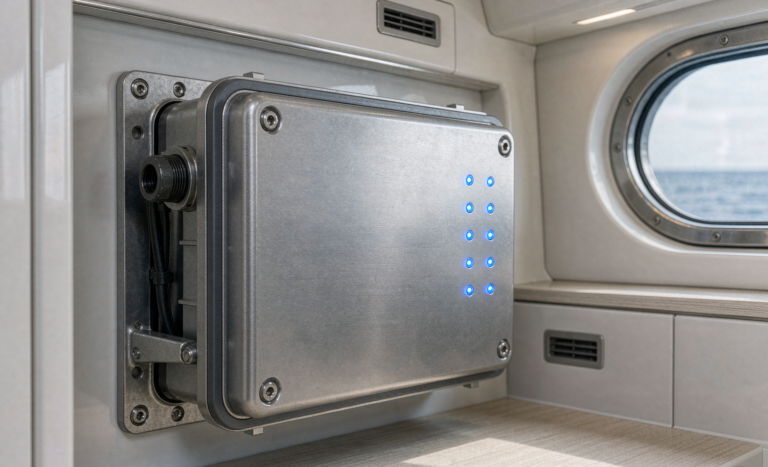
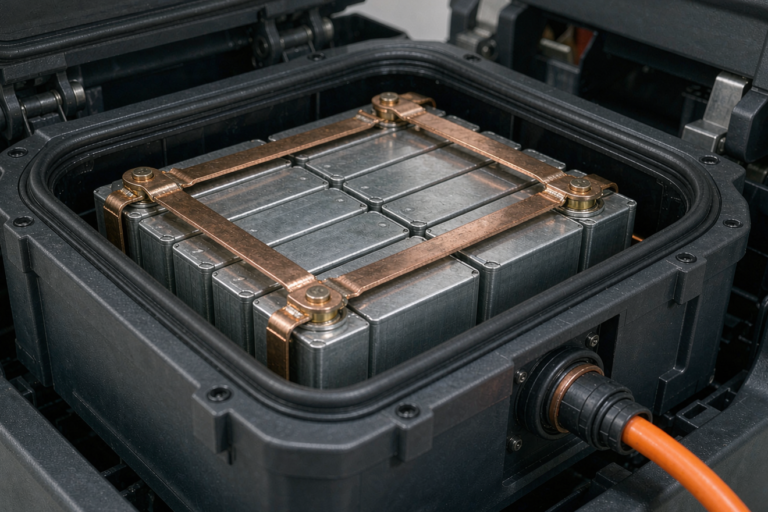
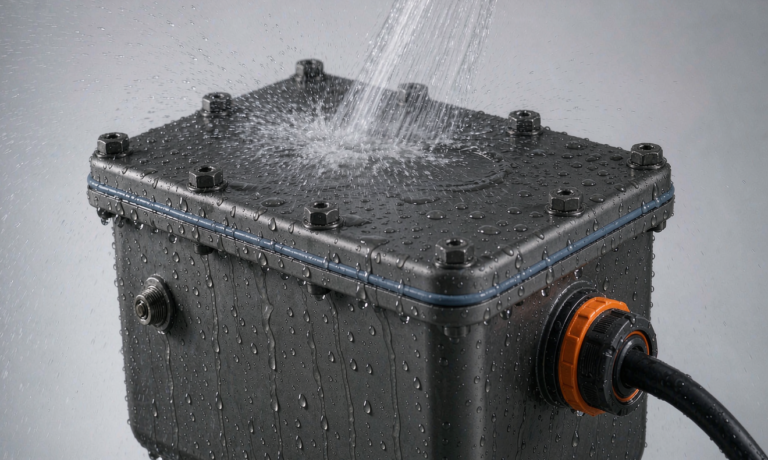
Ingress protection is the biggest determinant of how long a dock pack lasts. IP65 resists water jets, IP66 handles powerful jets, and IP67 survives temporary immersion to one metre for 30 minutes. For a cabinet that gets hosed down, IP66 is the practical minimum; for a pack mounted low on a floating dock, choose IP67.
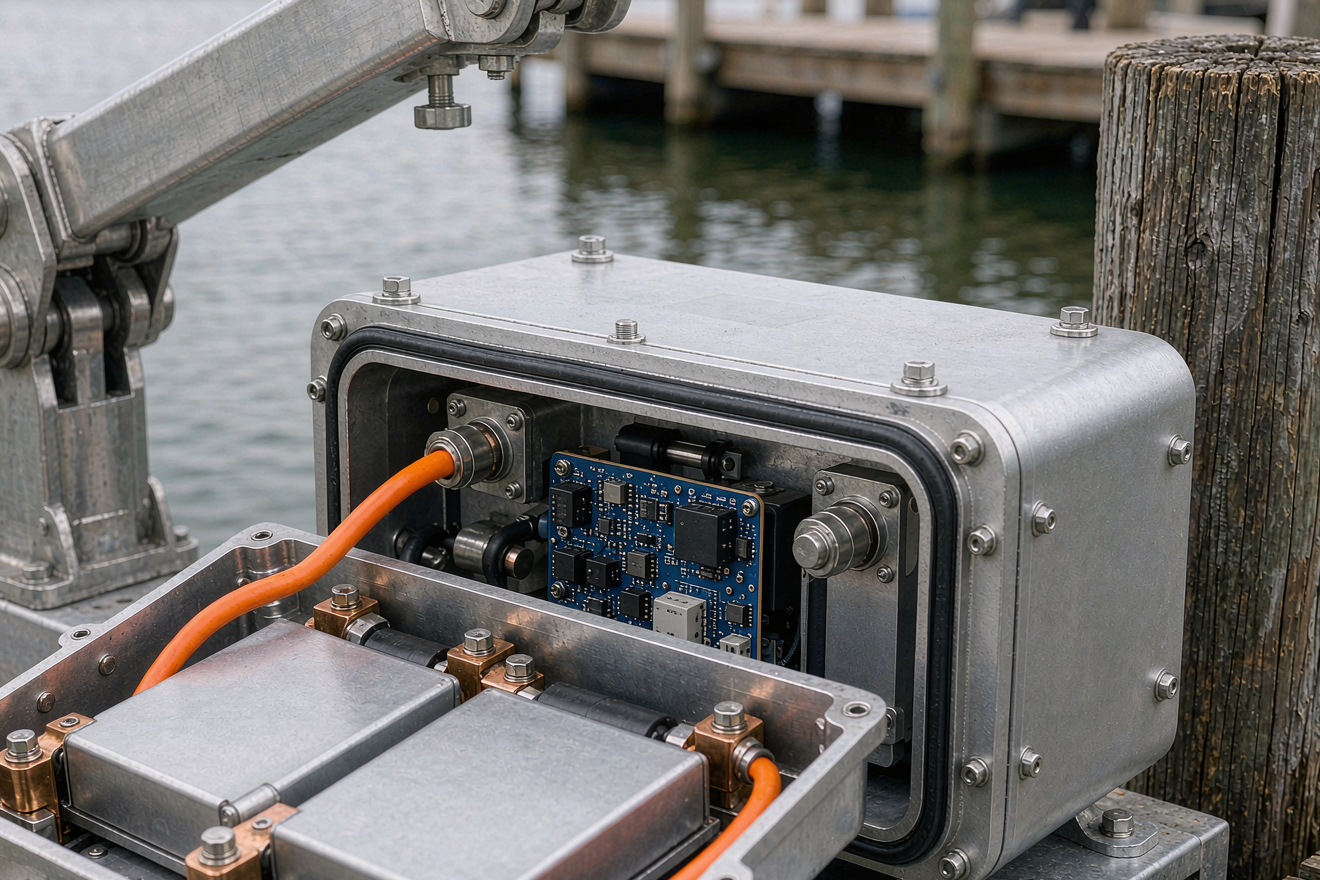
Use 316 stainless fasteners rather than 304, because molybdenum resists chloride pitting. Anodised 6061 aluminium or UV-stabilised polycarbonate handles salt air and sun. EPDM or silicone gaskets stay flexible in cold water, whereas cheap nitrile hardens and leaks within a season.
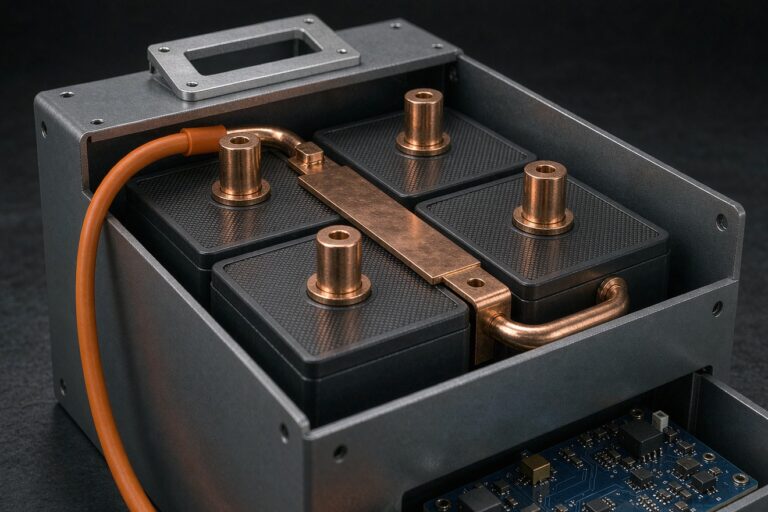
The most under-specified part is the pressure-equalisation vent. Temperature swings between sun and cool water pump humid air in and out; without a rated vent, the gasket breathes moisture into the pack and you get condensation on the BMS. A proper vent equalises pressure while blocking liquid water. Pair it with conformal coating on the BMS board, tinned copper busbars, and dielectric grease at every lug.
BMS, Charging and Shore Power Integration
The battery management system makes a marine pack safe rather than merely powerful. A competent BMS provides cell balancing, over-voltage and under-voltage protection, over-current and short-circuit cutoff, temperature monitoring, and state of charge and health estimation. On a dock, the feature I refuse to compromise on is low-temperature charge cutoff, which blocks charging at or below 0 degrees Celsius.
Charging a frozen lithium cell causes lithium plating, a permanent capacity loss and a safety risk. Discharging to minus 20 degrees Celsius is fine for LiFePO4, but charging below freezing is not. A charge profile of 3.45 to 3.65 V per cell is standard, or 13.8 to 14.6 V for a 4S 12 V pack. Do not float LFP at high voltage for days as you would a wet cell.
For power sources, a marine shore-power charger with a dedicated LiFePO4 profile is the usual choice where mains power reaches the dock. An MPPT solar controller with a lithium setting suits remote docks, and a DC-DC charger lets you charge from an alternator without cooking the pack.
Cold Water, Salt and Long-Term Reliability
Field reliability comes from three habits. The first is winter storage: leave the pack at about 50 percent state of charge, disconnect the terminals, and store it above minus 10 degrees Celsius if you can. Self-discharge is only 2 to 3 percent per month, so it will be ready in spring without a top-up charge.
The second is corrosion discipline. Salt spray testing to IEC 60068-2-52 and damp heat testing to IEC 60068-2-78 are the standards I ask suppliers to evidence, because they expose gasket and coating weaknesses before a customer finds them. The third is an annual inspection: check gasket compression, re-torque terminals to specification, confirm the vent is clear, and look for any green corrosion at the lugs.
Thermal management is rarely a problem at these C-rates, because a lift pack operates in short bursts and rests between them. What kills dock packs is water ingress, not heat, and that is an enclosure and venting problem rather than a cell problem.
Certification, Transport and Safety for Marine Lithium Packs
Before a lithium battery for boat lifts leaves the factory it needs the right paperwork. UN38.3 is mandatory for shipping cells and packs by air or sea. IEC 62133-2 covers sealed secondary cell and pack safety, and North American buyers usually ask for UL 1642 at cell level plus UL 2054 or UL 1973 at pack and industrial level.
Transport is where dock owners get caught out. Lithium packs move as Class 9 dangerous goods, usually at around 30 percent state of charge, with a material safety data sheet and a UN38.3 test summary attached. Spare packs carried by air fall under FAA and EASA watt-hour limits, and terminals must be protected against short circuit.
Lithium iron phosphate is intrinsically more thermally stable than nickel-rich alternatives and resists thermal runaway better under abuse, which matters on a dock where a pack sits next to fuel and vibrating hardware. Specify LFP for dock duty and keep enclosure, vent, and BMS quality high.
Frequently Asked Questions
Can I replace a lead-acid boat lift battery with a lithium battery directly?
The pack will physically fit, but you should not drop in a lithium pack without checking the charger and the motor controller. A lead-acid charger holds a float voltage that is too high for LiFePO4 and will shorten pack life, and some legacy hoist controllers do not tolerate the higher resting voltage. Replace the charger with an LFP-profile unit, confirm the BMS current rating exceeds motor inrush, and check that any alternator or solar input is compatible.
What size lithium battery do I need for a boat lift?
Start from the hoist motor current and the number of lifts per day. A 24 V residential lift that draws about 80 A for three minutes uses roughly 4 Ah per lift, so a 24 V 100 Ah LiFePO4 pack covers a full weekend of intermittent use with margin. For 12 V davits and small lifts, a 12 V 100 to 200 Ah pack is typical. If the same pack also runs dock lights or a pump, add 30 percent to the daily energy budget.
Are lithium batteries safe in a saltwater dock environment?
Yes, provided the pack is built for it. Lithium iron phosphate is chemically more stable than nickel-based chemistries, and a marine pack with an IP66 or IP67 enclosure, 316 stainless fasteners, a pressure-equalisation vent, and a conformally coated BMS handles salt air and washdown well. The failures I see in the field come from cheap enclosures with no vent and untreated terminals, not from the chemistry itself.
How long will a lithium battery last on a boat lift?
At a shallow daily duty cycle, a quality LiFePO4 pack rated for 3,000 to 6,000 cycles at 80 percent DoD will typically outlast the lift mechanism. In calendar terms, expect eight to twelve years with a seasonal pattern of light daily use and proper winter storage at partial charge. Deep discharges and charging below freezing are the two behaviours that shorten life most.
Can I charge a lithium battery for boat lifts with solar panels or a trickle charger?
Yes, if the charger or controller has an LFP profile. An MPPT solar controller with a lithium setting works well for remote docks, and a marine shore-power charger with a LiFePO4 mode is the usual choice where mains power reaches the dock. Avoid legacy trickle chargers that hold a fixed float voltage above 13.8 V, because they will overcharge a 12 V LFP pack. Confirm the controller disables charging below 0 degrees Celsius.
Do lithium marine batteries need UN38.3 or other transport certification?
Yes. Any lithium pack above the small-cell exemptions must have a UN38.3 test summary to ship by air or sea, and most marine OEMs also require IEC 62133-2 for the cells and pack plus UL 1642 and UL 2054 for the North American market. Spare packs travel as Class 9 dangerous goods, usually at around 30 percent state of charge, and air freight of spare packs is subject to FAA and EASA watt-hour limits. Ship with the documentation attached, not promised later.
Further Reading
References