Home Energy Storage for Electric Water Heater Load Shift
As a senior lithium battery engineer at Horizon Power, I am asked constantly where a home battery actually saves money. Solar self-consumption is the obvious answer, but the second-best target usually hides in the utility room. The electric water heater is the largest flexible load in most homes, and pairing it with a home energy storage battery is one of the cleanest load-shift projects you can engineer. In this guide I explain how a home energy storage battery and an electric water heater work together, the sizing math I use in the field, the control logic, and the code points that matter at commissioning.
Why the Water Heater Is the Best Load to Shift
Water heating is 14 to 18 percent of residential energy in all-electric homes, and the water heater is often the biggest deferrable draw after space heating. A typical unit uses two 4.5 kW resistive elements with only one heating at a time. Because the load is purely resistive, its power factor is near unity and inrush is small, which makes it far friendlier to an inverter than motor loads such as well pumps or air conditioners.
The load is thermostatically controlled and naturally deferrable. Hot water is a stored commodity, so heating the tank an hour earlier or later changes nothing at the tap. That is exactly what a home energy storage system needs: a load you can move from an expensive peak window into a cheap off-peak or solar-rich window without affecting comfort.
A 50 gallon tank also hides about 6 kWh of thermal buffer. Every degree Fahrenheit of swing stores roughly 0.12 kWh, so a 50 degree spread between 90 and 140 degrees Fahrenheit is free thermal storage. The lithium battery stores electricity; the tank stores heat. Engineer both and you get a two-layer buffer.
How a Home Battery Covers Water Heater Loads
I use two strategies, usually blended. The first is direct battery supply: during the peak window the inverter powers the water heater from stored energy instead of the grid. The water heater never notices, because the inverter output is a clean 60 Hz sine wave. The second is thermal pre-heat: heat the tank to its upper safe setpoint in the off-peak or solar window, then let that heat carry the home through peak while the battery covers everything else.
In practice the blend wins. I charge the home energy storage battery from midday solar or overnight off-peak power, then schedule the water heater’s two daily heating events into late morning and early afternoon. The evening peak is covered by the battery, so the water heater’s own grid draw is simply avoided. The tank’s thermal mass smooths the short heating spikes, so the battery sees a gentle discharge rather than a hard 4.5 kW step.
For time-of-use households this is the highest-leverage move short of whole-home backup. A custom battery solution that treats the water heater as a managed, deferrable circuit cuts peak demand more than any other single appliance integration.
Sizing the Battery for Your Water Heater
Sizing starts with element wattage and real duty cycle, not nameplate. A 4.5 kW element does not run continuously; it cycles. In a four-person home the water heater may draw 4.5 kW for about 45 minutes twice a day, roughly 6.75 kWh daily, landing near 7 to 9 kWh per day with standby.
A 10 kWh home energy storage pack at 90 percent depth of discharge and 92 percent round-trip efficiency delivers about 8.3 kWh usable, covering a typical day with margin. The discharge rate matters: at 0.5C a 10 kWh pack gives 5 kW continuous, clearing the 4.5 kW element with headroom for inverter losses. I will not spec below 5 kW continuous, because the element and home baseline can overlap in the evening.
If the home also runs a heat pump or electric range at night, I step up to a 13 to 15 kWh pack and a 6 to 7 kW inverter, because the water heater often tips a marginal system into clipping. Right-size the inverter first, then the battery.
Control Logic and Load Priority
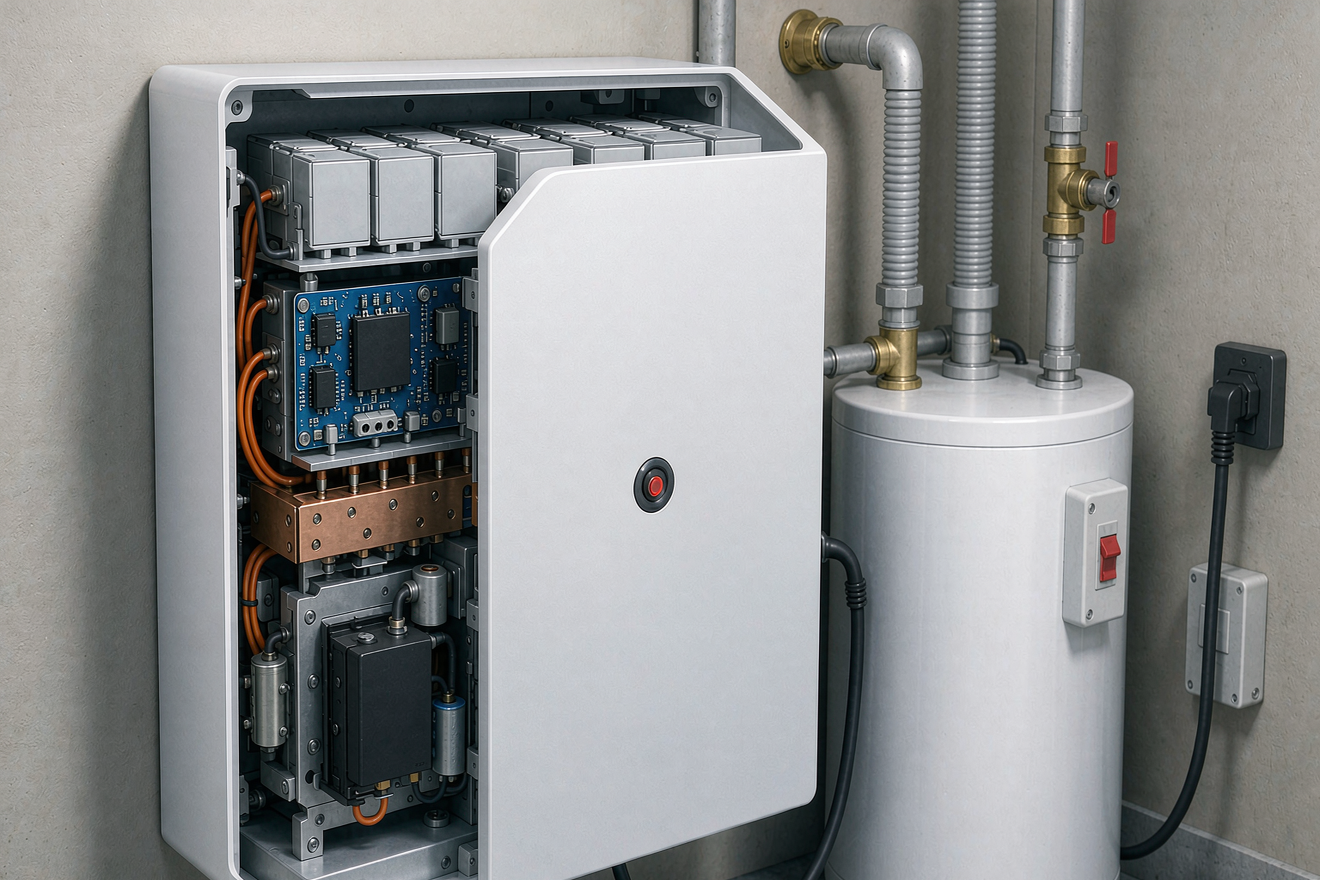
The hardware is simple: a rated contactor on the water heater circuit, driven by the energy management system or the inverter’s load-control relay. The water heater is a low-priority deferrable load, so it sits at the bottom of the shedding order. When state of charge is healthy and the tariff is off-peak, the contactor closes and the tank pre-heats; when the battery is low or the rate is peak, it opens and the tank rides its thermal buffer.
I program a soft window rather than a hard on-off. The system may top the tank whenever state of charge is above 60 percent and the solar forecast is positive, which keeps Legionella risk down and avoids one large draw. The lithium battery’s management system reports state of charge and temperature to the controller over CAN or Modbus; the controller decides. No cloud link is needed for basic logic, which keeps the install robust during the outages you are protecting against.
Sequence the water heater behind the refrigerator, medical devices, and communications. Those are non-deferrable; the water heater waits. That order is what makes a small pack feel large.
Chemistry and Hardware I Specify
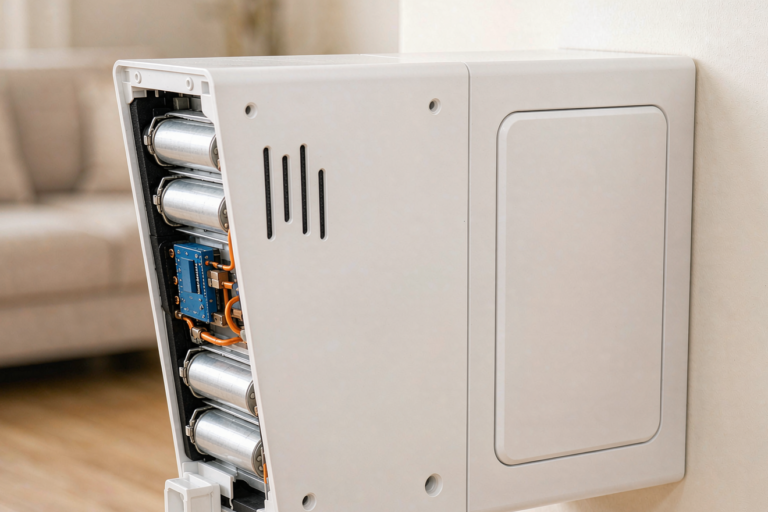
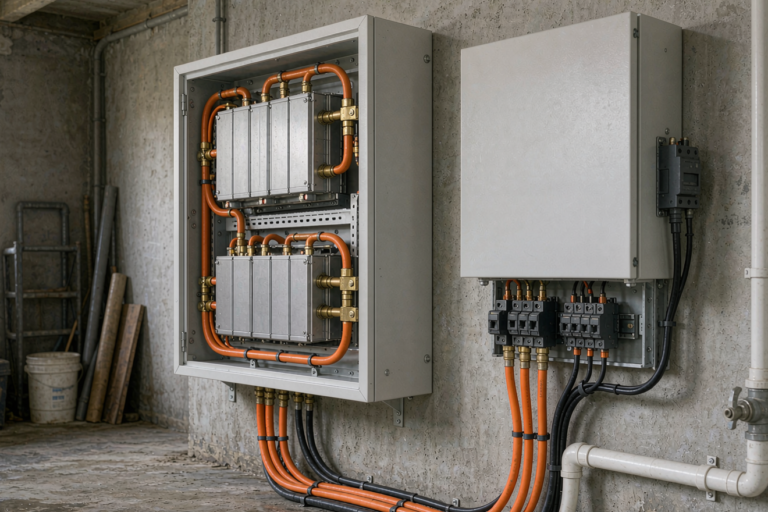
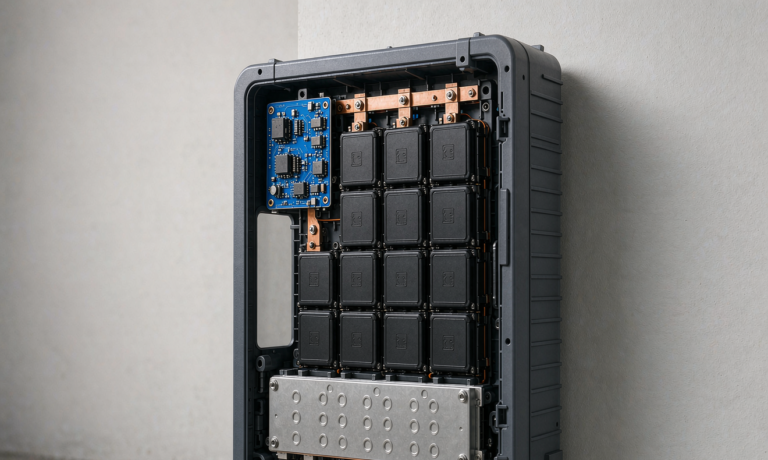
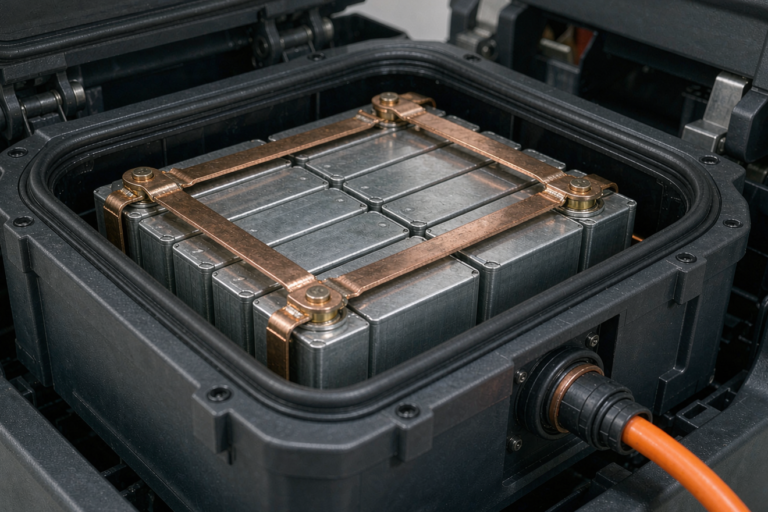
For residential storage I specify lithium iron phosphate almost exclusively. LFP delivers 150 to 180 Wh per kg and 350 to 400 Wh per liter, with 4000 to 6000 full cycles and an adiabatic onset near 250 degrees Celsius, the safest mainstream chemistry for an occupied home. The prismatic cells, blue management board, copper busbars, and orange high-voltage cabling in our enclosures are the same architecture across the Horizon Power home energy storage line.
The inverter must be listed to UL 1741 SB and compliant with IEEE 1547 so it can grid-form, ride through sags, and anti-island correctly. The water heater stays on its own NEC Article 422 branch; the battery sits on its own Article 706 branch with a dedicated disconnect. A custom battery solution here is mostly about matching the inverter’s continuous rating to the element and giving the controller a clean state-of-charge signal.
Codes, Safety and Installation
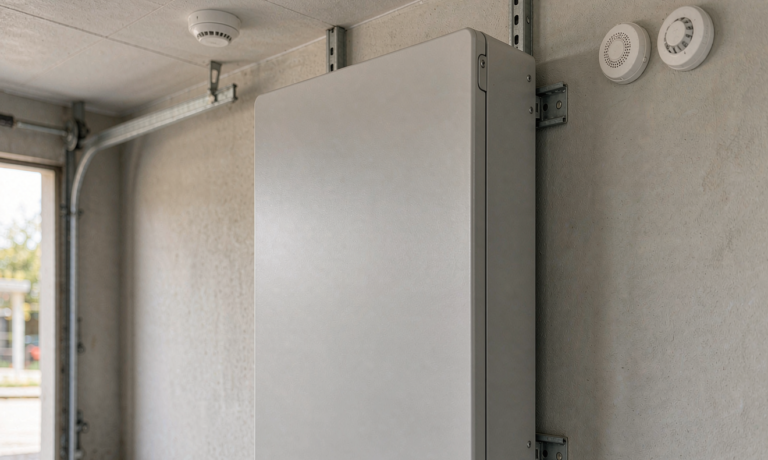
The standards stack is the same on every home energy storage job. The enclosure is listed to UL 9540, the install follows UL 9540A for thermal propagation, and NFPA 855 sets spacing and fire separation. NEC Article 706 governs the storage system; Article 422 governs the water heater. I keep the battery in a conditioned space, never in the water heater closet, because the heater raises local ambient temperature and the battery wants stable cooling.
The temperature and pressure relief valve is non-negotiable and must discharge to a visible terminus, never into the battery enclosure or any sealed space. For the battery I confirm the automatic disconnect and rapid-shutdown labeling, and I verify the inverter’s anti-islanding with a grid-loss test before sign-off.
Transport follows UN38.3 at 30 percent state of charge or below, and the cells carry IEC 62133 and IEC 62619 documentation. None of this is optional for a safe home install.
What the Savings Actually Look Like
The math is simple. If peak is about 0.40 dollars per kWh and off-peak about 0.12, every shifted kWh is worth roughly 0.28 dollars. A water heater drawing 7 kWh per day out of peak saves about 1.96 dollars daily, or roughly 59 dollars per month and 715 dollars per year before any solar credit. In high-tariff regions with demand charges the figure is higher, because the battery also shaves the water heater’s peak spike.
Against a 10 kWh LFP pack and a 5 kW inverter, payback lands in the four to seven year range by local rates and incentives, and the pack keeps working for 4000 to 6000 cycles. The water heater integration adds almost no hardware cost on top of the pack, so it is one of the few upgrades that pays for itself in wiring alone.
Frequently Asked Questions
Can a home battery run an electric water heater during an outage?
Yes, as long as the water heater is on the backed-up load panel and the inverter is rated for the 4.5 kW element. The element is resistive with near-unity power factor, so it is an easy load for a properly sized inverter. Keep the battery state of charge above the setpoint you reserve for critical loads so the water heater does not starve the refrigerator.
Do I need a special water heater to pair it with storage?
No. A standard residential electric resistance water heater works fine. What you add is a controlled contactor on its circuit and scheduling in the energy management system. Heat-pump water heaters also pair well and draw less, but they add a motor load the inverter must handle.
How big a battery do I need for water heater load shift?
For a typical 4.5 kW element and two daily heating events, a 10 kWh pack at 90 percent depth of discharge covers about a day of water heating with margin. Size the inverter to at least 5 kW continuous, because the element and the home baseline can overlap during the evening peak.
Will pre-heating the tank to a higher temperature cause scaling?
Pre-heating to about 140 degrees Fahrenheit for storage is standard practice to suppress Legionella, with a mixing valve at the tap to deliver safe 120 degree Fahrenheit water. Sustained temperatures above that increase mineral scaling, so I keep the storage setpoint at or just below 140 degrees Fahrenheit and rely on the thermal buffer rather than pushing higher.
Is it better to shift the water heater or the whole home?
Shifting the water heater is the cheapest, fastest win because it needs almost no extra hardware. Whole-home backup is a different goal and a different cost. I usually do the water heater load shift first, prove the savings, then expand the controlled load set as the household learns the pattern.
Does load shifting the water heater wear out the battery faster?
Not meaningfully. The daily throughput is modest, around 7 to 9 kWh, and LFP cells handle 4000 to 6000 cycles. Spreading the discharge across the tank’s thermal buffer actually smooths the profile, which is gentler on the cells than a hard step load. The bigger risk is an undersized inverter clipping the element, not battery wear.
Further Reading
References