Lithium Battery for Cordless Vacuum Cleaners
Inside almost every stick vacuum on the market the cordless vacuum battery is a small lithium-ion pack doing something that looks simple and is not: putting out 15 to 30 amperes on demand, inside a shell that cannot breathe, and still surviving several hundred charge cycles in a normal household. I have spent eleven years specifying packs for portable power tools and appliance makers, and the failure calls I take on vacuum batteries almost never start with a dead cell. They start with a pack that was sized for the demo unit and then shipped into a fleet.
Why suction loads punish small packs
A cordless vacuum battery is not a slow load like a phone or a fan. Treat it as a lithium battery first and a consumer cell second. The brushless motor draws 120 to 200 watts during full suction, so on an 18 volt nominal pack that is 7 to 11 amperes continuous, and the moment the impeller spins up the inrush pushes the pack toward 25 to 30 amperes for a second or two. That inrush arrives every single time the trigger is pulled, several times a session.
Three things follow from that duty and they drive every design decision downstream:
- Internal resistance matters more than capacity. A pack with 60 milliohms of DC resistance drops 1.8 volts at 30 amperes. The user sees that as a motor that seems weak exactly when the hose is most clogged.
- Heat has nowhere to go. The pack sits inside the same housing as the intake airway. There is no fan on the cells, only the cooling air the motor drools past them.
- Discharge cutoffs mis-trip. Protection boards set for a 0.5C continuous limit on a 4 amp-hour pack will open at 2 amperes. Suction is a 4C load by comparison.
Choosing cells: 18650, 21700 and series counts
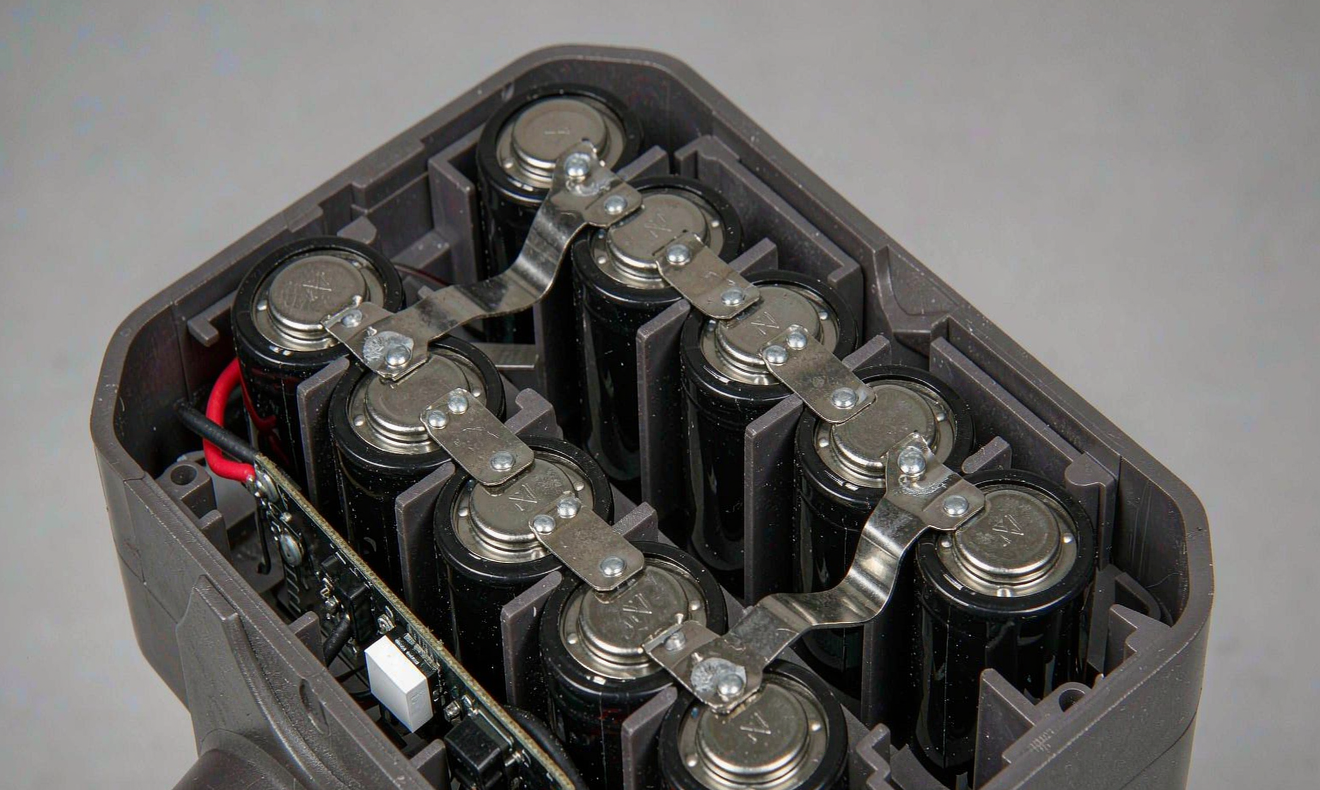
For a 14.4 volt or 18 volt appliance pack the lithium battery build is almost always 18650 or 21700 cylindrical cells in a 4S, 5S or 10S stack, with one or two parallel columns. A 4S1P pack of high-rate 18650 cells gives 14.4 volts nominal and about 2.5 amp-hours, which is what a light handstick uses. Move up to 5S2P and you are at 18 volts and roughly 5 amp-hours, enough for a 20 to 30 minute cleaning run. The 36 volt class used in larger wet-dry machines is typically 10S2P or 10S3P.
On cell choice I split the range into two buckets. For the high-flow models I use a high-rate INR 18650 rated at 20 to 25 amperes continuous, because the motor asks for peak current and a capacity-grade cell sags badly. For the mid-range I use a 21700 with a 10 to 15 amp rating, which buys runtime at lower weight and costs nothing in thermal terms because the suction interval is short. The pack weight budget is the hard limit: most handsticks cannot carry more than 600 grams of battery, and that is about 15 amp-hours of pack at the cell level before the enclosure and the board.
Sizing watt-hours for the real duty cycle
Runtime maths for a vacuum is unglamorous but it is where most specifications lie. Take an 18 volt 5S2P pack of 21700 cells at 5 amp-hours, 90 watt-hours. Full suction draws 150 watts, so the theoretical runtime is 90 divided by 150, which is 0.6 hours. Subtract the inverter and board losses and the motor duty of about 85 percent, and you land at 32 to 36 minutes. That only holds if suction stays at maximum. In real households the average duty is 55 to 65 percent, so the pack will look bigger on paper than in the customer’s hand.
When a customer tells me they need 45 minutes of continuous trade work I do not jump to 10 amp-hours. I ask what the machine draws and then decide where the extra capacity goes, because it goes straight into weight and then into the shoulder joint. On our own fleets we size to the duty, not the marketing number.
Heat inside a sealed housing
High-rate cells in a sealed tube will cook themselves if nothing watches them. A continuous 20 ampere draw on a 18650 dissipates roughly 5 to 7 watts inside a pack that may have 30 grams of air around it. Over a 15 minute session that is enough to push cell surface temperature past 60 degrees Celsius if the intake air is not doing work.
The controls I specify for this are blunt and reliable:
- A temperature sense on the pack negative bus, not on the cells, so the reading follows the hottest path.
- A hard cutoff at 70 degrees Celsius on charge and 75 degrees Celsius on discharge, with a 5 degree hysteresis before reset.
- A flame-retardant housing at UL94 V-0 with a ventilation path that uses the motor’s own airflow, so the pack sees room temperature air instead of exhaust air.
- Pad the cell tops with a graphite fill or a thin aluminium spreader; on a 10S stack it flattens the hottest cell by 4 to 6 degrees.
Protection board, balancing and cell matching
The board in a vacuum pack has to be a motor driver’s board, not a charger’s board, and that is where most lithium battery designs for appliances get it wrong. I set continuous discharge rating from the cell manual with a 1.5 safety factor and never run the pack at the cell’s absolute maximum. Overcurrent trip should be set above the motor’s inrush but below the cell limit: on a 20 amp cell that means a 30 amp trip with a 200 millisecond delay, so the startup kick does not open the pack.
Cell matching matters more here than in a low-draw pack because the current is high. We grade to within 15 millivolts on open-circuit voltage and within 3 milliohms on AC resistance before a pack is assembled. Without that, one cell in a 5S string takes the whole discharge current imbalance and the pack lives to about 60 percent of its cycle rating. Passive balancing with a 60 to 100 milliamp bleed across the string keeps the stack sane over the life of the tool.
Compliance, warranty and fleet replacement
Any pack we ship goes through UN38.3 transport testing and cells are specified to IEC 62133-2. For the appliance itself most markets want IEC 60335 compliance with the battery covered inside, and for US retail the pack should be tested to UL 2054 with the tool listed. None of that is optional once the pack goes into a consumer product with a 20 ampere discharge path.
What the label has to say
Three items on the pack label are the ones retailers and customs officers ask for. The cell chemistry and nominal voltage, the watt-hour rating in watt-hours rather than amp-hours, and the model or part number that ties the pack back to a drawing. We also stamp the hour and the factory code on the cell tabs side of the pack so a field return can be traced to a production day. Buyers who skip that step find out about it the first time a shipment is quarantined at a border.
When a brand comes to us with a new platform we usually start from a custom battery solution rather than an off-the-shelf pack, because the mechanical envelope, the balance lead routing and the discharge profile all have to match the tool. We mock a 5S2P build on the customer’s own housing, run it through the suction duty in a thermal chamber at 45 degrees Celsius ambient, and only then freeze the drawing. On lifecycle, a high-rate 18650 pack in this duty gives 500 to 800 cycles to 80 percent of initial capacity. The LFP cells some buyers ask for in a vacuum are a mistake here: they will not do the peak current and the pack will be heavier. What we do instead is plan the replacement. In rental and hospitality fleets we pull packs at 400 cycles and grade them, and the ones still holding 70 percent go into handheld floor buffers where the draw is 30 watts.
What is the right capacity for a cordless vacuum battery?
It depends on motor watts and duty. For a 150 watt motor with 60 percent average duty, 90 watt-hours gives roughly 35 minutes of usable runtime. Above that, extra capacity adds weight faster than it adds convenience.
Can I use a higher voltage pack in an existing vacuum?
Only if the motor controller and the charger both accept it. A 5S pack on a 4S tool will overdrive the MOSFETs, and a 10S pack on an 18 volt platform will not fit the connector or the protection logic.
Why does my vacuum battery get hot during heavy use?
Because the pack is inside the airflow path and drawing 20 amperes or more. If the housing temperature sensor is working, the pack will shut down near 70 degrees Celsius. If it gets hot to the touch on the outside during normal cleaning, the airway is clogged or the cells are aging.
How long should a vacuum battery last before replacement?
Twelve to eighteen months of daily household use, which is 400 to 600 full cycles. In rental fleets we replace at 400 cycles to avoid stranding a cleaner mid-job.
Is a 21700 cell better than an 18650 for vacuum packs?
21700 wins on runtime and thermal mass, and 18650 wins on availability and peak discharge cost. For a premium handstick with a 400 gram budget, 21700 usually wins. For a cheap tool sold in the millions, the 18650 toolchain is hard to beat.
Do these packs need active cooling?
No. A well-designed passive pack with a sensor cutoff and a spreader plate holds surface temperature under 60 degrees Celsius in normal duty. Active cooling would add the fan, the noise and the failure point that a handheld tool does not need.
Further Reading
References