Battery Solution for Construction Power Tool Fleets
After fifteen years designing lithium packs for industrial equipment, I have learned that a construction jobsite is one of the most brutal environments a battery ever sees. Dust, vibration, freezing mornings, 40°C afternoons, drops from scaffolding, and charge cycles that never stop. When a general contractor asks me for a battery solution construction power tools crews can actually depend on, they are not asking about a single pack. They are asking how to keep an entire fleet of impact drivers, grinders, rotary hammers, and saws running through a full shift without dead tools stalling the schedule. This is where a purpose-built custom battery solution beats a bag of mismatched consumer packs every time.
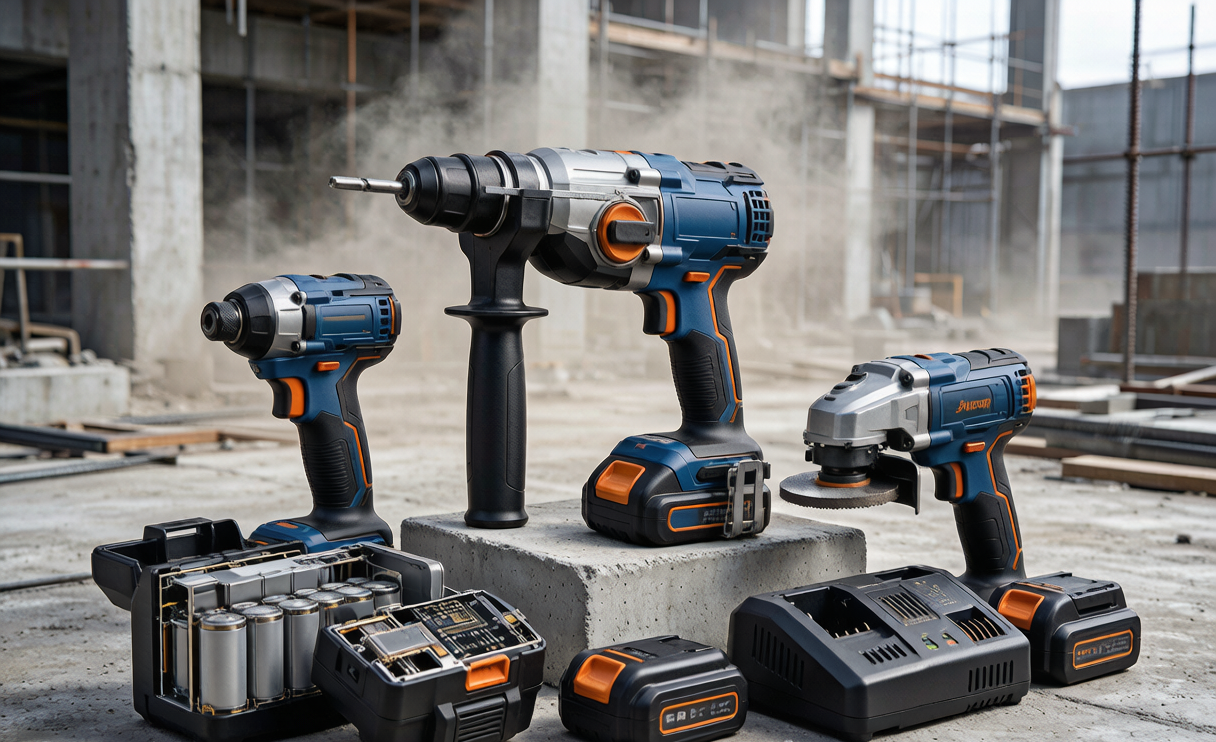
In this guide I will walk through how I approach fleet-level power for construction tools as an engineer: chemistry and cell selection, mechanical ruggedization, charging logistics, the BMS solution that keeps everything safe, and the total cost of ownership math that convinces procurement. My goal is to help you specify a battery application solution that survives the site, not just the spec sheet.
Why Construction Fleets Need a Dedicated Battery Solution
Consumer-grade cordless tools are engineered for a homeowner who runs a drill for ten minutes on a Saturday. A professional crew runs the same class of tool for six to eight hours a day, five or six days a week. That duty cycle changes everything. Heat builds up in packs that never get a chance to cool. Cells that were graded loosely start to diverge in capacity, and the weakest cell drags down the whole pack. A proper battery solution construction power tools program treats the pack, the charger, and the fleet logistics as one system rather than a box you grab off a shelf.
The core problems I see on real sites are consistent: runtime that collapses in cold weather, packs that swell and get scrapped early, chargers that cannot keep up with the number of tools, and no visibility into which packs are near end of life. A well-designed battery application solution attacks each of these directly. It starts with selecting the right chemistry and cell format, then wraps that in mechanical protection and an intelligent BMS solution so the pack behaves predictably from the first cycle to the thousandth.
Chemistry and Cell Selection for High-Drain Tools
Construction power tools are high-drain devices. A 1000W angle grinder or a rotary hammer under load can pull 30 to 60 amps in bursts. That rules out low-rate energy cells and points toward high-power cylindrical cells, typically 21700 format, with continuous discharge ratings of 30A to 45A per cell. When I design a pack, I calculate the peak current at the tool, divide by the number of parallel cells, and confirm each cell stays inside roughly 70% of its rated continuous current to leave thermal headroom.
NMC vs LFP for Power Tools
For most cordless tool packs I specify NMC (nickel manganese cobalt) chemistry. It delivers the high gravimetric energy density (250-280 Wh/kg at cell level) and the burst current that grinders and saws demand, while keeping pack weight low enough that a worker can swing the tool all day. LFP (lithium iron phosphate) is safer and lasts more cycles, but its lower energy density makes handheld tools heavier and bulkier, so I usually reserve LFP for the charging cart or the site energy storage buffer rather than the tool itself.
Cell grading matters enormously here. In a high-drain pack, one under-performing cell overheats and ages faster, so I insist on Grade A cells sorted to within a tight capacity and internal-resistance band. This is the single biggest quality difference between a professional custom battery solution and a cheap import pack that swells within a season.
Mechanical Ruggedization for the Jobsite
A battery that passes an electrical test in the lab is useless if it cracks on the first drop. Construction packs need mechanical design that assumes abuse. I design the enclosure to survive a 1.5 to 2 meter drop onto concrete on every face, using glass-filled nylon housings, internal cell holders that isolate each cell from shock, and potting or foam to stop cells from moving under vibration.
Ingress protection is equally critical. Concrete dust is conductive when damp and gets into everything. I target at least IP54 for the pack and the tool interface, with gasketed seams and drainage paths so condensation does not pool on the terminals. The contacts themselves should be gold-flashed or heavily plated to resist the fretting corrosion that vibration causes over thousands of insertion cycles. These details are invisible on a datasheet but decide whether a fleet survives two years or six months.
The BMS Solution: Protecting Every Pack in the Fleet
The battery management system is the brain of any serious battery solution construction power tools deployment. At minimum, the BMS solution must handle overcurrent protection, over- and under-voltage cutoff, cell balancing, and temperature monitoring with cutoff thresholds. For a fleet, I push for more: a fuel gauge that reports true state of charge, a cycle counter, and a state-of-health estimate so the site manager knows when a pack is nearing retirement before it fails on the tool.
Temperature management is where most tool packs fail in the field. Fast, repeated high-current discharge combined with rapid recharging pushes cell temperatures up. My BMS designs enforce a charge-temperature window (typically 0°C to 45°C) and will pause charging on a hot pack that just came off a saw, then resume when it cools. This one behavior prevents most of the swelling and premature aging I am called in to diagnose. I also design the BMS to log fault events so we can trace whether failures come from abuse, a bad charger, or a genuine cell defect.
Charging Logistics: Keeping the Whole Crew Running
People underestimate charging. A ten-person crew might carry thirty packs, and if they all need to recharge overnight on four chargers, the site starts the day short. A real battery application solution sizes the charging infrastructure to the fleet: enough multi-bay chargers to turn every pack around within the off-shift window, ideally with a staggered or sequential charge algorithm that limits peak electrical demand on the site supply.
I favor smart multi-bay chargers that communicate with the pack BMS. They can charge at the correct rate for each pack’s temperature and health, flag packs that fail diagnostics, and prioritize the packs the crew needs first. On larger sites I pair the charging bank with a buffer energy storage unit so charging does not trip breakers during peak load. Getting charging logistics right is often what turns a good pack into a genuinely reliable fleet.
Standards, Compliance and Safe Transport
Any lithium pack that ships or flies has to meet international safety and transport standards, and construction fleets are no exception. Every pack I design is validated to UN38.3 for transport safety, which covers altitude, thermal cycling, vibration, shock, and short-circuit testing. For the cells and pack safety I work to IEC 62133, and for tools sold into the EU and US markets I confirm CE, UL, and where relevant FCC compliance for any wireless telemetry.
These standards are not paperwork for its own sake. UN38.3 vibration and shock testing directly mirrors what a pack endures rattling around in a truck between sites, and IEC 62133 abuse testing confirms the pack will not propagate a thermal event if a single cell fails. Specifying a custom battery solution from a manufacturer that tests to these standards is your insurance against a jobsite fire and a recall.
Total Cost of Ownership: The Procurement Argument
Procurement teams often anchor on the sticker price of a pack, but that is the wrong number. The right number is cost per usable cycle across the fleet’s life. A cheap pack rated for 300 cycles that swells and dies in a season costs far more per shift than a professionally engineered pack rated for 1000 to 1500 cycles that holds capacity for three years. When I build the TCO case, I include pack lifespan, downtime cost when a tool dies mid-task, warranty replacement rate, and disposal.
In practice, a well-specified battery solution construction power tools program with Grade A cells, a proper BMS, and matched charging usually pays back its premium within the first year through reduced replacements and near-zero unplanned downtime. That is the argument that wins over finance: not a cheaper battery, but a lower cost per hour of tool uptime.
Frequently Asked Questions
What is the best battery chemistry for construction power tools?
For handheld high-drain tools, NMC cylindrical cells (usually 21700) are the standard choice because they combine high energy density with the burst current grinders and hammers need. LFP is better suited to charging carts or site storage buffers where weight matters less and cycle life and safety are prioritized.
How long should a professional tool battery pack last?
A properly engineered pack with Grade A cells and a good BMS should deliver 1000 to 1500 cycles while retaining at least 80% capacity, which typically means two to three years of daily professional use. Cheap packs often fail within 300 cycles due to poor cell grading and inadequate thermal management.
Can one battery solution cover a mixed fleet of tools?
Yes, and that is the point of a fleet-level battery application solution. By standardizing on a common pack platform and interface across compatible tools, a crew can share packs and chargers, simplify inventory, and reduce spares. A custom battery solution provider can design a modular pack family that scales across tool classes.
Why do construction batteries swell and how do you prevent it?
Swelling comes from gas generation inside cells, driven mainly by heat, over-charging, and aging of low-grade cells. Preventing it requires Grade A cells, a BMS that enforces charge-temperature limits and pauses charging on hot packs, and mechanical design that allows heat to escape. These measures are core to any serious BMS solution.
Do construction tool batteries need special safety certification?
Yes. Packs should be tested to UN38.3 for transport and IEC 62133 for cell and pack safety, plus CE, UL, or FCC marks depending on the destination market and whether the pack includes wireless telemetry. Insisting on these certifications protects against fire risk and market-access problems.