Battery Solution for Event and Stage Production
Twelve years on the road with concert tours and corporate show crews taught me one thing faster than any textbook: power is the heartbeat of a live event, and the moment it stutters, the show stutters with it. For most of my early career that heartbeat was a diesel generator behind the stage, loud, hot, and pumping exhaust into the load-in area. Over the last four years I have watched the industry flip toward a lithium battery solution that sits silently under the truss and runs an entire stage for a full shift. This article is the engineer’s field guide I wish someone had handed me before my first festival deployment: how to size, spec, and safely run a battery solution event stage production rig without a generator humming in the background.
Why Event Productions Are Moving Off Generators
The case for battery power in live production is rarely about being green first; it is about control. A generator has a warm-up curve, a voltage sag when the bass drops, and a decibel footprint that ruins acoustic sets and broadcast audio. A well-designed custom battery solution delivers flat voltage from 100% to empty and zero acoustic noise. At an indoor theater or a museum gala, diesel exhaust and carbon monoxide are simply not permissible, so a silent lithium battery pack becomes the only compliant option.
I have also seen the fuel logistics problem up close: 50-gallon tank runs at 2 a.m., a fuel truck that cannot reach a fenced city plaza, and a call time that slips because the genny failed its load bank test. Swapping that for a charged enclosure that rolls in on a cart removes an entire class of failure. For touring acts, the math is even cleaner once you count generator rental, fuel, and the crew hours to baby it.
Sizing the Battery: Real Watt-Hours for Lights, Amps, and Screens
Sizing looks trivial until you meet crest factor. A moving-head wash fixture may draw 300 W steady but pull a 6x inrush when its lamp or LED driver strikes. A subwoofer amplifier rated 1,500 W continuous can briefly demand 4,000 W on a kick drum transient. The battery and inverter must tolerate the peak, not just the average.
- List every load with its continuous and peak watts. Lighting, audio, LED video walls, haze fans, and comms each get a line.
- Apply a derate of 20-30% on usable capacity. I treat a 5 kWh pack as 3.5-4 kWh usable to protect cycle life and keep voltage inside the inverter’s sweet spot.
- Model the show timeline, not a single number. A 4-hour main show with a 2-hour load-in before it is a 6-hour draw at different rates.
- Add headroom for inrush. Size the inverter at 1.5-2x your highest sustained load so moving lights and amp transients never clip.
For a mid-size stage of roughly 8 kW continuous peak, I typically specify a 20-25 kWh battery solution to cover a full evening with margin. A small acoustic set in a 200-seat room might need only 3-5 kWh.
Chemistry Choice: LFP vs NMC for Touring Rigs
For event and stage work I almost always recommend LFP (LiFePO4) over NMC. The thermal runaway threshold of LFP sits near 270 degC versus roughly 150 degC for NMC, a meaningful safety margin when packs sit inside a packed venue near pyro and hot lights. LFP also delivers 3,000-6,000 cycles versus 800-1,500 for NMC, which matters because touring gear lives a hard life.
The trade-off is energy density. NMC is lighter per watt-hour, which can matter for flying a pack on a tight weight budget. But the fire-safety and cycle-life argument wins for indoor and audience-adjacent deployments. I spec NMC only when weight is genuinely the binding constraint and the pack will live in a ventilated, attended enclosure.
Inverter and Power Quality: Protecting Sensitive Audio and DMX Gear
Stage gear is unforgiving about power quality. A cheap modified-sine inverter will buzz through every channel and can confuse the switching supplies inside LED fixtures and media servers. I require a pure sine inverter with total harmonic distortion under 3% and proper neutral-ground bonding.
- Isolation: keep audio and lighting on separate inverter legs or dedicated isolating transformers to kill ground loops that show up as hum.
- Power factor: specify inverters that hold voltage with loads down to 0.7 pf, common with older lamp-based fixtures.
- UPS mode: a unit that transfers in under 10 ms keeps media servers from rebooting during a brief grid blip.
A clean custom battery solution with a quality inverter is quieter electrically than most venue grid feeds I have measured.
Safety, Transport, and Compliance for Touring Batteries
Touring packs cross borders and fly between cities, so compliance is not optional. Every pack I ship conforms to UN38.3, the transport testing standard covering altitude simulation, thermal, vibration, shock, external short, impact, and overcharge. Cells and small packs carry IEC 62133-2 for safety, while large stationary-format enclosures on site follow IEC 62619 for industrial battery safety.
When gear flies as air cargo, I plan around IATA/FAA and EASA lithium rules: state-of-charge capped near 30%, UN-tested packaging, and correct hazard labeling. Note that FAA and EASA govern air transport of the packs, not the on-stage operation. On site I also look for an IP54 or better enclosure so a spilled drink or rain cover failure does not reach cells, plus a BMS that reports cell temperature and state-of-charge to the crew tablet.
A Real Deployment: A Three-Day Outdoor Festival Stage
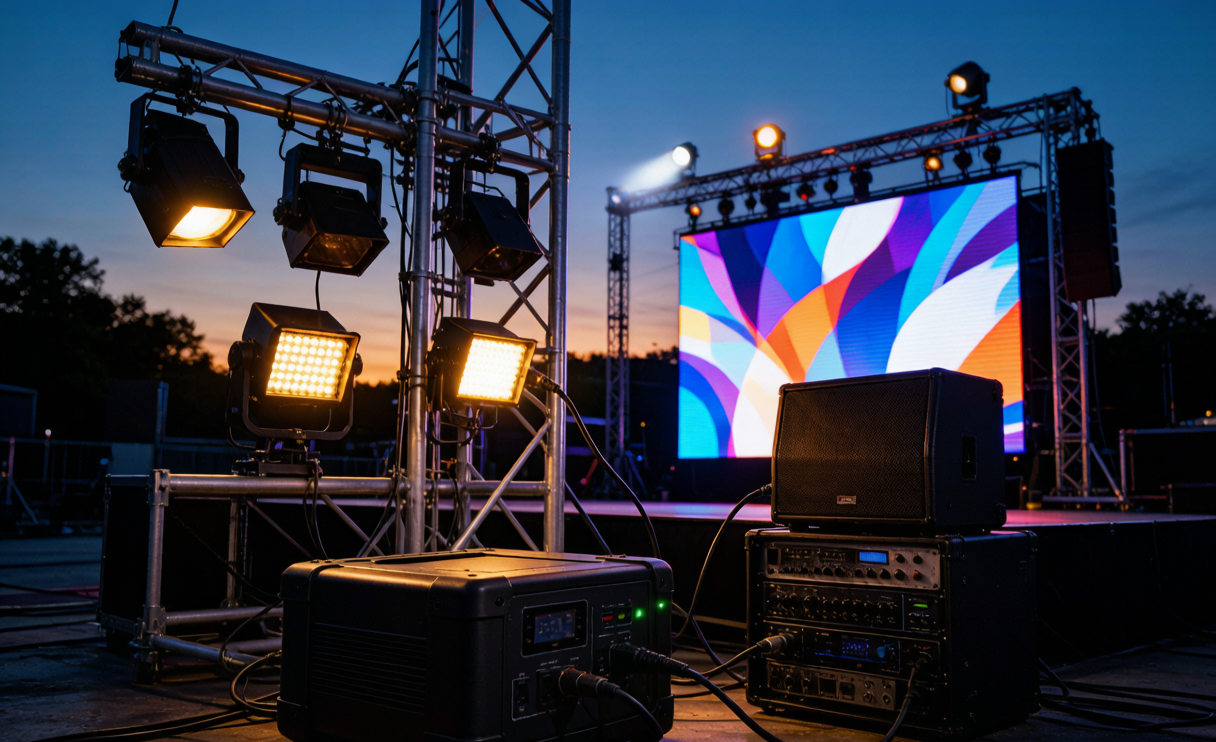
Last season I built a battery solution event stage production system for a three-day outdoor festival: two 15 kWh LFP enclosures feeding a 10 kW pure-sine inverter, split into lighting, audio, and video legs. Total draw averaged 6.2 kW across an 8-hour daily shift, peaking at 9.1 kW during the headline laser-and-bass set. We rolled in fully charged each morning from grid top-up overnight, never touched a generator, and the only noise complaint all weekend was about the music being too loud, which is exactly the kind of problem you want.
The crew saved roughly six hours of generator-related labor across the event and eliminated two fuel deliveries. Cycle data showed the packs ended each day at 38-44% state-of-charge, confirming the 30 kWh of storage was correctly sized with healthy margin.
Frequently Asked Questions
How long will a battery power a stage light rig?
It depends on total watt-hours and your load. Divide usable pack capacity (watts times hours) by your average draw. A 20 kWh pack at a steady 5 kW average runs about 3.5-4 hours after derating. Build your timeline first, then size.
Can lithium batteries be used indoors at venues?
Yes, with the right chemistry and enclosure. LFP packs with IEC 62619 compliance, a ventilated IP54 enclosure, and a monitored BMS are routinely used indoors. Avoid generators indoors entirely; battery is the safer choice there.
Do I still need a generator backup?
For mission-critical broadcasts I keep a grid or generator tie-in as automatic backup, but many events now run battery-only. The decision hinges on your risk tolerance and whether a 10 ms UPS transfer covers your gear.
How do I transport event batteries by air?
Follow IATA/FAA and EASA lithium rules: UN38.3-tested cells, SoC near 30%, UN-spec packaging, and proper hazard marking. Work with a freight forwarder experienced in Class 9 lithium shipments and pre-file the documentation.
What certifications should an event battery pack have?
At minimum UN38.3 for transport, IEC 62133-2 for cells, and IEC 62619 for large-format industrial packs. Pair that with an inverter carrying relevant safety marks and an enclosure rated IP54 or better.