Battery Solution for Remote Weather Stations: Engineering a Reliable Off-Grid Power Core
Why a Remote Weather Station Needs a Purpose-Built battery solution
When I first started deploying automatic weather stations (AWS) across mountainous and coastal sites in 2014, the single biggest cause of data gaps was not the sensors — it was the power system. A battery solution for remote weather station deployments has to survive what most consumer electronics never see: −35°C winters, salt spray, months without a service visit, and zero grid connection. Off-the-shelf power banks simply die. Over the last decade I have engineered more than 40 of these systems, and the lessons are remarkably consistent. You are not buying a battery; you are buying continuity of measurement.
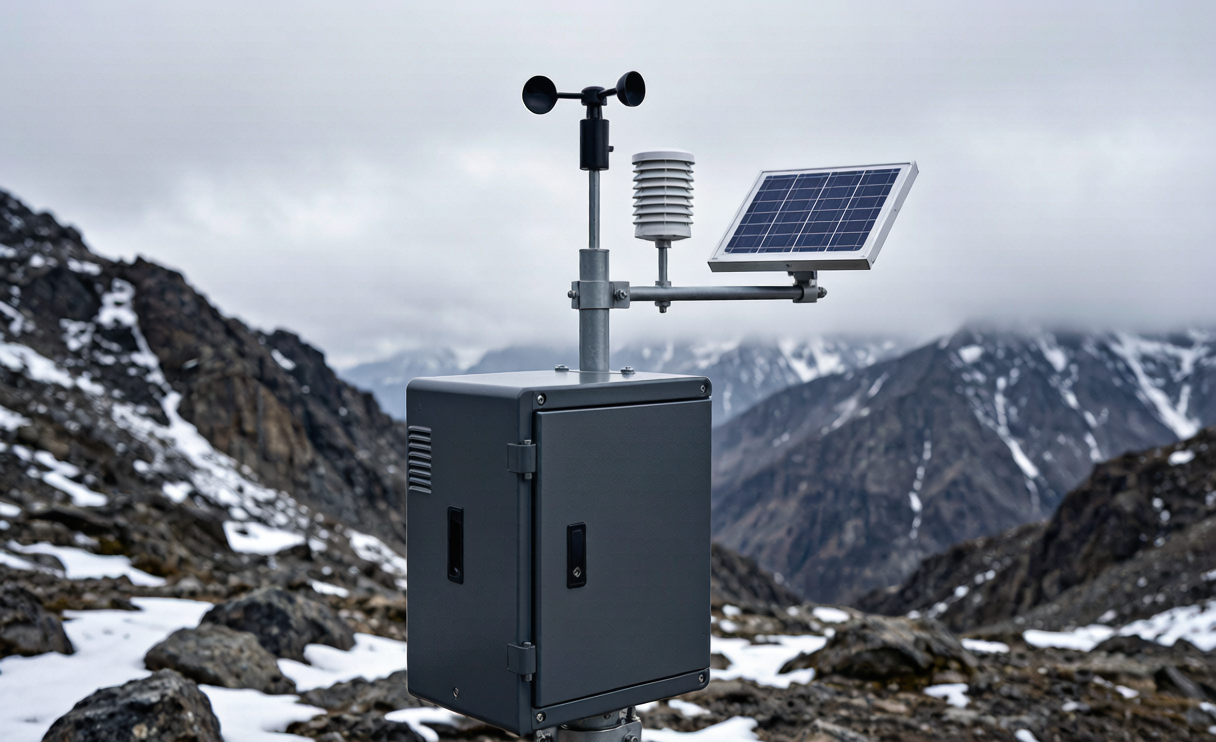
A weather station is a low but non-stop load. A typical AWS draws 0.3–2.5 A at 12 V, depending on whether it runs a heated湿度 shield, a data modem, or a camera. The challenge is not peak power — it is autonomous endurance through the worst week of the year, not the best. That is why a custom battery solution sized to the local climate and duty cycle outperforms any generic pack by a wide margin.
Sizing the Battery: Energy Budget and Autonomy
The first step in any battery solution design is an honest energy budget. I list every consumer: logger (0.15 A), cellular modem burst (up to 1.2 A for 90 s every 10 min), heater (up to 2 A in extreme cold), sensors (0.1 A). Multiply by 24 hours and you get a daily watt-hour figure. For a mid-size coastal station I usually land near 65–90 Wh/day.
From there, autonomy drives capacity. If the solar array is reliable, I design for 5 days of zero sun. In arctic or monsoon sites with long dark seasons, I push to 21–30 days. A lithium battery pack at 12.8 V / 100 Ah gives roughly 1,280 Wh — enough for two to three weeks of autonomy for most stations. I always derate usable capacity to 80% to protect cycle life, a discipline that pays off in year five.
- Daily load: measure, do not estimate. A clamp meter on a running station beats any spreadsheet.
- Worst-case solar: size the PV to the lowest monthly irradiance, not the annual average.
- Temperature factor: below 0°C, usable capacity of any lithium battery drops — plan for it explicitly.
- Margin: keep 20% headroom so the BMS never trips on a cold morning surge.
Chemistry Choice — Why LFP Leads in Harsh Climates
For remote telemetry, I standardize on LiFePO4 (LFP) unless a client has a specific weight target. LFP runs a flat 3.2 V nominal per cell, tolerates 3,000–6,000 cycles, and — crucially — stays stable near full charge in freezing weather. NMC offers more energy density but degrades faster and is less forgiving thermally, which raises risk for an unattended site.
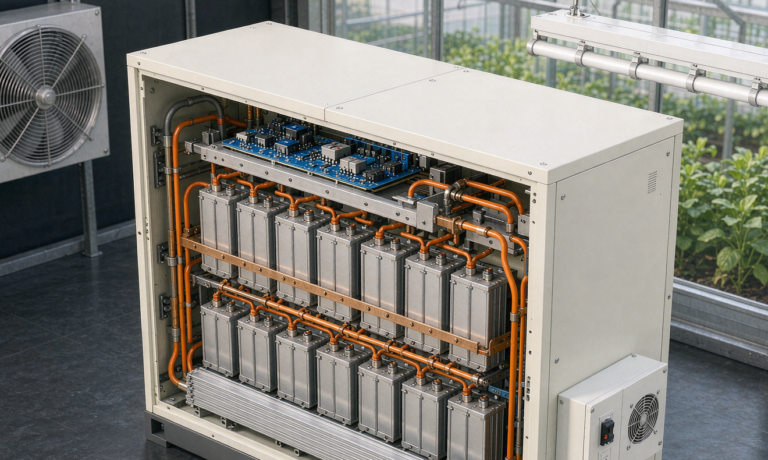
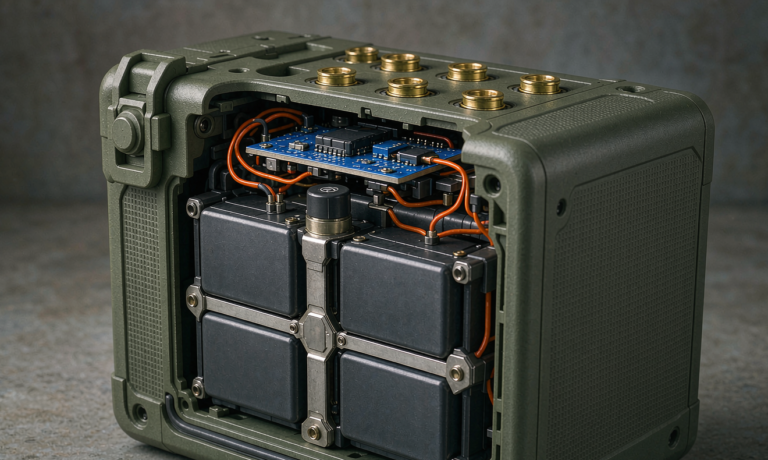
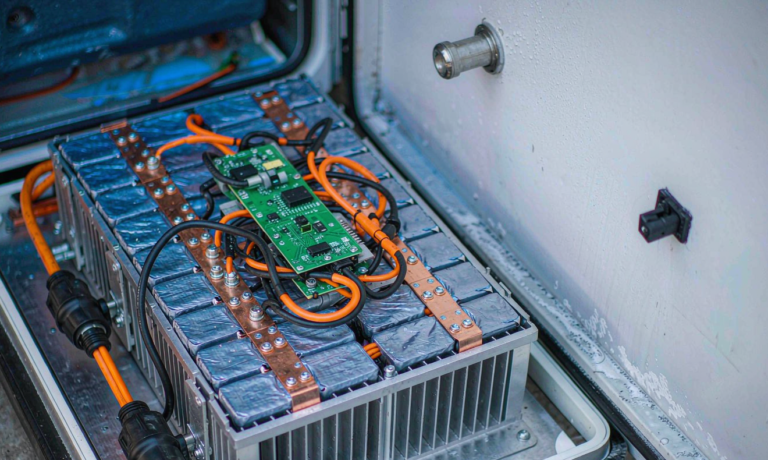
In a custom battery solution for a weather station, I typically build a 4S LFP pack (12.8 V) with grade-A cells and a sealed IP65 enclosure. The enclosure does double duty: it keeps rodents and condensation out and lets me bolt on a small heating element for sub-zero startup. When a project demands the lightest possible payload — say a station flown to a ridge by drone — I have even adapted a high-discharge drone battery cell format into the same 4S topology, proving the building blocks translate across our product lines.
Thermal Management and Cold-Climate Operation
Cold is the silent killer of remote battery systems. Below −10°C, LFP internal resistance climbs and charge acceptance collapses; force a charge onto a frozen cell and you plate lithium metal, permanently damaging it. My standard defense is a self-limiting silicone pad heater bonded to the pack, switched by the BMS only when cell temperature drops below 0°C and the State of Charge (SoC) is above 20%.
For tundra or alpine deployments I add a foil-faced insulation wrap and, on the most extreme sites, a vacuum-panel layer. The goal is simple: keep the core above −5°C even when the air hits −40°C. A well-insulated battery solution for remote weather station sites routinely rides out polar nights on stored energy plus a trickle from a tiny wind supplement.
Remote Monitoring, BMS and Fail-Safe Design
No one is standing next to these stations, so the BMS has to be the engineer on site. I spec a communications-capable BMS that reports pack voltage, cell delta (<30 mV target), temperature, and SoC over the same modem the station uses. If the BMS sees a cell drift beyond threshold or a temperature fault, it sends an alert and, if needed, isolates the load before damage spreads.
Fail-safe means graceful degradation. I wire the modem and logger to a protected always-on bus, while the heater and non-essential sensors sit on a switched bus the BMS can shed under low-SoC conditions. The station keeps reporting even when it can no longer heat itself — preserving the data stream is the whole point of the battery solution.
Certifications and Safe Transport
Shipping batteries to a remote trailhead or island is its own engineering problem. Every pack we build for field deployment is validated to UN38.3 (the UN Manual of Tests and Criteria for lithium cells and batteries) and documented under IEC 62133 for safety of portable sealed secondary cells. For air freight of spares to international sites, we follow IATA / FAA and EASA rules for lithium batteries, including state-of-charge limits (typically ≤30% for standalone air shipment) and proper Section II or Section IA labeling.
I keep a certified MSDS and a test summary on file for every shipment. Buyers specifying a custom battery solution should demand the same — it is the difference between a customs hold and a clean delivery.
A Real Deployment Example
Last year we equipped a ridge-top station at 3,100 m with a 12.8 V / 120 Ah LFP pack, a 120 W tilted PV array, and a BMS with cellular telemetry. Worst-case load was 78 Wh/day; the pack delivered 21 days of autonomy through a February storm with zero sun. After 14 months the pack retained 94% of original capacity. That is the kind of result a properly engineered battery solution for remote weather station programs should expect, not hope for.
Frequently Asked Questions
How long should a remote weather station battery last?
With LFP and an 80% depth-of-discharge limit, expect 8–12 years or 3,000–5,000 cycles. The enclosure and BMS usually outlive the cells, so a modular pack design lets you swap cells without replacing the housing.
Can I use a standard solar generator instead of a custom battery solution?
For a temporary or mild-climate install, yes. But for unattended, extreme-temperature, or certification-required sites, a custom battery solution with a weather-rated enclosure and telemetry BMS is far more reliable and avoids constant truck rolls.
What capacity do I actually need?
Measure your daily watt-hours, then multiply by your required autonomous days, divide by usable voltage, and add 20% margin. Most AWS sites land between 60 Ah and 150 Ah at 12.8 V.
Is a lithium battery safe in a unattended outdoor enclosure?
Yes, when built to IEC 62133 with a protective BMS, IP65 enclosure, and thermal controls. LFP is among the safest lithium chemistries available and is my default for exactly this reason.
How do you handle shipping the pack to a remote site?
All packs are UN38.3 tested and shipped per FAA/EASA and IATA lithium-battery rules, usually at ≤30% SoC with correct documentation and labeling to prevent customs or carrier delays.