Battery Solution for Electric Skateboards and Scooters: An Engineer’s Build Guide
As a senior lithium battery engineer at Horizon Power, I have spent the last decade designing packs for everything from heavy-lift drones to grid-scale storage. Over the past three years, one product category has grown faster than almost anything else in our custom battery solution pipeline: personal electric vehicles (PEVs) — electric skateboards and kick scooters. Riders want more range, faster charging, and above all a pack they can trust at 25 km/h on a crowded street. This guide walks through how we specify, build, and certify a battery solution for electric skateboard and scooter products, using the real numbers and standards we apply on the bench every week.
What Makes PEV Battery Packs Different
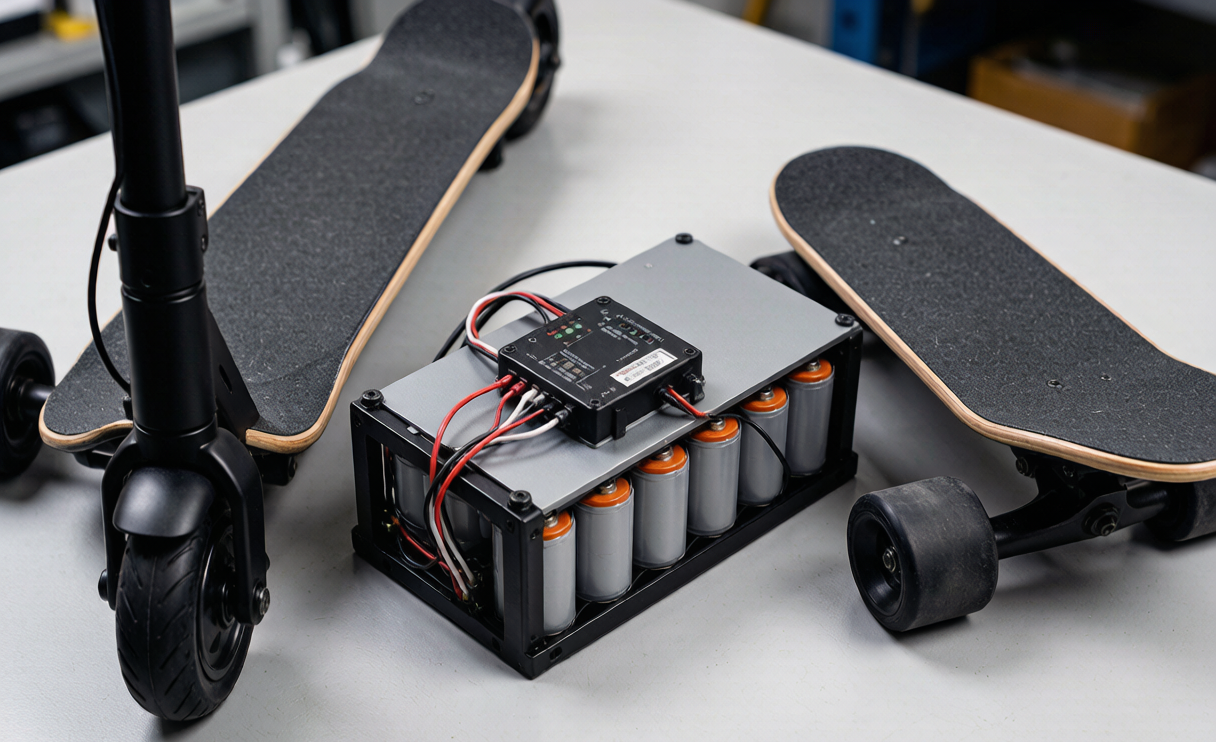
An electric skateboard or scooter does not have the volume of a car, nor the thermal headroom of a stationary home battery. The pack has to be thin, light, and shaped to fit a deck cavity or a stem housing. A typical board runs a 10S2P layout of 21700 cells, giving a nominal 36V and roughly 4.0 to 5.0 Ah of capacity in a slab about 12 mm thick. Scooters are a little more forgiving and often use a 10S or 13S cylindrical pack tucked into the stem or a down-tube.
The real engineering challenge is mechanical, not electrical. PEVs vibrate constantly, take impacts from curbs, and get dropped onto hard pavement. We design the enclosure for at least IP54 sealing, pot the cells against shock with a compliant urethane, and anchor the busbars so a hard landing cannot break a weld. A battery solution that looks good on a spreadsheet but rattles apart after 200 km is a failure no rider will forgive, and it is the single most common reason cheap packs fail in the field.
Space is also a certification problem. A thin deck pack leaves little room for a robust BMS and thermal padding, so the mechanical layout and the electronics have to be designed together from day one. Treating the battery as a bolt-on afterthought is how OEMs end up with swollen packs and warranty claims.
Choosing the Cell Chemistry: Why LFP Keeps Winning
For personal EV packs, the chemistry debate usually comes down to NMC (nickel manganese cobalt) versus LFP (lithium iron phosphate). NMC offers higher energy density — around 200 to 250 Wh/kg — which is tempting when every millimeter of deck space counts. But LFP gives you something riders value more: safety and longevity.
- LFP: roughly 120 to 160 Wh/kg, 2,000 to 4,000 cycles, extremely stable at high temperature, no cobalt, and a flat discharge curve that is forgiving of abuse.
- NMC: 200 to 250 Wh/kg, 500 to 1,000 cycles, higher fire risk if punctured or overcharged, and cobalt supply-chain concerns that complicate sourcing.
- LTO (less common): superb cycle life and fast charge, but low voltage and very high cost, so we reserve it for niche fleet applications.
For a consumer product that gets charged nightly in someone’s apartment, we increasingly recommend LFP. The slight weight penalty is worth the peace of mind, and the cycle life means the pack still holds most of its capacity after three years of daily use. Many of the leading scooter brands have already shifted their 2025 to 2026 lines to LFP for exactly this reason, and we expect the trend to accelerate as LFP energy density creeps upward.
Pack Voltage, Capacity and Real-World Range
Most PEVs run on 36V (10S) or 43.2V (12S) systems. Capacity typically lands between 4.0 Ah and 10.0 Ah. The range math is straightforward once you know consumption:
- A 36V 6.0 Ah pack equals 216 Wh of stored energy.
- An e-scooter consumes roughly 12 to 20 Wh/km in mixed city riding.
- An e-skateboard consumes about 8 to 15 Wh/km, depending on riding style and terrain.
That 216 Wh pack delivers roughly 11 to 18 km on a scooter and 14 to 27 km on a skateboard, before hills, rider weight, tire pressure, and headwinds eat into it. When a client asks for more range, the first lever we pull is cell count, by adding parallel groups, and the second is chemistry density. A well-designed custom battery solution balances both against the deck’s physical limit rather than blindly chasing the biggest number on the spec sheet.
It is also worth noting that advertised range is almost always measured at a low, steady speed with a light rider. Real-world riding is stop-and-go, which raises per-kilometer consumption by 20 to 40 percent. We always quote a conservative realistic range to customers so the product meets expectations instead of disappointing them on the first hill.
The BMS and Why Certification Is Non-Negotiable
The Battery Management System is the single most important safety component in a PEV pack. It is not optional, and it is not where you cut cost. A proper BMS handles:
- Over-voltage and under-voltage protection for every cell group.
- Over-current and short-circuit cutoff within milliseconds.
- Active or passive cell balancing to keep groups matched.
- Temperature-based charge and discharge limits, including cold-charge lockout.
- State-of-charge and state-of-health reporting to the controller via UART, SMBus, or CAN.
On the compliance side, every pack we ship meets UN38.3 for transport safety, and we build to IEC 62133 for portable cell and battery safety. For the North American market we align with UL 2271, the standard written specifically for batteries in light electric vehicles, and for Europe we target EN 50604-1. When products cross borders by air, the FAA and EASA rules for spare lithium batteries govern how the packs are labeled, documented, and packaged. Skipping any of these is how a great product becomes a recall, and a recall on a lithium pack is both expensive and reputationally damaging.
Connectors, Wiring and the Hidden Failure Points
The part riders never see, and the part that fails most often, is the wiring and connector between the pack and the controller. A loose XT60 or an undersized balance lead causes intermittent cutouts that are maddening to diagnose. We standardize on rated connectors with a margin of at least 20 percent over peak current, and we strain-relieve every lead where it exits the enclosure.
For PEVs we also pay close attention to the charge port. A worn or corroded charging connector is a fire risk, so we specify gold-plated contacts and a sealed grommet, and we validate the connector through thousands of mate cycles during qualification. These details sound minor, but they are the difference between a pack that is pleasant to live with and one that strands you mid-commute.
Thermal Behavior and Keeping Packs Cool
Low-speed PEVs rarely need active cooling — you are not pulling the continuous high C-rates of a racing drone. But heat still accumulates in a sealed deck, especially during a long climb or repeated hard acceleration. We specify an operating window of -10°C to 55°C for charging and allow discharge up to about 60°C before the BMS forces a cutoff. Good enclosure design, a thin thermal interface pad between cells and the housing, and a vent path for off-gassing are what keep a pack safe through a hot summer.
Cold weather deserves equal attention. Below 0°C, lithium plating during charging silently destroys cell life, so the BMS must lock out or reduce charge current in the cold. We tune that threshold carefully: too aggressive and the pack refuses to charge on a winter morning, too lax and the cells degrade. For riders in cold climates, we often recommend LFP specifically because it tolerates cold discharge far better than NMC.
Building a Custom Battery Solution With the Right Partner
If you are an OEM bringing a scooter or board to market, the fastest path is a battery solution built around your exact envelope rather than forcing a generic pack into your deck. A solid RFQ should specify nominal and maximum voltage, target capacity, maximum continuous and peak discharge current, physical dimensions and mounting points, connector type, target market certifications, and expected cycle life. At Horizon Power we grade every cell, run a full formation cycle before welding, and trace each pack by serial number. That discipline is what separates a pack that lasts 3,000 cycles from one that swells in a season.
The engagement itself follows a predictable arc: a feasibility review against your envelope, a prototype pack within two to four weeks, bench validation against the standards above, then a pilot run before full production. Spending the time on the prototype stage saves months of pain later, because most field failures trace back to a decision made in the first week of design.
FAQ
How many charge cycles should a scooter battery last?
An NMC pack typically delivers 500 to 1,000 full cycles before dropping below 80 percent capacity. An LFP pack built with grade-A cells should give you 1,500 to 3,000 cycles. For a daily commuter, that is the difference between replacing the pack every year and every four years.
Can I use a drone battery in my scooter?
Not recommended. A drone battery is optimized for very high discharge bursts and a different thermal and certification profile. A ground PEV needs sustained current, vibration resistance, and LEV-specific safety standards like UL 2271 or EN 50604. Use a pack designed for the application, not one borrowed from another.
What certification do I need to sell in the EU and US?
In the EU, target IEC 62133 and EN 50604-1. In the US, UL 2271 is the key light-electric-vehicle standard. UN38.3 is required for shipping in both regions, and FAA and EASA documentation applies to air freight of spare lithium batteries. Your contract manufacturer should be able to show current test reports, not just a certificate from years ago.
How should I store a PEV pack during the off-season?
Store at 40 to 60 percent state of charge in a cool, dry place, and top up every two to three months. Avoid full charge for long storage, and never leave a pack fully discharged — deep storage at low voltage is the fastest way to lose capacity permanently. A pack stored this way will still deliver nearly full range when the riding season returns.