Battery Solution for Disaster Sensor Networks: An Engineer’s Field Guide
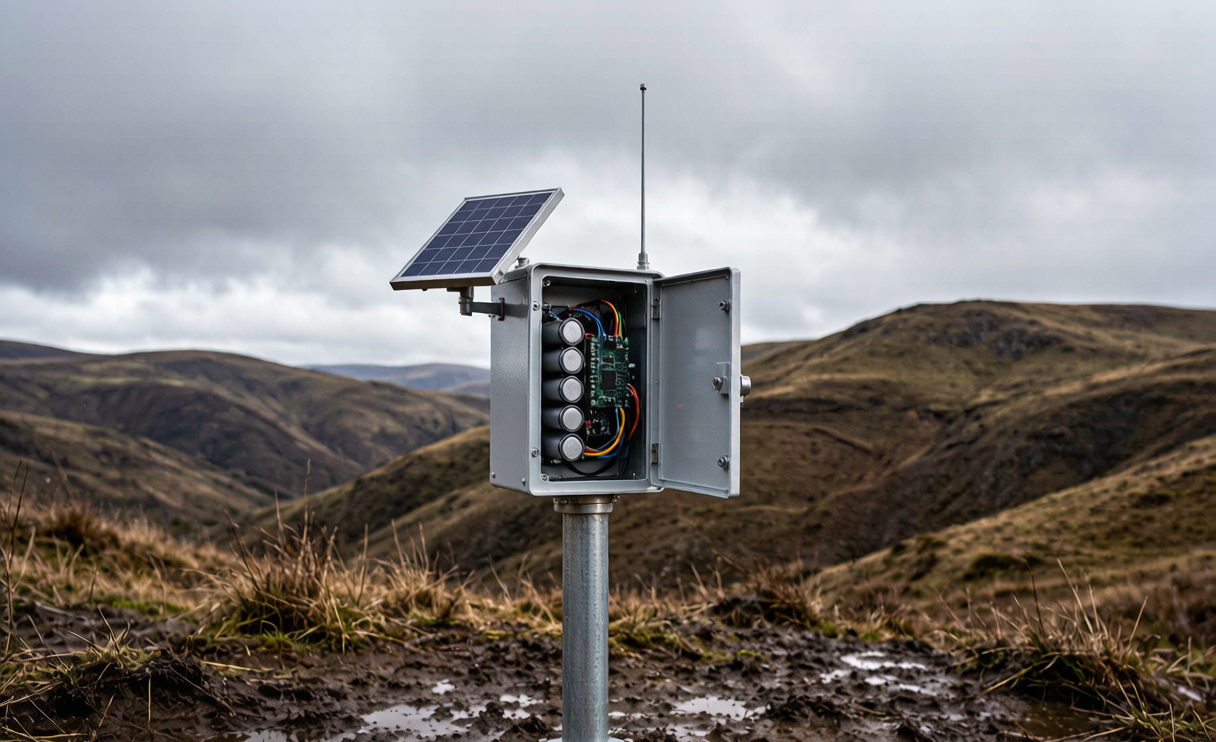
In August 2023 I stood in a mudslide-scarred valley in Sichuan province, holding a landslide early-warning node that had gone silent eleven days before the slope failed. The sensor was fine. The radio was fine. The battery pack — a bargain 18650 assembly with no low-temperature protection — had quit during a cold snap. That single dead pack meant a monitoring gap at exactly the wrong moment. I am Karl Huang, a senior lithium battery engineer, and after fifteen years of designing packs for unmanned systems and remote instrumentation, I can tell you that a disaster sensor network is only as reliable as its worst battery. This guide covers how I engineer a battery solution for disaster sensor networks: seismic arrays, flood gauges, landslide tiltmeters, wildfire cameras, and the gateways that tie them together.
Why Disaster Sensor Networks Punish Ordinary Battery Packs
A disaster sensor network is the harshest duty cycle I work with, and that includes the drone battery packs we build for inspection fleets. The nodes sit unattended for three to ten years. They sleep at microamp currents, then burst-transmit at hundreds of milliamps when an event triggers. Ambient temperatures swing from -30°C on a mountain ridge to +60°C inside a sun-baked enclosure.
Ordinary consumer lithium battery cells fail here for three reasons. First, self-discharge: a standard Li-ion cell loses 2–3% of charge per month, which is fatal over a five-year deployment. Second, pulse capability at low temperature collapses — a cell that delivers a 500 mA LoRa transmit pulse at 25°C may sag below the radio’s brownout threshold at -20°C. Third, calendar aging: capacity fade of 20% in the first two years is common for cells never designed for decade-long service.
The engineering answer is to match chemistry to the mission profile, not to grab whatever is cheapest per watt-hour.
Choosing the Chemistry: LiSOCl2, LiFePO4, or Hybrid
For always-on sensing nodes, my default is bobbin-type lithium thionyl chloride (LiSOCl2). Self-discharge is under 1% per year, shelf life exceeds 10 years, and the cells operate from -60°C to +85°C. The 3.6 V plateau is remarkably flat, which simplifies fuel gauging for the firmware team. The weakness is pulse current: a bobbin cell alone cannot feed a cellular modem.
That is why most of my disaster network designs are hybrids. I pair the LiSOCl2 primary cell with a hybrid layer capacitor (HLC) or a small rechargeable buffer that absorbs the 2 A peaks of an NB-IoT or LTE-M transmission. The primary cell trickles energy into the buffer at a rate it tolerates; the buffer handles the bursts.
For solar-recharged gateways and camera nodes, I switch to lithium iron phosphate (LiFePO4). It survives 3,000–6,000 cycles, tolerates daily solar cycling for a decade, and is far more thermally stable than NMC — thermal runaway onset near 270°C versus roughly 210°C. In a wildfire camera network, that margin is not academic. Where sub-zero charging is routine, I specify packs with self-heating foil or fall back to lithium titanate (LTO), which charges safely at -30°C at the cost of energy density.
Sizing the Pack: An Energy Budget Worked Example
Every custom battery solution I quote starts with an energy budget, never with a capacity guess. Here is a real worked example from a flood-gauge node we shipped in 2024:
- Sleep current: 8 µA continuous = 70 mAh per year
- Sensor sampling: 15 mA for 2 s, every 10 minutes = 44 mAh per year
- LoRa uplink: 120 mA for 1.5 s, hourly = 438 mAh per year
- Daily cellular health report: 1.8 A average for 12 s = 2.2 Ah per year
- Subtotal: roughly 2.75 Ah per year
I then apply the derating stack: 85% usable capacity at temperature extremes, 90% converter efficiency, 1% per year self-discharge, and a 30% end-of-life reserve because a disaster node must still fire its alarm in year seven. That 2.75 Ah per year becomes a requirement of about 38 Ah for a 10-year mission — two D-size 19 Ah LiSOCl2 cells in parallel with an HLC. Skip the derating and the pack dies in year six; I have replaced enough of those to know.
Protection and BMS Design for Unattended Service
A battery management system for a disaster node has a different job than the BMS in a drone lithium battery. In a drone, the BMS protects a human-piloted asset for 25 minutes at a time. In a sensor node, it must protect the cell from the node — firmware bugs included — for a decade with nobody watching.
My non-negotiables: redundant overcurrent protection (a resettable PTC plus a one-shot fuse), undervoltage lockout that disconnects at 2.0 V before copper dissolution wrecks the cell, and a watchdog-visible battery telemetry line so the network operations centre sees voltage and temperature in every health packet. The failure I mentioned in Sichuan traces to exactly this gap: the node had no battery telemetry, so nobody knew the pack was dying until it was dead.
I also insist on reverse-polarity protection at the connector. Field technicians replacing packs on a rain-soaked slope at dusk will eventually force a connector. Design for that day.
Environmental Hardening: IP Rating, Salt Fog, and Vibration
The enclosure is part of the battery solution. For flood and coastal deployments I specify IP68 per IEC 60529 with a Gore-type pressure-equalisation vent, because a sealed box that breathes with temperature swings will pump moist air past any gasket that cannot equalise. For coastal tsunami-warning nodes, the pack hardware must pass 500 hours of ASTM B117 salt fog — stainless or nickel-plated busbars, conformal-coated BMS, no bare aluminium.
Seismic and landslide nodes get the vibration treatment: IEC 60068-2-6 sinusoidal sweep and IEC 60068-2-27 shock testing, with cells potted or foam-restrained so tab welds never carry mechanical load. A cracked tab weld is invisible at commissioning and fatal in year three.
Every pack we ship is certified to UN 38.3 (tests T.1 through T.8: altitude, thermal cycling, vibration, shock, external short, impact, overcharge, forced discharge) and IEC 62133-2:2017. Larger stationary buffers for gateway stations follow IEC 62619. If the packs fly to site by air freight, IATA packing instructions PI 965–968 govern the logistics, and for drone-carried sensor deployment the operator still has to respect FAA and EASA payload battery rules — the same framework we apply to every drone battery we manufacture.
Fleet Monitoring and Replacement Strategy
A disaster network is a fleet, and fleets need battery lifecycle management. I push every client toward three practices. First, telemetry-driven replacement: replace packs on measured state-of-health, not on a calendar, which typically stretches replacement intervals 30–40% and cuts helicopter site visits. Second, cohort tracking: log cell lot numbers per node so that if one lot shows early passivation problems, you can target exactly the affected nodes. Third, staged spares: keep 5% of packs as commissioned spares stored at 40–60% state of charge and 15°C, which is the storage condition that minimises calendar aging.
Passivation deserves a special note for LiSOCl2 fleets. The same passivation layer that gives the chemistry its shelf life causes voltage delay after long dormancy — a node that has slept for months may see the cell voltage dip on the first big pulse. Good firmware issues a depassivation burst before critical transmissions; good pack design sizes the HLC so the node rides through the dip. Both, ideally.
Frequently Asked Questions
How long can a battery solution for a disaster sensor network realistically last?
With bobbin LiSOCl2 primaries, a disciplined energy budget, and sleep currents below 10 µA, 7–10 years is routine and I have fielded designs targeting 12. Solar-plus-LiFePO4 gateways run 8–10 years before the pack needs replacement, provided charging is temperature-managed.
Can I use rechargeable cells everywhere instead of primary cells?
You can, but you inherit solar panels, charge controllers, and winter deficits at every node. For low-power sensing nodes, a primary lithium battery is usually cheaper over the mission life and has fewer failure modes. I reserve rechargeables for gateways, cameras, and any node drawing more than about 50 mW average.
What certifications should I demand from a pack supplier?
UN 38.3 test reports for the exact pack (not just the bare cell), IEC 62133-2:2017 for portable packs or IEC 62619 for stationary buffers, an IP rating verified to IEC 60529, and salt-fog or vibration reports matching your environment. Ask for the reports themselves; a certificate number alone tells you nothing.
How does cold weather change the design?
Below -20°C, pulse capability is the binding constraint. I oversize the HLC buffer, derate usable capacity to 70–85%, and for rechargeable nodes either add self-heating layers or switch to LTO. Charging standard LiFePO4 below 0°C without heating causes lithium plating and permanent damage — the BMS must hard-block it.
Can one supplier cover sensors, gateways, and the drones that service the network?
That is exactly the model we run. A shared custom battery solution platform — common connectors, common telemetry protocol, common test regime — across sensor packs, gateway storage, and drone lithium battery fleets simplifies spares, training, and compliance audits enormously.
Final Thoughts from the Field
The battery in a disaster sensor node is the one component that cannot be patched over the air. Get the chemistry, the energy budget, the protection, and the telemetry right at design time, and the network will still be standing watch a decade later. If you are specifying a battery solution for a disaster sensor network and want a design review of your energy budget or environmental requirements, my team and I do this every week — bring your duty cycle numbers and we will pressure-test them together.