Drone Battery Integration for Racing Drones
As a senior lithium battery engineer at Horizon Power, I have watched more FPV races lost on the workbench than in the air. The pack itself may be a flawless drone lithium battery with excellent energy density and burst capability, but if it is not integrated correctly into the airframe, the pilot pays for it in sag, disarms, and a center of gravity that refuses to hold a line. drone battery integration for racing drones is the discipline of mating the cell, the bus, the connectors, and the flight controller into one coherent system. It is where cell chemistry meets mechanical reality, and it is the step most hobbyist builds rush.
Why Integration Is the Last Decade of Milliseconds That Wins a Race
A 5-inch racing drone draws 80 to 160 amps at peak and empties a 1300 to 1800 mAh pack in roughly two and a half minutes. In that window, integration losses are not theoretical. Every extra milliohm of bus resistance converts current into heat instead of thrust. Every loose strap shifts the center of gravity a few millimeters and changes how the quad rotates around its pitch axis. In my lab, I treat drone battery integration for racing drones as a first-order performance parameter, not an afterthought bolted on after the pack is chosen.
The good news is that a well-integrated lithium battery pack rewards the effort immediately. A clean bus layout can recover 0.2 to 0.5 volts of recovered pack voltage under burst load, which a racing flight controller reads as usable headroom before low-voltage cutoff trips. That headroom is often the difference between finishing a heat and being passed on the last split.
Mechanical Mounting, Hardpoints, and Center-of-Gravity Control
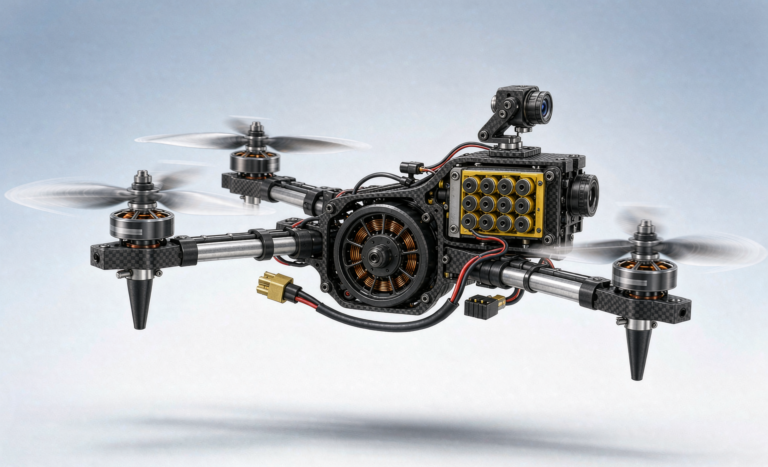
Start with the tray. Most modern racing frames use a bottom or side-mounted battery slot secured with hook-and-loop or a 3D-printed latch. The goal is twofold: the pack must not shift under 8 to 12 g of hard cornering, and its mass must sit where the airframe was designed to balance.
- Position for CG. On a 5-inch quad, I aim to place the cell pack so the airframe balances at or just behind the motor line. A pack mounted too far forward makes the nose drop; too far back and the quad tails out in punch-outs.
- Use dual straps, not one. A single wide strap can walk under vibration. Two crossed straps, or a strap plus a printed latch, hold the drone lithium battery through repeated hard throttle punches.
- Protect the pouch. Racing packs are soft-pouch lithium-ion or LiPo. A sharp carbon edge will eventually puncture the laminate. A thin neoprene or mylar sleeve is cheap insurance, and it also dampens rattle that would otherwise loosen solder joints.
Mechanically, the pack should feel like part of the frame. If you can slide it with a finger, the aerodynamic and inertial penalties will show up on the stopwatch.
The Electrical Interface — Connectors, Bus Resistance, and ESC Handshake
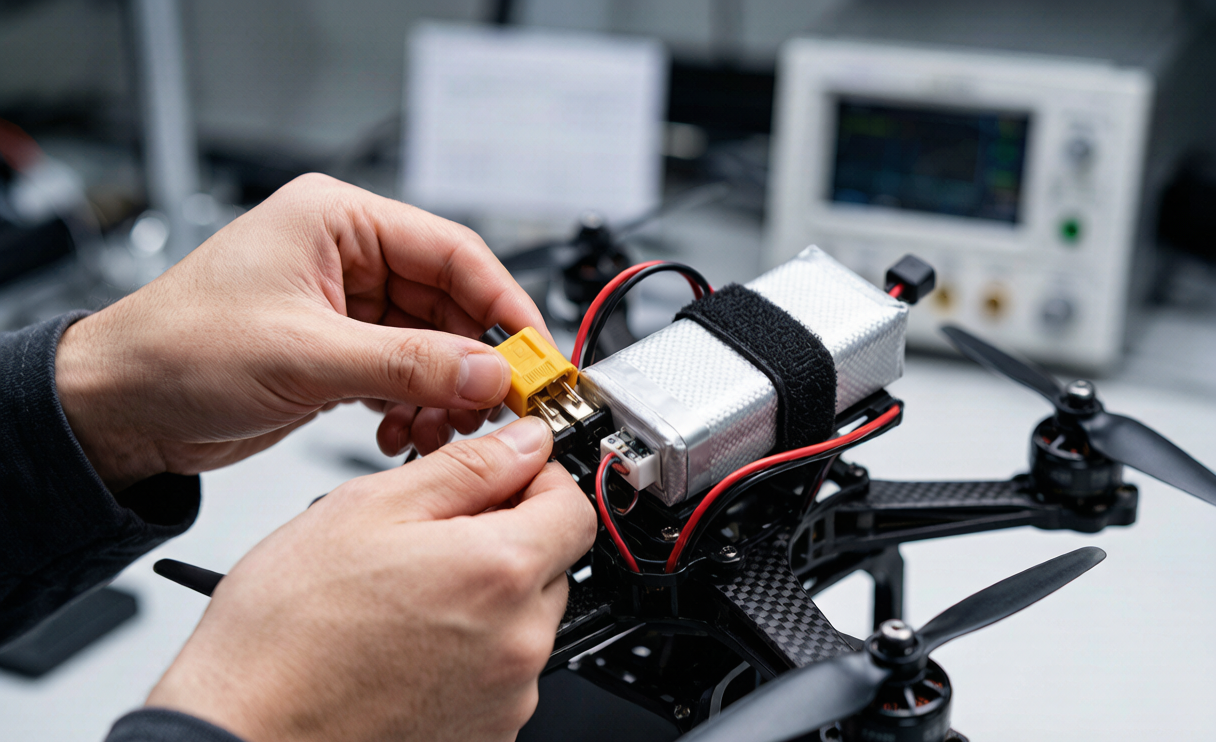
The connector is the single most overlooked source of voltage sag in a racing build. A worn XT60 or a cheap clone can add 3 to 6 milliohms per contact, and at 120 amps that is 0.4 to 0.7 volts lost before the current ever reaches the ESC.
- Pick a rated connector and keep it clean. For 4S to 6S racing packs I standardize on XT60 or MR30 for the main bus and genuine Amass hardware, not unknown marketplace clones. Contacts should be bright and springy.
- Keep the leads short and equal. Long, unequal main leads create loop area and inductance. I keep the pack-to-ESC run under 60 millimeters and trim both polarities to the same length during battery pack design review.
- Solder, do not twist. Cold or twisted joints are the classic inflight disarm. I use rosin flux, a calibrated iron at 380 degrees Celsius, and pull-test every joint at 5 newtons before the pack leaves the bench.
At Horizon Power we validate the complete integration harness, not just the cell, against UN 38.3 mechanical and thermal abuse tests and IEC 62133-2:2017 enclosure and cell-safety requirements, because a pack that passes standalone certification can still fail in a poorly integrated airframe.
Flight-Controller Battery Parameters You Must Set Before Takeoff
The flight controller does not know your pack is a high-C drone battery unless you tell it. These are the parameters I set on every racing build before the first arming beep.
- Cell count and nominal voltage. Set the correct series count (4S, 6S) and the nominal per-cell voltage. A mismatch makes the telemetry read nonsense and the low-voltage logic misbehave.
- Low-voltage cutoff (LVC). For racing I run a soft warning at 3.5 volts per cell and a hard cutoff near 3.3 volts. Cutting too early costs laps; cutting too late permanently damages the lithium battery and raises pack internal resistance for every future flight.
- Sag compensation and current scaling. Enable voltage-sag compensation so the PID loop does not interpret a momentary dip as a control error, and calibrate the current sensor so telemetry amp readings are trustworthy.
- Burst awareness. Some stacks let you cap throttle based on measured current. On a fresh pack this is rarely needed, but on a worn drone lithium battery it prevents the classic mid-race brownout.
Telemetry, Balancing Leads, and Strain Relief
A racing pack should report, not just deliver. I route the balance lead so it is accessible but strain-relieved, and I log per-cell voltage through the flight to catch a weak cell before it becomes a failure.
- Strain relief the balance lead. A dangling balance plug whipping in prop wash will eventually yank a cell tab. A small zip tie anchor near the stack solves it.
- Watch the delta. In my qualification logs, a cell-to-cell voltage delta above 30 millivolts under load is the early warning sign of an aging pack that needs retirement, not just recharging.
- Conformal coat the exposed joints. A light conformal coat on the bus solder points resists the fine carbon dust that racing venues generate, which otherwise creeps into connectors and raises resistance.
For teams that need repeatable, race-to-race consistency, a custom battery solution with matched cells, laser-welded nickel bus, and a standard connector footprint removes most of the integration variability I see in off-the-shelf packs.
Failsafe Behavior and a Pre-Flight Integration Checklist
Integration is also about what happens when something goes wrong. I configure the failsafe so a lost link drops the throttle and lands or disarms cleanly rather than continuing to draw a stalled pack into deep discharge. Then I run a fixed pre-flight integration check:
- Strap secure, no pack movement under a firm shake.
- Connector fully seated, click felt, no carbon dust in the contacts.
- Balance lead connected and strain-relieved.
- Flight controller shows correct cell count and per-cell voltage within 0.01 volt of the charger reading.
- Throttle response smooth on the bench, no cutoff at 50 percent punch.
- LVC set to the team standard, not the firmware default.
Run this checklist and most integration failures simply never happen. Skip it, and the same failure mode returns race after race.
How do I choose the right connector for a racing drone battery?
For 4S to 6S racing packs drawing 80 to 160 amps, use a connector rated well above your peak current with genuine spring contacts, such as XT60 or MR30. Keep the main leads short and equal in length, and inspect contacts for discoloration or looseness before every race day. A worn connector can cost more voltage than an entire cell upgrade.
What low-voltage cutoff should I set for FPV racing?
I set a soft warning at 3.5 volts per cell and a hard cutoff near 3.3 volts. This preserves the lithium battery for many more cycles while leaving enough reserve to finish a heat. Cutting at 3.0 volts repeatedly ages the pack quickly and raises internal resistance.
Why does my racing drone battery sag more after a few flights?
Sag grows as internal resistance climbs, usually from deep discharge, heat, or a developing weak cell. Log per-cell delta under load; a delta above 30 millivolts signals an aging drone lithium battery. Retire packs that show rising sag rather than pushing them, because the failure mode is inflight disarm.
Should I use a custom battery solution instead of off-the-shelf packs?
If you run a consistent airframe and want repeatable lap times, a custom battery solution with matched, laser-welded cells and a standard connector footprint removes most integration variability. It costs more per pack but pays back in predictable burst performance and simpler spares.
Are racing drone batteries regulated for air travel?
Yes. Spare lithium cells must follow IATA rules, generally the 100 watt-hour and 160 watt-hour thresholds for carriage, and packs must be protected from short circuit. We ship Horizon Power racing packs in non-conductive sleeves and follow UN 38.3 and IEC 62133-2:2017 documentation so they clear FAA and EASA handling without friction.
Conclusion
Drone battery integration for racing drones is where chemistry becomes performance. Mount for center of gravity, wire for low bus resistance, configure the flight controller for your actual pack, and verify with a fixed pre-flight checklist. Get these right and even a modest drone battery will fly like a stronger one. If you need packs engineered to drop into your airframe with matched cells, standard connectors, and full UN 38.3 and IEC 62133-2:2017 documentation, our team builds custom battery solution programs for racing and industrial drone fleets alike.