Drone Battery for Border and Perimeter Patrol
When a security director asks me how to keep a drone airborne over a 40-kilometre border fence or a refinery perimeter for an entire shift, the conversation is never really about flight time — it is about energy logistics. I am Karl Huang, a senior lithium battery engineer, and over the last decade I have spec’d drone battery packs for everything from racing quads to BVLOS inspection fleets. Border and perimeter patrol is one of the harshest applications I work on: long loiter windows, exposed terrain, temperature swings of 40°C in a single day, and a zero-tolerance expectation that the pack will not quit mid-sortie. In this article I will walk through how we engineer a drone lithium battery that survives the mission profile, the regulatory envelope that governs how you transport it, and the field-charging discipline that actually keeps a patrol fleet flying.
Mission Profile — Why Patrol Drones Are an Endurance Problem
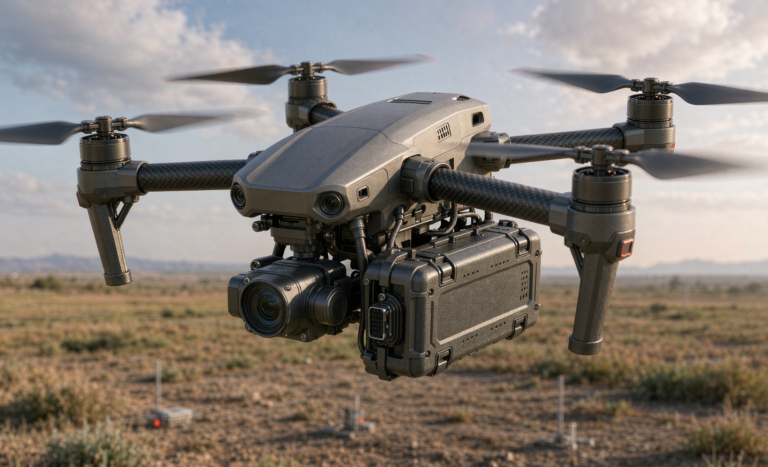
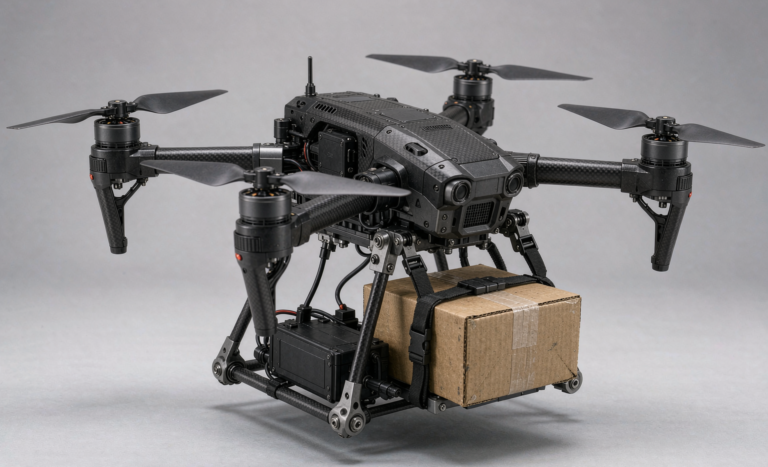
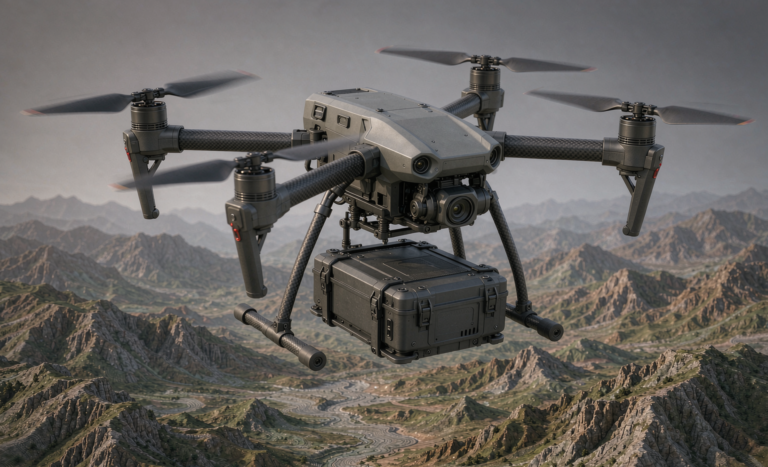
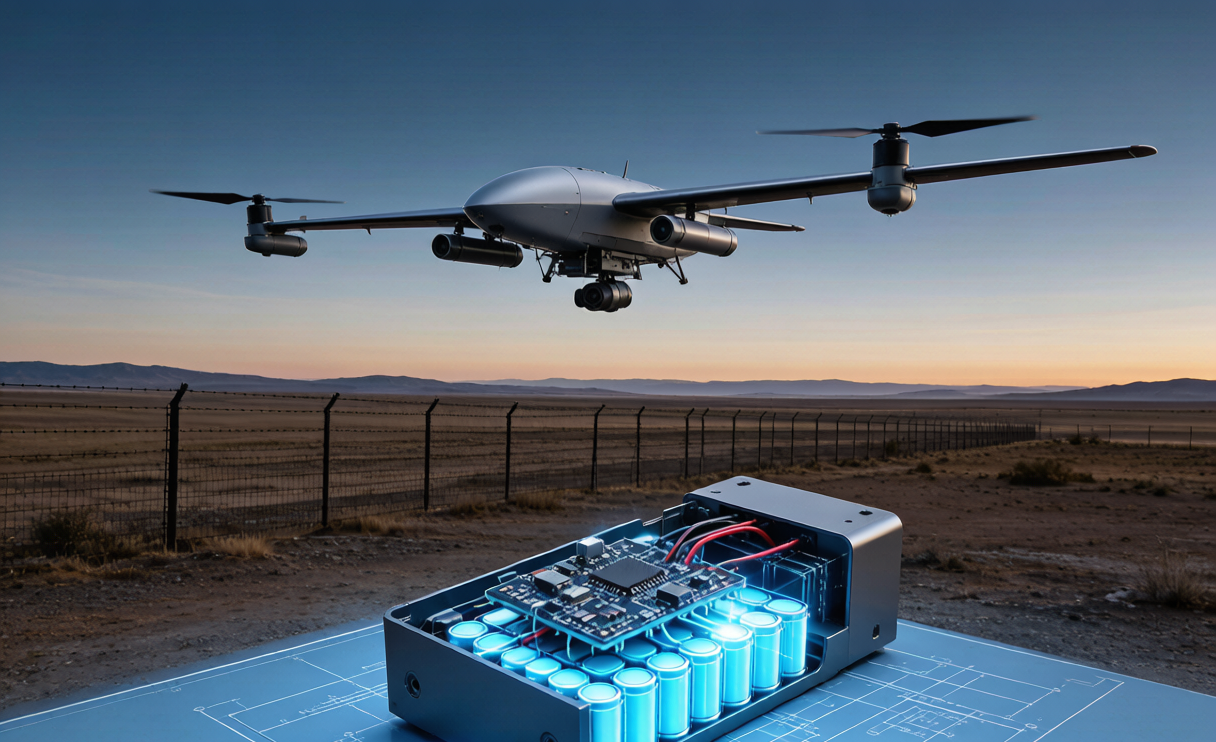
A patrol mission is not a 12-minute cinematic orbit. It is a slow, persistent transit: a fixed-wing mapping UAV loitering at 80–120 km/h along a line, or a multirotor holding a stationary hover over a gate, a heat signature, or a breach in a fence. The defining parameter is loiter time at low power, not peak thrust. A typical multirotor perimeter-patrol hover draws 1.2–1.8 kW at 8–16 kg AUW, while a fixed-wing patrol airframe cruises at 0.4–0.9 kW and can stay up far longer on the same watt-hours. The lithium battery must therefore be sized for sustained draw, not burst C-rate, and any reserve must cover a return-to-home that may be 15–30 km away across terrain with no landing zone.
In my experience the failure mode most teams underestimate is wind. A published 25-minute hover becomes 17 minutes the moment a 10 m/s crosswind shows up. We always budget a +10–25% gust overhead and a 30% state-of-charge (SoC) reserve for BVLOS patrol under FAA Part 107 / EASA SORA overflight-of-people considerations, because a pack that lands short is a lost mission and a recovery operation.
Energy Budget for Multi-Day Perimeter Coverage
Let us do the arithmetic a procurement team should be doing before they buy anything. A multirotor patrol pack hovering at 1.5 kW with +20% manoeuvre and +15% wind overhead needs roughly 2.0 kW sustained. A 6S 22 Ah pack (≈0.49 kWh usable) gives about 15 minutes. To cover a 40 km perimeter in one sortie you need 0.6–1.1 kWh installed — which means a 12S 14–18 Ah pack or a dual parallel 6S arrangement. Fixed-wing patrol shrinks this dramatically: at 0.6 kW cruise, a 1.0 kWh pack delivers 90–160 minutes, which is why long-range perimeter surveillance almost always moves to a fixed-wing or hybrid airframe.
The second number that matters is cycle logistics. A 24-hour perimeter watch with 90-minute fixed-wing sorties and 30-minute turnarounds needs 16 sorties and therefore 8–12 packs per airframe in rotation, charged from a field generator or solar buffer. The drone battery border perimeter patrol design is as much about the charger rack as the cells.
Chemistry Selection — NMC, LFP and Semi-Solid for Patrol
For patrol we normally choose between three chemistries, and the right answer depends on whether you prioritise energy density or cycle life.
- NMC / NCA (200–250 Wh/kg, 500–1000 cycles): the default for maximum endurance. If you need the longest loiter on the smallest mass, this is the cell. The trade-off is heat sensitivity and shorter calendar life.
- LFP (120–160 Wh/kg, 2000–4000 cycles): lower energy density but dramatically longer life and superior thermal tolerance. For ground control stations, tethered relays, and high-duty-cycle patrol depots where the pack charges twice a day, LFP wins on total cost of ownership.
- Semi-solid-state (250–300 Wh/kg, qualifying): the emerging option for endurance-priority patrol ships where every gram of mass costs loiter time, now entering qualification at several programmes.
We frequently recommend a split: a high-energy drone lithium battery on the airframe for flight, paired with LFP buffer packs at the charging node. That keeps the flying mass low while the ground infrastructure lasts for years.
Cold, Heat and Dust: The Environmental Envelope
Border terrain is unforgiving. At a mountain pass at −15°C, a lithium pack can lose 40–45% of its usable capacity versus 25°C — we measure 100% capacity at 25°C, 85% at 0°C, 70% at −10°C, and 55–60% at −20°C. The mitigation is a 5–15 W pad heater holding the core in a 10–25°C window, and we never launch a cold pack below 10°C without pre-conditioning.
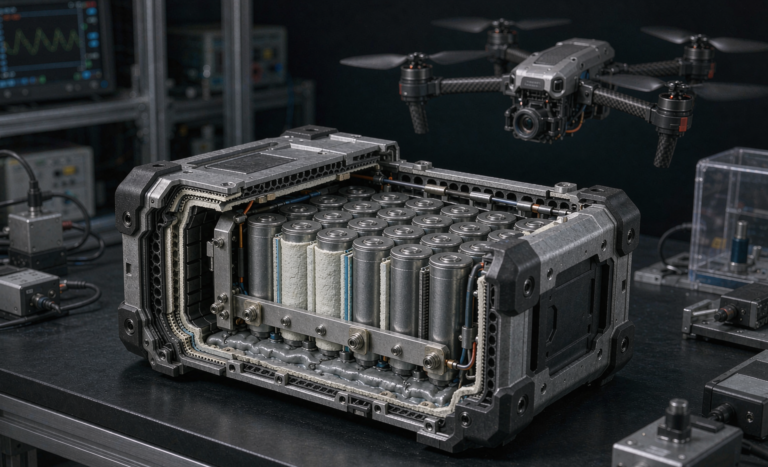
At the hot end, desert perimeter patrol sees 45–55°C pack-skin temperature on a summer sortie. We design sealed, passively cooled pods — no fans that pull in conductive dust — with conformal coating, potting, and 316L stainless terminals. Ingress protection of IP5X–IP6X plus a desiccant pack keeps the BMS alive through sandstorm cycles. A custom drone battery built for a temperate warehouse will die in its first month of perimeter duty if the sealing and thermal path are not engineered for the environment.
Swappable Packs and Field Charging Logistics
The single biggest operational lever is swap-and-charge discipline. We run a FIFO (first-in, first-out) pack pool with a QR/serial identity on every pack, logging baseline AC internal resistance, capacity, and cell thickness at 3.85 V/cell. Field charging is capped at 1C–2C with a 40°C charge-temperature gate; a pack that lands at 50°C waits, it does not charge. Packs stage in three zones — hot (just landed), cooling, and ready — and storage sits at 3.80–3.85 V/cell to minimise calendar ageing.
Retirement thresholds are non-negotiable for a security fleet: we pull a pack at 80% of original capacity, 2× its baseline internal resistance, a cell delta above 50 mV, or any 5% swelling. A patrol drone that drops from the sky because a tired pack puffed is a liability no operator should accept.
Safety, Compliance and Transport (UN38.3, IEC 62133, FAA/EASA)
Every drone battery we ship for patrol must clear the UN38.3 T.1–T.8 test series — altitude simulation, thermal, vibration, shock, external short, impact, overcharge, and forced discharge — and the pack design must meet IEC 62133-2:2017 for portable secondary cells and batteries containing alkaline or lithium cells. For air transport we stay inside the FAA and EASA 100–160 Wh carry-on and checked-baggage rules, and for cross-border movement under IATA we stage packs at or below 30% SoC with the UN3480 / UN3481 markings.
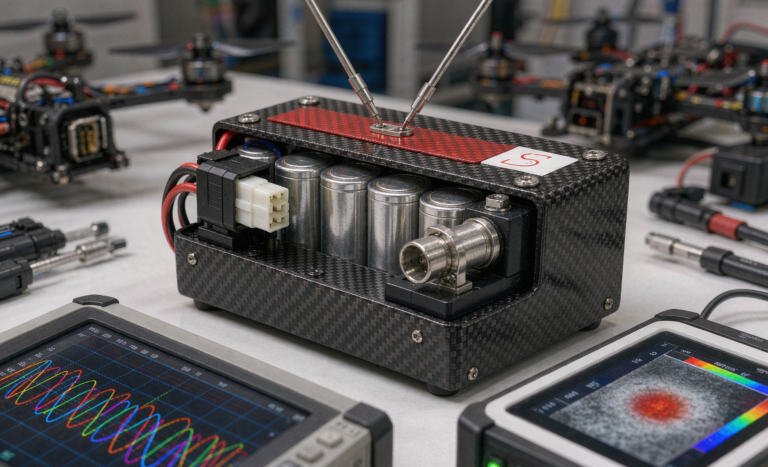
For ground convoy movement of larger patrol packs, IMDG and ADR provisions apply, and we advise operators to keep a documented test summary and a serialised outgoing test record (1 kHz ACIR, per-cell voltage delta, and thickness at 3.85 V/cell) with every pack. That paperwork is what gets a shipment through a border crossing without a 12-hour hold.
Building a custom battery solution for Your Patrol Fleet
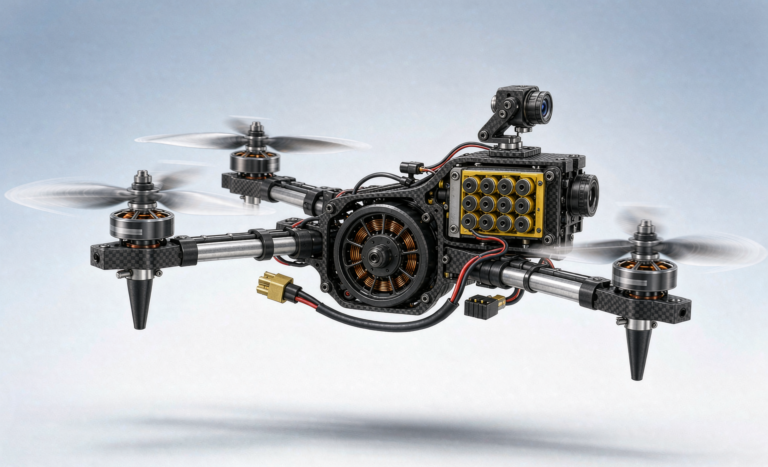
Off-the-shelf hobby packs are not engineered for a 3,000-cycle perimeter patrol programme. When a client comes to us we build a custom battery solution around their exact airframe and duty cycle: voltage platform (6S vs 12S — 12S halves the current and quarters the I²R loss), interconnect resistance held below 15% of pack resistance, a BMS with per-cell telemetry at 1–10 Hz and 20–30 mV delta alarms, and mechanical strain relief qualified to DO-160 and MIL-STD-810 vibration (5–2000 Hz). The result is a pack tuned for the mission rather than a compromise borrowed from consumer electronics.
If your programme needs a custom drone battery that matches a specific loiter requirement, temperature envelope, and compliance pathway, that is the work we do — and the difference between a pack that lasts a season and one that lasts a programme.
Frequently Asked Questions
How long can a patrol drone actually stay airborne?
A multirotor perimeter patrol pack typically delivers 15–30 minutes of hover with reserve; a fixed-wing patrol airframe carrying 0.8–1.1 kWh will stay up 90–160 minutes. Endurance is driven by cruise power, payload mass, and the +10–25% wind overhead we always budget.
Which chemistry is best for border patrol?
NMC/NCA for maximum endurance where mass is critical, LFP for ground charging nodes and high-cycle depots because of its 2000–4000 cycle life, and semi-solid-state where every gram of flying mass matters. Most programmes use a split of the two.
Can these packs operate in extreme cold?
Yes, with pre-conditioning. Lithium capacity fades to 55–60% at −20°C, so we use a 5–15 W core heater holding 10–25°C and never launch a sub-10°C pack without warming. The BMS logs cell temperature through the whole sortie.
What compliance do patrol drone batteries require?
UN38.3 T.1–T.8, IEC 62133-2:2017, and — for air movement — FAA/EASA 100–160 Wh limits plus IATA 30% SoC staging with UN3480/UN3481 markings. Cross-border ground convoys follow IMDG/ADR. A serialised test record travels with every pack.
How do we manage a multi-pack patrol fleet?
Run a FIFO pack pool with QR identity, baseline IR/capacity/thickness logging, 1C–2C charging behind a 40°C gate, 3.80–3.85 V/cell storage, and retirement at 80% capacity, 2× IR, 50 mV delta, or 5% swelling. That discipline is what keeps a 24-hour watch airborne.