Drone Battery for Maritime and Offshore Operations
As a Senior lithium battery Engineer at Horizon Power, I have spent the last eight years designing packs that leave the laboratory and go to work in the places batteries hate most. Few environments are as unforgiving as the sea. When a drone battery powers maritime and offshore operations — inspecting hulls, patrolling coastlines, surveying pipelines, or standing watch over offshore platforms — it is not just fighting gravity and wind. It is fighting salt, humidity, condensation, corrosion, and the relentless motion of a deck that never stops moving.
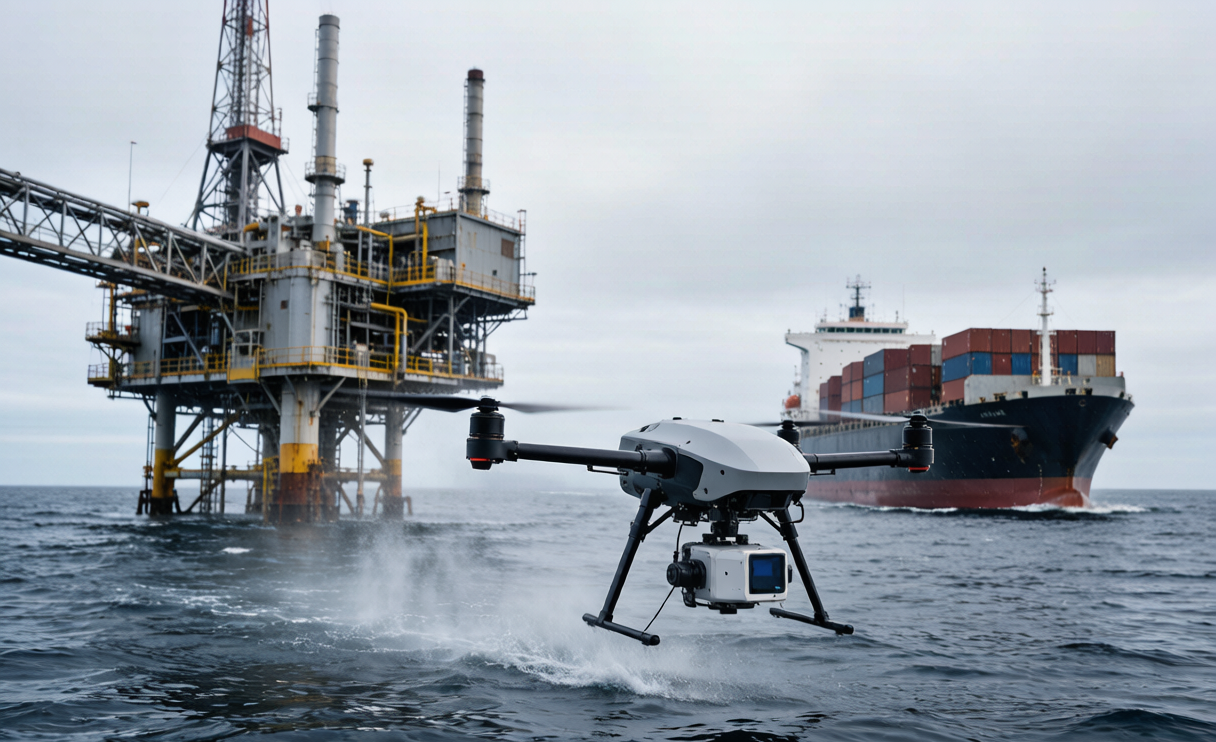
In this article I will walk through how we engineer a drone lithium battery for the marine world: the energy budget for station-keeping over a heaving deck, the sealing and corrosion standards that keep salt out, the chemistry trade-offs between flight time and cycle life, and the transport and charging rules that let a crew run a safe operation from a vessel hundreds of miles from shore.
Why the Sea Is the Hardest Place to Fly a Battery
The open ocean removes almost every safety net a land-based pilot relies on. There is no soft grass to land on, no roadside to set a pack down, and no wall outlet within reach. For a lithium battery, three forces compound at once:
- Salt-laden air (IEC 60068-2-52 severity 2–3 salt-mist, ISO 9227 neutral salt spray) corrodes exposed terminals and creeps along PCB traces.
- Relative humidity above 85% plus sea spray drives internal condensation, which can bridge cells and trip the BMS into protective shutdown mid-flight.
- Open-water wind and gusts are consistently stronger than over land because there is no terrain to break them; a drone holding station over a moving deck fights 8–14 m/s gusts far more often than an inland inspection.
These are not hypothetical risks. In a 2022 pilot program with a North Sea survey operator, three of nine off-the-shelf packs failed within a month — two from corrosion at the balance connector, one from condensation shorting the BMS. That failure pattern is exactly what marine-grade design exists to prevent, and it is why a custom battery solution built for the vessel’s actual duty cycle outperforms any catalog pack.
Energy Budget for Station-Keeping Over a Moving Deck
The single biggest difference between maritime and terrestrial missions is the hover-and-hold penalty. On land, a drone lands, swaps, and the job continues. Offshore, the drone often must loiter above a vessel or platform that is pitching and heaving, waiting for a safe landing window.
A typical mid-size quadcopter in this role draws:
- Hover: 1.5–2.2 kW
- Cruise (transit to survey point): 0.8–1.2 kW
- Payload (marine radar, thermal gimbal, or lidar): 12–40 W
- Station-keep overhead against gusts: +10–25% on top of hover
For a 45-minute mission with 20 minutes of loiter over a rolling deck, I budget 0.30–0.45 kWh of usable energy, then add a mandatory 30% state-of-charge (SoC) reserve for BVLOS-over-water rules (FAA Part 107 / EASA SC-LUC). The math is unforgiving: a 6S 22 Ah pack at 3.7 V nominal delivers only ~0.49 kWh, so a single pack barely clears the mission plus reserve. That is why we almost always spec a 12S platform or dual parallel packs for offshore work — more headroom, fewer forced landings in the water. This is where a well-matched drone battery sizing model earns its keep.
Sealing, Corrosion, and the IP Question
A marine drone lithium battery is defined less by its cells than by what surrounds them. We design to IP67 as a baseline for splash and brief submersion, and to IP68 for units that may be deck-washed or dropped overboard and recovered.
The build stack:
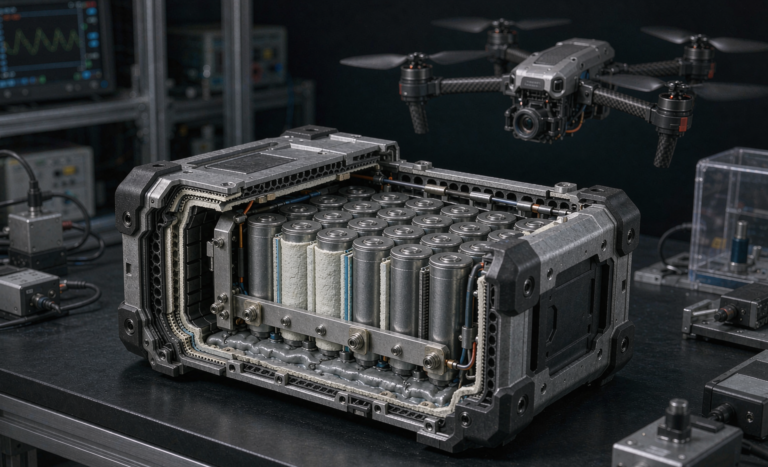
- Conformal coating (parylene or urethane) on every PCB and balance lead.
- Potting or closed-cell foam fill in the pack cavity to displace humid air and stop internal condensation.
- Marine-grade stainless (316L) or nickel-plated terminals with O-ring sealed connectors.
- A desiccant pouch sized to the internal volume, replaced at each 50-cycle service.
We validate against IEC 60068-2-52 (salt mist, 7-day cycle) and a 48-hour 95% RH condensation soak. A pack that cannot survive that on the bench will not survive a season offshore. Corrosion is a slow killer — it shows up as rising internal resistance and intermittent balancing faults long before a hard failure, which is exactly why the BMS isolation monitoring below matters.
Chemistry Trade-Offs — NMC vs LFP for the Marine World
For offshore drones, chemistry is a three-way tug-of-war between flight time, safety, and cycle life in a corrosive, humid habitat.
NMC (Nickel Manganese Cobalt): 200–250 Wh/kg, 500–1000 cycles. Best energy density, so best flight time per gram — critical when every gram of payload eats into loiter time. The downside is thermal sensitivity, which we manage with IP68 sealing and conservative 1.5C discharge caps.
LFP (Lithium Iron Phosphate): 120–160 Wh/kg, 2000–4000 cycles. Lower energy density but far longer life and inherently safer chemistry — no thermal runaway cascade if a cell is compromised. For a vessel that flies the same packs 300+ times per season, LFP’s cycle life often wins on total cost of ownership despite the weight penalty.
In practice, we offer both and let the mission decide. Long-range coastal patrol with light payloads → NMC. Daily heavy-lift hull inspection from a single vessel → LFP. A custom battery solution is almost always the right call here, because the trade-off depends on deck space, charger power, and how the crew rotates packs. A custom drone battery tuned to the vessel’s daily sortie count beats a generic one every time.
BMS Features That Earn Their Keep at Sea
A standard BMS is not enough offshore. The units we deploy add:
- Isolation/leak monitoring: detects moisture ingress before it bridges cells, forcing a safe RTL (return to land) instead of an in-air shutdown.
- Cell-level delta clamping at 20–30 mV to keep balancing accurate as corrosion nudges resistance.
- Cold-soak compensation: sea air near 0 °C with high humidity causes capacity fade (100% @ 25 °C → 85% @ 0 °C → 70% @ −10 °C); the BMS pre-conditions cells with a 5–15 W pad heater holding a 10–25 °C core window before launch.
- Sealed CAN-bus telemetry so the crew reads SoC, temperature, and isolation resistance from the bridge without opening the pack.
These are the features that separate a hobby pack from a marine-grade one. They also shorten the failure chain: a corrosion fault that would ground a standard pack becomes a logged warning the crew clears at the next service. For any lithium battery in a salt environment, that early-warning margin is the difference between a delayed sortie and a lost airframe.
Charging and Transport From a Vessel
Offshore, grid power is a luxury. Crews charge from a mix of vessel diesel generators, a wind/solar hybrid, or a battery buffer, so charger efficiency and moisture protection matter.
- Chargers rated IP65 with sealed XT60/AS150 connectors; never charge a damp pack — we gate charge start on an internal humidity sensor.
- Field charge at 1C–2C; a 6-channel ~1 kW charger services 6 stations per duty cycle.
- Storage discipline: 3.80–3.85 V/cell, FIFO rotation, three-zone staging (ready / charging / retired).
- Retirement thresholds: 80% capacity, 2× baseline IR, >5% swelling, or >50 mV cell delta.
Transport follows the same backbone as every other lithium program: UN38.3 (T.1–T.8), IEC 62133-2:2017, and — for sea freight between ports — IMDG Code packing provisions, with IATA 30% SoC limits for any air leg. Carry-on rules under FAA/EASA cap packs at 100–160 Wh, so most marine packs travel as UN3480/UN3481 cargo with the proper documentation. The same drone battery that flies the mission must also survive the supply chain that delivers it.
Frequently Asked Questions
How do you keep a drone battery from corroding on a salt-spray vessel?
Conformal coating on all electronics, potting or foam fill to displace humid air, 316L or nickel-plated sealed terminals, and a desiccant pouch serviced every 50 cycles — validated against IEC 60068-2-52 salt mist and a 48-hour 95% RH soak.
Why does offshore flying need more battery reserve than land?
There is no safe landing spot over water, so BVLOS rules require a 30% SoC reserve. Plus, station-keeping over a pitching deck and open-sea gusts add 10–25% draw on top of hover power, widening the safety margin the pack must carry.
NMC or LFP for a maritime drone?
NMC for maximum flight time on light long-range patrols; LFP for daily heavy-lift work where 2000–4000 cycles beat the weight penalty. A custom battery solution matches chemistry to the vessel’s mission profile and rotation cadence.
Can these packs be charged on a moving, power-limited vessel?
Yes — with IP65 chargers, a humidity-gated charge start, 1C–2C field charging, and a generator/solar/hybrid source. We never charge a damp pack, and the BMS blocks the charge cycle until internal humidity clears.
What safety standards apply to marine drone batteries?
UN38.3 (T.1–T.8) and IEC 62133-2:2017 as the baseline, IMDG for sea freight, IATA 30% SoC for air legs, and FAA/EASA 100–160 Wh carry-on caps. These are the same standards we apply across our full drone lithium battery range.