Drone Battery for Tethered and Persistent Surveillance
After more than a decade building packs for racing quads, search-and-rescue airframes, and offshore survey drones, I have learned that most drone battery engineering is a problem of endurance: how much energy can you carry aloft before the airframe runs out of lift. Tethered persistent surveillance inverts that question entirely. When a UAV is tied to a ground station by a thin umbilical, its flight power comes from the ground, not from the cells. That means the onboard lithium battery stops being the primary energy source and becomes something far more interesting — a redundant safety reserve that must work perfectly the one time the tether fails. As a senior lithium battery engineer at Horizon Power, I have designed these reserve packs for border watch, event security, and tactical ISR masts, and the rules are nothing like a free-flying aircraft.
Why Tethered Surveillance Changes the Battery Math
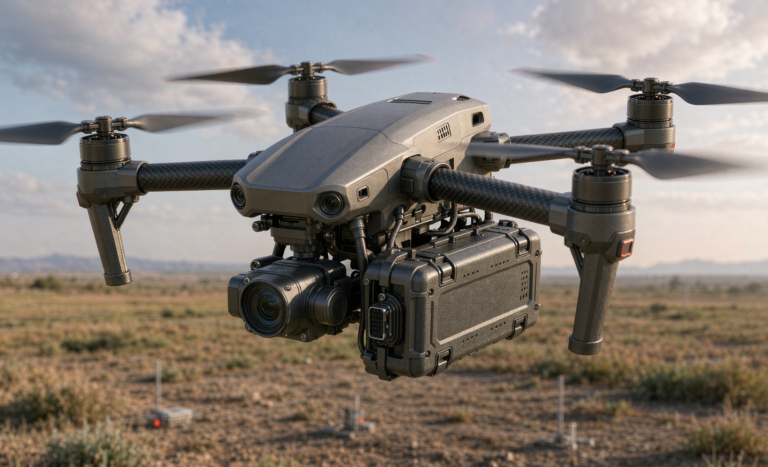
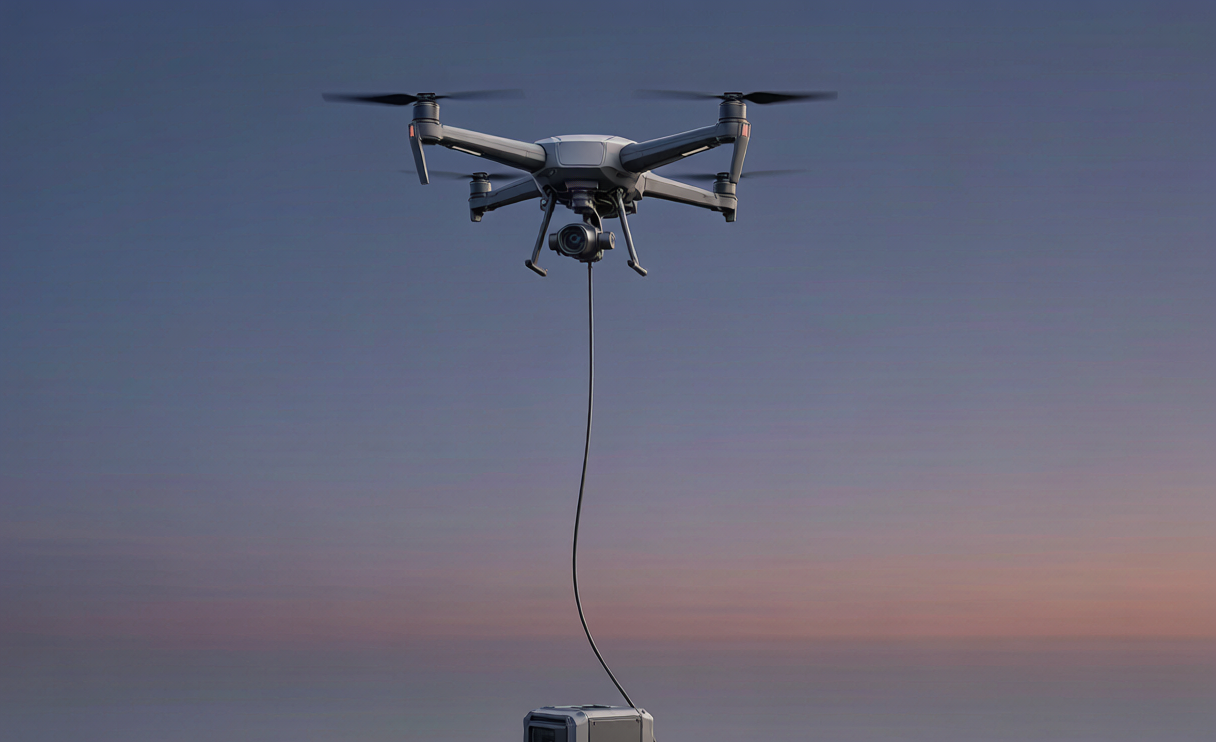
A tethered drone is essentially a flying mast. Instead of carrying the energy to stay aloft for 20 or 30 minutes, it draws continuous power from a ground power supply through a lightweight tether — typically two to four conductors plus an optional fiber line for data. The aircraft can loiter for hours or even days, limited by wind, maintenance, and the tether itself rather than by the onboard drone lithium battery. In this architecture the cells are sized for the worst-case moment: the tether cuts, the wind gusts, or the reel-in sequence begins, and the aircraft must still land itself safely.
That single shift — from primary source to backup reserve — changes every design number downstream. Capacity shrinks, but availability, isolation, and instant readiness become paramount. A free-flying surveillance drone might budget 0.30 to 0.55 kWh to stay up for half an hour. A tethered airframe often needs only 0.10 to 0.35 kWh of onboard storage, but it must deliver that energy on demand with zero warm-up, after sitting at float charge for twenty-four hours.
Sizing the Reserve Pack: What It Must Actually Carry
The reserve energy budget is governed by the emergency descent and return-to-land profile. A typical multirotor burns 1.5 to 2.2 kW in hover and 0.8 to 1.2 kW during a controlled descent or reel-in. Add a 10 to 25 percent gust overhead for the moment the tether lets go in wind, and a 60 to 120 second controlled descent plus a short translational landing requires roughly 0.05 to 0.12 kWh of usable energy. We specify two to three times that headroom — about 0.15 to 0.35 kWh — to cover aborted approaches, stronger-than-forecast gusts, and a second landing attempt.
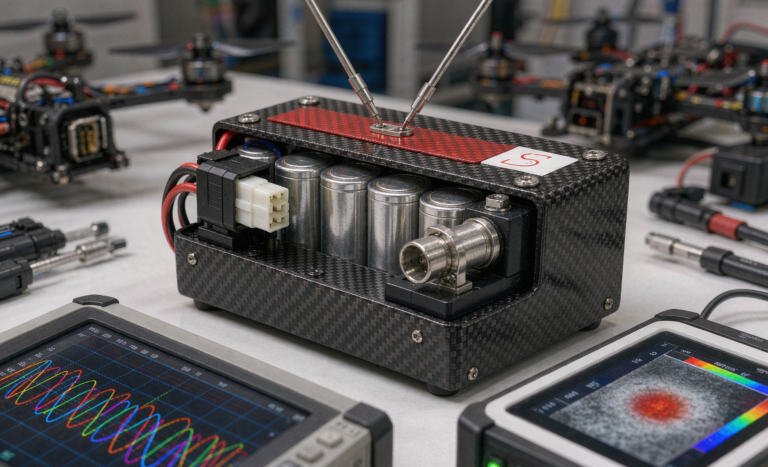
In cell terms that maps to a 6S (22.2 V nominal) pack of 10 to 16 Ah, or a split dual-pack for redundancy on larger airframes. Chemistry is a trade-off I discuss with every customer: NMC offers 200 to 250 Wh/kg, which keeps the reserve light, while LFP gives 120 to 160 Wh/kg but 2,000 to 4,000 cycles and a far more forgiving thermal envelope. For a reserve pack that spends its life at float, the cycle-life advantage of LFP is attractive, but many tethered masts are payload-limited, so NMC still wins on mass.
The Hybrid Tether-and-Battery Power Architecture
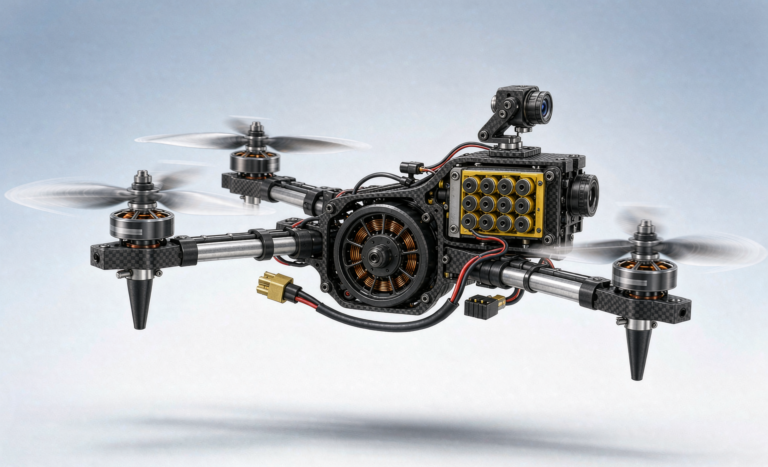
The heart of a tethered system is the power path. Ground-side, a 48 V or 400 V supply feeds the tether; airborne, a DC-DC converter and power management unit step that down to the motor bus and trickle-charge the reserve pack. The reserve lithium battery is held at a float of 3.80 to 3.85 V per cell so it is always mission-ready. The BMS has to do something unusual here: it must electrically isolate the tether input from the pack to prevent backfeed and overcharge, and it must hand off seamlessly when the tether drops so the aircraft never sees a voltage sag.
We implement this with OR-ing diodes or ideal switches, a dedicated airborne PMU, and a tether-fault detector that trips the reserve in under a millisecond. For persistent surveillance where the tether is the lifeline, that handoff is the single most important millisecond in the whole flight. A well-designed custom battery solution treats the tether and the pack as one redundant bus rather than two separate systems.
Thermal Management Inside a Sealed Tethered Pod
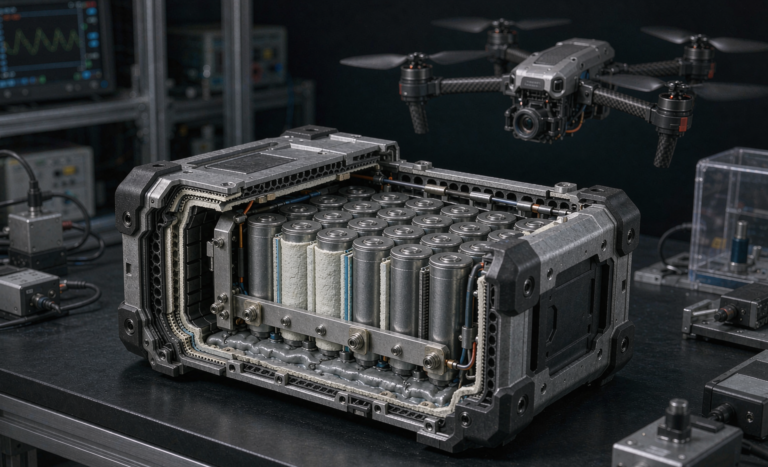
Tethered pods are usually enclosed to meet IP65 ingress protection, and they sit at altitude in direct sun or cold night air for the entire mission. The reserve pack is idle most of the time, but it must be ready the instant the tether fails. That creates a quiet thermal problem: you cannot draw meaningful cooling power from the reserve itself, because that reserve is the thing you are trying to protect. We rely on passive design — the aluminum chassis acts as a heatsink, the pack is mounted with thermal interface to the frame, and we avoid active fans that would drain the very cells they cool.
Telemetry matters more than hardware here. The BMS reports cell temperature and delta-V continuously to the ground over the redundant link, and our threshold logic flags any pack that drifts more than 20 to 30 mV from its neighbors. If a tethered mast loses its tether at altitude on a cold night, the reserve may need a 5 to 15 W pad heater to hold its core between 10 and 25 °C so it can deliver full power on descent — a detail free-flying drones rarely need because they are already warm from discharge.
Battery Management and Telemetry for Persistent Uptime
Because the aircraft may stay up for days, the reserve pack is managed for availability, not just for flight. Cell balancing keeps all series groups aligned, isolation monitoring detects the first sign of a tether or harness fault, and leak or arc monitoring protects the sealed enclosure. Capacity fade is well understood: a lithium cell delivers 100 percent of rated capacity at 25 °C, about 85 percent at 0 °C, 70 percent at -10 °C, and 55 to 60 percent at -20 °C. A tethered pack held at float stays warm, but the cold-start scenario — tether lost at altitude — is exactly where that fade bites, which is why we spec the heater and the headroom together.
The reliability target for persistent surveillance is different from a hobby pack. We retire a reserve at 80 percent capacity, at twice its baseline internal resistance, or at a 50 mV cell delta, whichever comes first. That discipline keeps the failure rate low enough that a 24/7 watch post can trust the aircraft to come home on its own.
Transport, Storage, and Compliance
Even a reserve pack has to move. Every pack we ship meets UN38.3 T.1 through T.8 and IEC 62133-2:2017, the baseline for lithium cells and batteries in transport and consumer/industrial equipment. For air freight we stage at 30 percent state of charge under IATA rules, and individual packs under 100 to 160 Wh travel as carry-on under FAA and EASA provisions (UN3480 for standalone cells, UN3481 for packed-with or contained-in equipment). The ground power supply is mains-powered and ships separately, so the airborne reserve is the only regulated item in the airframe.
In the field, storage discipline is what preserves a multi-year service life. We hold reserve packs at 3.80 to 3.85 V per cell, rotate on a FIFO basis, and log every cycle. A tethered mast that sits deployed for weeks still benefits from a periodic capacity check, because a pack that slowly self-discharges below its float window loses readiness without anyone noticing — until the tether fails.
Matching a Custom battery solution to the Mission
No two tethered installations are identical. Altitude ceiling, payload mass, wind class, and reel-in procedure all shift the reserve requirement, and a one-size pack either wastes lift or leaves the aircraft short. At Horizon Power we build a custom battery solution around the mission profile: reserve sizing from the descent budget, the airborne PMU and tether handoff logic, redundancy topology, and the heater strategy for cold-start recovery. The result is an aircraft that can loiter for days on tether power and still bring itself home the moment that tether is gone.
Frequently Asked Questions
How long can a tethered drone stay airborne?
Hours to days. Endurance is limited by the tether, wind class, and maintenance — not by the onboard drone battery, which only carries the emergency reserve. We have supported continuous loiter well beyond a single shift with scheduled ground-station checks.
Does a tethered drone even need a battery?
Yes. The onboard pack is the safety reserve for tether loss, reel-in, and brief maneuvering. Without it, any tether fault becomes a crash. The reserve is smaller than a free-flying pack but must be instantly available after sitting at float for a full day.
What voltage do tethered surveillance systems use?
Light tethers commonly run at 48 V DC, while heavier or higher-altitude systems use 400 V to reduce tether losses. Airborne DC-DC conversion steps that down to the motor bus and the 6S or 12S reserve pack.
How do you keep the reserve pack healthy during 24/7 loiter?
We float it at 3.80 to 3.85 V per cell, monitor temperature and delta-V by telemetry, run periodic capacity checks, and retire at 80 percent capacity, twice baseline internal resistance, or a 50 mV cell delta.
Can tethered surveillance packs ship by air?
Yes, provided they stay under 100 to 160 Wh per pack, meet UN38.3 and IEC 62133-2, and are staged at 30 percent state of charge under IATA. The ground supply ships separately as non-regulated equipment.