Drone Battery Performance for Inspection UAVs
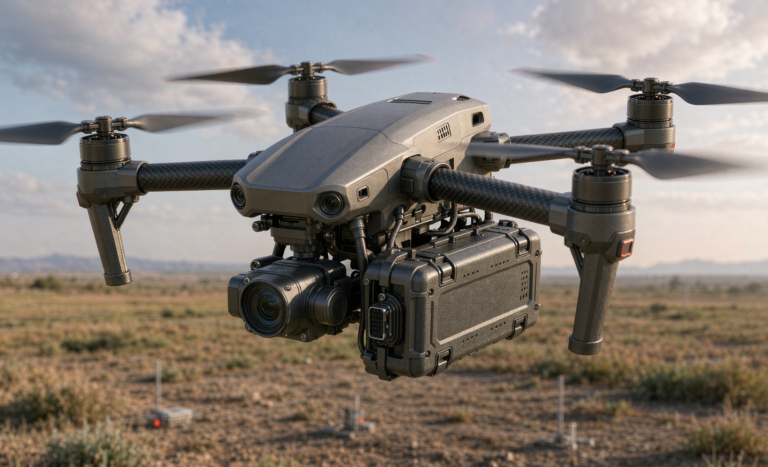
When operators ask me to spec a drone battery for inspection work, the first thing I tell them is this: inspection is not mapping, and it is not delivery. A mapping drone flies one long, energy-limited cruise line; a delivery drone carries a payload that dominates its power budget. An inspection UAV does neither — it climbs to an asset, holds a precise hover a few metres from a blade or a weld, fights gusts to keep the camera still, then repeats that cycle ten or twenty times per flight. As Karl Huang, Senior lithium battery Engineer at Horizon Power, I have spent years sizing packs for exactly this short-hop, station-keeping duty cycle, and the engineering rules are different from anything else in the field.
Why the Inspection Duty Cycle Breaks the Usual Rules
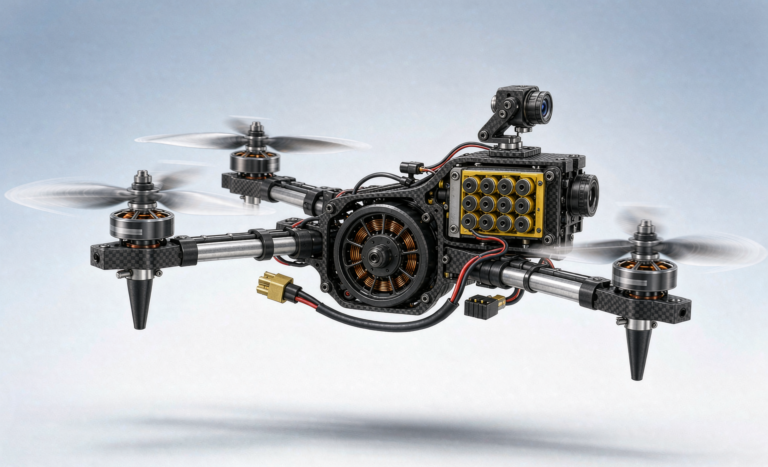
Most battery-performance articles talk about range or flight time as if the drone flew level the whole mission. Inspection flights do not. A typical close-up survey of a bridge, a flare stack, or a wind-turbine blade is a sequence of vertical take-off and landing (VTOL) cycles stitched together by short transits. The energy cost is dominated by three things: a steady hover-throttle floor, repeated climb/descent between assets, and gust-disturbance power spent keeping the airframe still enough for the camera.
For a 4–6 kg airframe, the hover floor sits around 1.5–2.2 kW. Every gust correction on top of that can add 10–25% steady overhead, and a sharp gust can spike instantaneous draw to 2.5–3.5C for a second or two. That burst behaviour is why I size the pack’s direct-current internal resistance (DCIR), not just its watt-hours, as carefully as the capacity.
The Station-Keeping Power Floor and Gust Disturbance
The defining number for inspection endurance is the station-keeping power floor: the watts the drone lithium battery must deliver just to hold position with the payload bus live. On a calm day a 5 kg inspection quad hovers near 1.8 kW. Add a 12–40 W thermal camera, a 20–80 W gimbal, RTK at 5–12 W, and a 10–25 W zoom or spotlight, and the payload bus alone can pull 50–160 W before you count propulsion.
Gusts are the silent budget killer. Wind does not just add a constant overhead — it forces the motors to make rapid thrust corrections, and those corrections push current through the pack’s internal resistance. At 150 A drawing through an 8 mΩ pack, a single gust correction dissipates 1.2 V of sag and 180 W of heat inside the cells. Over a 20-minute sortie with steady 10–25% gust overhead, that is real capacity you never get back, so I always budget the inspection mission at the disturbed hover power, never the still-air number.
Per-Asset Climb, Hover, and Transit Energy
To size a pack honestly you have to model the mission as a sum of asset visits, not a single cruise. For one asset on a 5 kg quad I budget roughly:
- Climb to inspection height (15–30 m): about 0.006–0.010 kWh at 3.0 kW peak.
- Precision hover at the asset (3–5 min): about 0.09–0.15 kWh at the 1.8 kW floor plus gust overhead.
- Transit to the next asset (100–300 m): about 0.005–0.010 kWh at 0.8–1.2 kW cruise.
- Payload bus (camera, gimbal, RTK, lights): about 0.002–0.005 kWh per stop.
That works out to roughly 0.12–0.18 kWh per asset. A sortie covering 10–14 assets therefore burns about 1.4–2.0 kWh of usable energy. Add 10% for gusts and a 30% regulatory/emergency reserve under FAA Part 107 and EASA SORA overflight rules, and you need about 2.0 kWh installed. In practice that means a 12S 22 Ah pack pair (each ~1.0 kWh) or a single 12S 44 Ah pack — not the 6S 22 Ah pack that works fine for a lighter mapping run.
How Hover Stability Protects Image Quality
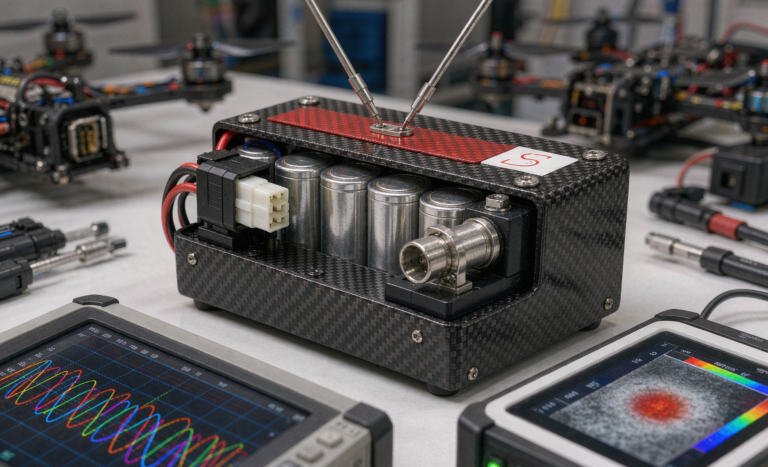
Close-up inspection lives or dies on image sharpness, and that is where the lithium battery becomes a camera component, not just a power source. When pack DCIR is high, a gust correction drops pack voltage by V = I × R. The ESC reads lower voltage and the motors transiently change RPM, which the gimbal and long lens turn into micro-jitter or rolling-shutter wobble — exactly the artefacts that hide a hairline crack. I therefore specify inspection packs with DCIR verified below 10 mΩ at 1 kHz ACIR plus a 3C/10 s DC pulse, a total sag under 8% of nominal, and an isolated, regulated payload rail with 20–40 ms holdup so the camera never sees the propulsion bus dip.
Interconnect resistance also steals sharpness. I keep every connector and harness segment under 15% of the pack’s internal resistance — on an 8–12 mΩ 12S pack that is a 1.2–1.8 mΩ budget, satisfied with AS150/XT150 connectors and 8 AWG silicone leads. A loose 3 mΩ contact at 100 A dissipates 30 W and 0.3 V of sag, enough to blur a close-up panel survey.
Chemistry Choice for an Energy-Limited, Burst-Capable Duty
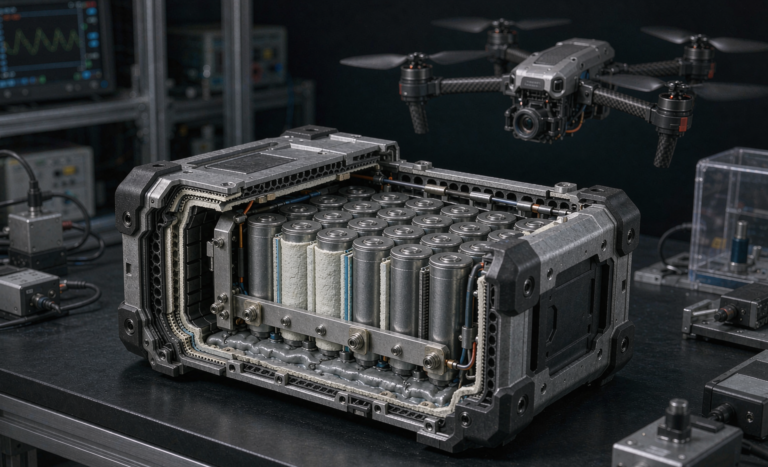
Inspection hover is a 0.5–1.5C energy-limited load with occasional 2.5–3.5C gust bursts, so my default chemistry is NMC or NCA at 200–250 Wh/kg with 500–1000 cycles. That gives the Wh/kg needed to keep the airframe light while leaving headroom for the bursts. High-power LiPo (150–200 Wh/kg, 3–6 mΩ, 30–50C) is tempting for gust response but costs 20–30% mass for capacity you mostly do not use, so I reserve it for gusty coastal or mountainous sites. LFP at 120–160 Wh/kg with 2000–4000 cycles is my ground charging-cart chemistry, not the airframe pack, and semi-solid cells at 250–300 Wh/kg are qualifying now for long-duration ship-based inspections.
The 6S–to–12S voltage lever matters here too. Doubling pack voltage from 6S to 12S halves the current and quarters the I²R loss: at 60 A a 12S pack loses 36 W to 10 mΩ, while a 6S pack pulling 120 A loses 144 W for the same power. For an inspection quad that means cooler packs, less sag, and steadier hover — directly better imagery.
Field Logistics, Compliance, and a Custom Build
Inspection fleets run hard, so I manage packs as a tracked pool. Each pack gets a QR or serial identity with a baseline ACIR, capacity, and thickness logged at 3.85 V/cell. Field charging stays at 1C–2C behind a 40 °C charge gate, packs are rotated FIFO, and storage sits at 3.80–3.85 V/cell. I retire a pack at 80% original capacity, 2× baseline internal resistance, a >50 mV cell delta, or 5% puffing — any one of those ends the pack’s flying life.
Transport follows the same playbook we use across every program: UN38.3 T.1–T.8, IEC 62133-2:2017, IATA 30% state-of-charge for air carriage, and FAA/EASA 100–160 Wh carry-on limits (packs above 160 Wh ship as cargo under UN3480/UN3481). When a client needs a different airframe, a different payload bus, or cold-start performance for dawn inspections, we deliver a custom battery solution — and when the platform is bespoke we build a custom drone battery around the exact climb, hover, and burst profile rather than forcing a standard pack to fit.
FAQ
How many inspection points can a drone battery cover per charge?
For a 5 kg inspection quad on a ~2.0 kWh installed pack, budget roughly 0.14–0.18 kWh per asset including climb, hover, transit, and payload. That gives about 10–14 close-up inspections per sortie after a 30% reserve — fewer in sustained wind, more on calm days with lighter payloads.
Why does hover stability matter for inspection image quality?
Pack voltage sag during gust corrections changes motor RPM, which the gimbal and long lens convert into micro-jitter and rolling-shutter wobble. Keeping pack DCIR under 10 mΩ and sag under 8%, with an isolated payload rail, is what keeps close-up crack surveys sharp.
Which battery chemistry is best for inspection UAVs?
NMC or NCA at 200–250 Wh/kg is the default for the energy-limited hover with burst headroom. High-power LiPo suits very gusty sites, LFP is best for ground charging carts, and semi-solid is qualifying for long ship-based runs.
How much do gusts reduce inspection battery life?
Steady 10–25% gust overhead is normal; sharp gusts can spike draw to 2.5–3.5C for a second or two. Budget the disturbed hover power, not still-air numbers, or you will land short of the last few assets.
How should inspection drone batteries be transported and stored?
Cap state-of-charge at 30% for air transport under IATA, follow UN38.3 T.1–T.8 and IEC 62133-2:2017, respect FAA/EASA 100–160 Wh carry-on limits, and store packs at 3.80–3.85 V/cell in a FIFO rotation.