Drone Battery Performance for Racing Drones: Managing the
After a decade of building and abusing high-discharge packs on the bench, I can tell you the single biggest performance lever in FPV racing is one most pilots never measure: heat. A racing drone battery is not limited by how many milliamp-hours it carries — it is limited by how much temperature it can survive before the cells start fighting back. This guide is the field playbook I give our racing customers: how a drone lithium battery actually heats up during a heat, where the dangerous thresholds sit, and the thermal-discipline habits that keep lap times repeatable from the first punch-out to the final corner.
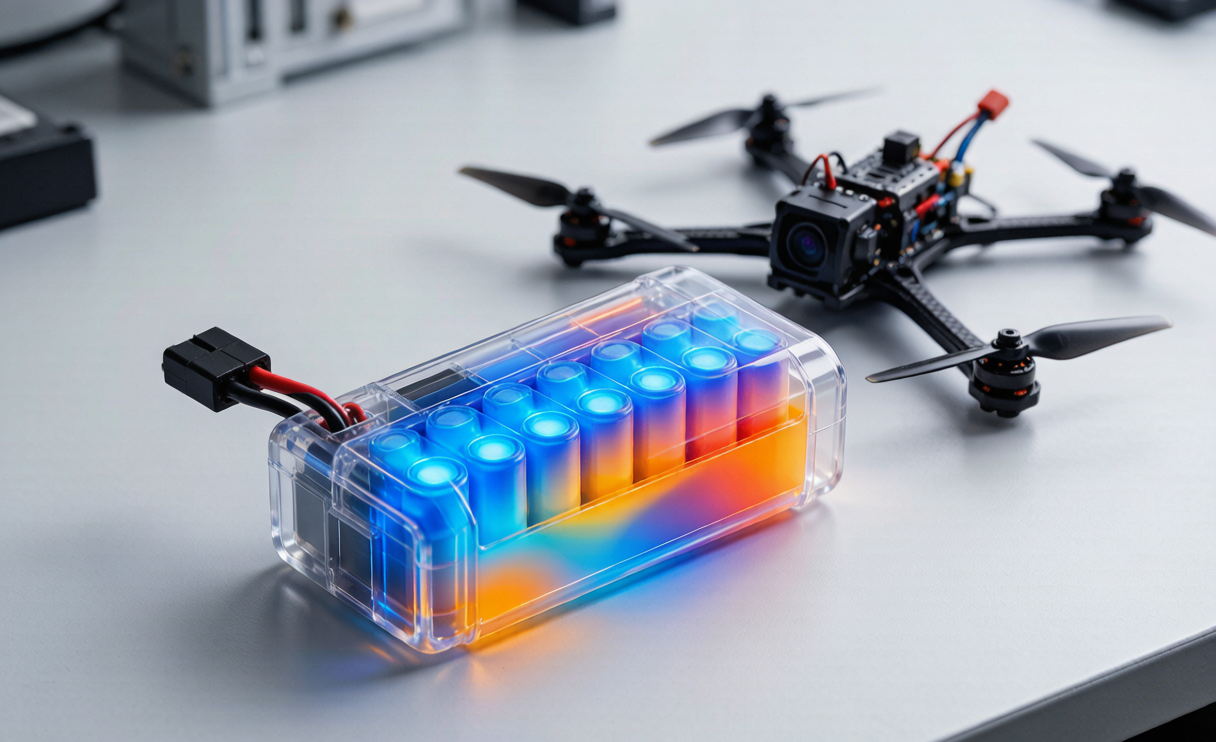
Why Racing Packs Are Thermally Limited, Not Capacity Limited
When a pilot asks me why their drone battery delivers a blistering first lap but a visibly slower fourth lap, the answer is almost never capacity. A 6S 1300 mAh pack still holds most of its energy at the end of a 90-second heat. What changed is temperature. Inside a racing quad the pack can pull 80–120 A in hard corners and punch 150–180 A on full-throttle punch-outs, and that current does not disappear — it becomes heat. The physical ceiling on drone lithium battery performance in racing is the thermal envelope, not the watt-hour rating printed on the label. Once cells cross a certain temperature, internal resistance climbs, voltage under load sags, and the ESC starts limiting throttle to protect the pack. I have measured this on the bench and on the track, and the pattern is reproducible across every chemistry we build.
The Heat Source — I²R Losses Inside the Pack
The dominant heat term in a high-discharge lithium battery is resistive loss: P = I² × R. At 150 A and a DC internal resistance (DCIR) of roughly 6 mΩ for a healthy racing pack, that is 135 W of pure heat generated inside the cells and busbars — in a package the size of a deck of cards. Because surface area is tiny, that power density is extreme. The cells themselves produce most of it (ohmic loss in the jelly-roll plus a smaller entropic component), and the weld tabs, harness, and connector add another 10–20 W when current is high.
- Cell ohmic loss: the largest single term, scaling with the square of current.
- Busbar and weld-tab loss: grows fast at burst C-rate, and is where poorly built packs melt.
- Connector and harness loss: a loose XT60-style connector can add 5–10 W of localized hot-spot heating.
- Entropic heat: reversible during charge/discharge, but small versus ohmic loss at racing currents.
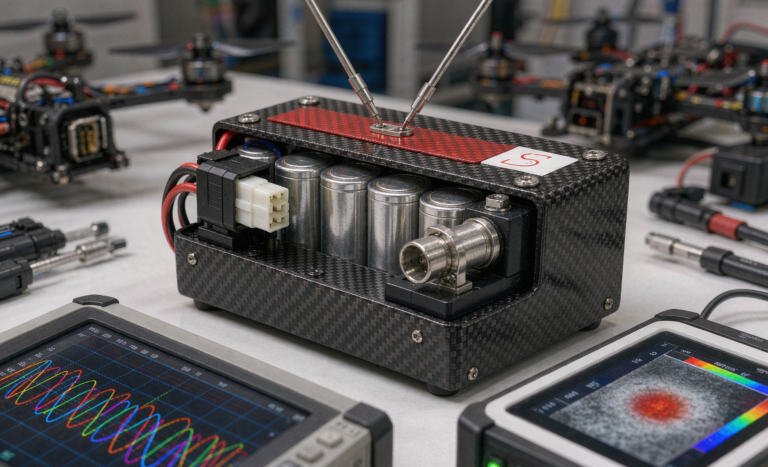
In my lab I log pack temperature with a surface thermistor on the wrap and a second probe between two center cells. On a hot day the wrap can read 42°C while the cell core runs 8–12°C higher — a gap that surprises pilots who only feel the outside of the pack.
Mapping the Current Profile to a Temperature Rise
A race is not a steady discharge; it is a sawtooth of throttle. To predict heating I integrate the current profile. The core temperature rise ΔT follows roughly ΔT ≈ (Σ I²·R·dt) / (m·c) minus cooling, where m·c is the pack’s thermal mass. A 1300 mAh 6S pack has a thermal mass of about 55–65 J/K, so even 120 J of accumulated loss lifts the core by 2°C — and a full heat burns several hundred joules. The practical takeaway: short, violent bursts hurt less than sustained mid-throttle because the pack sheds heat between punches. The drone battery that cooks is the one held at 70–90 A through a long straight for five consecutive laps.
This is why I tell teams to look at their throttle trace, not their flight time. A pilot carrying 80% throttle for 60 seconds straight will thermal-limit a pack that easily survives ten 90-second heats with relaxed cruise sections.
The Temperature Thresholds That Actually Matter
There are two numbers I watch on every racing drone lithium battery we validate:
- The 45°C knee. Around 45°C cell-core temperature, DCIR begins a non-linear climb. Voltage under load drops, so the quad feels soggy even though the pack is “full.”
- The 60°C hard limit. Above 60°C we see accelerated SEI growth and, on abused packs, swelling. I treat 60°C as a hard stop for any pack I will reuse.
Between those two lines the pack is still flyable but quietly aging faster. For a one-off finals run a pilot may accept 58°C; for a season of club racing I want the core under 50°C at pack-off. The difference is pack lifespan — a pack kept under 50°C might deliver 200+ hard cycles, while one routinely baked at 60°C is done in 60–80.
DCIR and Temperature — A Two-Way Coupling
Heat and resistance feed each other. A warmer cell has lower ohmic resistance at the instant of measurement, which is why a pack feels punchy for the first few laps as it warms from 25°C to 40°C. But sustained heat raises the *baseline* DCIR through electrolyte dry-out and interface degradation, so by lap six the same pack sags harder than it did on lap one. This two-way coupling is the trap: the early warm-up feels like free performance, and the late-race sag feels like mystery voltage drop. It is the same lithium battery physics, just time-shifted.
On the bench I characterize DCIR at 25, 40, and 55°C precisely to model this. A pack that gains punch from 25→40°C but then collapses past 55°C gets a thermal de-rate in its build spec.
Passive Cooling Strategies That Work on the Track
You cannot bolt a fan to a 1300 mAh pack and call it done — weight is lap time. The cooling that works is passive and structural:
- Thermal mass. A slightly larger pack (1500 vs 1300 mAh) at the same C-rate runs cooler simply because it has more grams of cell to absorb the joules. Sometimes the “heavier” pack is the faster pack over a whole heat.
- Airflow placement. Mounting the pack where prop wash hits it — usually the top tray — sheds 3–6°C versus a buried bay.
- Wrap choice. A matte shrink-wrap radiates better than a glossy one; a thin thermal pad against the frame conducts heat to the chassis.
- Pre-cool discipline. Storing packs at 20–22°C instead of 30°C gives a real buffer before the 45°C knee.
I have seen a 4°C drop just from moving the pack from an enclosed pod to an open top mount. That is the difference between a pack that sags on the last lap and one that does not.
Closed-Loop Thermal Telemetry for Racers
The best teams treat temperature like RPM — something to log, not guess. A small telemetry tag on the balance lead reports pack voltage and, with a tagged thermistor, core temperature to the goggles. When a pilot sees “52°C” on lap four, they ease throttle and protect the pack. For a drone battery program at any scale, this closed loop beats any rule-of-thumb. I spec a voltage-based IR estimate as a fallback: if pack voltage under a known current dips below a threshold, the pack is heating and should be rested.
A De-Rating Protocol That Protects Pack Life
For fleet and club racing I recommend a simple, written de-rate protocol so pack life is not left to pilot mood:
- Under 45°C core: full send.
- 45–52°C: fly, but no back-to-back heats without a 10-minute rest.
- 52–60°C: finish the run, then cool to under 40°C before next flight.
- Over 60°C: retire the pack from that session; inspect for swelling.
This is not about babying equipment. It is about keeping the pack in the flat part of the resistance curve where lap times stay repeatable — which is the whole point of racing.
How We Engineer Thermal Headroom Into Custom Racing Packs
When a team comes to us for a custom battery solution, thermal headroom is the first thing we model, before capacity or weight. We simulate the throttle trace they actually fly, size the cell count and C-rate so the core stays under 50°C through a full heat, and choose weld geometry and busbar cross-section to kill harness hot-spots. For one 4S indoor class we moved from 0.2 mm to 0.35 mm nickel and dropped busbar loss by a third — the pack stopped warming in the final minute and the pilot gained a consistent last-lap pace. Every pack we ship is UN38.3 and IEC 62133-2 validated, and for cross-border events we document the FAA 100 Wh and EASA thresholds even though a racing pack is far below them; clean certification paperwork is part of the drone lithium battery deliverable, not an afterthought.
Frequently Asked Questions
Why does my drone battery feel slower on later laps if it is not empty?
Because the cells have heated past the 45°C knee and DCIR has climbed, so voltage under load sags even with charge remaining. The limit is thermal, not capacity. Resting the pack drops resistance back and the punch returns.
What is the safest maximum temperature for a racing lithium battery?
I treat 60°C cell-core as a hard stop and prefer pack-off temperatures under 50°C for repeatable lap times and long pack life. The wrap can read 10°C cooler than the core, so measure between cells, not just on the surface.
Does a bigger battery always make the drone heavier and slower?
Not necessarily. A slightly larger pack at the same C-rate has more thermal mass and runs cooler, which can keep voltage under load higher through the whole heat. Over a full race the “heavier” pack sometimes wins on consistency.
How can I cool a drone battery without adding a fan?
Use passive methods: mount the pack in prop wash, choose a matte shrink-wrap, add a thin thermal pad to the frame, and pre-store packs at 20–22°C. Moving a pack from an enclosed bay to an open top tray alone can cut 3–6°C.
Can a custom battery solution really fix thermal sag?
Yes. By modeling your actual throttle trace and sizing cell count, C-rate, and busbar geometry, we keep the core under the resistance knee through a full heat. That removes the late-race sag without adding weight where it hurts.