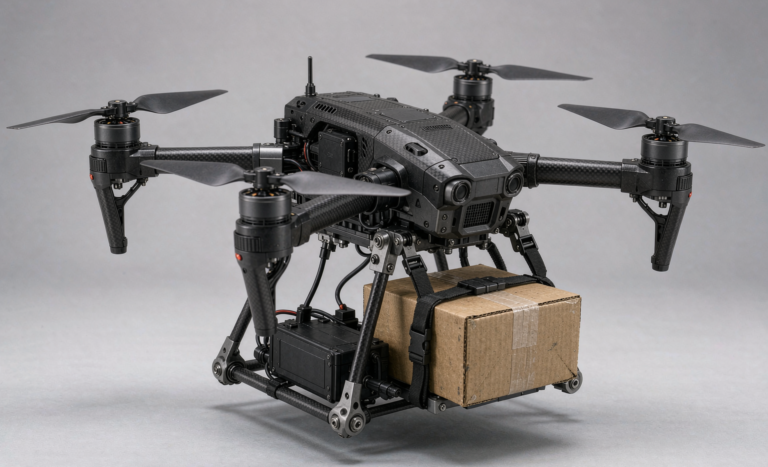
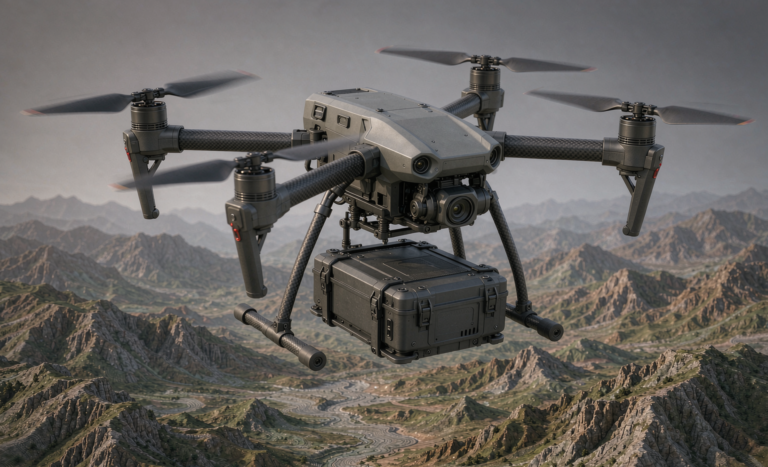
Drone Battery Reliability for Delivery Drones
Why Delivery Reliability Is a Different Engineering Problem Than Range
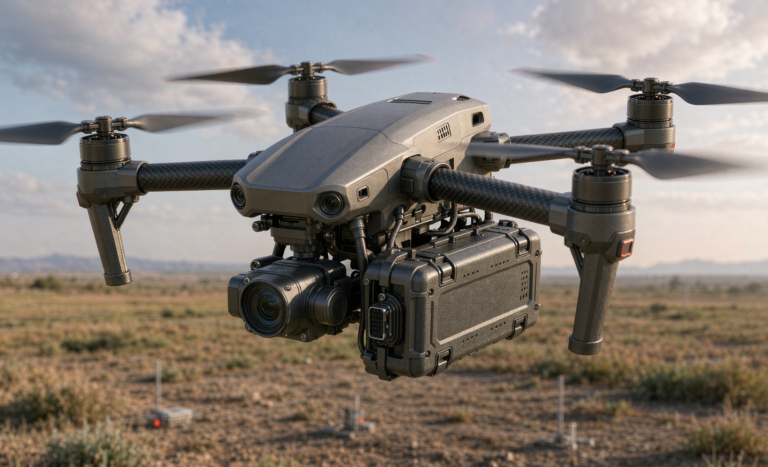
When a logistics operator sits across the table from me and asks about a drone battery, the question is almost never “what’s the maximum range?” The real question is: “How many of my 80 daily drops will actually complete?” That is a reliability problem, not a performance problem — and the two are solved with completely different engineering.
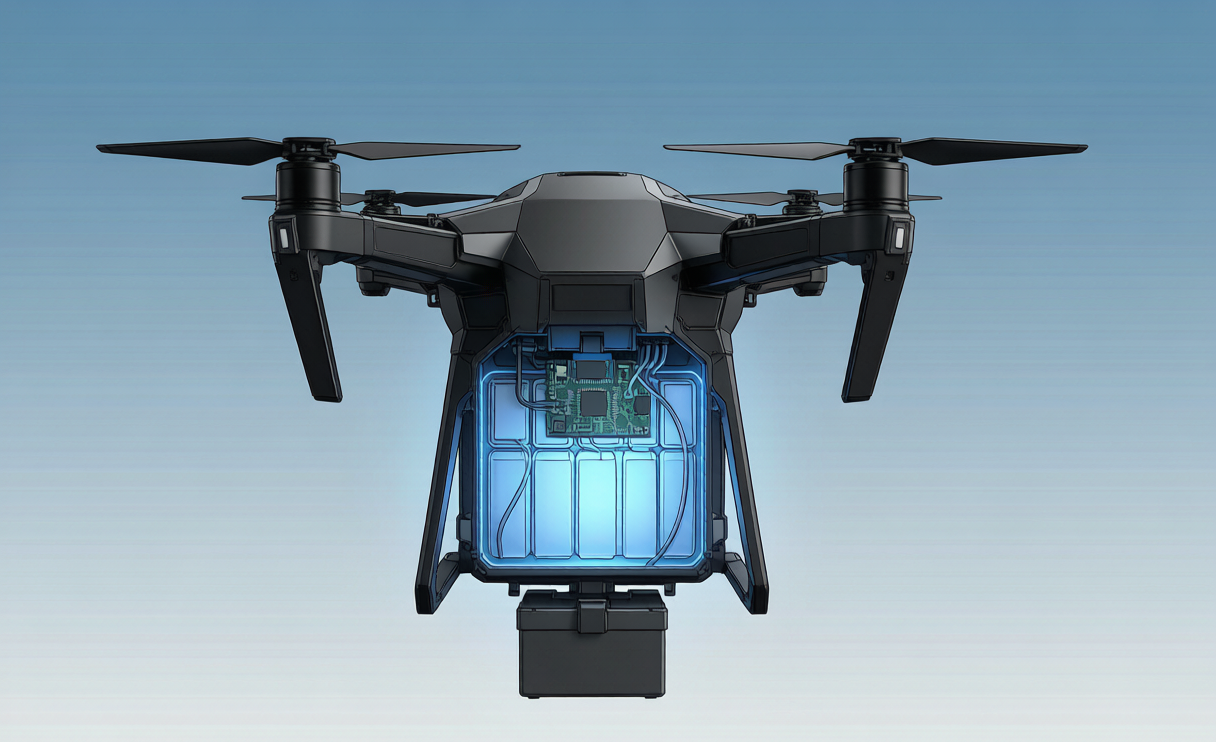
A delivery operation is judged by completed deliveries per day, not by the farthest single flight. A pack that delivers 95% of its rated capacity but fails unpredictably costs the operator far more than a pack at 80% that never surprises them. Reliability, in my math, is the probability of a completed sortie across the whole fleet: P(completed) is the product of the independent subsystem probabilities, and a delivery program lives or dies on keeping that product above 99%. Range is just one of those factors.
The reason delivery is its own reliability challenge comes down to the duty cycle. Unlike a mapping or inspection aircraft that cruises in a relatively steady energy-limited band, a delivery drone battery spikes to 3.5–5.0 kW — that is 6–9C — for 3–5 seconds on every single takeoff, then repeats that 60–120 times a day. That repeated pulse-power cycling drives DCIR (direct-current internal resistance) upward faster than any cruise mission I have measured. When sag crosses about 8% of nominal pack voltage, the BMS triggers an automatic return-to-launch — with the parcel still onboard. A failed delivery. So the reliability work is about keeping sag below that threshold for the entire service life, not about squeezing out the last watt-hour.
The Failure Modes That Actually Drop Parcels
Over a decade of teardowns, I have found that delivery packs fail in a small number of repeatable ways, and none of them are dramatic. They are quiet:
- Mid-mission sag crossing the 8% threshold. As DCIR climbs with cycles, the same takeoff pulse that sagged 1.2 V when new now sags 1.8 V, and the BMS calls RTL early. The fix is in cell selection and pulse verification, not in adding capacity.
- Pack-to-pack inconsistency in a shared depot pool. If packs are not binned, no two airframes fly the same mission. One aircraft makes every drop; its sister ship strands parcels at sortie 70. Binning to ±2% capacity and ±5% DCIR fixes this at the source.
- Cold morning deliveries. The 7 a.m. doorstep window is the worst case. A lithium battery fades hard in the cold: 100% of rated capacity at 25°C, 85% at 0°C, 70% at −10°C, and only 55–60% at −20°C. A pack sized with no cold margin will strand parcels on the first frosty route.
- Connector wear from daily mate and demate. At a busy depot a pack is plugged and unplugged 500–1000 times across its life. Gold-over-nickel plating holds up; tin or nickel oxidizes. I have measured a contact go from 0.25 mΩ to 2.5 mΩ after 400 cycles — that is 25 W of heat inside a 5 W housing, and the resulting hot contact causes intermittent voltage dropouts mid-flight.
- Cargo-bay thermal-isolation failure. For cold-chain or pharma loads, a pack that leaks heat into the box — or a bay heater that draws down the flight pack — turns a power problem into a spoiled-package problem. Isolation is part of the reliability spec, not an afterthought.
Redundant Pack Architecture So a Single Cell Fault Never Drops a Package
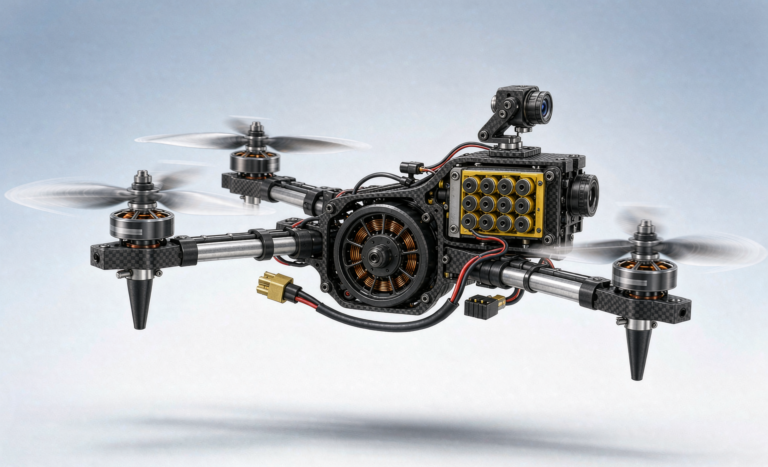
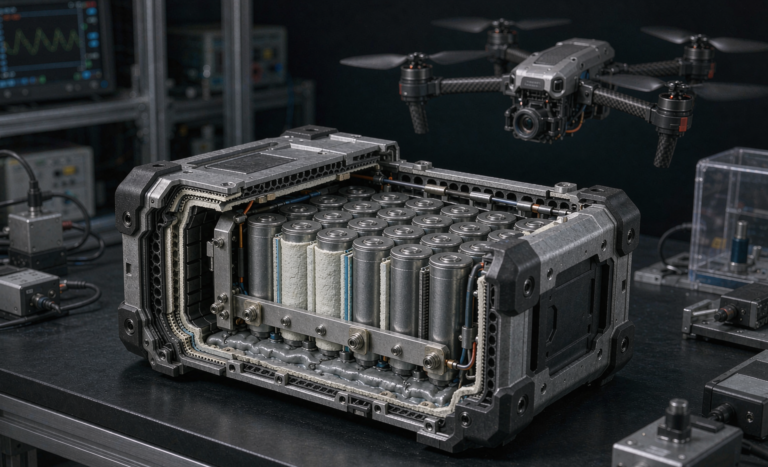
The single biggest reliability lever I specify for delivery fleets is redundancy at the pack level. A custom drone battery built for parcel duty uses two parallel packs with ideal-diode OR-ing, sized so that either pack alone sustains at least 60 seconds of hover. If a cell fault develops in pack A during climb, pack B carries the drop and flies the return-to-launch. The customer’s package lands; the fault is logged, not felt.
Around that I hang an isolated, regulated payload rail with 20–40 ms holdup. When the motors pull a hard spike, the avionics and release mechanism never see the dip — so a motor transient can never brown out the drop servo at the worst possible moment. The BMS samples per-cell voltage at 1–10 Hz with 30 mV and 50 mV delta alarms and an automatic RTL on telemetry link loss. None of this adds range. All of it adds the thing the operator actually buys: a drop that happens every time.
Incoming Screening and Lot Acceptance — Reliability Is Built Before First Flight
Reliability is not something you test into a pack after it is built; it is something you screen for before the pack ever flies. Every lot that arrives at a delivery depot goes through environmental stress screening: a thermal cycle plus a vibration profile drawn from the real route, which shakes out early-life defects that a bench capacity check would miss.
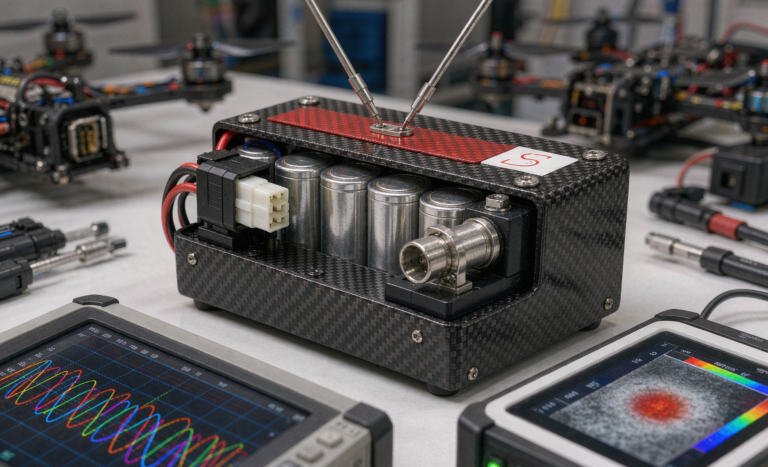
Lot acceptance for me has hard numbers. Cell-to-cell ACIR measured at 1 kHz must sit within 5% delta; capacity delta under 2%; thickness delta under 5%. Packs are then binned into performance tiers so the FIFO pool is consistent — every airframe draws from the same tier, and the fleet flies as one. Each pack gets a QR/serial identity and a baseline record of IR, capacity, and thickness, and the cells inside a single pack are matched to ±2% capacity and ±5% DCIR. A custom battery solution that skips this matching is, in my experience, the most common reason a delivery program sees “random” failures that are not random at all.
Predictive Maintenance — Retire the Pack Before It Fails
The most expensive failure in delivery is the one that strands a parcel in front of a customer. My rule is simple: pull the pack while it is still safe, not after it lets you down. The BMS telemetry does the watching — cell delta creeping past 30–50 mV, internal resistance climbing 10–20% month over month, or a 5–8°C thermal gradient across cells all flag a pack for the bench before it ever affects a sortie.
The retirement thresholds I publish to every operator are explicit: 80% state-of-health, or 2× the baseline internal resistance, or a cell delta over 50 mV, or more than 5% puffing. These are chosen conservatively on purpose. A drone lithium battery pulled at 80% SOH still has margin; a pack kept past that point is where the quiet failures start. Fleet health dashboards turn this into a risk score and a scheduled pull-ahead, so maintenance is planned into the depot shift, not reacted to in the field.
Field Logistics That Protect Uptime
None of the above survives contact with a real depot unless the daily logistics are right. A fleet doing 80 deliveries a day at roughly 0.45 kWh per sortie moves about 36 kWh through the charging bench — that is 1C charging for 10–14 packs per aircraft plus 2–3 kW of charge power, typically two 6-channel chargers at around 1 kW each. I gate charging at 40°C and keep the discharge window between 15°C and 45°C, with FIFO rotation and storage at 3.80–3.85 V per cell so packs are never sitting hot or over-charged between shifts.
Rapid-swap matters for uptime: under 60 seconds pack change, with a three-zone staging area — charged, in-flight, and cooling — so a hot pack never goes back on an aircraft before its thermal window closes. And because these packs ship between hubs, every one meets UN38.3 (tests T.1 through T.8), IEC 62133-2:2017, IATA’s 30% state-of-charge rule for transport, and the FAA/EASA 100–160 Wh carry-on band. A custom drone battery built around the airframe and the depot duty profile — not a repurposed hobby pack — is what keeps that completed-delivery rate above 99%.
Frequently Asked Questions
How reliable should a delivery drone battery be?
I target a fleet completed-delivery rate above 99%, which means each subsystem probability multiplies. A pack that is 99.9% reliable per sortie still strands roughly one parcel in a thousand; the engineering goal is to push the pack factor high enough that the fleet number clears 99% once you multiply in avionics, link, and weather. Redundancy and predictive retirement are how you get there.
Why do delivery packs degrade faster than survey or inspection packs?
Because delivery is pulse-power cycling, not steady cruise. Every takeoff is a 6–9C spike for 3–5 seconds, repeated 60–120 times a day. That duty drives DCIR up faster than an energy-limited mapping flight, so delivery packs need cells verified for pulse and a tighter retirement window.
Can one bad cell really drop a package?
Without redundancy, yes — an internal short or a high-IR cell can push sag past the 8% threshold and trigger early RTL with the parcel onboard. That is exactly why I specify dual parallel packs with OR-ing: a fault in one pack lets the other complete the drop and the return.
What storage charge should a depot fleet use between shifts?
3.80–3.85 V per cell. It minimizes calendar aging and capacity loss, keeps packs ready for FIFO issue, and stays inside the safest band for both overnight storage and IATA transport at 30% state of charge.
When do you retire a delivery pack?
At 80% state-of-health, or 2× baseline internal resistance, or a cell delta over 50 mV, or more than 5% puffing — whichever comes first. The point is to pull it while it is still safe and predictable, not after it has stranded a customer’s parcel.
Do delivery batteries need special shipping rules between hubs?
Yes. Every pack must pass UN38.3 (T.1–T.8) and IEC 62133-2:2017, ship at the IATA 30% state-of-charge limit, and stay within the FAA/EASA 100–160 Wh carry-on band. A properly documented custom battery solution arrives at the next hub cleared, not quarantined.