Drone Battery Cost Optimization for Delivery Drones (3)
Why the Charger, Not Just the Cell, Sets Your Delivery-Drone Battery Cost
After three years of building power systems for last-mile logistics fleets, I have watched operators fixate on pack price per watt-hour while ignoring the single largest controllable variable in their drone battery budget: the energy and infrastructure that refill it. A 100 Wh delivery pack might cost you $70–90, but the way you charge it over its 400–600 cycle life quietly determines whether you get 600 cycles or 320. When you run fifty drones, that gap is the difference between buying 1,100 packs a year and buying 2,000. And because a delivery operation flies hundreds of missions every single day, the small per-charge decisions that feel trivial at the bench compound into six-figure swings by year end. In this article I will walk through the charging-infrastructure and energy-economics levers I use to optimize drone battery cost optimization delivery drones programs from the depot floor up, not just from the bill of materials.
The Real Cost of a Charge: Electricity per Mission
The first number every fleet controller should know is energy per mission. A mid-size delivery quad carrying a 1–2 kg payload on a 6S lithium pack draws roughly 400–600 W in average cruise and hover. Across a typical 12–18 minute mission that is about 0.10–0.15 kWh drawn from the pack. But the wall-plug figure is higher: lithium battery charging is only about 85–92% energy-efficient once you account for the constant-voltage taper, balancing losses, and cabinet cooling. The efficiency penalty is not one thing but three: roughly 3–4% is lost to cell balancing across a pack that is never perfectly matched, another 3–5% disappears into the constant-voltage top-off where current trickles in for the final 20% of charge, and 1–2% is cabinet fan and converter standby draw. Add them and the true grid energy per mission is closer to 0.13–0.17 kWh, a figure I always use for cost modeling because it reflects what the utility meter actually sees.
At a blended commercial tariff of $0.12–0.18 per kWh, that is roughly two cents of electricity per mission. Spread across 1,500 missions a day on a fifty-drone depot, you are spending on the order of $10,000–14,000 a year just on electrons. That sounds trivial next to pack spend, but it is the floor — and it is where demand charges and poor scheduling quietly multiply the bill by two or three.
Time-of-Use Tariffs and Depot Demand Charges
Commercial sites are rarely billed on energy alone. The demand charge — the peak kW your depot draws in any fifteen-minute window — is often the dominant line item, and a delivery fleet is a perfect storm for it. If every pack lands at 17:00 and forty chargers switch on at once, you spike the building peak and pay for that spike every month. To make the math real: a 300 W charger drawing 0.85 power factor pulls about 360 VA, so forty simultaneous chargers alone add 14.4 kVA to the building peak. At a typical $12–18 per kVA monthly demand rate, that single uncontrolled spike costs $170–260 every month for a full year — $2,000–3,100 annually — purely from letting the schedule decide when to plug in.
I design depots around off-peak and shoulder windows. A custom battery solution for a logistics client used a 30 kWh buffer bank (LFP stationary storage, certified to IEC 62619) that absorbed the evening charge surge and refilled itself overnight at $0.07/kWh instead of $0.22/kWh peak. The buffer paid for itself in eleven months and cut the demand-charge line by roughly 60%. The lesson is simple: a drone lithium battery is cheap to charge when you decide when to charge it, and expensive when the schedule decides for you.
Fast-Charge vs Cycle-Life: Finding the Economic C-Rate
Operations teams always want faster turnaround, and vendors happily sell 4C or 5C chargers. But from a cost standpoint, aggressive fast charging is a loan against pack life. In our lab data, a 6S NMC delivery pack rated for ~600 full cycles at 1C degrades to roughly 420 cycles at 2C and ~300 cycles at 4C, driven by accelerated lithium plating and elevated cell temperature during the constant-current phase.
The economic optimum for most last-mile fleets lands near 1.5–2C. At that rate you still turn a pack around in 35–50 minutes — enough for a realistic duty cycle with a small pack float — while preserving 85–90% of rated cycle life. Pushing to 4C to save twenty minutes per charge can raise your annual pack procurement by 40%, which dwarfs any labor saving. I quantify this directly: if a pack costs $80 and lasts 600 cycles at 1C versus 300 at 4C, your cost per mission for energy storage doubles from $0.13 to $0.27 before you count the extra charger wear.
Depot Charging Architecture and Capital Trade-offs
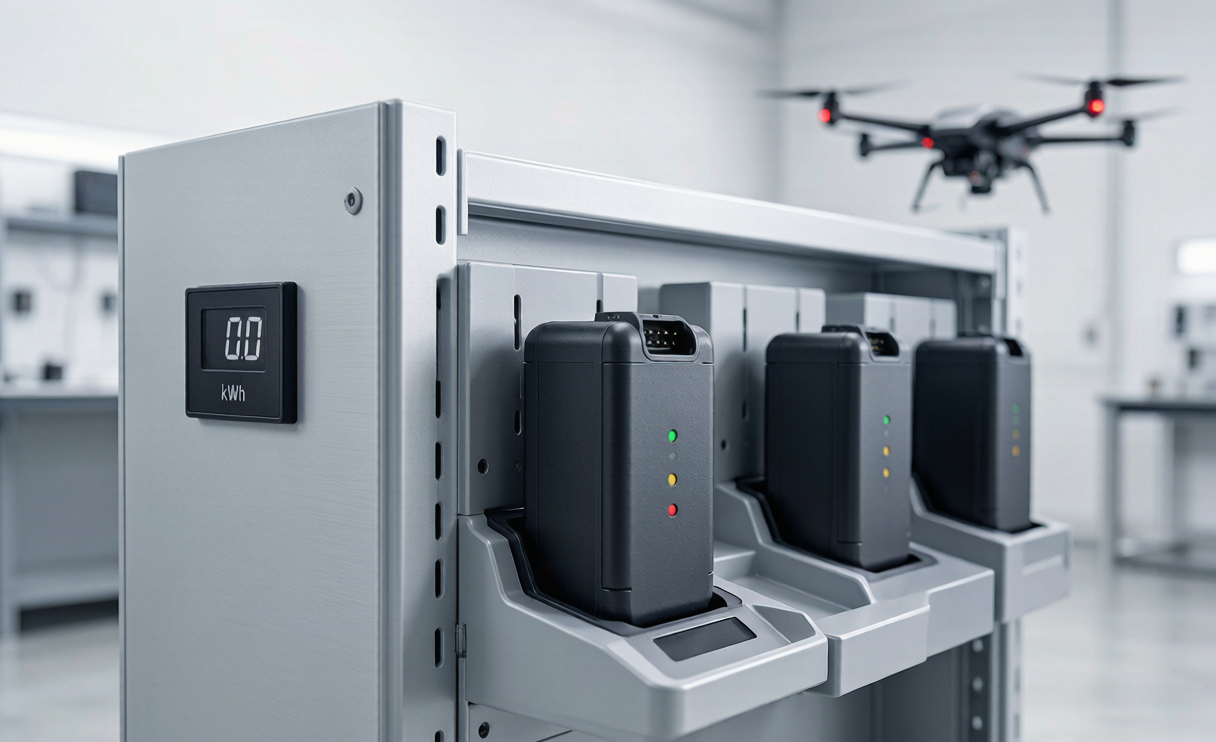
The physical charging system is itself a cost center. I generally compare three topologies. Distributed wall-chargers are cheapest to install but hard to meter, balance, or cool. Centralized cabinets with active balancing and shared cooling are more capital up front but give you one thermal and one metering point. Rack-based depots with hot-swap cradles and per-slot telemetry are the most expensive but enable true continuous operations with a minimal pack float.
For a fleet doing more than 20 missions per drone per day, I recommend the rack approach as a custom battery solution, because it lets you right-size the pack inventory: you buy fewer packs when swaps are instantaneous. The per-slot telemetry also pays for itself — I have caught failing cells at 8% capacity divergence during a routine charge rather than in flight, avoiding both a lost aircraft and a customer-delivery miss. The cabinet must meet IEC 62477 / IEC 60335 for power conversion safety, and the stationary buffer that smooths demand should meet IEC 62619 / IEC 63056. Skimping on certified charge gear to save 10% up front routinely costs 30% later in downtime and thermal incidents.
Standards, Safety, and the Hidden Cost of Non-Compliance
Compliance is not a paperwork tax; it is a cost control. Every pack we ship for delivery programs is validated to UN38.3 (the T.1–T.8 sequence: altitude, thermal, vibration, shock, external short, impact, overcharge, forced discharge) and built on cells qualified to IEC 62133-2. Spare packs crossing borders by air stay at or below the 100 Wh FAA threshold; above that you trigger Class 9 hazardous-goods handling that adds dollars and days to every replenishment.
In the depot itself, thermal-runaway containment is the line between a line item and a catastrophe. I spec charge bays with ceramic barriers, off-gas venting, and per-slot fusing so one failing lithium battery cannot take down a forty-pack cabinet. EASA and national aviation authorities increasingly expect documented depot safety for drone operators, and an uninsured thermal event is the most expensive “saving” a logistics team can make. Designing charging infrastructure to standard from day one is the cheapest insurance in the budget.
A Worked Fleet Energy-Cost Model
To make the levers concrete, here is a model I run for new clients. Take a fifty-drone depot, each drone flying 30 missions per day, 340 operating days a year: 510,000 missions annually. Energy per mission at the wall is 0.14 kWh, so grid energy is 71,400 kWh/year. At a blended $0.15/kWh that is about $10,700 in electricity.
Now the bigger lever: pack life. At 1.5–2C disciplined charging with buffer-smoothed, off-peak energy, packs deliver ~550 cycles. With 510,000 missions a year and ~30 missions per pack-life-equivalent, the fleet consumes about 930 packs a year at $80 each — $74,400. Switch to undisciplined 4C peak charging and cycle life falls to ~300, pushing pack spend to ~$136,000. The charging strategy alone swings $60,000 a year, roughly six times the entire electricity bill. That is why I tell operators that drone battery cost optimization delivery drones lives or dies at the charge bay, not the procurement spreadsheet.
Frequently Asked Questions
What is the cheapest way to charge a delivery-drone battery fleet?
The cheapest sustainable approach is off-peak charging smoothed by a small stationary buffer bank, held at a 1.5–2C rate. You avoid demand-charge spikes and preserve pack cycle life, which together beat any marginal saving from buying cheaper cells.
Does fast charging really shorten drone battery life that much?
Yes. In our testing a 6S NMC delivery pack drops from about 600 cycles at 1C to roughly 300 cycles at 4C. Because pack cost dominates the budget, that halving of life roughly doubles your cost per mission even though charging is faster.
How much does electricity actually cost per delivery mission?
Typically one to two cents of grid energy per mission after charge losses, but the surrounding demand charges and the cycle-life impact of how you charge are where the real money moves.
What safety standards apply to depot charging infrastructure?
Packs follow UN38.3 and IEC 62133-2; charge converters should meet IEC 62477 / IEC 60335, and any stationary buffer bank IEC 62619 / IEC 63056. Spare packs should stay at or below the 100 Wh FAA air-transport limit.
Is a buffer battery worth the capital for a small depot?
For sites with sharp evening charge spikes and high demand charges, yes — payback is often under a year. For a small, flat-profile operation, disciplined off-peak scheduling without a buffer is usually enough.