Drone Battery Reliability for Racing Drones: What Field
In fifteen years of building drone lithium battery packs for everyone from agricultural survey operators to cinematic crews, the FPV racing community is the one that breaks batteries faster than any other — and learns the most from it. A racing drone pulls 80 to 120 amps through a pack the size of a deck of cards, slams it into the ground at 60 mph, and asks for the same punch on the next lap. If you want to understand drone battery reliability, racing drones are the worst-case laboratory on the planet. I am Karl Huang, Senior Lithium Battery Engineer at Horizon Power, and in this article I walk through exactly what we measure, what fails first, and how we engineer a pack that survives a full race season instead of a single heat.
What “Reliability” Actually Means for a Racing Drone Battery
Reliability sounds like a simple word until you put a number on it. For a consumer lithium battery, reliability is often quoted as 500-cycle calendar life at 0.5C. For a racing drone, that number is almost meaningless. A race pack rarely sees 500 cycles — it sees 80 to 150 brutally hard cycles and a dozen crashes. What pilots actually care about is consistency of voltage under load. A reliable drone battery delivers 90% of its launch-day punch on lap 20 of a three-minute final, after a dozen hard throttle spikes, not just on the first pack of the day.
We therefore break drone battery reliability into four measurable dimensions: (1) cycle life at high C-rate, (2) capacity retention after thermal stress, (3) internal resistance (DCIR) growth, and (4) mechanical survival under vibration and shock. A pack that wins on one axis and fails on another is not reliable — it is a gamble. The engineering work is balancing all four.
The Cell Chemistry Decision — LiPo, LiHV, and Where Solid-State Fits
Almost every racing drone runs on lithium polymer (LiPo) or high-voltage lithium polymer (LiHV). Standard LiPo sits at 3.7V nominal per cell and 4.20V fully charged; LiHV pushes nominal to 3.8V and full charge to 4.35V, buying roughly 4–5% more usable energy and a flatter voltage curve under load. The trade is tighter tolerance on charge termination and slightly faster aging.
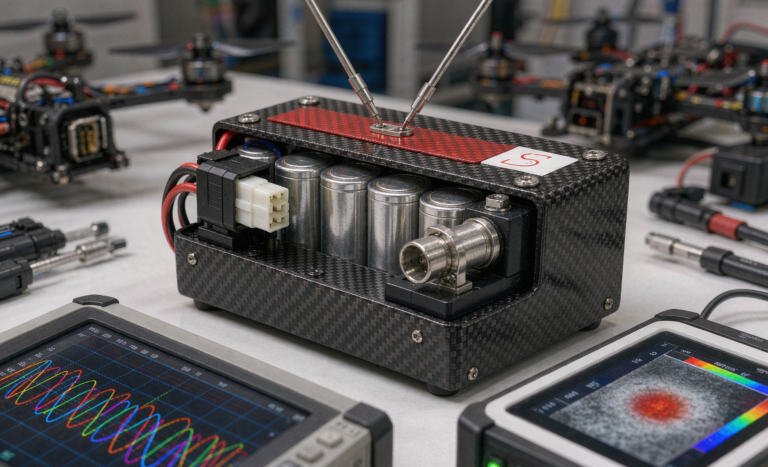
The single most important cell parameter for racing is DCIR — direct current internal resistance. Lower DCIR means less voltage sag during a punch-out, which means more motor RPM and more punch. We measure DCIR with an HPPC (Hybrid Pulse Power Characterization) pulse at 10C and 30C and track how it climbs with age. Graphene-doped LiPo reduces DCIR and improves heat handling, but it costs more and still ages. For racers who need a custom battery solution, we sometimes spec semi-solid-state cells where the priority is thermal margin rather than peak C-rate — useful for pilots who have melted more packs than they care to count.
Discharge rating is the other headline number. A racing pack routinely pulls 30–50C continuous and 80–100C+ in short bursts. A cell rated at 75C burst that sags to 3.3V under load is worse than a 100C cell that holds 3.6V. Always validate the rating on the bench; vendor C-ratings are optimistic by design.
The Real Failure Modes I See on the Bench
When a racing drone lithium battery dies, it is rarely the chemistry. It is the system around the cells. The five failure modes I see most often:
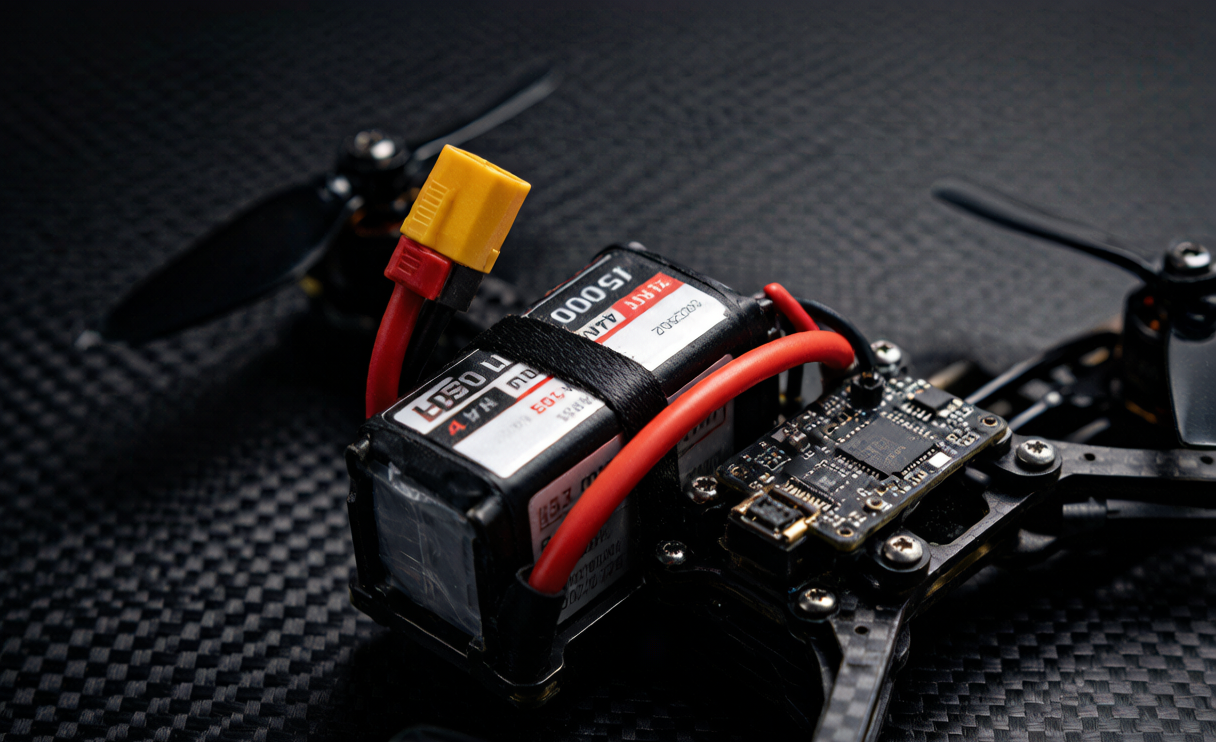
- Joint fatigue at the XT60 and balance leads. Vibration at 30–80 Hz loosens solder and spot-weld points. The pack reads fine on the charger and fails mid-flight.
- Capacity fade from deep, hot cycling. A typical 1500 mAh 6S pack loses 15–20% capacity after 80 full-throttle cycles, and DCIR grows 25–40% over the same window.
- Swelling from over-discharge and over-temperature. Pushing below 3.0V per cell under load, or charging above 45°C, accelerates gas generation inside the pouch.
- Connector melting at the main power leads. Sustained burst current past the rated limit welds the XT60 or burns the silicon wire insulation.
- Cell imbalance from aggressive differential discharge. Hard cornering and throttle differential load cells unevenly; without balancing, one cell becomes the weak link.
Each of these is design-addressable. The job of a reliability engineer is to move the failure from “random mid-race” to “predictable and caught at pre-flight.”
Standards We Design and Test Against
Reliability claims mean nothing without test discipline, so we qualify every drone battery pack against the same baseline the aviation and industrial world uses. The backbone is UN38.3, the UN transport test for lithium cells and batteries, covering altitude simulation (T.1), thermal (T.2), vibration (T.3), shock (T.4), external short (T.5), impact (T.6), and forced discharge (T.8). A pack that cannot pass UN38.3 does not leave the building, full stop.
On top of that we apply IEC 62133-2 for secondary cell safety, and we lean on IEC 60068-2-6 (vibration) and IEC 60068-2-27 (shock) to qualify the pack mechanically well beyond the UN38.3 minimum — racing drones see far harsher real-world profiles than the standard test. For environmental sealing of the electronics and lead strain-relief we reference IEC 60529 (IP rating) and use conformal coating on the balance leads. And because pilots fly internationally, we brief every customer on FAA and EASA rules for carrying spare lithium batteries: carry-on only, terminal protection, and state-of-charge limits for transport. For larger industrial packs we also pull in IEC 62619 for safety management of the system.
Engineering for Vibration and Shock Survival
The bench test that best predicts a racing pack’s life is the random-vibration profile on a shake table, run per IEC 60068-2-6. We sweep 10–500 Hz with 0.04 g²/Hz and look for joint resistance drift. If the XT60 solder joint drifts more than 5%, we redesign the strain relief. We then hit the pack with IEC 60068-2-27 shock pulses of 500 m/s² half-sine — that is the “crash” simulation — and verify no internal open circuit.
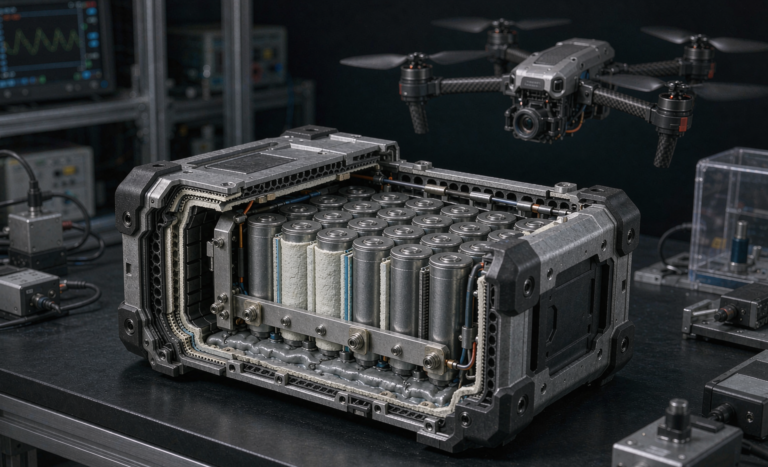
Mechanically, we favor soft silicone wire over stiff PVC for the main leads, because it absorbs vibration instead of transmitting it to the cell tabs. We pot the balance plug, add foam padding between the pack and the frame, and where a customer wants a true custom battery solution we can move from shrink-wrap to a hard 3D-printed case for the harshest tracks. None of this adds weight a racer wants — so we keep it to under 4 grams.
How We Validate a Pack Before It Hits the Track
Before any drone lithium battery carries the Horizon Power name, it passes a four-stage validation. Stage one is the pulse discharge test: 20 repeated 100C bursts with 30-second recovery, logging voltage sag and rebound. Stage two is an accelerated cycle test at 10C to 80% depth of discharge until capacity falls below 80% — we want to see at least 120 cycles. Stage three is a drop and crash simulation on the shake table plus a 1.5 m free-fall onto a hard surface. Stage four is thermal imaging during burst discharge to confirm no hot spot exceeds our 60°C internal limit.
Only after a pack passes all four do we send it to a small group of beta pilots for field validation. Their crash logs are more valuable than any bench number, because real tracks combine vibration, heat, and pilot error in ways we cannot fully simulate. This field-feedback loop is how our drone battery reliability numbers keep climbing season over season.
Maintenance and Operating Discipline That Extends Life
Even a perfectly engineered lithium battery will die early in the hands of bad habits. The discipline that extends racing-pack life is simple and non-negotiable. Store at 3.80–3.85V per cell (storage charge), never at full charge — a pack left at 4.35V ages dramatically faster. Never discharge below 3.0V per cell under load; set your low-voltage warning at 3.5V and land. Charge below 45°C and fly between 20°C and 50°C; cold packs sag, hot packs swell. After every event, inspect for swelling and wiggle the balance leads. A custom battery solution from our team includes tuned protective thresholds in the BMS so the pack cuts out before damage rather than after — a small safety margin that pays for itself in fewer replacements.
Frequently Asked Questions
How many cycles does a racing drone battery last?
A well-built racing drone battery typically delivers 80–150 aggressive cycles before capacity drops below 80% of launch-day values. Gentle pilots on a single discipline see the higher end; full-throttle racers pushing 100C bursts see the lower end. Proper storage charge and avoiding deep discharge are the two habits that add the most cycles.
What C-rating do I actually need for FPV racing?
For most 5-inch class racing, a continuous 60–75C and burst 120C+ cell is the practical floor. But C-rating on the label is optimistic — validate DCIR on the bench. A cell that holds voltage under load matters more than a high number on the wrap. Match the rating to your motor/prop draw, not to marketing.
Is LiHV better than LiPo for racing?
LiHV gives 4–5% more usable energy and a flatter under-load curve, which translates to slightly more punch and longer laps. The cost is tighter charge tolerance and a bit faster aging. Many racers run LiHV for qualifying and LiPo for practice. Either way, the cell quality and DCIR matter more than the chemistry label.
Can I make a racing drone battery safer with a BMS?
Yes, but with care. A BMS adds over-current, over-discharge, and temperature protection that prevents the worst failures — melted leads, deep discharge, thermal runaway. The trade is a few grams and slightly higher DCIR. For a custom battery solution we keep the BMS minimal and tune thresholds so it protects without cutting power mid-lap.
How should I store racing drone batteries between events?
Charge each cell to 3.80–3.85V (storage voltage), disconnect from the drone, place in a fire-safe container away from heat, and check voltage monthly. Never store at full charge or fully depleted. Good storage discipline is the single biggest factor in long-term drone battery reliability after the pack leaves our lab.