Drone Battery Safety for Mapping UAVs
Mapping drones have become indispensable tools for agriculture, mining, construction, and urban planning — but the battery that keeps them airborne is also the component most likely to cause an incident if misunderstood. I am Karl Huang, Senior lithium battery Engineer at Horizon Power, and in this guide I will walk through how we engineer a safe drone battery for mapping UAVs, from regulatory certification to real-world field handling.
Why Mapping UAVs Demand a Different Safety Profile
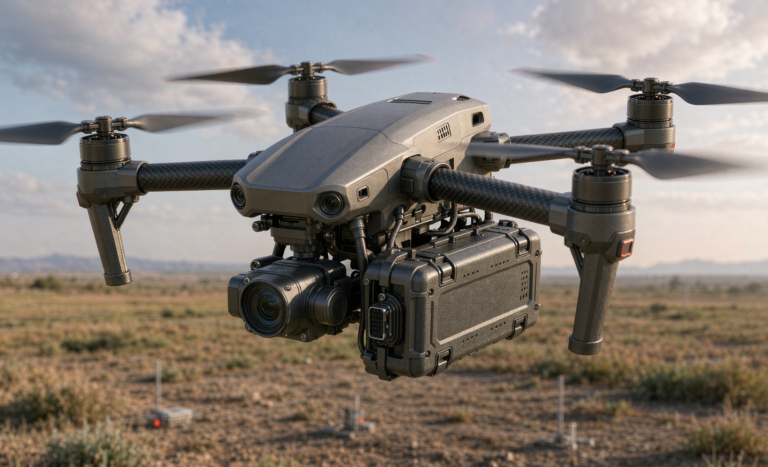
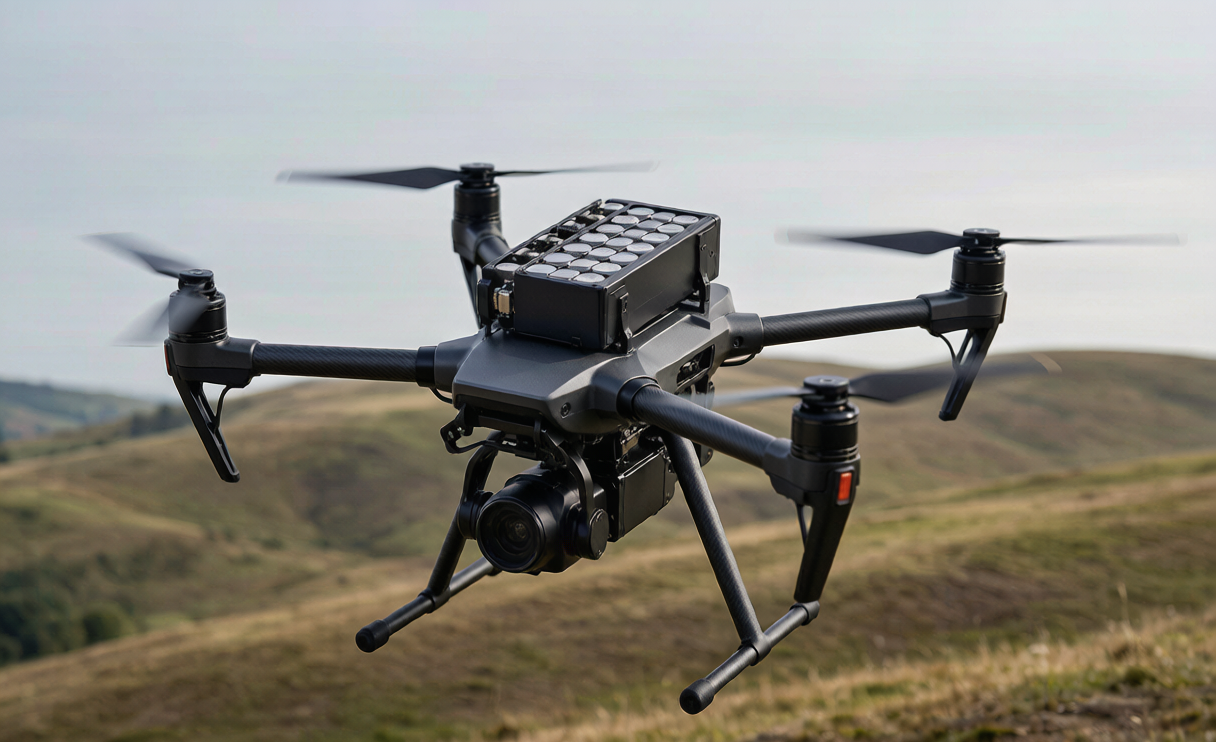
In my ten years as a Senior Lithium Battery Engineer at Horizon Power, I have probably tested more survey-grade battery packs than most people have flown drones. Mapping UAVs — the quadcopters and fixed-wing aircraft that capture orthophotos, LiDAR point clouds, and multispectral maps — are not your weekend cinematic toys. A typical mapping sortie runs 30 to 90 minutes of continuous, near-constant discharge while hauling a heavy sensor payload. That duty cycle is precisely what makes the drone battery the single most safety-critical component on the airframe.
When a mapping mission covers hundreds of hectares of farmland or a sprawling mining site, the aircraft often operates beyond visual line of sight (BVLOS) under autonomous waypoint navigation. A sudden cell failure does not just end the flight; it can drop an expensive LiDAR unit into a ravine or, worse, ignite mid-air. I always tell our customers that the energy density you crave for long endurance is the same energy density you must respect with rigorous safety engineering. The margin between a reliable pack and a dangerous one is rarely the chemistry — it is the design discipline around it.
The Regulatory Floor: UN38.3, IEC 62133, and Air Transport Rules
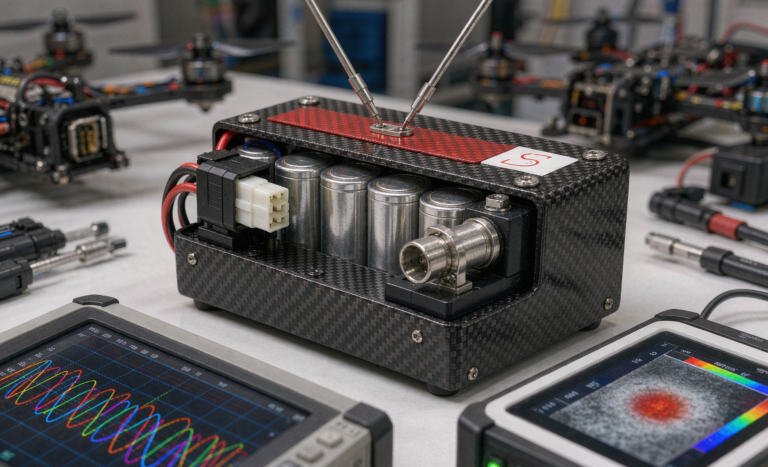
Before any drone lithium battery leaves our factory, it must clear the regulatory baseline that governs how cells behave under abuse. The most universally cited is UN38.3, the transport testing standard from the UN Manual of Tests and Criteria. A compliant cell or pack must survive eight rigorous tests: altitude simulation (a pressure drop to roughly 11.6 kPa, simulating 15,000 m), thermal testing between –40°C and +75°C, vibration, shock, external short circuit, impact/crush, overcharge, and forced discharge. I have watched packs fail the external short-circuit test at 55°C because a supplier skimped on separator thickness — and that is exactly the failure mode you never want discovered at 120 meters above a client’s rooftop.
For the cells themselves, IEC 62133 (and its sibling IEC 62619 for industrial cells) sets the benchmark for safe secondary lithium construction, covering short-circuit, overcharge, and temperature abuse. On the operational side, aviation authorities impose their own limits. In the United States, FAA Part 107 operators must follow strict rules on battery transport and carriage, and spare lithium batteries are barred from checked baggage. In Europe, EASA publishes acceptable means of compliance that explicitly address lithium battery fire containment and crew procedures. At Horizon Power we treat these not as paperwork but as the design spec: if a pack cannot pass UN38.3 and IEC 62133 in our own lab, it never reaches a customer’s mapping rotor.
Cell Chemistry Choices for Survey Drones
The eternal trade-off in any lithium battery program is energy density versus safety margin. Mapping UAVs overwhelmingly use cylindrical or pouch lithium polymer (LiPo) and high-rate lithium-ion (Li-ion) cells rated for 4S to 12S configurations — that is 14.8 V up to 44.4 V nominal. High-discharge LiPo gives you the burst current for vertical take-off and the payload lift, but it is also the least forgiving chemistry if punctured or over-discharged.
We increasingly recommend semi-solid-state cells for long-endurance mapping platforms where the flight plan exceeds 60 minutes. Semi-solid electrolytes are far less flammable than conventional liquid electrolytes, which structurally lowers thermal-runaway risk. For a fixed-wing mapping drone surveying a pipeline corridor, the modest weight penalty of semi-solid chemistry is more than paid back by the safety headroom and the cycle life. Choosing chemistry is never generic — it is matched to your mission profile, ambient range, and the consequences of failure.
Thermal Runaway Prevention in the Field
Thermal runaway is the specter every battery engineer fears: a single cell exceeds roughly 130°C to 150°C, decomposes exothermically, and cascades into its neighbors. Mapping UAVs are especially exposed because they often fly in direct sun with the battery buried under a sensor bay where airflow is poor. I have measured pack-skin temperatures of 48°C during a 40°C desert survey — only 7°C below our rated ceiling.
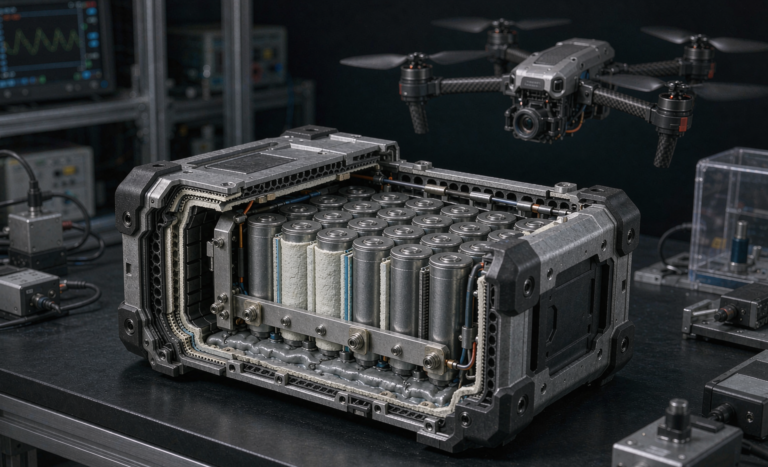
Our defense is layered. First, we specify cells with a high thermal-runaway onset temperature and a stable nickel-manganese-cobalt (NMC) or lithium-iron-phosphate (LFP) blend depending on the platform. Second, we embed at least two independent temperature probes in the pack and wire them to a BMS that cuts discharge at a conservative 55°C. Third, we design the enclosure with vent channels so a single cell venting does not cook its neighbors. On one agricultural mapping contract, this layered approach caught a faulty cell at 51°C and landed the aircraft safely instead of letting it cascade.
Battery Management System Safeguards Every Mapping Pack Needs
A mapping drone battery is only as safe as its Battery Management System. At minimum, the BMS must provide over-voltage protection (typically 4.25 V per cell ceiling), under-voltage lockout (around 3.0 V to protect cycle life and prevent reverse charging), over-current and short-circuit interruption within milliseconds, and multi-point temperature monitoring. Beyond protection, a good BMS reports State of Charge (SoC) and State of Health (SoH) so operators can ground a degrading pack before it becomes a hazard.
For survey fleets, we standardize on communication over SMBus or CAN bus so the ground station can read each cell’s voltage live during the mission. That telemetry is gold: a slowly drifting cell on flight 200 of a season is exactly the kind of silent warning that prevents an in-flight incident. I have refused to ship packs that lacked cell-level balancing, because imbalance is the fast lane to localized overcharge and, ultimately, fire.
Safe Field Handling, Charging, and Storage
Even a perfectly engineered pack fails if mishandled. Our field manual for mapping operators is blunt. Charge only in a fire-safe LiPo bag or a metal cabinet, never unattended, and never at rates above the pack’s rated C. Inspect every connector and strap before flight — a loose XT60 can arc and weld itself shut. Between missions, store cells at 30° to 60° State of Charge in a cool, dry place; a fully charged pack left in a hot vehicle for a week is a slow-motion accident.
Transport follows the rules we discussed: pack each drone lithium battery in a UN-certified case, keep terminals insulated with caps or tape, and carry spares in the cabin, not the hold. I personally audit our customers’ storage rooms twice a year, and the single most common violation is “storage charged to 100% because it is ready to fly.” Ready-to-fly is the enemy of safe-to-store.
Building a custom battery solution for Your Mapping Platform
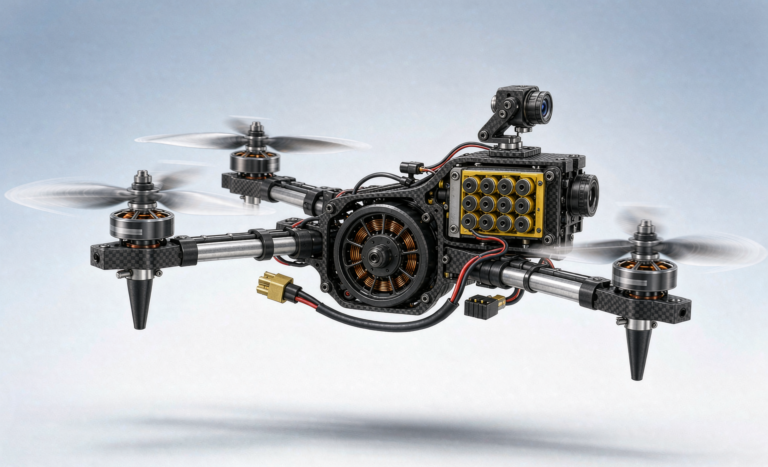
No two mapping airframes are identical. A heavy vertical-takeoff-and-landing (VTOL) hybrid needs burst current a lightweight photogrammetry quad does not, and a fixed-wing corridor survey needs energy density a inspection copter can trade away for ruggedness. That is why off-the-shelf packs so often underperform or overheat in real survey work. The right answer is almost always a custom battery solution engineered to your exact voltage, form factor, discharge curve, and thermal envelope.
At Horizon Power we start every custom program with a mission-profile audit: payload mass, average and peak current, ambient temperature range, and landing/charging cadence. From that we select cells, design the BMS protection budget, model thermal behavior in simulation, and validate against UN38.3 and IEC 62133 before first flight. A well-executed custom battery solution does more than prevent fires — it extends flight time, lengthens pack life, and gives your operation a documented safety case that satisfies both insurers and aviation regulators.
Frequently Asked Questions
What is the safest battery type for mapping UAVs?
There is no single winner. For short, high-thrust missions, quality LiPo remains common, but for long-endurance survey flights we lean toward semi-solid-state or LFP blends that resist thermal runaway. The safest choice is a certified pack with a properly specified BMS matched to your platform — chemistry alone does not guarantee safety.
How should I store drone batteries between survey missions?
Store them at 30°–60% State of Charge in a cool, dry location, ideally in a fire-safe cabinet. Avoid leaving packs at 100% charge for days, and never leave them in a hot vehicle. Inspect terminals and connectors before each mission and log cycle counts so aging packs are retired on schedule.
Do mapping drone batteries need UN38.3 certification?
Yes. UN38.3 is the baseline transport safety standard for all lithium cells and batteries, and most aviation and freight rules reference it directly. A credible manufacturer provides test reports; at Horizon Power we re-validate every production batch against the UN38.3 test suite rather than relying on a one-time certificate.
How does temperature affect drone battery safety during long mapping flights?
Heat is the primary accelerator of degradation and runaway risk. Flying in direct sun with poor pack ventilation can push skin temperatures toward the 55°C cutoff. Good thermal design, multi-point BMS temperature sensing, and conservative discharge limits keep the pack in its safe operating envelope even on hot, long survey days.