Drone Battery Testing for Racing Drones: A Senior
Racing drones are unforgiving machines. A freestyle quadcopter can pull 100-150 A from a single 6S pack in a hard punch-out, and a closed-course racer sees dozens of full-throttle cycles in a single afternoon. Over my years as a senior lithium battery engineer building packs for competitive pilots, I have learned that the difference between a podium finish and a mid-air cut-off is almost always decided on the test bench, not at the field. This guide walks through the drone battery testing racing drones protocol I use to qualify every pack before it ever leaves the lab.
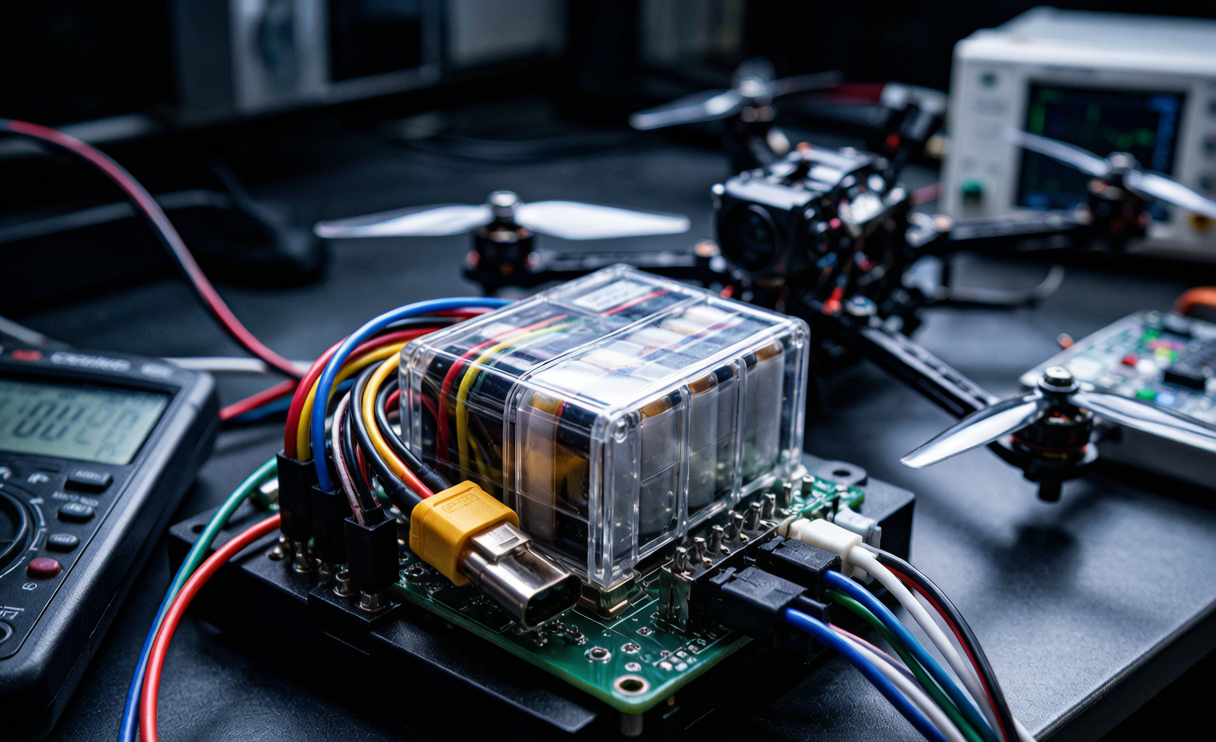
When we talk about drone battery testing racing drones, we are really validating three things at once: raw power delivery, thermal stability under abuse, and consistency across a fleet. A single weak cell in a 6S configuration will drag the whole pack down, and at 25C-30C discharge rates the margin for error is tiny.
Field failures rarely announce themselves. They show up as a pack that flew perfectly on Saturday and then sagged out of a turn on Sunday. In my records, roughly 70% of mid-race cutoffs trace back to a cell whose IR drifted faster than its neighbors, not to a manufacturing defect. That is exactly why a one-time factory test is never enough for a competitive program. The pack has to be qualified, then monitored, then retired on data rather than on guesswork.
Why Racing Drones Demand a Different Test Philosophy
Most consumer drones are optimized for endurance: gentle 5C-10C discharge, long cruising, and minimal heat. Racing is the opposite. A drone lithium battery built for FPV racing must sustain continuous 20C-30C discharge with brief spikes well above 40C. That single fact changes how we test, how we rate, and how we retire packs.
In my lab, I treat internal resistance (IR) as the most important health metric. A fresh, high-quality 6S 1300 mAh racing pack typically measures 6-9 mΩ total pack resistance. Once IR climbs past 12-14 mΩ, voltage sag under load becomes severe enough to trigger ESC low-voltage cutoffs mid-race. We log IR on every cycle, not just at incoming inspection, because the trend matters more than the snapshot.
The second pillar is capacity retention. A pack that reads 1300 mAh on the label but delivers 1180 mAh after five hard cycles is a liability. We set a hard acceptance gate of ≥95% of rated capacity at the first formation cycle for any pack destined for competition. Below that, it goes back to the supplier.
The Core Electrical Tests Every Drone Battery Must Pass
Before any pack is approved, it runs through a standardized electrical suite. Here is the baseline I hold every supplier to:
- Capacity verification at 1C constant current to 3.0 V/cell cutoff, 25 °C ambient.
- Maximum continuous discharge at the rated C-rate (for example 25C) for the full rated duration, with pack temperature and voltage recorded every 5 seconds.
- Peak pulse test: 10-second bursts at 40C-50C, five repetitions with 60-second rests, to confirm the drone lithium battery can survive the punch-outs without excessive sag.
- Voltage sag mapping: we plot pack voltage under a simulated race throttle curve to predict real-world cutoff behavior.
- Cycle life to 80%: racers rarely care about 500 cycles, but we still validate that the pack holds ≥80% capacity through at least 150 aggressive cycles before retirement.
These numbers are not arbitrary. They map directly to how a lithium battery behaves when a pilot yanks full throttle out of a corner. If sag exceeds 0.8 V per cell under peak load, the pack fails the gate regardless of its headline capacity.
Thermal and Mechanical Stress Validation
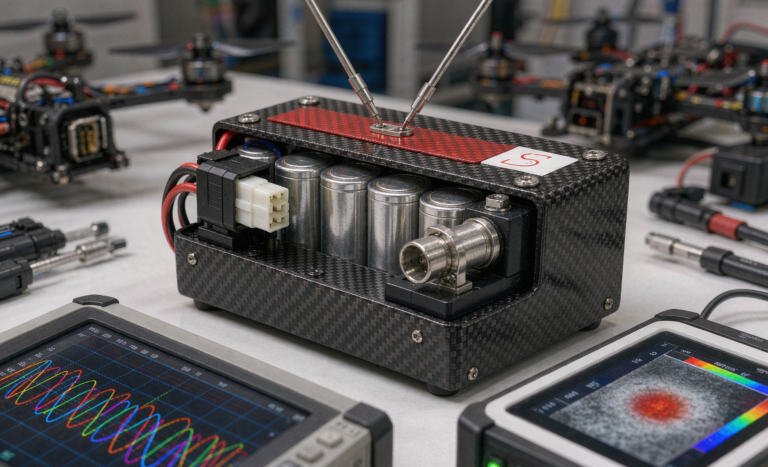
Racing packs live in the worst thermal environment in the entire drone industry: closed bodies, no airflow, repeated hard acceleration. We run thermal imaging during a full discharge to confirm surface temperature stays below 60 °C at the cell level. Above that, LiPo swelling risk climbs sharply and cycle life collapses.
Mechanically, every racing pack is subjected to vibration testing on a shaker table (10-200 Hz random profile, 1 hour per axis) to simulate the brutal resonance of a quadcopter frame. We also drop-test assembled packs from 1.5 m onto concrete to verify the shrink-wrap and solder joints survive a crash-style impact. A battery that leaks after a hard landing is a fire risk, not a race component, so it never ships.
Regulatory Baselines: UN38.3, IEC 62133, and Air Transport
No matter how good a pack performs on the bench, it cannot ship or fly without passing the regulatory gauntlet. The foundation is UN38.3, the UN manual of tests and criteria covering altitude simulation, thermal test, vibration, shock, external short circuit, impact, overcharge, and forced discharge. Every drone battery we ship carries UN38.3 certification, and we keep the test reports on file for buyers who audit us.
For cell-level safety, we reference IEC 62133, which governs the construction and testing of secondary lithium cells and batteries. It is the baseline that buyers in the EU and many Asian markets expect, and it aligns closely with how we structure our own internal abuse testing.
Air transport is where racing teams get surprised. Under FAA and EASA rules, spare lithium batteries must be carried in carry-on baggage, terminals protected, and packs above 100 Wh require operator approval. A typical 6S 1300 mAh pack is about 29 Wh, comfortably under the limit, but teams running larger 6S 2200 mAh or parallel setups need to plan their travel carefully. I always include a one-page compliance summary with every custom battery solution we deliver so pilots clear security without drama.
A Practical Test Sequence from My Lab
Here is the exact sequence I run for a new race pack variant. It takes roughly 48 hours per sample but it has prevented dozens of field failures:
- Formation charge at 0.2C, rest 30 minutes.
- Capacity verification at 1C.
- IR measurement hot and cold (after a 1C discharge, and after a 4 °C cold soak).
- Three back-to-back 25C discharges with 10-minute rests; record sag and peak temperature.
- Five 45C 10-second pulses with thermal imaging.
- Vibration plus drop mechanical screen.
- Document everything in a pass/fail matrix; only ≥95% capacity and ≤12 mΩ ships.
This discipline is why our pilots trust the pack. When you are 40 meters up in a split-S, the last thing you want to question is your drone battery testing racing drones history.
Choosing a Custom battery solution for Your Race Program
Off-the-shelf packs are fine for practice, but serious programs benefit from a custom battery solution tuned to their exact frame, motor KV, and prop choice. In my experience, a bespoke 6S pack with matched cells (IR variance under 1 mΩ across the set) can shave 0.3-0.5 V of sag versus a random retail pack. That translates directly into sharper throttle response and a few extra seconds of usable punch per lap.
When we design a custom race pack, we start from the motor’s max current draw, then size the pack for the target race duration plus a 20% safety margin, then select cells with the lowest IR we can source consistently. The lithium battery chemistry decision, standard LiPo versus a high-rate graphene-hybrid, comes down to whether the pilot prioritizes absolute C-rate or cycle life. For most racers, the hybrid wins.
Whatever you choose, insist on full test documentation. A supplier who cannot show you the UN38.3 certificate and a cycle-test report is not a partner you want strapping to a 30C airframe, and the cost of finding out mid-season is far higher than the cost of a proper qualification program.
The economics are straightforward. A qualified custom pack costs more up front than a bulk retail pack, but when you factor in the packs you no longer retire early from unexplained sag, the cost per competitive flight actually drops. More importantly, you stop losing races to a component you could have controlled. That is the entire point of a disciplined drone battery testing racing drones program: turn an unknown into a measurable, repeatable number.
Frequently Asked Questions
How often should I retest my racing drone batteries?
For competition packs, I recommend a full IR and capacity check every 20-30 cycles, or immediately if you notice voltage sag, swelling, or shortened flight time. Track-day packs can go longer, but a monthly check catches problems before they become crashes.
What internal resistance is acceptable for a racing drone battery?
A healthy 6S racing pack should sit around 6-9 mΩ total. Once you see 12-14 mΩ or higher, plan to retire the pack from competition use even if it still flies. The sag will cost you races and the swelling risk rises with every hard cycle.
Can I ship racing drone batteries on an airplane?
Yes, but follow FAA and EASA rules: carry them in cabin baggage, protect the terminals, and keep each pack under 100 Wh unless you have operator approval. A standard 6S 1300 mAh pack is well under the limit at roughly 29 Wh.
Do I really need a custom battery solution for amateur racing?
Not at first. Practice on quality retail packs, learn your throttle discipline, then move to a custom battery solution once you are consistently hitting the limits of off-the-shelf performance and want that extra edge on lap times.