Drone Battery Performance for Racing Drones: Instrumenting
Why a Bench Spec Sheet Never Tells the Whole Race-Day Story
After fifteen years on the lithium battery bench, the single habit that has saved me the most race weekends is refusing to trust a printed C-rating. A “45C” label on a drone battery is a marketing number, not a flight number. The pack that wins a heat is the one whose drone battery performance racing drones actually delivers under the violent, bursty load profile of first-person-view competition — and that is something you can only know by measuring it in the air, not by reading the cell datasheet on the workbench.
Every FPV lap is a sawtooth. You pull 90–150 A out of a 1300 mAh pack for a tenth of a second on a punch-out, coast near zero amps through a split-S, then spike again on the exit. The average current over a lap might be 18–25 A, but the instantaneous load is three to six times that. A bench that only reports a steady 1C capacity will confidently miss the one failure mode that ends your final: a mid-event voltage cliff that drops you below the ESC cutoff exactly when you need full power. That gap between spec and reality is why I started instrumenting racing packs with on-board telemetry loggers instead of guessing.
Building the On-Board Telemetry Logger
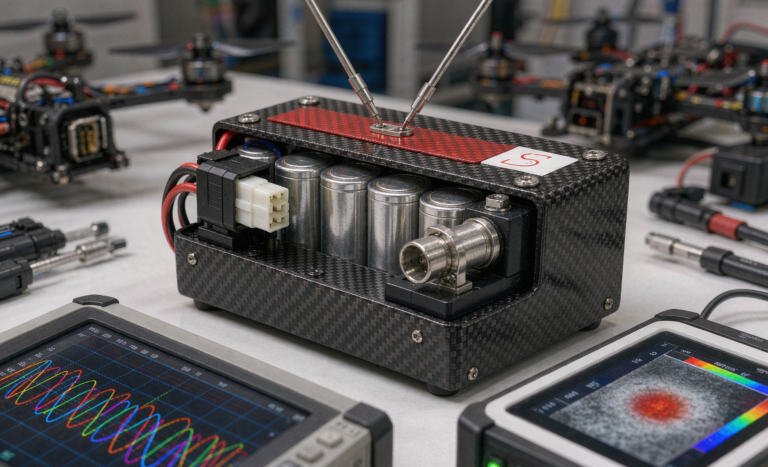
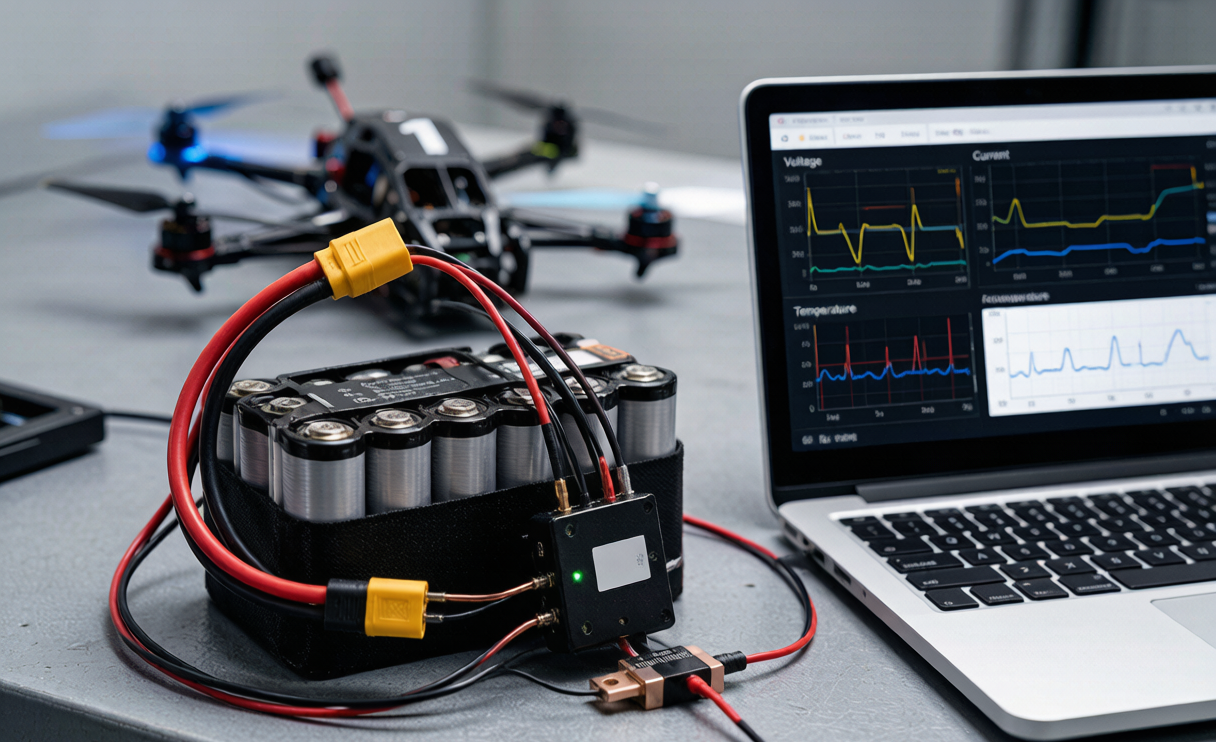
The hardware is smaller and lighter than most pilots expect. A racing drone lithium battery is already a tight mass budget, so the logger has to earn its grams. I use a sub-6-gram module built around a 12-bit ADC sampling a 0.5 mΩ shunt for pack current and individual voltage taps off each cell balance lead. A pair of NTC thermistors — one at the pack center and one at the outer wrap — capture thermal rise where it matters most. The whole assembly runs off the flight controller’s 5V rail and writes to a micro-SD card or streams over a spare UART at 50–100 Hz. At those rates, a ten-minute session is roughly 30,000 to 60,000 samples per channel, enough to reconstruct every punch-out and every sag event.
The reason I insist on per-cell taps rather than just pack voltage is simple: pack voltage hides imbalance. A 6S pack can read a healthy 22.2 V while one cell is sagging to 3.4 V and another is floating at 3.8 V. Only per-cell logging shows you the weak link, and in racing the weak cell is the one that triggers the low-voltage cutoff for the whole pack. For a lithium battery pushing 150 A, that hidden imbalance is the difference between finishing a final and tumbling out of the sky.
What We Actually Capture — and at What Rate
The four channels that earn their place on every logger are pack current, per-cell voltage, pack temperature, and a derived DCIR. I sample current and voltage at a minimum of 50 Hz; below that you start averaging away the 100–200 ms spikes that define FPV performance. Temperature can log at 5–10 Hz because thermal rise is a slow process by comparison. From those raw channels I compute a live internal resistance on every burst:
- Sag depth (V) — how far terminal voltage drops under peak current. A healthy 6S 1300 mAh 45C pack should hold above roughly 18.4 V at 120 A; anything that dips to 17.9 V on a logged burst is a reject.
- Delivered C-rate — peak instantaneous current divided by rated capacity. This is where a “45C” pack often shows it is really a 30–38C pack on the track.
- Energy per lap (Wh) — integrating current over a lap window tells you exactly how much capacity each circuit costs, which is the number that drives your reserve strategy.
- Interburst recovery (mV per 4 s) — a healthy pack recovers 120–160 mV during the coast between punch-outs; a tired pack recovers half that, and you feel it as a dead feeling throttle by lap four.
All of these are computed from the same three raw channels, so the logger stays light and the math is cheap. The point is not pretty dashboards — it is a repeatable, quantitative picture of how a specific pack actually flies.
Turning Lap Traces into a Pack “Performance Passport”
Once I have a clean session log, I fold it into what I call a performance passport for that pack: a one-page baseline of its sag floor, delivered C-rate, energy-per-lap, thermal rise, and recovery rate, all captured at the same charge endpoint and the same ambient temperature. The first time I log a pack it becomes the reference; every later session is compared against that baseline. This is the heart of data-driven validation. Instead of “this pack feels good,” I can say “this pack held 18.7 V at 120 A, delivered 41C peak, and rose 9 °C over a ten-lap final — identical to its passport.”
The passport also makes cross-pack comparison honest. Two packs with the same label from the same batch routinely differ by 8–12% in delivered C-rate because of cell-matching spread and weld resistance. Without telemetry, you would never know which one to put in your primary quad. With passports, you sort your fleet by measured performance, not by serial number, and your custom battery solution becomes a documented, traceable product rather than a mystery brick.
Catching the Weak Pack Before It Costs a Heat
The most valuable use of race-day telemetry is rejection, not bragging rights. I set hard gates against the passport baseline: a pack that drops more than 0.3 V below its sag floor, climbs more than 25% in DCIR, or recovers less than 80% of its baseline recovery rate gets pulled from the race pool. In one qualifying batch last season, three of twelve “60C” packs failed two or more gates on their first logged session — they would have looked identical on the bench, and two of them would almost certainly have thrown a low-voltage cutoff in the finals. Telemetry caught them in practice, for free.
This is also where a drone lithium battery earns trust. A pilot who has logged a pack knows its real ceiling and flies to it. A pilot flying blind either over-cools the pack (leaving performance on the table) or over-draws it (risking a mid-final cliff). The logger removes the guesswork, and over a season that consistency is worth more race wins than any single gram of mass savings.
Correlating Battery Telemetry to Lap Time
The next step past rejection is optimization. Once every session is logged, I overlay battery sag against lap-time data from the flight controller. The pattern is consistent: the packs with the shallowest sag and fastest recovery let the pilot carry more throttle through corners, and that shows up as 0.2–0.5 seconds per lap. On a tight track where the difference between first and fourth is under a second, battery performance is the whole ballgame.
I have also used the logs to tune configuration rather than blame the cells. When a pack consistently sagged harder on the third sector, the trace showed it was the sustained high-current climb out of the bowl, not a cell fault. We moved that pilot to a 6S2P arrangement for that track and the sag floor rose 0.3 V — a free half-second a lap, found in data, not in a new chemistry. That is the loop I want every engineer to build: log, compare to passport, correlate to lap time, change one variable, log again.
Closing the Loop — Telemetry Built Into the Custom battery solution
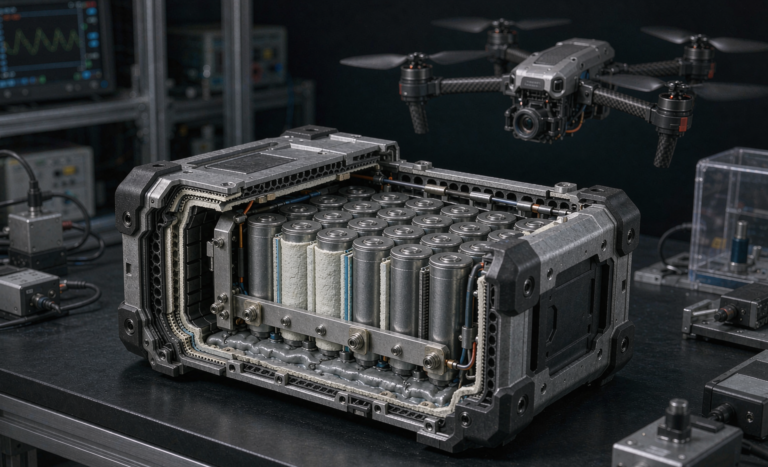
The real maturity step is moving the logger from an external tack-on to a native feature of the pack. In our custom battery solution work for racing teams, we now build a sealed telemetry port and a balance-lead breakout into the pack enclosure, so a logger plugs in without soldering or disturbing the wrapper. Each pack carries a DataMatrix genealogy code linking it to its first logged passport, its lot qualification, and every later session. That turns a disposable hobby pack into a managed, measurable component with a service life you can actually predict.
We still qualify every cell lot to UN38.3 (T.1–T.8) and IEC 62133-2 before it ever flies, and we keep the pack under the FAA/EASA 100 Wh air-transport band so it can travel to events. Telemetry does not replace those safety baselines — it sits on top of them, telling you not just that a pack is safe, but that this specific pack is fast. For a team chasing tenths of a second, that distinction is everything.
Frequently Asked Questions
How many Hz should the logger sample at for FPV racing?
Sample pack current and per-cell voltage at no less than 50 Hz, and 100 Hz if your logger can handle it. FPV punch-outs last 100–200 ms and spike to 120–200 A, so anything slower than 50 Hz averages away the exact event that defines drone battery performance racing drones. Temperature is fine at 5–10 Hz because it changes slowly.
Can telemetry logging hurt pack weight or balance?
A purpose-built racing logger is under 6 grams and mounts on the pack wrapper or frame, so the CG penalty is negligible if you place it near the pack centerline. The performance insight it returns is worth far more than the gram. In a custom battery solution we integrate the tap breakout into the enclosure so there is no extra harness to disturb balance.
What is the single most useful metric for predicting a bad race?
Interburst recovery rate. A pack that recovers less than 80% of its baseline recovery between punch-outs is losing internal resistance fast and will throw a low-voltage cutoff late in the final. Sag depth and delivered C-rate tell you about raw power; recovery tells you about endurance under repetition, which is what ends races.
Do I need a data logger if I already use a digital twin?
Yes. A digital twin simulates expected performance from a model you built on the bench; a logger measures actual performance in the air. The twin sets the prediction, the logger catches the gap between prediction and reality — weak welds, imbalanced cells, a tired pack that the model assumed was fresh. Use both: twin to design, logger to validate.
How do regulations affect instrumented racing packs?
The logger adds no hazard if it draws only from the flight controller rail and uses insulated taps. Keep the pack within the FAA/EASA 100 Wh limit and qualified to UN38.3 T.1–T.8 and IEC 62133-2, and the telemetry hardware travels and races like any other lithium battery. Document the added mass in your weight and balance check.