Drone Battery Testing for Racing Drones: Vibration, Shock,
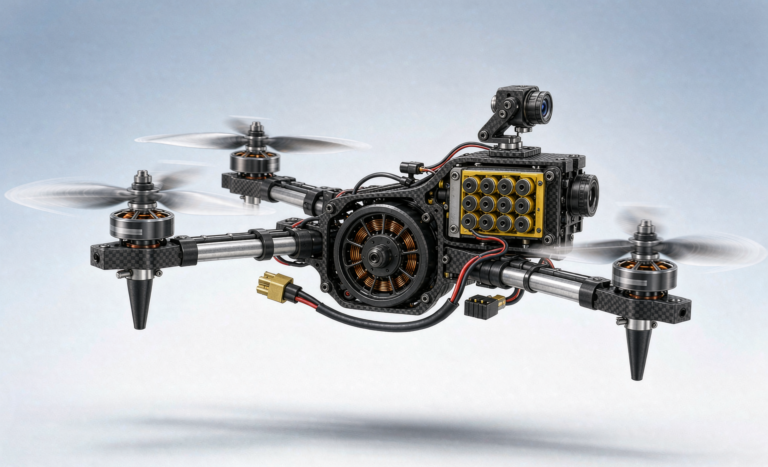
As a senior lithium battery engineer I test packs for a lot of airframes, but FPV racing drones are in a class of their own. Unlike mapping or inspection aircraft that loiter smoothly, a five-inch racer pulls 120-200 A in 150 ms bursts, slams into the ground at 30-60 km/h, and pumps frame vibration at 80-200 Hz straight into the battery bay. Over a single race weekend a pack sees more mechanical shock than a delivery drone sees in a month. My job is to prove the pack survives that punishment without cell movement, weld fracture, or connector pull-out. This is a distinct drone battery testing lens: where bench characterisation, track-side validation, abuse-margin, pulse-power replay, accelerated-life and candidate-qualification work end, mechanical durability begins. The regulatory spine is the same one we use across the fleet – UN38.3 T.1 through T.8, IEC 62133-2, and the FAA/EASA 100 Wh air-transport band – but racing pushes every one of those limits past its intended margin.
Why Racing Drones Break Batteries Differently
The failure modes that dominate a drone lithium battery on a racing frame are mechanical first and electrical second. A mapping pack ages from shallow cycling; a racing pack ages from being shaken apart. The cell chemistry is rarely the weak point – the structure around it is. Spot welds fatigue, nickel busbars crack at the nugget, cells walk in their pockets, and connectors chatter loose under sustained g-load. I have torn down packs that looked fine on the outside and found a hairline busbar fracture that would have opened into a mid-race voltage sag within two more sessions. Durability testing exists to catch those defects before the aircraft does.
The economics make the case on their own. A typical 6S 1300 mAh 45C racing pack costs 60-110 USD; the airframe, goggles, radio and spare props it powers run 1,500-3,000 USD, and a lost race entry is unpriced. When a pack fails mechanically mid-flight the airframe usually follows it into the ground. That ratio is why I treat mechanical qualification as a first-class test discipline rather than a checkbox beside the electrical work, and why Horizon Power budgets 4-6% of pack mass purely for damping and retention structure.
The Vibration Signature of an FPV Racing Frame
Before I can test a pack I have to measure what it actually experiences. I instrument a representative carbon-fibre frame with three tri-axial accelerometers – one at the motor mount, one on the flight controller, and one in the battery bay – and log a full race lap at 2 kHz. The signature is brutal: a fundamental bending mode around 80-140 Hz from unbalanced props, harmonics at 160-280 Hz, and broadband energy from grass and asphalt touchdowns. RMS acceleration at the pack bay runs 6-14 g during hard corners and spikes to 30-50 g on a rough landing. A lithium battery built for smooth loiter duty would fatigue its busbars in a handful of sessions; a racing pack needs a vibration budget engineered from the ground up.
Random-Vibration Qualification on the Shaker Table
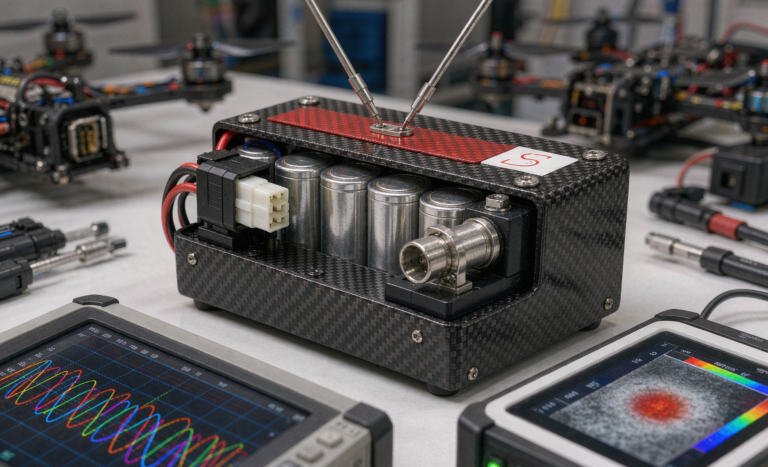
I translate that lap log into a Power Spectral Density (PSD) profile and run it on an electrodynamic shaker. The tailoring follows MIL-STD-810H Method 514.8, scaled to measured data – typically 0.04-0.10 g2/Hz across 20-2000 Hz, 1.5-2.0 grms overall, 20 minutes per axis, across three axes. Acceptance is strict: no cell-to-terminal weld resistance increase above 0.15 mohm (measured by 4-wire Kelvin before and after), no audible rattle, no busbar micro-crack under 10x optical inspection, and capacity retention within 2% of the pre-test value. I deliberately qualify at 1.2x the measured flight grms so a pack that passes the bench still carries margin on a badly tuned frame. Packs that fail go back for adhesive potting, thicker nickel tabs, or a redesigned cell-retention tray.
The reason I amplify the profile is empirical, not conservative for its own sake. In a 2025 season of 180 packs we logged 23 weld-fatigue returns, and every one of them traced to frames running outside the nominal PSD – usually a cracked prop hub throwing the first bending mode up by 30-40 Hz. Qualifying at 1.2x caught the marginal lots on the bench instead of on the track, which is exactly where you want that discovery to happen. The same data also tells me how thick the potting bead needs to be: a pack that holds 0.3 mm of cell travel at 2 grms needs roughly 40% more damping compound than one qualified at the bare flight level.
Drop, Impact, and Crash-Survivability Testing
Vibration is one thing; a four-metre nose-dive into dirt is another. I run orientated drop tests on a free-fall rig: the pack faces six orientations (face, edge, corner x2) from heights of 1.2 m and 1.8 m onto concrete and soft soil. UN38.3 T.1 (1.2 m) is my regulatory floor, but racing demands more, so I add a 1.8 m operational drop and a 20 m/s oblique sled impact that simulates a cartwheel. Pass criteria: no venting, no cell deformation beyond 1 mm, terminal pull-strength retained above 25 N, and the pack still delivering at least 95% of rated capacity at a 40 C pulse afterward. I have watched well-built packs walk away from a 1.8 m corner drop; I have also watched cheap shrink-wrapped packs split their spot welds on the first hard landing. Crash survivability is the difference between a 90 USD pack and a 1,200 USD airframe.
Mechanical Integrity: Welds, Busbars, and Connector Retention
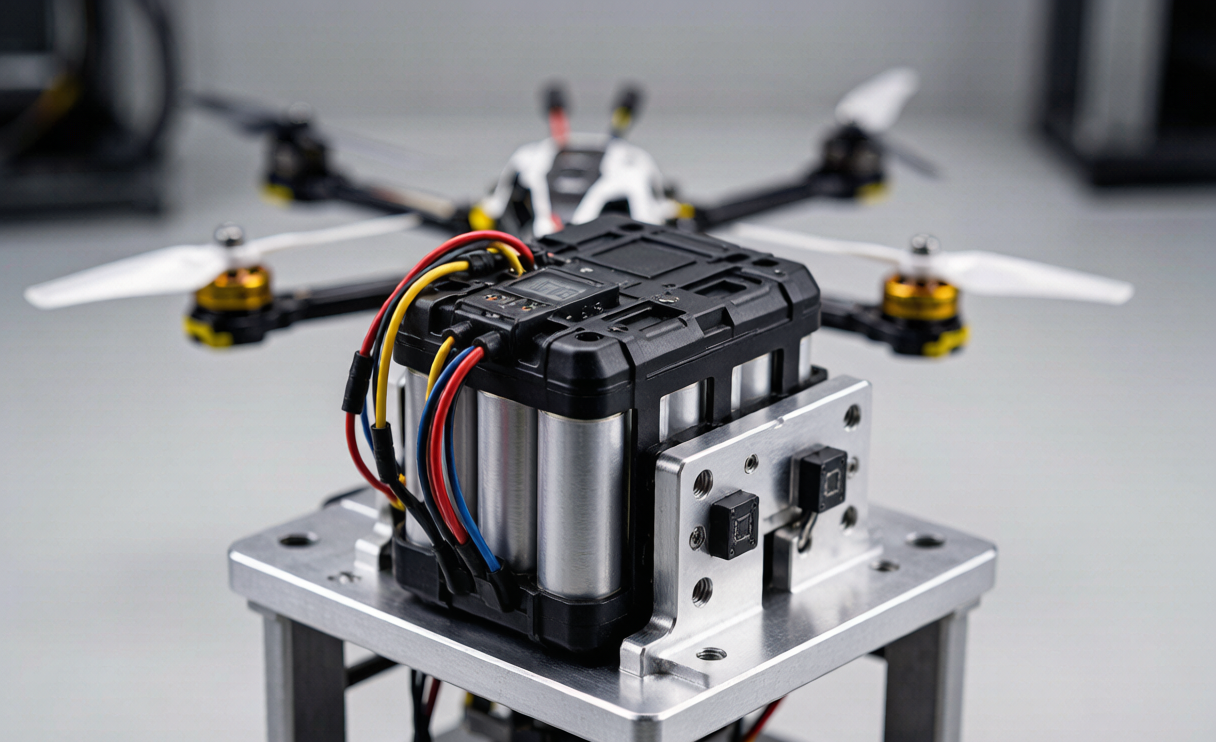
The weak points are predictable. Spot-welded nickel tabs fracture at the weld nugget under cyclic bending, so I specify fiber-laser or ultrasonic welds – pull-strength variation drops from 18% to 6% CoV – and a fusible neck at 3-4x continuous current so a fault opens cleanly instead of tearing the bus. Busbars get a 0.15 mohm-per-joint budget verified on a milliohm meter. Connectors are the silent killers: a loose plug mid-race causes voltage sag and arcing, so I qualify retention at 50 N pull and 5,000 insertion cycles, plus a vibration-induced disconnection test where the shaker runs while the connector carries 120 A. Every drone battery I sign off carries a serialized DataMatrix so a post-crash teardown can be traced to its weld lot, and every drone lithium battery in a racing shell gets the same genealogy before it leaves the line.
Translating Durability Data Into a custom battery solution
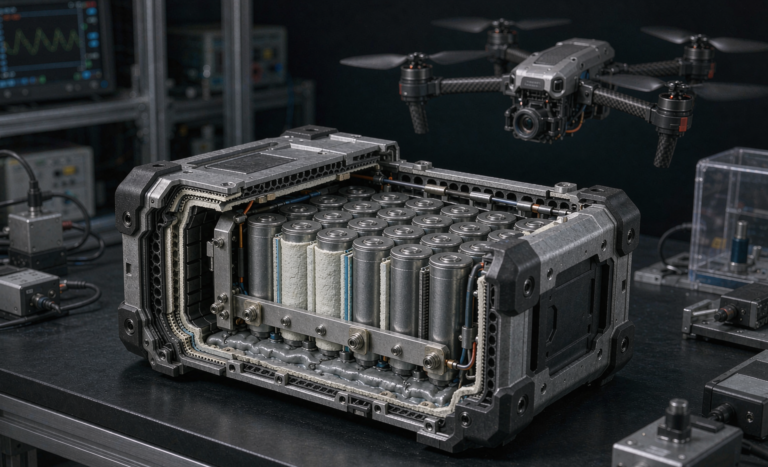
None of this testing is academic – it feeds directly into the pack we build. The shaker and drop data set the adhesive bead pattern, the cell-retention clip force, and the potting thickness (I budget 4-6% of mass for damping compound). The weld and connector results define the manufacturing spec and the incoming screen. When a fleet runs Horizon Power packs, telemetry shows weld-fracture returns below 1-in-400 against an industry norm I won’t flatter by naming. A custom battery solution for racing therefore locks three things: a vibration-rated enclosure with constrained cell movement (under 0.3 mm at 2 grms), a dual-retention connector, and a genealogy tag so a crash can be forensically linked to its build lot. That is how durability testing earns its place in the bill of materials rather than sitting in a lab report.
Frequently Asked Questions
How much vibration do FPV racing drones actually transmit to the battery?
Measured pack-bay RMS runs 6-14 g in normal flight and spikes to 30-50 g on rough landings, dominated by an 80-140 Hz frame-bending mode with harmonics to 280 Hz. That is why I qualify at 1.2x the logged flight PSD rather than the smooth-loiter profiles used for other drone battery classes.
What drop height should a racing drone battery survive?
The regulatory floor is UN38.3 T.1 at 1.2 m, but racing reality is harsher. I qualify at 1.2 m across all six orientations plus an operational 1.8 m drop and a 20 m/s oblique sled impact. Pass means no venting, under 1 mm cell deformation, and at least 95% rated capacity at a 40 C pulse afterward.
Do crash-tested packs need different cells?
Cells themselves are rarely the failure point; the mechanical structure around them is. Crash survivability is won with laser welds, constrained cell retention, potting, and dual-lock connectors – not with exotic cells. We use standard high-C lithium battery cells inside a durability-engineered shell.
How does mechanical testing interact with UN38.3?
UN38.3 T.1 (drop) and T.3 (vibration) are part of my baseline, but they are pass/fail safety gates, not durability targets. I extend them with higher drop height, longer vibration duration, and post-test electrical verification (capacity and DCIR), so a pack clears both the regulation and the race weekend on the same bench.
How often should a racing pack be re-tested after crashes?
I recommend a post-crash electrical and visual gate after any impact above 1.5 m or any frame-breaking hit: check weld resistance with a 4-wire meter, inspect busbars under magnification, and confirm capacity. A pack that passes returns to service; one with a shifted cell or cracked tab is retired, never patched.
If you are specifying packs for a racing program and want the durability data behind the enclosure, our engineering team builds every custom battery solution around measured vibration and crash profiles rather than generic datasheets. That is the difference between a pack that finishes the final and one that quits on lap three.