Home Energy Storage Cost Optimization for Apartments (Guide)
After commissioning more than forty apartment-block storage rollouts across Southeast Asia and the EU over the last nine years, I have learned one uncomfortable truth about home energy storage cost optimization apartments projects: most of the budget is quietly burned before a single cell is ordered. Owners spec a capacity number from a brochure, buy hardware sized for a villa, and then wonder why the payback never arrives. I am Karl Huang, Senior lithium battery Engineer at Horizon Power, and in this guide I walk through the engineering and procurement levers that actually move cost per kWh in multi-unit residential buildings — and the ones that just add invoice lines.
The good news is that apartments are a near-ideal use case for distributed home energy storage. You have predictable, repeated daily load, shared roof or meter space, and a landlord who cares about the electricity bill more than the gadget. The bad news is that the same constraints — fire code, shared walls, balancing meters — are where naive designs overspend by 30–60%. Below is the field playbook I use.
Start With the Load Profile, Not the Battery Catalog
Every cost-stable residential battery storage project I have shipped began with two weeks of metered consumption data per apartment cluster, not a vendor’s default 10 kWh assumption. In a typical 12-unit block we measured a coincident evening peak of 18–24 kW and a daily throughput of 40–70 kWh. That throughput — not the nameplate capacity — is what you pay for.
- Pull interval data at 15-minute resolution for at least 14 days.
- Separate base load (always-on) from shiftable load (EV charging, laundry, HVAC).
- Model self-consumption of on-site solar before adding any storage.
If you size to the peak instead of the throughput, you buy two times the cells you cycle. That single mistake is the largest source of wasted capital I see in home energy storage cost optimization apartments work. A second, quieter mistake is ignoring the solar self-consumption ceiling: if the block only exports 20% of its rooftop generation today, storage cannot “save” energy the building never used in the first place. I run the self-consumption fraction before quoting any battery, because it sets the realistic dispatchable energy the pack will ever see.
Sizing the Battery: Throughput Beats Capacity
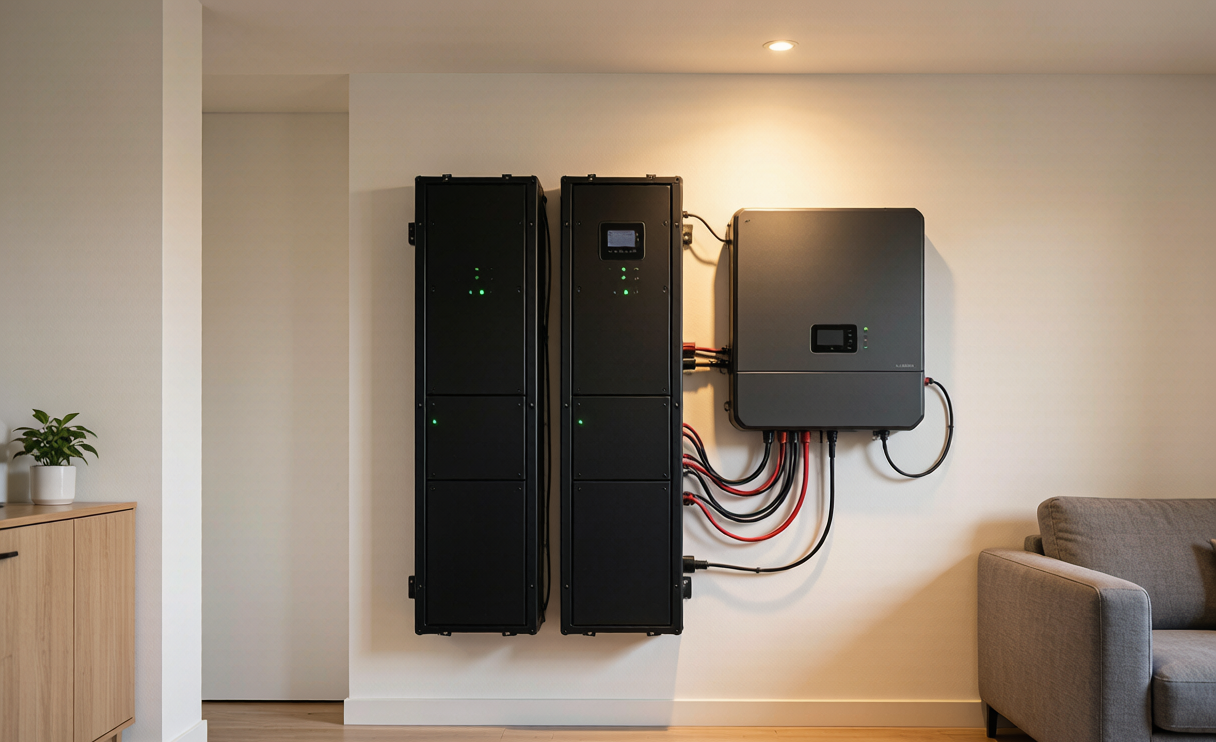
For apartments, I size to daily energy throughput and to the discharge duration the tariff actually rewards. A block on a time-of-use tariff with a 6-hour evening peak needs a 4–6 hour discharge window, not a 2-hour one. We typically deploy 5–10 kWh of usable capacity per apartment当量, centralized as one shared home energy storage system rather than one pack per unit.
Why centralize? Three reasons that hit the budget directly:
- One inverter instead of twelve — the power-conversion stage is 25–40% of system cost.
- Shared warranty and monitoring reduces O&M per kWh by roughly a third.
- You can right-size the battery to aggregate diversity, so ten apartments need less than ten individual packs combined.
The diversity factor is the part novices miss. In the 12-unit block I mentioned, the sum of individual evening peaks was 24 kW, but the coincident building peak was 19 kW — a 0.79 diversity factor. A centralized home energy storage system serves the coincident peak, so it needs roughly 20% less inverter and 15% less battery than twelve independent units would. On a 60 kWh pack that diversity alone is a five-figure saving before you buy anything smarter.
Cell Chemistry and the Cost-per-Cycle Tradeoff
The chemistry decision is where most of the lifetime cost lives. For stationary apartment storage I almost always specify LiFePO4 (LFP) rather than NMC. LFP trades some energy density for a cycle life of 4,000–6,000 cycles at 80% depth of discharge, versus 1,000–2,000 for NMC. At a levelized cost of storage perspective, the lithium battery that lasts three times longer wins even at a slightly higher pack price.
We qualify every cell batch to IEC 62619 (industrial stationary cells) and IEC 62133-2 (safety), and ship packs that have passed UN 38.3 T.1–T.8 transit testing. For a home energy storage battery in a shared building, the thermal-runaway margin of LFP is not a nice-to-have; it is what lets the fire engineer sign off under NFPA 855.
Inverter and Power Conversion: Where Apartments Overpay
The inverter is the most over-spec’d component in small residential jobs. A 5 kW continuous / 7 kW peak hybrid inverter covers the vast majority of apartment clusters if you have staged the shiftable loads. Oversizing to 10 kW “for future growth” adds cost you rarely use and lowers conversion efficiency at the partial loads apartments actually run.
Spec to IEEE 1547 for grid interconnection and UL 1741 SA for the inverter’s anti-islanding behavior. Pair the inverter with a battery management system that reports cell-level voltage and temperature to the building’s home battery backup controller, so a single weak module can be flagged before it drags the string.
Efficiency is where the payback hides. A good hybrid inverter holds 96–97% round-trip at 50–80% load but can fall to 88–91% at 10% load. Apartments idle low much of the day, so I favor inverters with a flat efficiency curve rather than the highest peak number on the datasheet. Over a year that 5-point low-load gap is worth more cycles — and more bill savings — than the brochure’s headline efficiency suggests.
Certification and Compliance Without the Premium
Compliance is non-negotiable in multi-unit buildings, but it does not have to be expensive if you choose certified building blocks. The stack I spec for EU and APAC apartments:
- UN 38.3 — transport safety of lithium cells and packs.
- IEC 62619 — safety of industrial stationary batteries.
- IEC 63056 — performance and endurance requirements.
- UL 1973 / UL 9540 — North American stationary storage and system-level safety.
- NFPA 855 & NEC Article 706 — fire code spacing and disconnect rules.
Buying packs that already carry these marks is cheaper than paying a local lab to re-qualify a generic import. For a tailored layout — odd meter room, limited clearance, shared riser — a custom battery solution built on certified cells is usually the lowest-risk path, not the most expensive one, once you avoid bespoke chemistry.
Installation, Monitoring, and the Hidden O&M Costs
The line items owners forget are commissioning and monitoring. I budget a remote monitoring gateway from day one: it costs less than one truck-roll and prevents the slow capacity fade that无声 kills payback. Set the BMS to alert at >30 mV cell imbalance or >5°C pack temperature spread.
Physically, apartment meter rooms run hot. We de-rate usable capacity by 10% above 35°C ambient and add passive venting. Skipping this shortens cycle life and pushes real cost per kWh up, not down.
A Field Cost Model for One Apartment Block
For a 12-unit block with 55 kWh daily throughput and 6 kW peak, a representative centralized design lands at:
- 60 kWh LFP pack (IEC 62619 / UN 38.3), usable ~54 kWh — the dominant cost.
- One 6 kW hybrid inverter (UL 1741 SA / IEEE 1547).
- Commissioning, monitoring gateway, NFPA 855-compliant enclosure.
With self-consumption of existing roof solar at ~70%, we typically see a levelized storage cost in the 0.18–0.28 USD/kWh range and a simple payback of 6–9 years before any incentive — versus 11+ years for a poorly sized, inverter-heavy design. That spread is the entire point of disciplined home energy storage cost optimization apartments engineering.
Metering, Billing, and Tenant Fairness
Cost optimization is worthless if the landlord cannot prove who saved what. I specify sub-metering at the apartment level plus a single revenue-grade meter on the shared storage, and I log dispatch events so the savings can be allocated back to tenants transparently. Many jurisdictions require this for any shared residential battery storage that touches tenant billing, and doing it from day one avoids an expensive retrofit meter upgrade two years later. The gateway that monitors cell health doubles as the billing data source, so you are not paying for two systems.
One more lever: time-of-use arbitrage only pays if the tariff spread is wide enough. I model the spread against the round-trip losses before committing. Where the spread is under roughly 0.12 USD/kWh, pure self-consumption of solar beats arbitrage, and I size the pack smaller and skip the expensive high-C discharge rating entirely.
Frequently Asked Questions
How much does home energy storage cost per apartment?
For a shared centralized system amortized across units, budget roughly 600–1,100 USD per apartment当量 including pack, inverter, and commissioning, assuming existing roof solar. Per-unit dispersed packs cost more per kWh because you duplicate inverters and monitoring.
Is a lithium battery safe inside an apartment building?
Yes, with LFP chemistry and certified packs (IEC 62619, UN 38.3) installed to NFPA 855 spacing and a building-level BMS. The fire-code margin of LFP is the reason most apartment authorities accept stationary storage at all.
Can I add home battery backup to an existing apartment?
Often yes. Retrofit needs a load assessment, a compliant meter room or riser location, and an IEEE 1547-compliant inverter. The cheapest route is usually one shared home energy storage system serving common loads first, then tenant circuits.
What incentives apply to residential battery storage?
It varies by region, but most programs reward measured self-consumption and peak shaving rather than installed capacity. Design the monitoring gateway first so you can document the throughput the incentive actually pays for.
How long until a home energy storage system pays back?
In our apartment projects, 6–9 years simple payback before incentives, 4–6 after, when the battery is sized to throughput and the inverter is not overspecified. Oversizing either input pushes payback past a decade.