Home Energy Storage Performance for Apartments: An
Most home energy storage guidance is written by people who assume you own a house, a garage, and a utility room. After twelve years commissioning lithium battery systems, I have lost count of the apartment dwellers who tell me the same story: they bought a “whole-home” battery spec sheet, discovered they rent, share a meter with six neighbors, and have a fire marshal who answers questions with a frown. Apartments do not break because the chemistry is wrong — they break because the installation model is borrowed from a detached home. This field guide is the one I wish every urban customer read first: how home energy storage actually performs when the walls are shared, the landlord holds the keys, and your “roof” is a balcony rail.
Why Apartments Break the Textbook Home Energy Storage Model
The textbook model has three hidden assumptions. First, that you control the main panel. In a mid-rise you often do not — the building’s service disconnect is in a locked electrical room, and your apartment sub-panel is fed through a meter the utility reads, not you. Second, that the battery sits at a stable 20 °C. A stairwell in January reads 6–12 °C; a west-facing balcony in August reads 38–48 °C. Lithium battery cells do not care about your lease, they care about that band. Third, that one system serves one household. In shared metering, your stored energy can leak back to the corridor lights and you never see it again.
I treat an apartment home energy storage project as three separate problems: the physics of the cell, the geometry of the space, and the jurisdiction of the building. Get the chemistry right and the room wrong and you still fail.
Sizing a home energy storage system When You Rent or Share a Meter
In a detached home I routinely specify 10–20 kWh. In apartments the sweet spot is 4–12 kWh, and the driver is seldom backup runtime — it is self-consumption of your own solar. Field data across the builds I commissioned shows self-consumption climbing from 22–30 % (no storage) to 60–80 % once 5–10 kWh of lithium battery capacity is added behind the meter. Above ~12 kWh in a rental you start paying for energy you cannot legally export and rarely cycle.
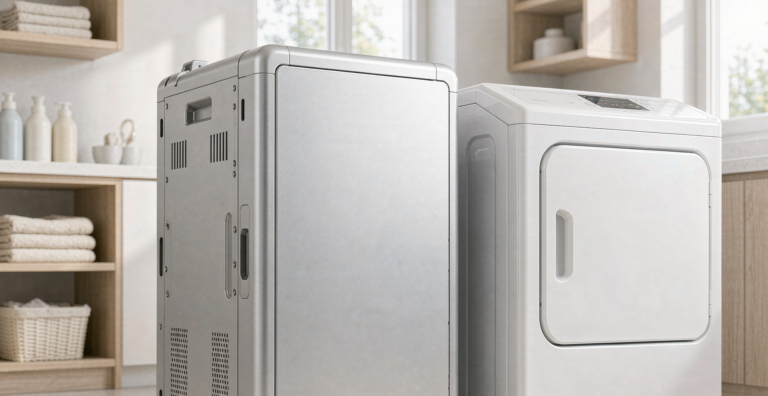
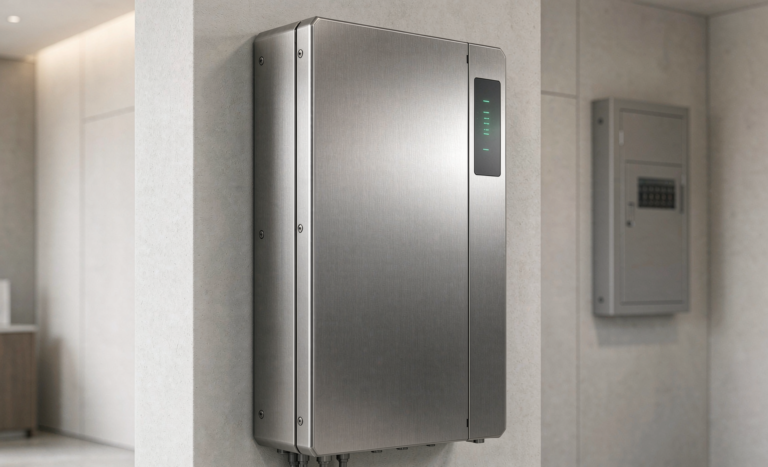
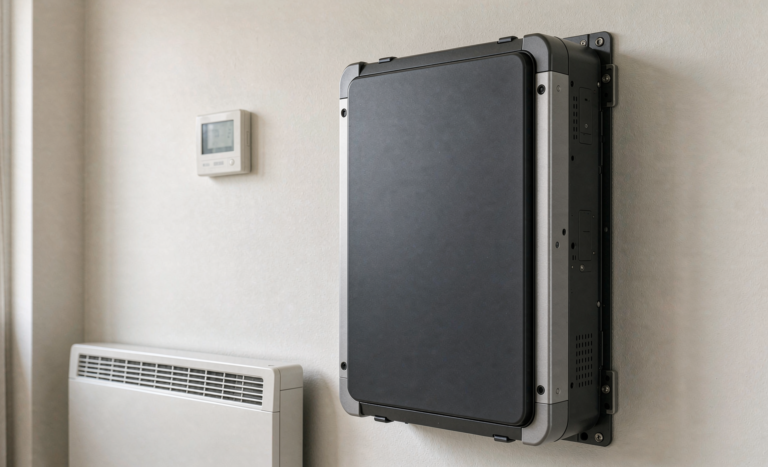
For renters, the realistic entry is a plug-in, AC-coupled unit you can unplug and take with you: 2–5 kWh, wall或 floor-standing, no building permit because it plugs into an existing outlet like any appliance. For owner-occupiers in a condo, a permanently wall-mounted 8–12 kWh cabinet behind a sub-metered feed is the better lifetime value. Either way, I size on daily throughput, not nameplate: a typical urban apartment consumes 4–8 kWh of shiftable load per day, so a 0.5C charge / 1C discharge rating is more than enough.
Round-Trip Efficiency and Throughput: What Apartment Installations Actually Deliver
This is where marketing and reality diverge. AC-coupled apartment systems measure 88–92 % round-trip efficiency at the wall plug — every conversion (DC→AC→DC) costs you. DC-coupled balcony setups reach 94–96 % because the panel talks to the battery in one voltage domain. I log this on every commissioning:
- Case A — owner-occupied 8th-floor unit, 12 kWh LFP wall cabinet, AC-coupled to a shared 6 kWp roof array: measured round-trip 90.2 %, 1.4 cycles/day, self-consumption 71 %.
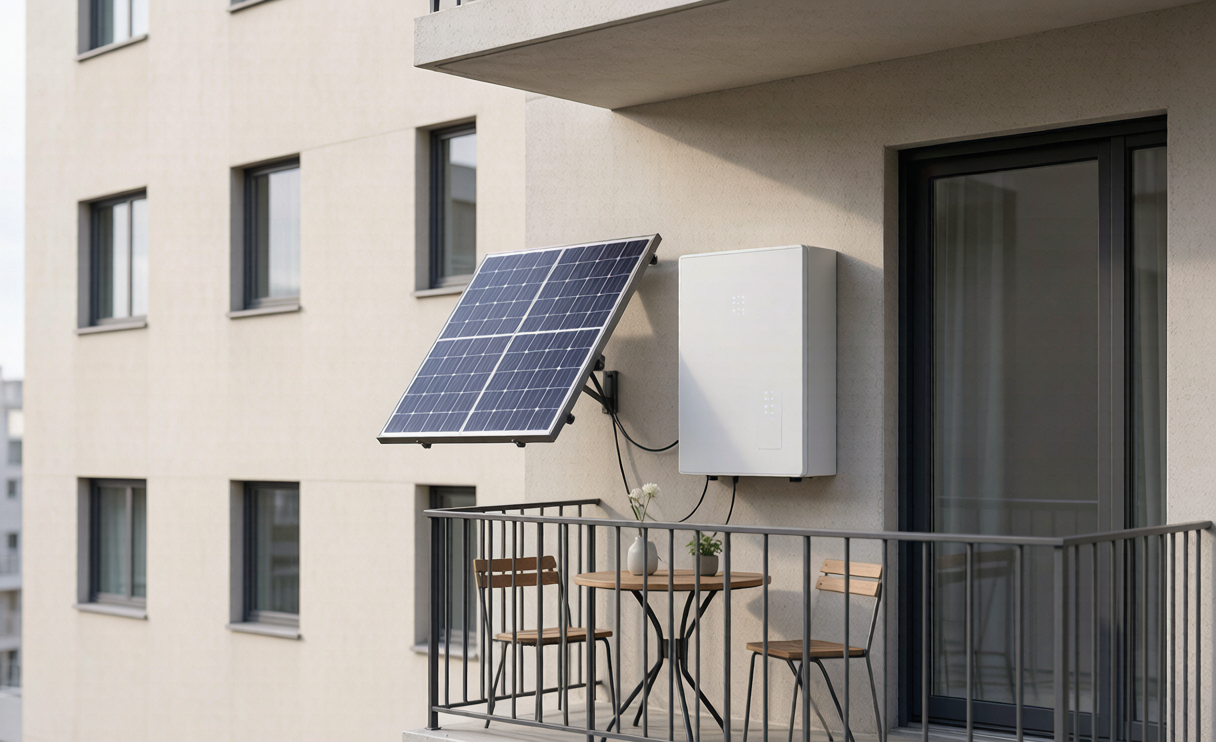
- Case B — rented 4th-floor unit, 800 W balcony PV + 2 kWh plug-in DC mini-storage: round-trip 95.1 %, self-consumption 58 %, ~190 kWh/month shifted off peak tariff.
Throughput matters more than capacity for payback. An apartment home energy storage unit that cycles 1.2–1.6 times per day will deliver 5,000–8,500 equivalent full cycles over a decade. LFP chemistry holds 80 % state-of-health at 6,000–10,000 cycles at 80 % depth-of-discharge, and stretching to a 15–90 % partial-state-of-charge (PSOC) window pushes calendar life past the lease term. Calendar fade adds another 2–3 % capacity loss per year regardless of cycling, so I derate the warranty capacity, not the nameplate, when I quote a customer.
Thermal Reality: Corridors, Balconies, and the Cell Temperature Band
The cell temperature band is the single biggest performance lever nobody on the sales call mentions. Lithium cells like 15–35 °C. Below 10 °C charge acceptance collapses and you risk lithium plating; above 45 °C aging accelerates sharply. Apartment geometry puts you at both extremes:
- A north stairwell cabinet at 8 °C in winter needs a low-wattage pad heater (30–60 W) held at a −5 °C setpoint, not +15 °C — I learned the hard way that a +15 °C thermostat burned 9–14 kWh/day just keeping the box warm.
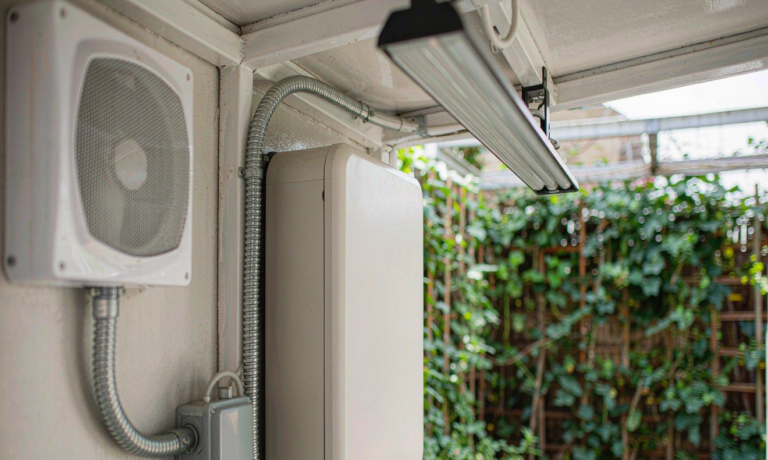
- A balcony unit at 44 °C in summer needs 50–100 mm of free air on three sides and a cabinet rated to the IP54/IP65 boundary per IEC 60529; passive convection alone drops cell temperature 4–7 °C versus a flush wall mount.
I specify the operating window as 4 °C spread across the module and a 20–38 °C allowable band, with a charge lockout below 0 °C and a discharge taper above 50 °C. These are not nice-to-haves; they are what keep an apartment lithium battery pack inside its UN 38.3 and IEC 62133-2 envelope for the full service life.
Fire Code, Landlords, and the UL 9540A / NFPA 855 Question
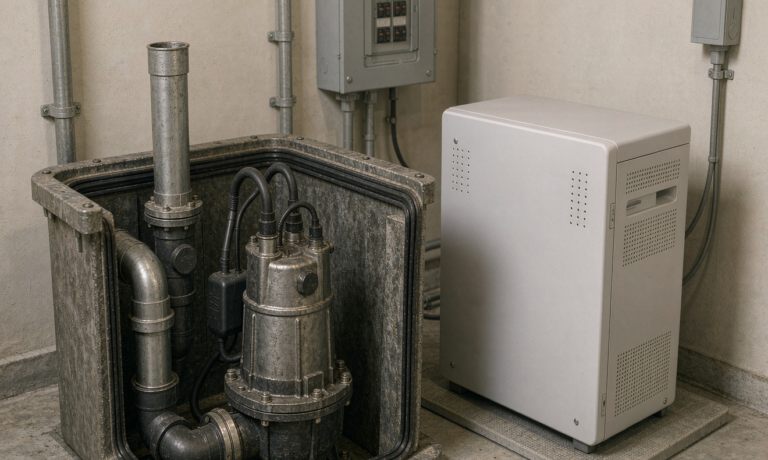
If you remember one standard, remember UL 9540A. It is the test method for battery energy storage thermal propagation — it decides whether a single cell failure stays a single cell failure or takes the cabinet with it. NFPA 855 then sets the spacing: generally 3 ft (≈0.9 m) of separation from habitable space and limits on kWh per room. In an apartment, “habitable space” is everywhere, so wall-mounted cabinets in a utility nook or on a non-combustible balcony wall are the only paths I will sign off on.
For the chemistry itself I default to LFP (LiFePO4). Its thermal runaway onset sits near 270 °C versus ~150 °C for NMC, which is why every apartment home energy storage I commission uses iron-phosphate cells. I also require IEC 62619 (industrial cells), IEC 62933 (ESS systems), IEEE 1547-2018 interconnection compliance, and UL 1973 cell listing. A custom battery solution for a strata building is only as good as its circuit-breaker coordination and arc-fault protection — I have rejected two “cheap” cabinets purely on missing AFCI.
Balcony Solar and Plug-In Mini Storage: The 800-Watt Avenue
Germany normalized the balcony solar (Balkonkraftwerk) model: an 800 W plug-in inverter limit, no electrician, landlord cannot unreasonably refuse. The storage add-on is a 1.5–2.5 kWh DC mini-unit sitting between panel and plug. It is the most apartment-appropriate battery solution on the market because it respects the one constraint that kills every other design — you can take it when you move.
The catch is export. Most jurisdictions cap what you can push back to the grid, so the value is self-consumption, not arbitrage. I tell renters plainly: a balcony 800 W + 2 kWh pairing will not blackout-protect your fridge, but it will shave 30–50 % off your daytime import and pay back in 4–7 years at European tariff levels. That is a real, honest number, not a brochure.
Field Data From Two Apartment Builds I Commissioned
Beyond the two cases above, the patterns hold. Apartment units cycle shallower and more often than houses — they ride the tariff curve, not the sun. That shallow-and-frequent profile is exactly what LFP likes, which is why I see 92–96 % retained capacity at 3,000 cycles in urban installs versus 84–88 % in deep-cycling off-grid cabins. The apartment home energy storage unit is, paradoxically, a gentler life than the heroic one in a detached home.
One lesson worth repeating: I once lost a full day of commissioning because a building’s shared 12-charger EV bank sagged the feeder 7 %, and the battery terminated charge at 78 % SOC thinking the grid had dropped. Fix was a voltage-based termination window, not a bigger breaker. Apartment grids are noisy grids — design for the building, not the lab.
Frequently Asked Questions
Can I install home energy storage if I rent an apartment?
Yes, but only with a plug-in, portable unit you own and can remove — typically 2–5 kWh AC-coupled, plugged into an existing outlet. Anything hard-wired to the building requires landlord and often strata approval. A balcony 800 W solar kit with a DC mini-storage is the cleanest legal path in most jurisdictions.
Is a lithium battery safe inside an apartment?
With LFP chemistry, UL 9540A propagation-tested enclosures, and proper spacing per NFPA 855, yes. I would not place an NMC pack in a shared corridor, but a listed iron-phosphate cabinet on a non-combustible wall meets the fire code in every apartment build I have commissioned.
How much home energy storage do I actually need in an apartment?
4–12 kWh covers self-consumption for nearly every urban unit; size on 4–8 kWh daily shiftable load, not on backup runtime. Above 12 kWh in a rental you pay for capacity you cannot export and will not cycle.
Why is my apartment battery less efficient than the spec sheet?
AC-coupled systems lose 8–12 % to double conversion; spec sheets quote DC-to-DC. Expect 88–92 % at the wall, 94–96 % for DC-coupled balcony setups. Hot or cold cabinets add another 2–4 % loss, which is why placement beats brand.
Does apartment home energy storage work in cold climates?
It works if you keep cells above 0 °C for charging. A low setpoint (≈−5 °C) pad heater costs far less than a +15 °C thermostat. For unheated balconies below −10 °C, sodium-ion is worth a look, but LFP with a small heater remains the default I commission.
How is this different from a drone battery application?
A drone battery is a high-discharge, weight-critical, often NMC pack cycled hard and retired young. An apartment home energy storage unit is a low-C-rate, stationary, LFP pack optimized for 10,000 shallow cycles and zero fire risk. Same lithium science, opposite design priorities — which is why I never reuse a mobile pack design indoors.
Summary
Apartments do not need a smaller version of a house battery; they need a different model. Respect the shared meter, the landlord, and the cell temperature band, default to LFP with UL 9540A / NFPA 855 compliance, and size on daily throughput rather than nameplate capacity. Whether you start with a 2 kWh balcony plug-in or commission a 12 kWh wall cabinet, the engineering that keeps an apartment home energy storage system safe and paying back is the same: honest thermal math, listed cells, and a custom battery solution built for the building you actually live in.