How to Size a Home Battery Backup for Whole-House Power
As a Senior lithium battery Engineer at Horizon Power, I have sized and commissioned hundreds of residential storage systems over the past decade. One question comes up in almost every call: ‘How do I size home battery backup so it actually keeps my whole house running during an outage?’ The bad news is that there is no single magic number. The good news is that sizing is a repeatable engineering calculation, not guesswork. In this guide I will walk you through the exact method my team uses, with real load numbers and worked examples, so you can spec a system with confidence.
1. Start With a Real Load List (in kWh, Not Just Watts)
The most common mistake homeowners make is looking at the nameplate wattage of their panel and assuming they need a battery that big. You do not. What matters is energy (kilowatt-hours, kWh) consumed over time, not instantaneous rating alone. Build a load list of the circuits you want to keep alive, then estimate daily run time.
Here is a realistic essential-load list I use for a typical 2,000 sq ft home:
- Refrigerator / freezer: 150 W average x 24 h = 3.6 kWh/day
- LED lighting: 120 W x 5 h = 0.6 kWh/day
- Wi-Fi router and network: 15 W x 24 h = 0.36 kWh/day
- Furnace blower (gas heat): 800 W x 4 h = 3.2 kWh/day
- Sump pump: 400 W x 1 h = 0.4 kWh/day
- Television and electronics: 200 W x 4 h = 0.8 kWh/day
- Well pump: 1,000 W x 0.5 h = 0.5 kWh/day
Add those up and your essential daily load is roughly 9.5 kWh. If you also want central air conditioning, add about 21 kWh/day (3,500 W x 6 h), pushing the whole-house figure to about 30 kWh/day. These two numbers are the foundation of how you size home battery backup capacity.
2. Calculate Peak Power and the Right Inverter Rating
Energy tells you how long the battery lasts; power tells you whether it can start your loads at all. Motors and compressors draw a large inrush current for a fraction of a second. A refrigerator compressor can pull 1,500 W at startup; a well pump can briefly draw 2,000 W; a central AC compressor can exceed 6,000 W on locked-rotor start.
For an essential-loads system, plan for a continuous load around 3,000-5,000 W with a surge allowance of 8,000-10,000 W. For whole-house coverage including AC with a soft starter, I typically specify a continuous inverter of 10,000 W (10 kW) with a 2x surge rating of 20,000 W. The inverter, not the battery, is what must handle these instantaneous peaks, so match it carefully when you size home battery backup systems.
3. Decide Your Backup Duration: Hours or Days?
Next, multiply your daily kWh by the number of days you want to ride through. This is where priorities diverge:
- One outage day, essential loads: 9.5 kWh x 1 = 9.5 kWh usable.
- Two days, essential loads: 9.5 kWh x 2 = 19 kWh usable.
- One day, whole house with AC: 30 kWh x 1 = 30 kWh usable.
- Two days, whole house: 30 kWh x 2 = 60 kWh usable.
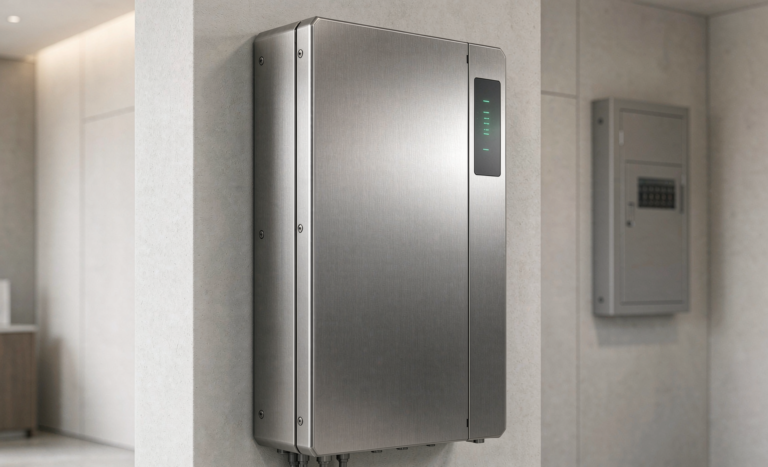
Remember that usable capacity is less than nameplate because you should not fully discharge the cells. With a quality LFP battery at 90% depth of discharge, a 30 kWh usable target means a nameplate of about 33-34 kWh. Our home energy storage battery modules are designed around this 90% DoD envelope so the math stays honest.
4. Pick the Chemistry: Why I Recommend LFP
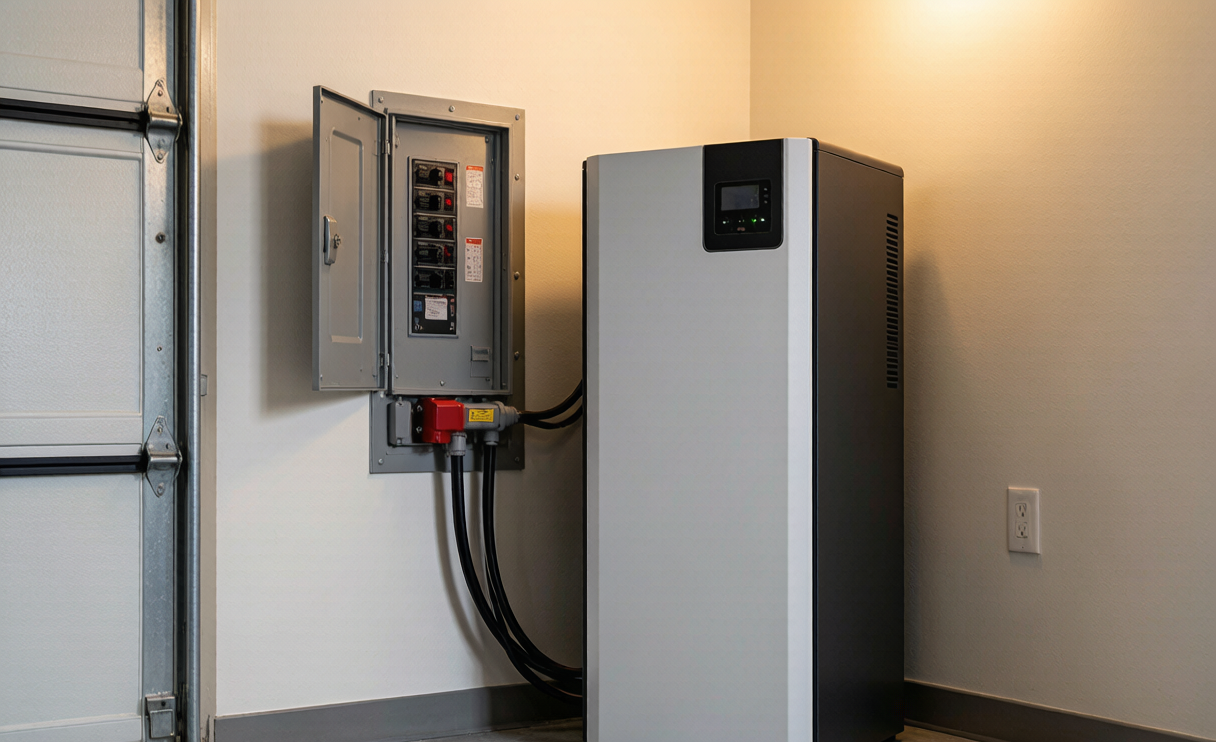
When clients ask me to size home battery backup for decades of service, I steer almost everyone to lithium iron phosphate (LFP). Compared with older lead-acid or even standard NMC lithium battery packs, LFP offers a longer cycle life (4,000-6,000 cycles to 80% capacity), superior thermal stability, and a flatter discharge curve that delivers rated power down to near-empty. For a residential battery storage install in a garage or utility room, that safety margin matters more than a few percent of extra energy density.
The trade-off is that LFP is slightly heavier and a touch lower in nominal voltage per cell, but for stationary home energy storage that is irrelevant. What you gain is a system you can essentially forget about for 10-15 years.
5. Balance the System and Check Round-Trip Efficiency
Finally, account for losses. A real system loses 10-15% in the inverter, wiring, and battery management. If you need 30 kWh usable at the loads, size the nameplate to about 34-35 kWh and choose an inverter with >90% round-trip efficiency. Also confirm your home energy storage inverter supports the transfer switch and grounding your local code requires.
A worked whole-house example: 30 kWh/day x 1 day = 30 kWh usable; at 90% DoD = 33 kWh nameplate; add 12% losses = ~37 kWh pack; pair with a 10 kW continuous / 20 kW surge inverter. That is a clean, defensible spec.
FAQ
How many kWh do I need to run a house?
For essential circuits (fridge, lights, heat, internet, pump), budget 9-12 kWh per day. For true whole-house coverage including air conditioning, plan 25-35 kWh per day. Multiply by your target backup days, then divide by depth of discharge (use 0.9 for LFP) to get nameplate capacity.
Can a home battery backup power an air conditioner?
Yes, but it is the hardest load. A central AC can need 3,500 W running and 6,000+ W starting. Use a soft starter to cut inrush, and size the inverter for at least 2x the running wattage as surge. This is the single biggest factor when you size home battery backup for whole-house comfort.
What size inverter do I need?
Add up the watts of everything that could run at once, then add the largest motor surge. Essential-loads systems usually need 5-8 kW continuous; whole-house systems with AC need 10 kW continuous and 18-20 kW surge. Never let the inverter be the weak link.
How long will a 10 kWh battery last?
At 90% DoD that is 9 kWh usable. For an essential load of 9.5 kWh/day, roughly one day. For a whole-house load of 30 kWh/day, only about 7-8 hours. This is exactly why I always start the sizing process from a real load list rather than a round number.