Stackable Home Energy Storage: Scaling Capacity as You Grow
As a senior lithium battery engineer, I have spent the better part of a decade designing and validating residential storage systems for households across Europe, North America, and Southeast Asia. One pattern has become impossible to ignore: families rarely know their exact energy needs on day one. A young couple buys a small solar array, then adds an EV charger two years later, then a heat pump, then a workshop. The rigid “one box, fixed size” battery era is ending. What replaces it is stackable home energy storage — a modular architecture that lets you grow capacity in clean, predictable increments instead of ripping out and replacing the whole system.
In this article I will walk you through exactly how stackable systems are engineered, how the modules talk to each other, what happens to voltage and safety as you add capacity, and how to size a stack that will still make sense five years from now. Everything here comes from real design work, not marketing copy.
Why Stackable Home Energy Storage Changes the Game for Homeowners
The core advantage of stackable home energy storage is capital efficiency. With a traditional single-enclosure unit, you must guess your future demand and oversize upfront, or accept that you will throw the unit away when you outgrow it. A modular home energy storage battery lets you start with, say, 5 kWh and add another 5 kWh module whenever your lifestyle changes. Each module is a self-contained lithium battery pack with its own battery management system (BMS), so the risk of a single point of failure is dramatically lower.
From an installer’s perspective, the stack also simplifies logistics. Modules ship as identical, handled boxes. You carry them up a staircase one at a time instead of wrestling a 120 kg monolith through a doorway. For the end user, the visible benefit is a system that visibly grows with the home — the physical stack becomes a record of the household’s evolving energy story.
The Modular Topology: How Battery Modules Physically Stack
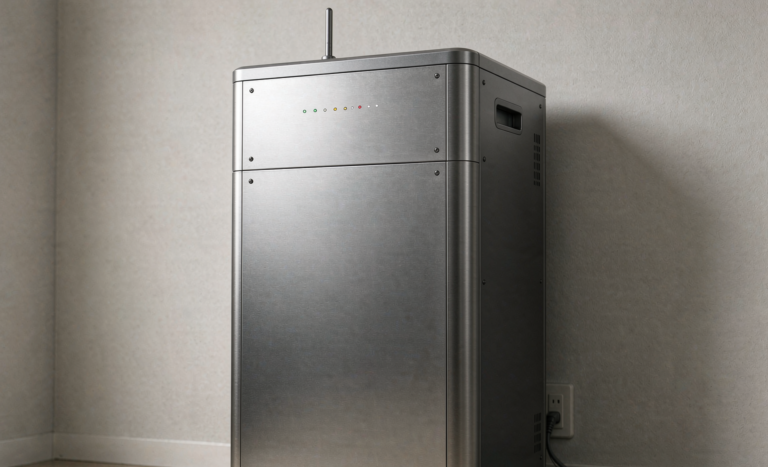
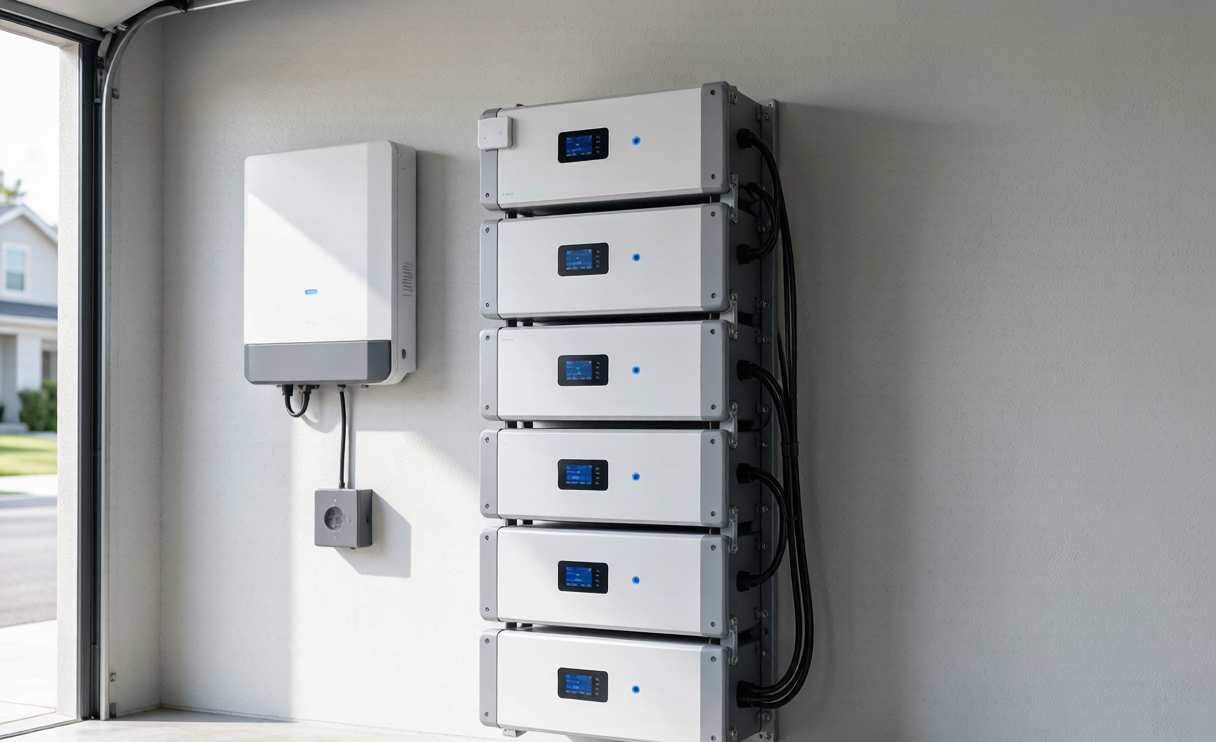
Most residential battery storage stacks I design use a floor-standing tower or a wall-mounted rail. Each module is a 48 V-class LFP battery (lithium iron phosphate) pack, typically rated between 4.8 kWh and 5.12 kWh. The mechanical design is the first thing we obsess over. Modules snap together with a tongue-and-groove or rail interface, and power and signal connectors are mated automatically as you seat the unit. There is no loose cabling dangling between packs.
Electrically, modules can be arranged in two ways. In a parallel stack, every module shares the same nominal voltage (around 51.2 V for LFP) and the stack’s amp-hour capacity simply adds up. In a series stack, voltage climbs as you add modules. For home energy storage, parallel stacking at a fixed 48 V bus is by far the most common because it keeps the inverter happy and avoids the complications of a high-voltage DC bus inside a living space. I almost always recommend parallel topology for residential battery storage unless the inverter explicitly requires a higher string voltage.
The enclosure itself matters. A good module has an IP-rated housing, a fire-retardant outer shell, and clearly labeled positive and negative bus bars at the rear. We design the base unit to carry the weight of the entire column, so the bottom module is structurally reinforced while upper modules stay lighter for safe handling.
Voltage, Bus Architecture, and Communication When You Expand
This is where engineering discipline separates a safe stack from a hazard. When you add a module to a 48 V parallel home energy storage battery stack, three things must happen correctly: voltage equalization, current sharing, and state-of-charge (SOC) synchronization.
Voltage equalization. Every LFP battery module has a slightly different open-circuit voltage even when “full.” If you hard-connect two packs at different voltages, a large equalization current can flow for a moment. We solve this with controlled pre-charge circuits and by requiring the new module to be within a tight voltage window of the existing stack before the contactor closes. The BMS will refuse to connect otherwise.
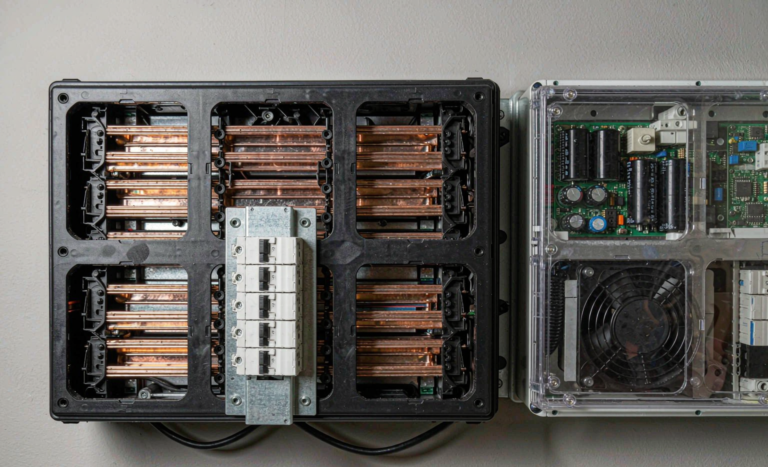
Current sharing. In an ideal parallel stack, each module contributes proportionally to load. In reality, internal resistance varies. A well-designed stack uses either passive balancing across the bus or per-module DC/DC converters so one pack does not silently carry the whole house. I have seen cheap stacks where a single weak module overheats because it was the path of least resistance — proper current sharing design prevents that entirely.
Communication. Modules do not just sit there; they talk. The dominant protocol in residential battery storage is CAN bus, with some systems using RS-485 or a proprietary daisy-chained link. Each module reports voltage, temperature, cell balance status, and cycle count to a stack controller or directly to the hybrid inverter. When you add a module, the controller performs a “discovery” handshake, learns the new serial number, and recomputes the total usable capacity. The homeowner sees the extra kilowatt-hours appear in the app within seconds. This is the part customers notice: the system simply recognizes the new lithium battery and reallocates energy intelligently.
Safety Engineering in a Stacked Lithium Battery System
Safety is non-negotiable, and a stacked system actually gives us more levers than a monolithic box. Here is what I specify on every stackable home energy storage project:
- Per-module BMS. Each lithium battery has its own protection: over-voltage, under-voltage, over-current, short-circuit, and over-temperature cutoff. One module fault isolates that module without killing the whole stack.
- Cell-level fusing. Every parallel group inside a module has a fusible link so a single cell failure cannot cascade.
- Thermal runaway containment. We use LFP chemistry precisely because its thermal runaway threshold is far higher than NMC. Modules are separated by air gaps in the stack to slow any heat propagation.
- Arc-fault and ground-fault protection. The inverter side monitors for DC arc faults, a leading cause of storage fires.
- Ventilation and spacing. Even though LFP is stable, we still require clearance around the stack and avoid sealed closets. A small fan or passive convection path keeps cells in their happy 15–35 °C window.
I want to be direct about one myth: no lithium battery is “fireproof.” The engineering goal is to make a fault rare, contained, and self-clearing. A modular home energy storage battery design achieves that better than a single oversized pack because the blast radius of any single failure is limited to one module.
Sizing Your Stack: From 5 kWh to Whole-Home Backup
Sizing is where homeowners get stuck, so let me give you the engineer’s shortcut. List your essential loads: fridge, lights, router, a well pump if you have one, and maybe an air conditioner during an outage. Add their running watts, multiply by the hours you want backup, and you get a rough kilowatt-hour target. A typical essential-load backup need lands between 10 and 15 kWh, which is two to three stackable modules.
If you want whole-home backup including HVAC, you are looking at 20–30 kWh — four to six modules — plus an inverter sized for the simultaneous inrush current of your largest motor load. The beauty of stackable home energy storage is that you do not need to decide all of this today. Buy the base, prove the system, then extend the stack as your confidence (and your solar yield data) grows.
One practical note: your inverter’s maximum charge/discharge current caps how fast the stack can move energy. A 100 A 48 V inverter delivers about 5 kW continuous. If your stack can deliver more, the surplus simply sits unused. Match the inverter to the stack, not the other way around.
My Engineering Checklist Before You Buy
Before you commit to any residential battery storage purchase, run through this list I give every client:
- Confirm the chemistry is LFP battery (safer, longer cycle life) unless you have a specific reason otherwise.
- Verify the module supports true hot-swappable expansion — some “modular” claims only allow expansion at commissioning.
- Check the communication protocol matches your inverter (CAN bus is the safe default).
- Ask for the per-module BMS spec sheet, not just the system sheet.
- Confirm the warranty is stated in cycles at a defined depth of discharge, not just years.
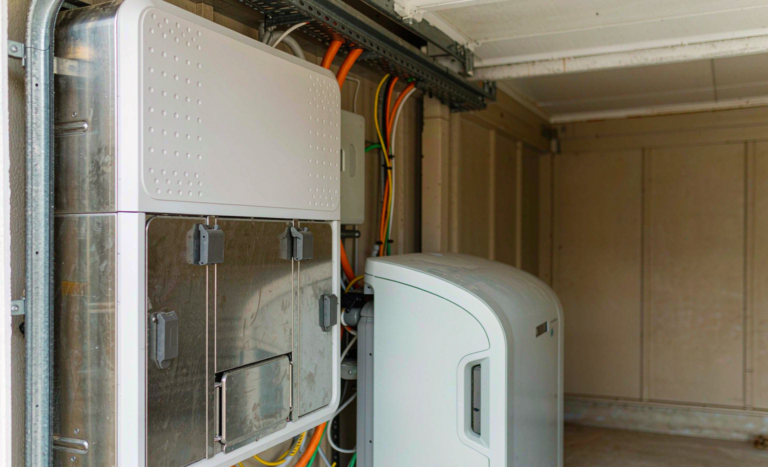
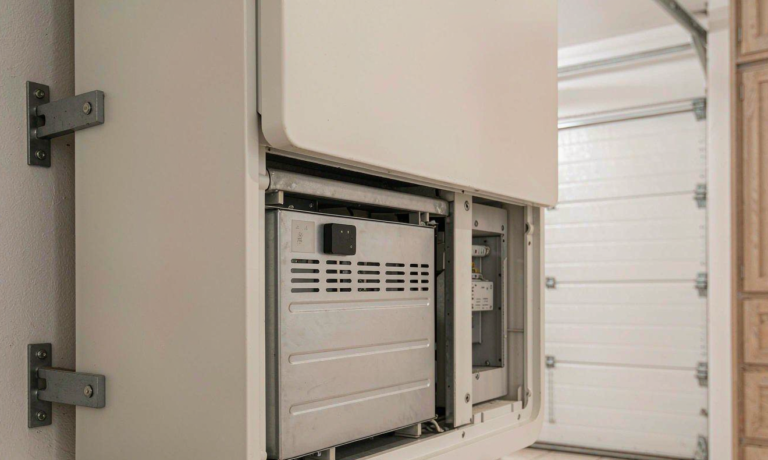
- Make sure the enclosure rating fits your install location (garage, utility room, or outdoor).
Get these right and a stackable home energy storage system will serve you for a decade or more, quietly scaling as your home’s appetite for clean power grows.
Frequently Asked Questions
Can I add modules from a different brand to my existing stack?
In almost all cases, no. Communication protocols, BMS logic, and mechanical interfaces are vendor-specific. Mixing brands risks unequal voltage windows and unsupported discovery handshakes. Stick to the same manufacturer’s modules, and ideally the same firmware generation.
Does adding more batteries make my system less efficient?
Marginally. Each additional lithium battery has its own self-consumption and conversion loss, so a larger stack has slightly higher standby draw. But the difference is small, and the flexibility usually outweighs it. Proper current sharing keeps round-trip efficiency in the 90–95% range even with five or six modules.
How many modules can I safely stack?
It depends on the inverter’s current limit and the bus-bar rating, but most residential systems cap at six to eight modules per stack. Beyond that, we usually recommend a second parallel string or a second inverter rather than one very tall tower, both for safety and for structural stability.
Will the stack keep working if one module fails?
Yes, with a well-designed per-module BMS. The faulty module isolates itself and the rest of the home energy storage battery continues to serve the load at reduced capacity. That graceful degradation is exactly why I favor modular topology over a single large pack.
Is stackable home energy storage worth it for a small home?
If your loads are tiny and unlikely to grow, a fixed unit may be cheaper upfront. But for most households with solar and any plan to add an EV or electrify heating, the modular approach protects you from expensive premature replacement. Start small, expand later.