Lithium Battery Cost Optimization for Power Tools
Every product manager who has ever priced a cordless power tool eventually asks the same question: how do we make the battery cheaper without making it dangerous? After twelve years designing lithium battery packs for drills, impact drivers, and outdoor equipment, I can tell you the honest answer is uncomfortable. Cost is not one number on a BOM; it is a network of trade-offs between cell chemistry, pack architecture, the battery management system (BMS), certification strategy, and manufacturing yield. Get any single link wrong and the savings you captured on paper evaporate in the field as warranty claims.
This article walks through the engineering levers I actually use when a client asks for lithium battery cost optimization for power tools. I will show where the money really goes, which optimizations are safe, and which ones quietly undermine the UN38.3 and IEC 62133 compliance that lets a product ship across borders. The goal is not the cheapest pack on earth. The goal is the lowest total cost of ownership that still earns trust from operators and regulators alike.
Why Power Tool Battery Cost Is a Systems Problem
A cordless tool battery is deceptively simple to draw on a slide and brutally complicated to build at scale. The cell itself is usually 30 to 55 percent of the pack cost. The remaining budget is swallowed by the protection board, the enclosure, the interconnects, assembly labor, and certification. When a procurement team says “cut the cell cost,” they are often attacking the visible line item while ignoring the larger, recurring costs hidden in returns and rework.
In my experience the biggest savings come not from buying cheaper cells but from designing the system so it tolerates normal variance. A pack that fails when a cell ages two percent faster than its sibling will trigger a warranty return that costs ten times the component it tried to save. Lithium battery cost optimization for power tools, done right, is mostly about removing fragility.
Cell Selection — The Single Biggest Lever
For power tools the dominant chemistry is still the lithium-ion 18650 or 21700 cylindrical cell using an NMC or NCA cathode. These cells deliver the high pulse current that a drill motor demands during a stall. The first decision is discharge rate. A 10A continuous / 20A pulse cell costs less than a 15A / 30A cell, but if your tool peaks at 25A, the weaker cell will heat, sag, and age early.
I routinely model three cell tiers for a client and compare not just unit price but projected cycle life under the tool’s actual duty cycle. A slightly more expensive high-rate cell often wins because it lets us shrink the BMS cooling and the enclosure, recovering the difference. This is where lithium battery cost optimization for power tools stops being guesswork and becomes arithmetic.
Another lever is capacity grade. Power tools rarely need maximum runtime; they need consistent torque. Specifying a 2.5Ah cell instead of a 3.0Ah cell, when the use case is intermittent, can cut cell cost by double digits without changing the operator’s perceived performance.
Pack Architecture and the Cost of Welding
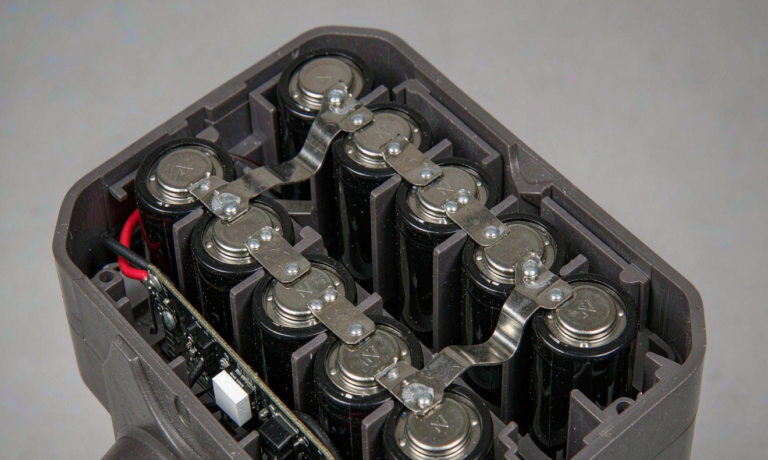
How you connect cells dominates assembly cost. Spot welding nickel strips is cheap and fast, but nickel has high resistance, which means heat and voltage sag under load. Copper-nickel composite busbars reduce losses but add material and process cost. For most consumer drills, optimized pure-nickel strip at the right thickness is the sweet spot.
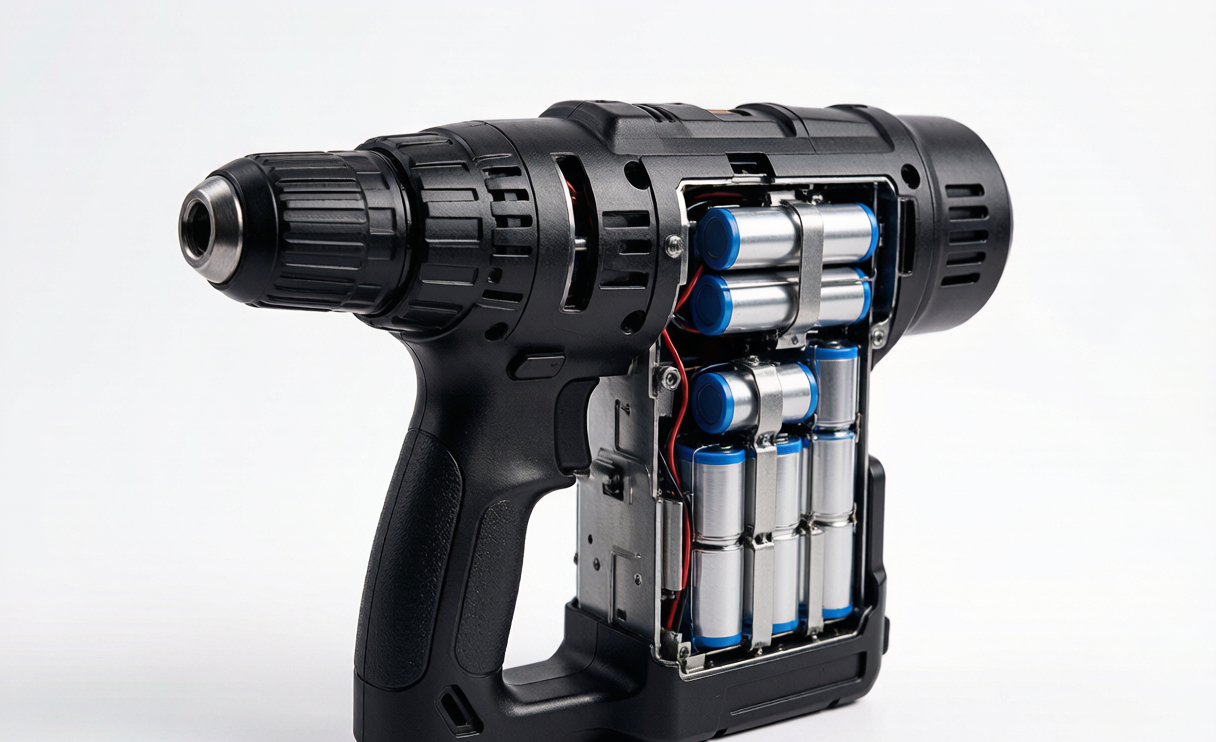
Cell arrangement also matters. A 5S2P layout needs more welds and more interconnect than a 5S1P with higher-capacity cells. I have replaced a 10-cell layout with a 5-cell layout using larger-format cells and cut weld count in half while improving thermal behavior. The lithium battery pack becomes simpler, lighter, and cheaper to assemble, which is the rare case where all three improve together.
BMS Trade-offs: How Much Intelligence Do You Need?
The protection board is where engineers either save money or waste it. A basic BMS provides over-current, over-voltage, under-voltage, and short-circuit protection. That is the non-negotiable floor for any lithium ion battery in a consumer tool. Adding fuel gauging, cell balancing, and Bluetooth telemetry increases BOM and firmware cost, and each feature is a new failure point.
For a value-tier drill, I recommend a proven single-chip protection IC with passive balancing only if the cell matching is tight. For a premium tool where brand experience matters, a coulomb-counting gauge justifies its cost through fewer “my battery died” support calls. The key is matching BMS sophistication to the product tier rather than bolting features on by default.
Certification Strategy That Pays for Itself
Certification is not a tax on cost; it is a gate that prevents far larger losses. Every pack we ship is validated against UN38.3, the transport test covering altitude simulation, thermal, vibration, shock, external short circuit, impact, and forced discharge. Skipping or faking this is not optimization; it is liability.
For the cell and pack we apply IEC 62133-2, the international safety standard for portable sealed secondary cells and batteries containing alkaline or other non-acid electrolytes. For the tool itself, IEC 62841 governs safety of electric motor-operated hand-held tools. In North America, UL 2054 covers household and commercial batteries while UL 2595 addresses the general safety of battery-powered motor-operated tools. Planning these tests early, with margin built into the design, avoids the expensive late-stage redesign that destroys any savings earned upstream.
I have watched teams shave pennies off a connector, only to fail an IEC 62133-2 crush test and spend six figures re-tooling. A certification-aware design review at the schematic stage is the cheapest insurance in the entire project.
Manufacturing Yield and the Hidden Cost of Rework
The most overlooked cost center is yield. A pack designed with impossible weld tolerances or a BMS that needs manual firmware flashing will bleed money on the line. I design for poka-yoke: fixtures that make the wrong assembly physically impossible, automated resistance checks on every weld, and a single-point BMS programming step.
For lithium battery cost optimization for power tools, a two percent yield improvement on a million-unit run is worth more than most component negotiations. The cheapest unit is the one that passes test the first time and never comes back.
A Real Cost-Breakdown Example From My Bench
On a recent 20V drill platform we started with a 5S2P pack of 2.0Ah cells, a nickel strip, and a feature-rich BMS. The BOM was acceptable but the warranty rate was climbing. We re-specified to 5S1P using 4.0Ah high-rate cells, moved to a thicker single-pass nickel strip, and dropped to a streamlined protection IC. Cell cost rose slightly; everything else fell. Total pack cost dropped about nine percent and the return rate more than halved.
The lesson is that lithium battery cost optimization for power tools is rarely about a single cheaper part. It is about the system finding its natural, robust, low-friction shape.
Future-Proofing Cost Without Over-Engineering
Cell prices fall roughly five to eight percent per year as volumes rise. Designing a pack that can accept a newer, cheaper cell generation without a full re-certification is a quiet superpower. I keep mechanical and electrical interfaces stable while qualifying alternate cell sources, so procurement can chase the market without dragging engineering into a redesign every season.
A reputable lithium battery manufacturer will offer this kind of roadmap transparency. When evaluating partners, ask not just for today’s price but for their qualification path for next year’s cells.
Frequently Asked Questions
What is the cheapest safe way to reduce power tool battery cost?
The safest high-impact lever is right-sizing the cell to the actual duty cycle and simplifying the pack layout, not buying lower-grade cells. Match discharge rate to peak load, avoid over-specifying capacity, and design the BMS to the product tier. These moves cut cost without touching the safety margin required by UN38.3 and IEC 62133-2.
Can I use cheaper cells and rely on the BMS to protect them?
No. A BMS is a last line of defense, not a performance enhancer. If cells cannot deliver the tool’s peak current, the BMS will trip constantly or the cells will overheat before protection engages. Lithium battery cost optimization for power tools must start with cells that meet the load profile, then add the minimum protection needed.
How much does certification really add to the cost?
Properly planned, certification is a small fraction of lifetime cost and prevents far larger losses from recalls and import rejections. The expensive certification is the one you do twice because the design changed late. Early design review against IEC 62841, UL 2054, and UL 2595 keeps that cost predictable.
Is a custom battery solution worth it for a small tool brand?
Often yes, even at modest volumes. A custom battery solution tailored to your exact duty cycle removes the margin you pay when using an off-the-shelf pack sized for a heavier tool. The savings compound across the product line when the architecture is shared.
Which chemistry is best for cost-sensitive power tools?
For most cordless tools, cylindrical lithium-ion NMC or NCA cells remain the cost-performance leader because of mature supply and high pulse capability. Lithium iron phosphate (LFP) is cheaper per watt-hour and safer thermally but heavier and lower voltage per cell, which complicates tool electronics, so it fits niche slow-drain tools rather than high-torque drills.