Lithium Battery for Marine Trolling Motors: Sizing, BMS and ABYC Compliance Guide
I have spent a good part of the last twelve years on the electrical side of small craft — bass boats in the south, aluminium skiffs in the Pacific Northwest, and a fair number of saltwater guide boats in between. Almost every one of those projects started the same way: the owner is tired of dragging two or three flooded lead-acid batteries to the bow, tired of the voltage sagging out on the third drift, and wants to know whether a lithium battery will actually fix it. It usually will, but only if you size it honestly and install it the way the marine standards expect. This guide is the same conversation I have with customers before we build a custom battery solution for a trolling motor bank.
Why Anglers Move from Flooded Lead-Acid to a Lithium Battery Bank
The physics argument is short and brutal. A Group 27 flooded deep-cycle battery rated at roughly 100 Ah weighs about 25–30 kg and, if you want it to survive more than a season, you discharge it to 50% depth of discharge — so you get about 50 usable amp-hours. A 12 V 100 Ah LiFePO4 pack weighs 11–13 kg, tolerates 80–90% depth of discharge, and gives you 85–90 usable amp-hours from the same label rating. That is roughly 1.8× the usable energy at less than half the weight, and the weight comes off the bow, which changes how the hull rides and how fast it planes.
The second argument is voltage stability. Lead-acid sags continuously: a 12 V bank under a 40 A trolling load will sit somewhere around 11.8–12.1 V for much of the discharge, and the motor controller and fishfinder see that. A LiFePO4 pack holds 13.0–13.2 V until it is almost empty, then falls off a cliff in the last 5–8% of capacity. In practice the motor spins at the same rpm on hour five as it did on hour one, which is the thing anglers actually notice.
The third argument is cycle life. I specify 3,000–6,000 cycles to 80% capacity retention for well-built LFP packs at 0.5 C and 25 °C, against 300–500 cycles for a properly maintained flooded deep-cycle. Spread over a guide boat running 120 days a year, the lithium battery is cheaper per season even before you count the fuel saved from hauling less lead.
Choosing the Chemistry: LiFePO4, NMC and Where Semi-Solid-State Fits
For trolling motors, LiFePO4 is the default and I rarely argue with it. The nominal 3.2 V cell gives a 12.8 V four-cell pack that drops straight into a 12 V boat without a converter, the chemistry is thermally stable with a decomposition onset well above the 200–270 °C range you see in layered oxide cells, and the flat discharge curve suits a motor controller that expects a 12 V nominal supply. Energy density at pack level runs 90–130 Wh/kg for a marine-hardened enclosure, which is more than enough when the alternative is lead.
NMC and other nickel-rich chemistries give you 160–200 Wh/kg at pack level, and I use them where volume is the hard constraint rather than weight — a kayak with a transducer pod, or a shallow-water skiff where the battery has to vanish into a hatch. The trade-off is stricter thermal management and, in my experience, a shorter calendar life in a hot, sealed compartment.
Where I am watching closely is semi-solid-state. The gel or semi-solid electrolyte variants reduce free liquid electrolyte, which improves tolerance to puncture and gives a modest energy density bump, and the abuse behaviour in nail penetration testing is meaningfully better. I do not yet spec it as standard for a fishing boat because the cost per cycle still does not beat a good LFP pack, but for customers running lithium battery packs in uninsulated compartments where summer internal temperatures exceed 55 °C, it is worth quoting. On the other end of the cost curve, sodium-ion chemistry is starting to appear in stationary applications and is interesting for dockside and home energy storage bank roles, though its lower volumetric density makes it a poor fit for a bow-mounted trolling bank today.
Sizing a Trolling Motor Lithium Battery: Thrust, Amp-Hours and Runtime
Every serious sizing conversation starts with the current draw, not the thrust rating. Thrust numbers are marketing; amps are what the battery sees. The working figures I use:
- 12 V, 45–55 lb thrust motor: 40–55 A at full speed, 20–30 A at roughly half speed
- 24 V, 70–80 lb thrust motor: 45–60 A at full speed, 22–32 A cruising
- 36 V, 100–112 lb thrust motor with GPS anchor lock: 40–55 A at full speed, but a highly variable 8–25 A duty cycle when spot-lock is doing the work
Then apply a duty cycle. Nobody runs a trolling motor at 100% for four hours. On a typical drift-and-cast day I budget 35–45% duty; on a spot-lock-heavy day in wind, 20–30%. A 55 lb motor at 50 A peak with a 40% duty cycle averages roughly 20 A. A 12 V 100 Ah lithium battery with 90 Ah usable gives you about 4.5 hours of real fishing, and a 12 V 150 Ah pack gives you around 7 hours. That is the number to put in front of the customer, not the peak-draw number.
Two rules I apply every time. First, size for the worst day, not the average day — a windy tournament day with a fully loaded hull and three anglers moving around is 20–30% worse than the brochure case. Second, leave a 10–15% reserve. A BMS that trips on low-voltage disconnect at the far end of a lake is a miserable experience, and repeatedly hitting LVD shortens nothing but costs you trust.
One thing that surprises people: Peukert’s law, which punishes lead-acid hard at high discharge rates, is almost irrelevant for lithium. A 100 Ah LFP pack delivers close to 100 Ah whether you pull it at 0.2 C or 1 C. This is why a lithium battery that looks only modestly bigger on paper feels dramatically bigger on the water.
BMS, Charge Profile and Charger Compatibility
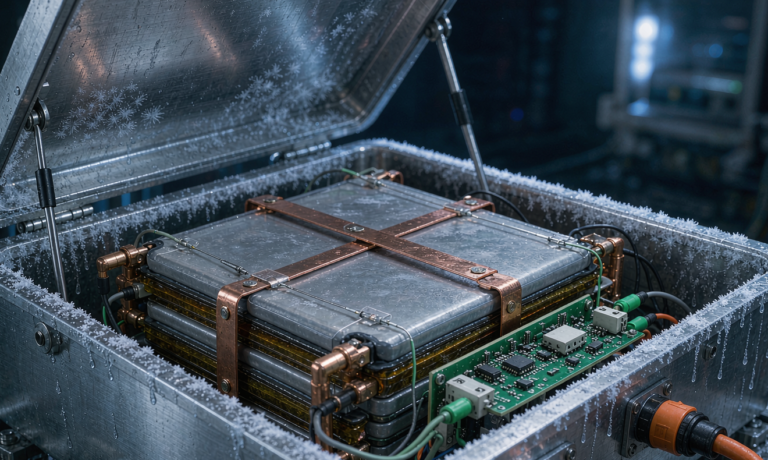
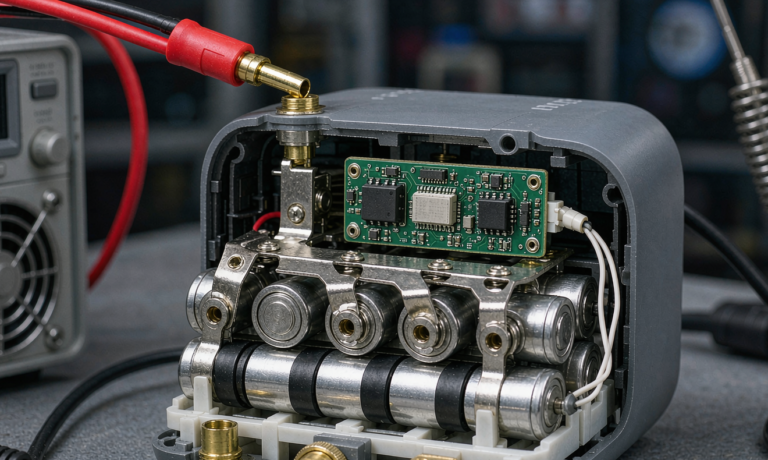
The battery management system is the part that decides whether your pack lasts eight years or two. For a marine trolling bank I require cell-level voltage and temperature monitoring, passive balancing at 50–200 mA with a balance window above 3.40 V per cell, over-current protection set to roughly 1.5–2× continuous rating with a 5–30 second delay so the motor’s inrush does not nuisance-trip, and a low-temperature charge lockout. That last one matters more than most buyers realise: charging LiFePO4 below 0 °C plates metallic lithium on the anode and permanently damages the cell, so the BMS must open the charge MOSFET when the cell temperature sensor reads under about 0–2 °C and close it again above 3–5 °C.
The charge profile for a 12.8 V LFP pack is absorb at 14.2–14.6 V with a termination current of roughly 0.05 C, then either stop or float at 13.4–13.6 V. Do not leave a lead-acid equalisation profile connected — a 15.5 V equalise cycle will push an LFP pack into over-voltage protection and, on a cheap pack without redundant protection, into trouble. Most quality marine chargers now ship an LFP profile; if yours does not, replace it rather than adapt it.
The alternator question comes up on every boat with an outboard. A lithium battery has very low internal resistance — typically 1–3 mΩ for a 100 Ah pack — so when it is discharged and connected directly to a stock alternator, it will pull far more current than the alternator was designed to deliver continuously, and the alternator overheats. In my experience anything above a 60 A alternator feeding more than about 100 Ah of lithium needs a dedicated DC-DC charger sized at 20–50 A, or an alternator with external regulation and a temperature sense on the stator. This is the single most common installation failure I am called to diagnose.
Protection devices also need revisiting. A large LFP pack can deliver several thousand amps into a dead short, so the fuse’s interrupting rating matters as much as its current rating. I specify Class T fuses with roughly 20 kA AIC on the main bank feed, or MRBF terminal fuses rated for 58 V DC where space is tight, rather than the ANL fuses that were fine on a lead bank.
Saltwater, Vibration and Heat: Enclosure and Wiring
Marine is a harsher environment than most people budget for. Three things kill trolling motor packs, in order: water ingress at the cable glands, vibration fatigue at the cell interconnects, and heat in a sealed compartment.
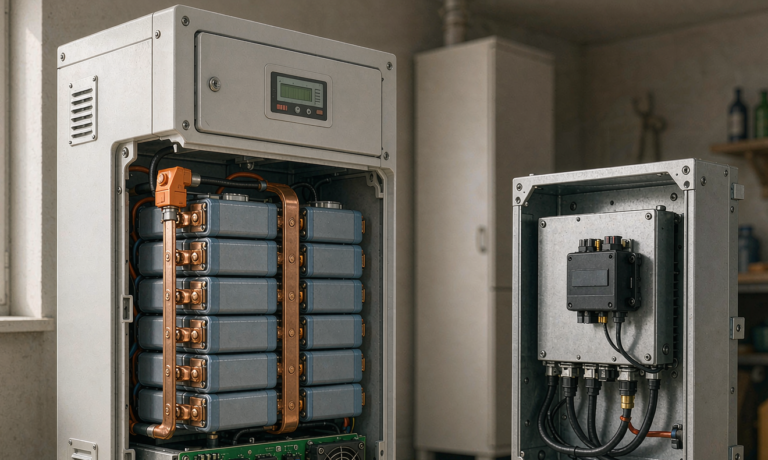
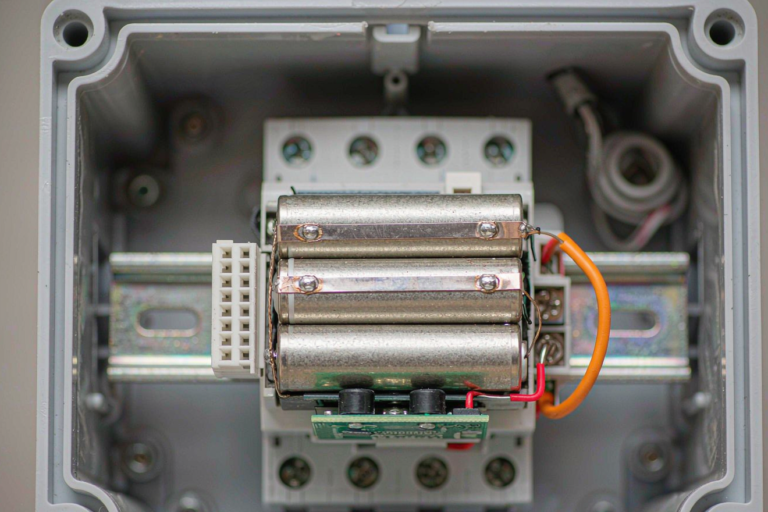
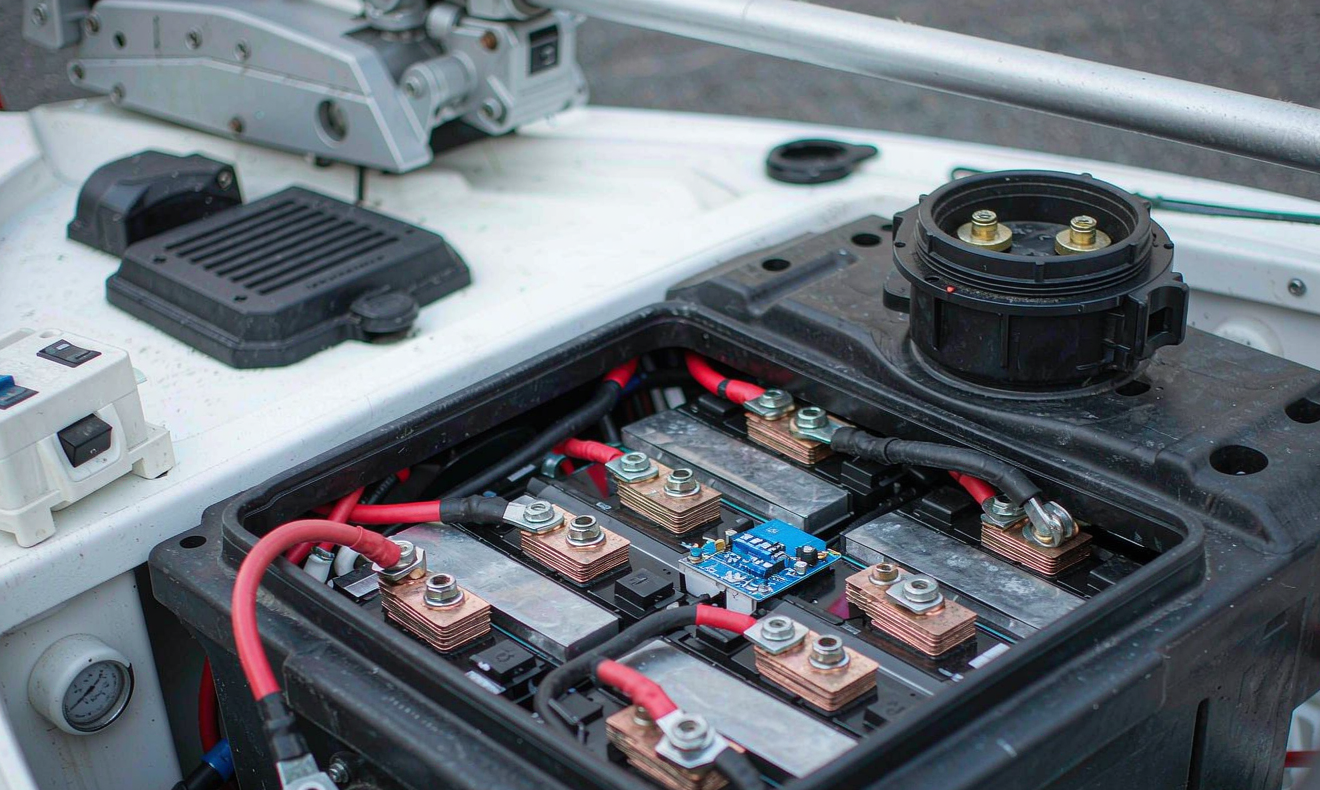
For enclosure I build to IP66 or IP67 with a compression gasket, use marine-grade tinned copper cable — not automotive copper, which wicks corrosion up the strands — and specify 316 stainless hardware with dielectric grease on the terminals. Cable glands get a drip loop. The BMS board gets conformal coating, because salt fog finds everything. Where the customer wants evidence, I test to ASTM B117 salt spray and to the vibration profiles in UN38.3 T3 and the random-vibration approach of SAE J2380.
Vibration is underrated. A bass boat crossing a chop at 60 km/h puts real shock loading into a bow-mounted battery. Good builds use welded or bolted busbars rather than long flexible leads, potting or bracket restraint on the cell stack, and anti-rotation hardware on every terminal. I have opened packs after two hard seasons where the failure was a fatigued nickel strip, not a dead cell.
Heat: LFP charges from 0 to 45 °C and discharges from about −20 to 60 °C, and cycle life degrades roughly by half for every 10 °C rise above 25–30 °C at high state of charge. A black bow locker in July can hit 60 °C internally. Vent the compartment, avoid dark-coloured enclosures where you can, and do not mount the pack against an exhaust-adjacent bulkhead.
Wire sizing follows ABYC E-11 ampacity with a 3% voltage-drop budget. As a worked example: a 50 A trolling motor with a 3 m one-way run is 6 m of conductor round-trip. Three percent of 12.6 V is 0.38 V, so total resistance must be under 7.6 mΩ — that lands you on roughly 6 AWG (about 13 mm²) tinned copper. Overcurrent protection goes on the positive conductor within 178 mm (7 inches) of the battery terminal unless the run is sheathed, and a battery selector or isolator switch rated for the full motor current belongs in the circuit.
Compliance and Safety: ABYC, UN38.3, IEC 62133 and ISO 8846
A marine lithium battery has to satisfy both transport and installation rules. On the transport side, every cell and pack we ship clears UN38.3 (the T1–T8 test sequence, including altitude, thermal cycling, vibration, shock, external short circuit, impact and overcharge), and the cells carry IEC 62133-2 certification. For larger stationary-style banks, IEC 62619 is the relevant safety standard. You should be able to request the UN38.3 test summary from any supplier; if they cannot produce one, that tells you what you need to know.
On the installation side, ABYC A-31 covers battery installation in the US market: the battery must be restrained against movement in any direction, installed in a ventilated location, and protected against accidental contact with metal objects. ABYC E-11 covers the DC electrical system, including conductor sizing, overcurrent protection and bonding. Where a battery is installed in a compartment that may contain fuel vapour — an engine room or a livewell-adjacent space with a petrol system — ISO 8846 ignition-protection testing applies, and the pack must be certified ignition-protected rather than merely sealed.
I also recommend ABYC TE-13 or equivalent lithium-specific guidance for the charging system, and a Marine UL listing (UL 1973 for the battery, UL 1243 or the relevant marine standard for the charger) where the vessel is insured commercially. Insurers and surveyors increasingly ask for these by name, and retrofitting documentation after a survey failure is more expensive than building to it from the start.
Commissioning and Maintenance Checklist
This is the five-step protocol I run on every trolling motor bank before it goes on the water:
- Insulation and isolation check. With the pack disconnected, measure resistance from each terminal to the case at 500 V DC; anything under 1 MΩ means moisture is inside and the pack does not ship.
- Cell balance verification. Charge to full, rest two hours, then confirm the cell delta is under 30 mV. A pack that arrives at 80 mV delta will not improve in service.
- Capacity confirmation. A 0.2 C discharge to the BMS low-voltage cut-off should deliver at least 95% of the nameplate rating at 25 °C.
- Protection trip test. Verify over-current, over-voltage, under-voltage and low-temperature charge lockout actually open the contactor or MOSFETs. Do this on the bench, not on the lake.
- Installed-system test. With the motor running at full thrust, measure voltage at the motor terminals. If you see more than 3% drop from the battery terminal, the cable run or a connection is undersized.
After that, maintenance is genuinely light. I ask customers to check terminal torque once a season, inspect glands and seals for cracking, and pull a Bluetooth or shunt-based state-of-charge log every few months to confirm balancing is keeping up. Store the boat with the pack at 40–60% state of charge rather than full, and if the boat is out of the water for winter, disconnect the pack or put it on a maintenance charger with a true LFP storage mode.
Frequently Asked Questions
Can I replace my lead-acid trolling batteries with a lithium battery without changing the motor?
In most cases yes. A 12.8 V LiFePO4 pack is a drop-in for a 12 V motor, and 25.6 V and 38.4 V packs replace 24 V and 36 V series lead banks. Check that the motor’s peak current is within the pack’s continuous discharge rating with margin — I want at least 25% headroom — and confirm the charger has an LFP profile. Motors with regenerative braking on GPS spot-lock can push current back into the pack, so confirm the BMS or motor manufacturer allows it.
How many amp-hours do I need for a full day of fishing?
Work from average draw, not peak. A 55 lb, 12 V motor averages roughly 20 A at a 40% duty cycle, so a 100 Ah pack with 90 Ah usable gives about 4.5 hours and a 150 Ah pack about 7 hours. Add 20–30% if you fish windy water or run a spot-lock-heavy pattern, and keep a 10–15% reserve so the BMS never trips at the far end of the lake.
Is it safe to charge a lithium battery from my outboard’s alternator?
Only with the right hardware in between. A discharged LFP pack has very low internal resistance and will pull more current than a stock alternator can deliver continuously, which overheats and eventually destroys it. Fit a DC-DC charger sized at 20–50 A, or an externally regulated alternator with stator temperature sensing. Above roughly 100 Ah of lithium on a 60 A alternator, direct connection is not acceptable.
What certifications should a marine lithium battery have?
At minimum a UN38.3 test summary and IEC 62133-2 for the cells, IEC 62619 for larger packs, IP66 or IP67 on the enclosure, and for US installations compliance with ABYC A-31 and ABYC E-11. If the pack lives anywhere near fuel vapour, ask for ISO 8846 ignition-protection certification. UL 1973 is increasingly requested by insurers for commercial vessels.
How long will a LiFePO4 trolling motor battery last in saltwater service?
Specified correctly, 3,000–6,000 cycles to 80% capacity at 0.5 C and 25 °C, which is eight to twelve seasons for a serious weekend angler and four to six for a full-time guide. In salt service the limiting factor is almost never the cells — it is connector corrosion, gland leakage, or vibration fatigue at the interconnects. Tinned copper, 316 stainless, conformal-coated electronics and solid busbar restraint are what actually deliver that life.
Can I charge the pack in freezing weather?
Not below 0 °C without protection. Charging LiFePO4 below freezing plates lithium metal on the anode and causes permanent capacity loss and a real safety risk. Every marine pack I build has a low-temperature charge lockout that opens the charge path at about 0–2 °C and re-enables above 3–5 °C, and some include a small self-heating film that brings the cells up to temperature before accepting charge. Discharging down to about −20 °C is fine; charging is not.
Do I need a separate starting battery?
Almost always yes. Cranking an outboard demands 300–600 A for a second or two, and sizing a lithium battery to that surge is expensive and wastes capacity. Keep a dedicated AGM or a small high-rate lithium start battery for the engine and the electronics, and let the deep-cycle LFP bank do what it is good at. A 20–40 A DC-DC charger or an isolator keeps both charged without connecting them directly.