Lithium Battery for Power Tools
As Karl Huang, Senior lithium battery Engineer at Horizon Power, I have spent the better part of twelve years on the factory floor and in the test lab watching lithium packs either thrive or melt under one of the harshest duty cycles in all of consumer and industrial electronics: the cordless power tool. A power drill, impact driver, or angle grinder is not a gentle load. It is a high-drain, thermally abusive, mechanically violent environment that will expose every weakness in a battery design within the first hundred charge cycles. If you are specifying or sourcing a lithium battery for power tools, the margin between “good enough” and “field failure” is narrower than most buyers realize.
In this guide I will walk through exactly how we engineer a high-drain lithium pack for cordless tools — from C-rating math and cell chemistry selection to thermal design, pack architecture, and the certification stack that keeps a jobsite safe and legal. These are lessons learned from failed teardowns, warranty returns, and more than a few burned test fixtures.
Why Power Tools Are a Brutal Test for Lithium Cells
The defining challenge of a power-tool battery is pulsed, peaky current. Unlike a laptop that sips a steady 2–3 A, an 18 V cordless drill can pull 20–40 A the instant the trigger is squeezed, and a brushless angle grinder can demand 50 A or more under a stall condition. On a 2.0 Ah pack, that is a discharge rate of 20C–25C. On a 4.0 Ah pack running a hedge trimmer, you still routinely see 10C–15C sustained bursts. Very few consumer applications stress cells this hard, this often.
High C-rate discharge does three unpleasant things at once. It drops the terminal voltage through internal resistance, it raises cell temperature fast, and it accelerates capacity fade if the pack is not built to shed heat. In my lab I have watched a poorly designed 18650 pack lose 18% of its capacity in just 150 heavy cycles because the spot welds heated up and the BMS let the cells run hot. A properly engineered lithium battery pack for the same tool lost only 9% over 400 cycles. The chemistry was identical; the engineering was not.
Sizing for High-Drain: C-Rating and What Your Tools Actually Demand
The first number I look at is the cell’s continuous discharge rating, expressed as a C-rate. A 2.5 Ah cell rated for 20C continuous can deliver 50 A. But continuous rating is not the same as pulse rating, and power tools live in the pulse world. A quality high-drain 21700 cell — say a 4.0–5.0 Ah INR-format cell — will typically support 30A continuous and 45–60A pulse for 10–30 seconds. That is the kind of headroom a circular saw needs when you bind the blade.
When we build a custom battery solution for a tool OEM, we size the pack so that peak tool current lands at no more than 70–80% of the pack’s rated pulse capability. That 20–30% buffer is what prevents voltage sag from tripping the tool’s under-voltage cutoff mid-cut and what keeps cell temperature in the safe band. I also insist on matching configuration to load: a 5S2P arrangement of 4.0 Ah cells gives you 14.8 V nominal and 8.0 Ah, while a 5S1P gives the same voltage at half the capacity but twice the per-cell current — wrong choice for a high-drain tool.
- Calculate peak current first. Read the tool motor’s locked-rotor draw, not its nameplate average.
- Divide by cells in parallel to get per-cell current, then compare against the cell’s pulse rating with margin.
- Check voltage sag. At high C-rate, IR dominates. Pick cells with low AC impedance (<25 mΩ fresh) for snappy trigger response.
Cell Chemistry Choices — NCM vs LFP on the Jobsite
For power tools, the two realistic chemistries are nickel-cobalt-manganese (NCM, a lithium-ion variant) and lithium iron phosphate (LFP). NCM wins on energy density — typically 200–250 Wh/kg versus LFP’s 140–170 Wh/kg — which is why almost every mainstream 18 V and 20 V cordless platform uses NCM. You get more runtime in the same pack weight, and weight is everything when a contractor is holding a tool overhead for eight hours.
LFP, by contrast, is the safer and longer-lived option. It is intrinsically more thermally stable (no exothermic release until well above 200 °C), tolerates shallow abuse better, and routinely delivers 2,000–3,000 cycles versus NCM’s 500–1,000 in heavy service. For stationary or cart-mounted tools — a bench grinder, a jobsite radio, a shop vacuum — I often recommend an LFP battery because the weight penalty does not matter and the cycle life pays for itself. For handheld tools where every gram counts, NCM remains king. A BMS solution tuned to the chemistry is non-negotiable either way: LFP needs tighter balancing because of its flat voltage curve, while NCM needs aggressive over-voltage and temperature protection.
Thermal Management Under Sustained Load
Heat is the silent killer of power-tool packs. Every watt of I²R loss inside the pack becomes heat, and at 40 A through even low-resistance connections, that adds up fast. In a sealed tool pack with no风扇, the only path to the environment is conduction through the casing and radiation — which is why pack layout matters more than people think.
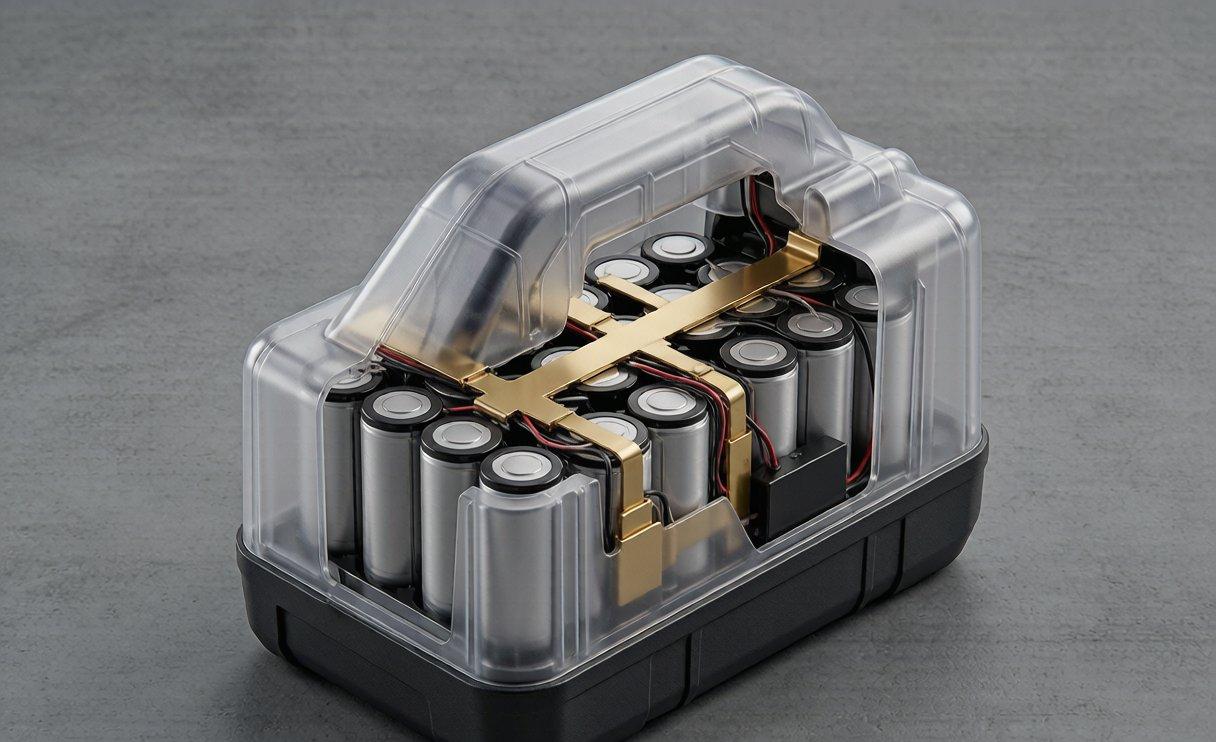
Our thermal rules of thumb: keep cell-to-cell spacing for lateral conduction, bond the cell group to an aluminum heat spreader where the tool design allows it, and never bury the BMS board in the hottest corner. I have measured a 14 °C gradient across a poorly laid-out pack; the hot cells aged three times faster than the cool ones, and the pack drifted out of balance. We also derate the pack by ambient temperature — above 45 °C cell surface, the BMS steps current down rather than letting it cook. For cold-climate work below 0 °C, we add a soft pre-heat or simply limit discharge until the pack warms from its own losses, because lithium plating on the anode is permanent damage you cannot reverse.
Pack Architecture, Welding, and BMS Protection
The cells are only as good as the pack around them. For cylindrical cells we use ultrasonic or capacitor-discharge spot welding with pure-nickel or nickel-plated steel strips — never solder directly to the can, which anneals the steel and raises resistance. Busbar cross-section is sized for the peak current with a 2× safety factor; I have seen thin nickel strips glow red on a stall test, and that is a fire waiting to happen.
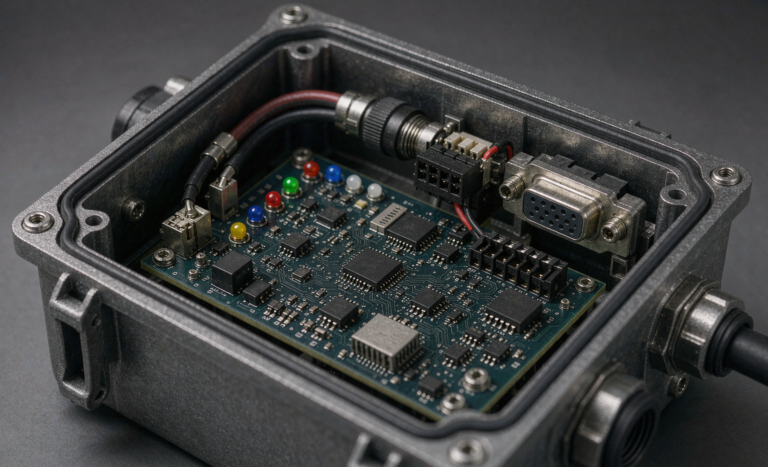
The electronics are where a consumer pack and an industrial pack diverge. A real lithium-ion battery pack for tools needs a BMS that does:
- Over-current and short-circuit protection with sub-millisecond response on the MOSFET stage.
- Per-cell voltage monitoring for both charge and discharge cutoffs (typically 4.20 V charge, 2.50 V discharge for NCM).
- Balance charging — passive balancing is fine for tools, active balancing is overkill at this cost point.
- Temperature sensing with at least one NTC on the cell group and one on the FETs.
- Fuel gauging via coulomb counting plus voltage modeling, so the tool shows an honest remaining runtime.
We pot the BMS in a thin layer of conformal coating for humidity resistance and glue the sense wires so vibration — the other killer on a jobsite — cannot work them loose. A lithium battery manufacturer that skips the vibration test is gambling with your warranty returns.
Certification and Field Safety
No power-tool pack leaves our building without the certification stack the market requires. The foundation is UN38.3, the UN transportation test that proves the cells and pack survive altitude simulation, thermal, vibration, shock, external short, impact, and forced-discharge testing — mandatory before the battery can legally ship by air, sea, or road. On top of that, IEC 62133 (with its 62133-2 amendment for lithium systems) governs the safety of portable secondary cells and batteries, covering short-circuit, overcharge, and forced-discharge abuse. For the pack as a tool subsystem we align with IEC 62841 (the standard for handheld motor-operated electric tools) and UL 2595 for the battery system used in household and similar electrical appliances.
In the field, ingress protection matters. A pack rated IP54 or IP65 shrugs off the dust and splash that would corrode a bare terminal block in a season. We also label every pack with its Watt-hour rating, because that number — not the amp-hour — is what Customs and airline crews use to decide whether the battery is freely transportable (under 100 Wh), requires airline approval (100–160 Wh), or is simply forbidden (over 160 Wh).
From Prototype to Production: Commissioning a Power-Tool Pack
When a client comes to us for a custom battery solution for a new tool platform, the path is predictable. We start with the tool’s locked-rotor current and duty cycle, then select cells and configuration against the 70–80% pulse margin rule. EVT validates the pack in the actual tool; DVT stresses it on a cycle bench at 45 °C; PVT confirms the production line welds consistently within impedance limits. Only after the three gates do we tool up volume production.
One detail I never compromise on: every pack ships with a state-of-health record. We log the formation-cycle capacity and internal resistance at the factory, so when a pack comes back under warranty we can tell in sixty seconds whether it was a manufacturing defect or user abuse (like leaving it discharged in a freezing truck). That data loop is what lets a lithium battery pack program actually improve instead of repeating the same failures.
Conclusion
A lithium battery for power tools is deceptively simple to draw and deceptively hard to get right. Sizing for real pulse current, picking the right chemistry for the job, shedding heat, welding cleanly, and protecting with a competent BMS — miss any one of those and the pack fails where it matters most, in a contractor’s hands on a deadline. Get them all right, and you build a pack that outlasts the tool around it. That is the standard we hold every Horizon Power pack to, and it is the difference between a battery that gets returned and one that gets recommended.
Frequently Asked Questions
What C-rating do I need for a cordless power tool battery?
You need a pack whose pulse rating exceeds the tool’s peak current by at least 20–30%. For an 18 V drill pulling 30 A on a 2.0 Ah pack, that is roughly 15C continuous and 25C+ pulse; always size from locked-rotor current, not the average nameplate draw.
Is LFP or NCM better for power tools?
NCM wins for handheld tools because of its higher energy density and lower weight; LFP wins for stationary or cart-mounted tools because of its safety margin and 2,000–3,000-cycle life. Choose by whether pack weight or pack lifespan drives your total cost.
Why does my tool battery die so fast in the cold?
Below 0 °C, lithium cells cannot accept or deliver current efficiently and risk plating lithium on the anode, which is permanent capacity loss. A good pack limits discharge in the cold or uses its own heat to warm up before demanding full current.
Do power tool batteries need UN38.3 and IEC 62133?
Yes. UN38.3 is required for legal transport of the cells and pack, and IEC 62133 governs portable secondary-cell safety (short-circuit, overcharge, forced discharge). Without both, the pack cannot be shipped or sold compliantly in most markets.
How many cycles should a quality power tool battery last?
A well-engineered NCM pack in heavy service should deliver 500–1,000 cycles to 80% capacity; an LFP pack should deliver 2,000–3,000. Lifespan depends heavily on thermal design, depth of discharge, and whether the BMS actually protects the cells.
Can I use the same BMS for NCM and LFP packs?
Not safely. NCM charges to 4.20 V per cell while LFP charges to 3.65 V, and their cutoff and balance thresholds differ. The BMS must be programmed and the hardware sized for the specific chemistry, or you risk overcharge or chronic imbalance.