Lithium Battery Integration for Mobility Devices
I have spent most of the last four years integrating lithium packs into vehicles that carry people who cannot walk: powered wheelchairs, mobility scooters, and the growing family of light electric vehicles used inside airports, hospitals, campuses and retirement communities. On paper it looks like a simple swap. Two 12 V lead-acid blocks come out, a lithium battery pack goes in, the user gains range and the fleet manager gains five years of service life. In the workshop it is rarely simple, and the failures are almost never about the electrochemistry. They are about the four interfaces that surround the cells: the envelope it has to fit, the connector it has to mate with, the data the controller expects, and the human being who has to service it at 6 a.m.
This article is a working engineer’s guide to lithium battery integration for mobility devices. It covers powered wheelchairs, mobility scooters, and the light personal electric vehicles that share the same architecture. It is written for the people specifying and commissioning these conversions, not for marketing. Where I quote a number, it is a number I have measured or a number you can check against a published standard.
Start with the duty cycle, not the datasheet
The first question I ask a client is never “how many amp-hours do you want?” It is “how far does the device actually travel in a day, and over what surface?” For a powered wheelchair with a 100 kg occupant on flat indoor flooring, I measure 15-25 Wh/km. Take the same chair outside, over cracked paving, kerb cuts, a 1:12 ramp and the occasional gravel path, and consumption rises to 30-45 Wh/km. Tyre pressure, caster condition and the user’s own driving style move those figures by more than the difference between cell grades.
Most active users of a powered chair travel 3-5 km per day, which puts realistic daily consumption at 100-200 Wh. That number matters because of what the original equipment usually is: two 12 V 50 Ah AGM blocks in series-parallel, roughly 1200 Wh nameplate, of which you can honestly use about half before you start destroying the plates. That is 600 Wh usable in a 33 kg package.
A 4S LFP block of the same nominal amp-hour rating is 12.8 V, 1280 Wh nameplate, and you can discharge it to 10-20% SoC without meaningful cycle-life penalty. That is about 1000 Wh usable in roughly 7 kg. So the honest pitch for lithium in this application is not simply “lighter” — it is 1.6 to 1.7 times the usable energy at less than a quarter of the mass, which then cascades into everything else: less work for the user pushing a chair manually when the pack is flat, less strain on attendants lifting packs, less wear on the chair’s own structure and castors.
When you can, validate the duty cycle against ISO 7176-4, the standard test for energy consumption and theoretical distance range of powered wheelchairs and scooters. It is a dynamometer cycle, so it will not reproduce your user’s gravel path, but it gives a defensible baseline that a procurement department and an insurer can both accept.
The lead-acid to lithium migration: five traps that catch everyone
Almost every integration job I take on is a retrofit, and the retrofit path has five well-worn failure modes. Every one of them has cost me or a client a conversion.
1. The existing charger was designed for a different animal
A lead-acid charger for a 12 V block runs an absorption stage at 14.4-14.7 V and a float stage at 13.5-13.8 V. A 4S LFP pack tops out at 3.65 V per cell, 14.6 V for the pack, so the absorption voltage is awkwardly close to the lithium ceiling rather than comfortably below it. A 3S NCM pack tops out at 12.6 V, which a 14.4 V absorption stage will push straight past. This is the single most important chemistry decision in a retrofit: 4S LFP is the only common configuration that survives contact with a legacy lead-acid charger, and even then it survives badly.
The details that bite: temperature compensation. Lead-acid chargers raise absorption voltage by roughly 3-5 mV per cell per °C as temperature falls, which for a 12 V block is 18-30 mV/°C. Between 25 °C and 0 °C that pushes the charger toward 15.0-15.2 V, which trips the BMS over-voltage protection on a cold pack. Then there is equalisation mode: some chargers deliberately go to 15-16 V for a timed period to desulphate plates. On a lithium pack that is a BMS disconnect at best. And pulse or “desulphation” modes inject voltage spikes the BMS was never characterised for.
2. Voltage is a terrible fuel gauge for LFP
Lead-acid sags visibly under load, and every wheelchair controller on the market was calibrated against that sag. Its low-voltage rollback — the behaviour where the chair slows down to warn you before it stops — triggers on a voltage that corresponds to a lead-acid pack at 20-30% SoC. An LFP pack at 20% SoC sits at almost exactly the same terminal voltage as LFP at 80% SoC, because the LFP discharge curve is famously flat between about 3.2 and 3.3 V per cell.
The result is the complaint I hear most often from first-time converters: “the gauge read full and then the chair just stopped.” The controller never saw the warning, because there was no warning to see. The fix is data, not cells: a coulomb-counting gauge that reports state of charge over the controller’s own bus, and a recalibration of the rollback thresholds against the lithium discharge curve. If a device cannot be recalibrated, I derate the pack deliberately and program the BMS protection thresholds to open early enough that the controller’s own rollback has already fired.
3. Regenerative braking needs somewhere to go
Many power chairs and most scooters return braking energy to the pack. That current has to be accepted. At high state of charge, at low temperature, or the moment after a BMS has opened its charge MOSFET, that energy has nowhere to go and the DC bus voltage rises until the controller faults — which is a genuinely unpleasant failure to have on a slope.
So the integration requirement is this: the BMS and the motor controller must be designed together and must agree on what happens when regeneration arrives at a full or cold pack. In practice that means either a controller that tapers regen current as a function of SoC and temperature, or a BMS that admits a limited charge current regardless of its protection state, plus a dump path for the remainder.
4. A lighter pack is not retained by an old strap
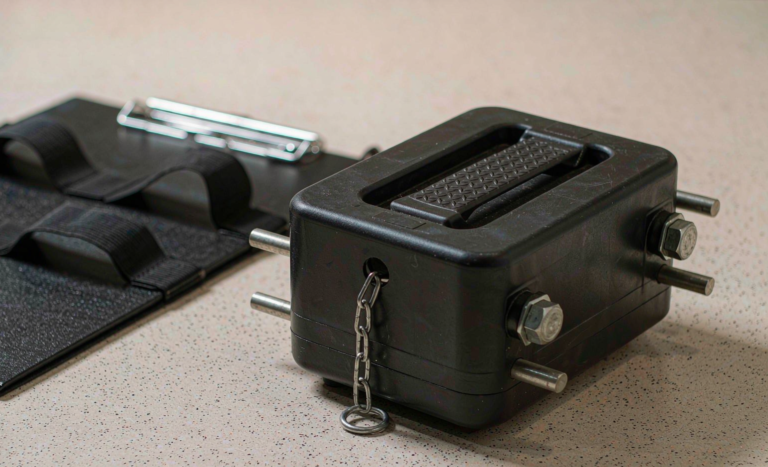
This one is embarrassing because it is so simple. The original hold-down was sized for 33 kg of lead. The lithium battery pack weighs 7 kg, sits higher in the tray, and has a low-friction plastic or aluminium case. On the first kerb strike it slides. I have seen a pack ejected from an under-seat tray at walking pace, and I have seen one work loose enough to chafe its own harness against a frame tube. If you convert, re-engineer the retention: positive location, anti-rotation, and a strap or clamp that carries the full shock load defined in ISO 7176-8.
5. Cold charging is a hard stop, not a performance note
Charging a graphite-anode lithium ion cell below 0 °C plates lithium metal on the anode. That capacity loss is permanent, and the plated metal becomes a dendrite nucleation site for the rest of the pack’s life. No BMS setting undoes it. The consequence for mobility devices is practical and seasonal: a scooter parked in an unheated garage overnight cannot be charged in the morning, and the correct behaviour — the pack refusing charge until it has warmed — looks exactly like a fault to the user. Say so on the label, say it in the handover, and where the duty requires it, specify a pack with an internal heater and a charge interlock.
Mechanical integration: envelope, mounting and the connector you can actually reach
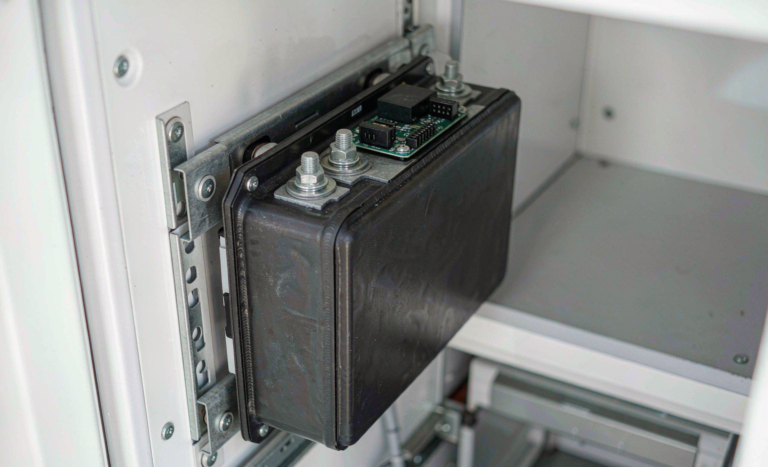
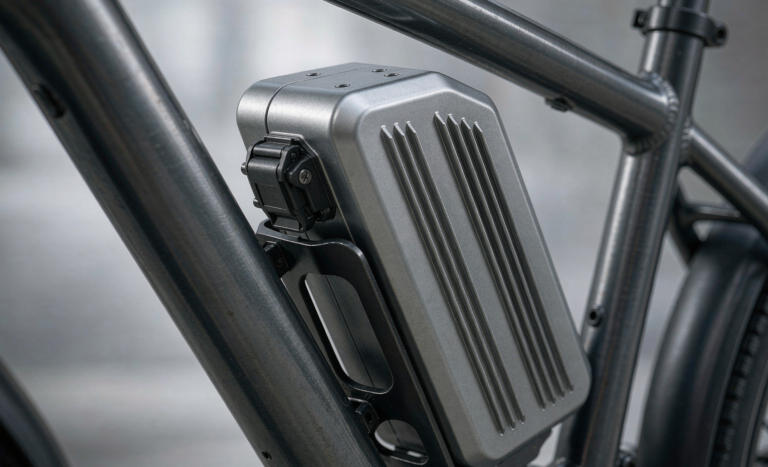
Mobility device battery compartments are dictated by the chassis, not by the battery. Under-seat trays, rear pannier boxes, and the Group 24 / U1 / NF22 footprints that legacy lead-acid established years ago. A drop-in block that matches the footprint but not the terminal position is not a drop-in; every centimetre of adapter harness is a centimetre of added resistance, added failure point and added assembly time.
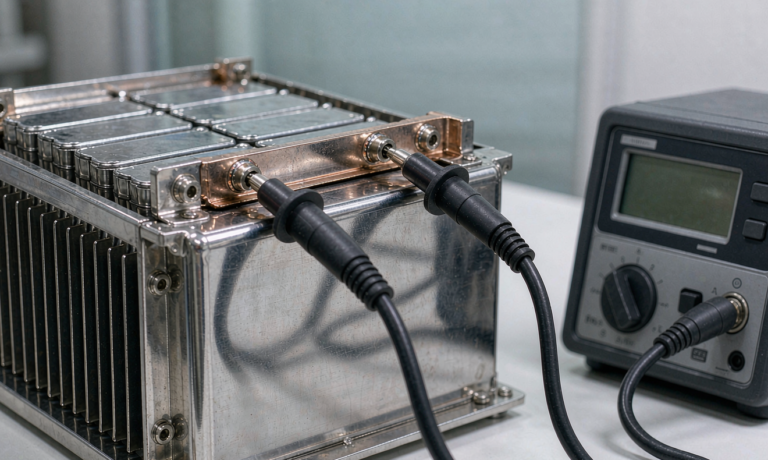
Shock and vibration are the dominant mechanical loads. Powered chairs drop off kerbs regularly; ISO 7176-8 defines static, impact and fatigue strength testing for exactly this, and a pack mount should be validated against it rather than against a drawing. Cells inside the pack need compression and anti-vibration support; the enclosure needs a strain relief that takes the harness load so the connector pins do not; and the harness must never be the shortest path for the pack’s weight.
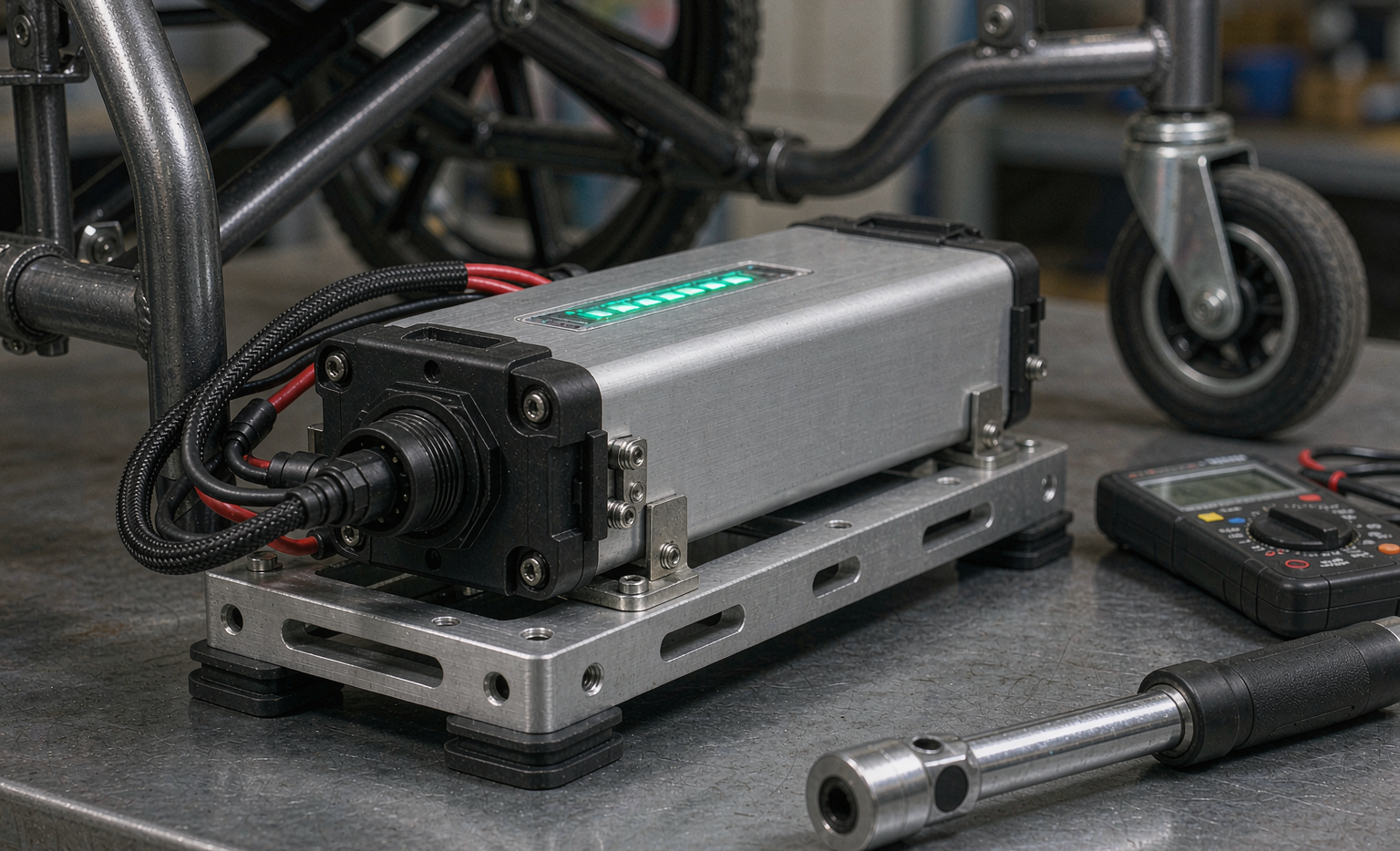
Serviceability is where cheap conversions get expensive. Ask three questions before signing off a design: can a technician reach the service disconnect without removing the seat? Can the connector be mated and unmated by a gloved hand that cannot see it? Is the state-of-charge indicator visible to the user while seated? I have watched a skilled technician spend 40 minutes on a pack swap that should have taken four, purely because the connector faced the frame.
The data interface: why a “dumb” drop-in can make a good chair worse
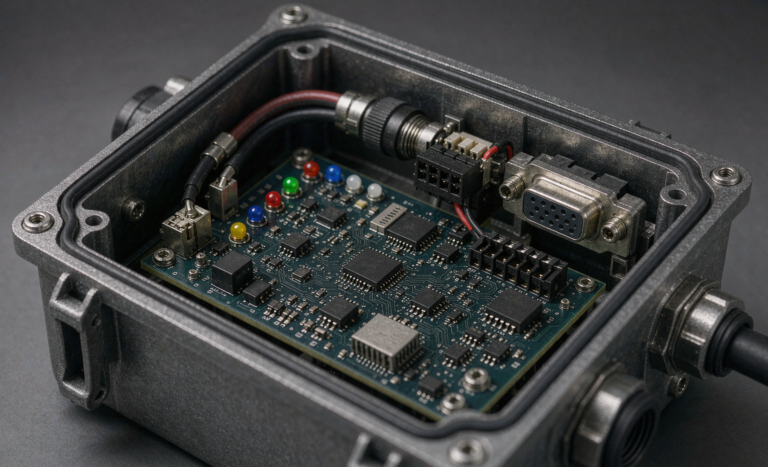
There are two families of lithium retrofit for mobility devices. The first is a sealed 12 V block with an internal BMS and no external communication — genuinely plug-and-play, genuinely cheap, and genuinely blind. The second exposes state of charge, fault codes and cell data to the device, usually over CAN, sometimes over a simple analogue or resistor-coded line.
I recommend the second for anything used by a person who depends on the device, for the same reason I recommend telemetry on a commercial drone battery fleet: a pack with no data history cannot be diagnosed, and a pack that cannot be diagnosed gets replaced whole when a single cell is at fault. The data requirements I write into a specification are modest: pack current and voltage, minimum and maximum cell voltage, at least two temperature points, state of charge, and fault codes with a parameter snapshot at the moment of the fault. One hertz is plenty; 0.2 Hz is survivable.
That log is what lets you distinguish a real pack failure from the far more common causes of a “dead battery” call: a charger that has drifted, a connector that has developed millivolts of drop, or a user whose daily route now includes a hill it did not include last year.
Charging, connectors and the fleet charging room
Off-board chargers are the norm, and the connectors are a genuine hazard in this industry. Mobility chargers have historically used XLR-style connectors with pinouts that differ between manufacturers — some with the centre pin positive, some negative, some with a temperature-sensor pin. Mating the wrong charger can present reverse polarity or double voltage to a pack. If your fleet has more than one device generation, standardise on a keyed, polarity-guarded connector such as the Anderson SB series, colour-coded and mechanically incompatible across voltages. It is a small bill that prevents the most expensive class of warranty claim.
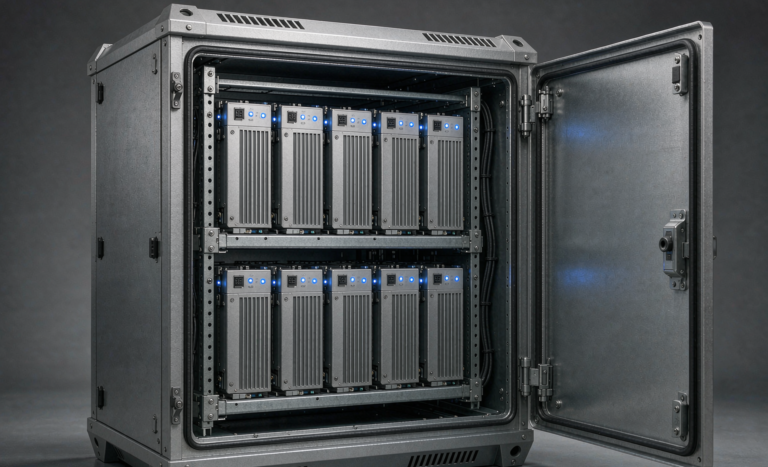
For fleets — airports and hospitals running dozens of chairs — the charging room is the real project. Twenty chairs charging overnight at 8 A and 24 V is not a large electrical load on paper, roughly 4 kW, but it is concentrated, it runs in an occupied building, and it concentrates every thermal event in the fleet into one room. My rules: non-combustible surfaces, spacing between packs, no stacking of chargers, ventilation that does not depend on a door being propped open, and a charging schedule that never charges a pack that arrived cold until it has been given time to warm. Water ingress matters for outdoor scooters: specify IP54 as a floor and IP65 wherever the device is washed or left in the rain, per IEC 60529.
Keep a spare pool of 5-10% of fleet size in the first year and 3-5% afterwards. Store spares at 30-50% SoC in a cool room and rotate them first-in-first-out, because spares age on the calendar while they wait. That is the same rule we apply to spare packs for drone fleets, and it is the one fleet managers always skip.
Air travel, shipping and the regulatory stack
Mobility devices fly. A wheelchair user’s pack has to clear the same rules that any lithium battery clears, and this is where a well-built pack with no documentation fails. The requirements I design to, and you should verify against the current edition before shipping, are: a watt-hour rating permanently marked on the pack; terminals protected against short circuit, which effectively means a recessed connector or an insulating cover; a pack that can be removed if the device does not protect the installed battery; and a UN 38.3 test summary that can be produced on request. The test summary has been mandatory to make available since January 2020, and airlines and freight handlers do ask for it. Cells and packs also need IEC 62133-2 compliance.
For the passenger-facing limits, current FAA and IATA guidance for mobility aids with lithium ion batteries allows an installed battery up to 300 Wh, or two batteries each up to 160 Wh, with airline approval; spare batteries are generally limited to 160 Wh, with two spares permitted subject to approval. Those numbers are a design constraint, not a formality — they are why a 24 V 60 Ah pack (1440 Wh) is fine for a scooter that never leaves the county and completely unusable for a chair that flies four times a year. When we ship standalone packs by air, the state-of-charge limit of 30% applies under IATA for lithium ion battery consignments shipped alone, which is the same rule my team handles every week for drone battery consignments.
The rest of the stack, depending on the product and market: ISO 7176-4 for energy consumption and range, ISO 7176-8 for strength, ISO 7176-9 for climatic testing, ISO 7176-14 for power and control systems, ISO 7176-21 for electromagnetic compatibility. If the device is a medical electrical device, IEC 60601-1 applies and its clause 15.4.3 on secondary lithium batteries becomes a design requirement rather than a recommendation. For e-scooters and light personal electric vehicles, look at EN 17128 in Europe and UL 2272 or ANSI/CAN/UL 2849 in North America. Choose a lithium battery manufacturer who can produce the whole file, not a cell datasheet and a promise.
Validating a conversion: the 90-day instrumented pilot
I never take a mobility conversion straight to full fleet. Ten devices, one shift pattern, 90 days, with logging. Before the first day, define the kill criteria in writing, because a pilot without pre-agreed failure conditions always passes — the person running it is the person who argued for it.
Day zero baselines, five numbers, all as absolutes rather than judgements: controlled discharge capacity as a percentage of nameplate, a standardised DCIR pulse measurement (rest time, ambient temperature, SoC window, current and duration all written into the procedure, because a trend line built on unstandardised measurements is fiction), cell voltage spread at rest in millivolts, insulation resistance from each pole to chassis, and a torque audit with paint marks on every fastener.
Then read the pilot against thresholds. Capacity within ±3% of the model — and be suspicious of a pack that beats the model, which is usually a gauge drifting rather than a cell performing. DCIR at 1.15 times baseline triggers investigation, 1.3 times triggers planned replacement, 1.5 times triggers retirement. Cell spread recorded in millivolts, never as “balanced” or “unbalanced”. Unplanned battery-related stoppages below 0.5 per thousand device hours and, importantly, trending downward — flat is a systemic problem, not a bedding-in period.
Above all, keep the temperature-time histogram. Arrhenius behaviour means calendar ageing roughly doubles for every 10 K rise, so the hottest two hundred hours in a pack’s life cost more than the coolest two thousand. It is the most valuable artefact of any pilot and the one almost nobody keeps.
Lifecycle economics for fleets
Run the arithmetic honestly and the decision is rarely close. Take an airport fleet of 40 chairs. AGM pairs cost $320-400 a set and, in daily rental duty with users who arrive with unknown charge states, last 12-18 months. Over eight years that is six sets, roughly $2,100-2,400 per chair, plus six service visits at about 45 minutes each. An LFP pack at $900-1,300 plus a compatible charger at $150-250 delivers 2,000-4,000 cycles to 80% of original capacity at 80% depth of discharge, which in this duty is eight years or more, with one or two service visits. Then add the soft returns: fewer lifting injuries, less chair wear, and fewer users stranded at the far end of a terminal.
The end-of-life story is worth planning for too. A pack retired at 75-80% of beginning-of-life capacity with a complete service history is a genuinely useful object: home energy storage at 0.2C is the natural second home for it. A pack with no history is a disposal cost. Second life is won or lost on documentation, not electrochemistry.
When to specify a custom pack
Catalogue blocks cover most of this market, and I recommend them whenever they genuinely fit. When they do not, battery pack design stops being an exercise in amp-hours and becomes an exercise in interfaces, and the battery solution has to be engineered against the service reality rather than selected from a table. Specify custom when two or more of these are true — that is the point at which a custom battery solution stops being a luxury and becomes the cheapest option over the service life: the envelope or mounting points are dictated by the chassis; continuous or peak C-rate exceeds what the catalogue part can shed as heat; the temperature window is permanently outside the catalogue range; the environment is corrosive, wet or dusty enough to need a specific ingress rating; the BMS must talk to a specific device controller or fleet management system; or serviceability requirements — module weight, handle geometry, connector orientation, reaching the disconnect without dismantling anything else — are part of the product definition.
On chemistry, my default for mobility is an LFP battery: cost per kWh, cycle life, supply chain maturity, and a voltage window that tolerates the legacy chargers still in the field. NCM earns its place where volume is genuinely constrained and a 20-30% energy gain buys a wheelchair its full range in a package that fits an existing tray. A semi-solid state battery is the right answer for the small set of devices where volume really is the binding constraint, with the caveat that its stack pressure has to be maintained by the pack structure for years, and that its cold-soak power sensitivity makes a heater and charge interlock mandatory rather than optional. A sodium ion battery is the wrong answer for a moving platform — its energy density penalty is free in a fixed plant and expensive in something that has to carry a person — though it is a serious candidate for the fixed buffer in a fleet charging room.
Two clauses belong in every supply contract: the number of years the module and its firmware will be supported, and the last-time-buy notification period. The worst outcome in this industry is not a pack failure; it is waiting eleven weeks for a module that was discontinued, for a chair that carries a person.
FAQ
Can I keep my existing lead-acid charger when I convert to lithium?
Usually not safely. A 4S LFP pack can tolerate a 14.4 V absorption stage, but the charger’s temperature compensation can push it past 15 V in a cold room, and any equalisation or desulphation mode will trip the BMS or damage it. Budget for a lithium-profile charger; it is a small fraction of the conversion cost and it removes the largest single failure mode.
Why does my gauge read full and then the chair stops?
Because LFP holds an almost constant voltage between roughly 20% and 80% state of charge, and your controller’s low-voltage rollback was calibrated against lead-acid sag. There is no voltage warning to detect. The fix is a coulomb-counting gauge reporting SoC to the controller, plus recalibrated rollback thresholds.
How cold is too cold, for charging and for discharging?
Discharging is a performance question: expect 20-30% capacity loss at -10 °C and roughly double-to-triple the internal resistance versus 25 °C, and it recovers when the pack warms. Charging below 0 °C is a hard prohibition, because it plates metallic lithium permanently and creates dendrite nuclei. A pack that refuses to charge on a cold morning is protecting itself.
Can my converted wheelchair still fly?
Generally yes, within the watt-hour limits in current FAA and IATA guidance for mobility aids — an installed battery up to 300 Wh, or two batteries each up to 160 Wh, with airline approval; spare batteries up to 160 Wh. You need a permanently marked Wh rating, short-circuit-protected terminals, a removable pack where the device does not protect the installed one, and a UN 38.3 test summary available on request. Confirm the current edition with the carrier before you travel.
Should I choose LFP or NCM for a wheelchair pack?
LFP by default, for cycle life, cost and voltage compatibility with legacy chargers. Choose an NCM battery only when the envelope genuinely cannot accommodate LFP and the extra volumetric energy is the difference between the range the user needs and a pack that does not fit.
Is lithium safe in a device that carries a person?
A pack built to IEC 62133-2 with a UN 38.3 test summary, installed in a mount validated against ISO 7176-8, charged by a matched charger with a working thermal interlock, is meaningfully safer than the AGM it replaces in one important respect: no hydrogen gassing during charging. The incidents that gave this category a bad name came from uncertified packs, mismatched chargers and mechanically damaged cells, all of which are procurement decisions, not chemistry.
How long should a pack last, and how do I know when it is done?
In daily mobility duty, expect eight to ten years from LFP at 80% depth of discharge, versus 12-18 months from AGM in the same service. Judge by measurement, not by feel: capacity as a percentage of beginning-of-life, DCIR normalised to 25 °C (1.15× investigate, 1.3× plan replacement, 1.5× retire), and cell spread in millivolts at rest.
Can I retrofit lithium into a scooter that already has regenerative braking?
Yes, but only if the BMS and the motor controller are specified together. Regeneration current arriving at a full or cold pack has nowhere to go, and a BMS that simply opens its charge path will fault the controller, sometimes on a slope. Require a controller that tapers regen with SoC and temperature, or a BMS that admits a limited charge current regardless of protection state, plus a dump path.
Do I need a custom pack, or will a catalogue 12 V block do?
Start with catalogue. Move to custom when two or more of these hold: the chassis dictates the envelope, the C-rate exceeds the catalogue part’s thermal capability, the temperature window is permanently out of range, the environment needs a specific ingress rating, the BMS must speak a specific protocol to the device or fleet system, or service access is part of the product definition.
What should I ask a supplier before signing?
Five documents: the IEC 62133-2 and UN 38.3 test summaries, the cell datasheet with cycle-life test conditions stated in full, the BMS protection thresholds and whether they can be reconfigured for your controller, the warranty definition of end-of-life capacity, and the committed years of module and firmware support with a last-time-buy notification period.