Home Energy Storage Deployment for Cabins
I have commissioned battery systems in city basements, on coastal roofs and in more than a few places where the last forty minutes of the drive were not on a road at all. The cabin jobs are the ones I enjoy and the ones that punish shortcuts hardest. When people ask me about home energy storage deployment for cabins, what they usually expect is a smaller version of a suburban backup system. What they actually need is a machine that has to run correctly for months with nobody watching it, in a temperature range the datasheet treats as a footnote, fed by a generator that was bought ten years earlier and never sized for this.
That difference is not a matter of degree. It changes the load calculation, the chemistry choice, the enclosure, the commissioning procedure and the list of documents you should collect before you pay. Everything below comes from installations that either worked through their third winter or taught me something expensive before their first.
A cabin is not a small house: four constraints that rewrite the design
A suburban home energy storage install assumes daily occupancy, service within a day, a grid that absorbs your mistakes, and a climate-controlled room. Remove all four and the engineering changes.
Unattended operation is the dominant failure mode
For a house, a fault is an inconvenience someone notices within hours. For a cabin, a fault in November is discovered in April. I have opened enclosures where a single tripped DC breaker meant the pack sat at low state of charge through six weeks of freeze-thaw, and the pack that came out of that winter had a very different capacity to the one that went in. The design response is not a bigger battery; it is a system whose failure modes are self-announcing and whose default state is safe. Local display, local audible alarm, physical disconnect that a non-owner can find, and enough autonomy that a single fault is not a death sentence.
The grid is not your buffer
Grid-tied systems lean on the utility for surge, for the tail of a dark week and for the moment you run three loads at once. Off-grid, the inverter is the grid. Every surge, every inrush and every dumb simultaneity lands on your battery solution and your inverter in real time. That is why the sizing exercise starts with the load diary and not with a kWh number on a brochure.
Service distance changes what “maintainable” means
If the nearest qualified person is four hours away, a design that needs quarterly specialist attention is a bad design. I push cabin owners toward systems where the annual visit is a torque check, a visual inspection and a log download — the same three things, in the same order, every time.
Connectivity will fail, so autonomy must not depend on it
Cell coverage at remote sites is intermittent and satellite terminals lose power in storms. I have watched owners build a monitoring strategy on an app that could not reach the site it was monitoring. The rule I use: the system must make every important decision locally. Cloud monitoring is a convenience layer on top, never the control path.
Sizing from the load diary, not from the battery brochure
Every cabin I have seen oversized or undersized was sized from a guess. The fix takes one weekend and a plug-in meter.
Build the diary before you buy anything
Log the real cabin for two visits — one summer, one shoulder season — and write down what ran, for how long, and what the peak was. A realistic small cabin looks something like this:
- Lighting: 8 fixtures at 8 W LED, five hours = 0.32 kWh/day. LED is not optional off-grid; incandescent would quadruple this line.
- Refrigeration: 1.2 kWh/day for a modern unit; 2.5 kWh/day or worse for an old fridge working in a hot kitchen. This is the single line item I most often see underestimated.
- Water: a 1/2 hp well pump draws about 750 W running, with a locked-rotor surge of roughly three to five times that for one to two seconds. Two or three pump events a day is 0.5–1.0 kWh.
- Communications: router plus satellite or fixed wireless, 0.4–0.6 kWh/day, running continuously.
- Devices and small loads: 0.3–0.5 kWh/day.
That totals roughly 3–4 kWh/day for a disciplined weekend cabin. Add electric cooking, an electric water heater or a clothes dryer and you are at 10–14 kWh/day, which is a completely different machine. My consistent advice: put heat, hot water and drying on propane or wood. A kilowatt-hour of electricity is the most expensive way to make heat you can buy, and every kWh you remove from the electric load removes roughly three to four kWh of installed battery capacity from the quote.
Autonomy days, then usable capacity, then nameplate
Three days of no meaningful sun is my default for a cabin that someone sleeps in, because snow on the array plus three overcast days is an ordinary week in February, not a crisis. Work backwards:
- Daily load, winter-adjusted: 4 kWh/day.
- Autonomy target: 3 days = 12 kWh of usable energy.
- LFP usable window: I commission to 10–90% state of charge for cycle-life reasons, so usable ≈ 80% of nameplate.
- Required nameplate: 12 ÷ 0.80 ≈ 15 kWh.
Then apply the cold derate, which the next section covers, and check it against the array. At 45° north latitude, a fixed array tilted at roughly latitude plus 15° will deliver on the order of 1.8–2.2 kWh per kW installed per clear winter day, but a horizontal or snow-covered array can fall under 1.0. A 4 kW steeply tilted winter array gives you somewhere around 5–7 kWh on a good solstice day and close to nothing under a snow cover. This is precisely why the autonomy calculation, not the average-day calculation, sets the pack size.
Cold: the chemistry constraint that decides whether the pack works at all
Temperature is where cabin systems die, and it kills them in two separate ways that owners routinely conflate.
Discharge derate versus the charging prohibition
A cold lithium-ion pack loses available power and usable capacity. That is a performance annoyance and it is recoverable — the pack simply delivers less than it did at 20°C and returns to normal when warm. Charging is the hard limit. Below roughly 0°C, charging a standard graphite-anode lithium battery drives lithium plating: metallic lithium deposits on the anode instead of intercalating. That capacity loss is permanent, and worse, the deposits are nucleation sites for dendrites that can later pierce the separator. There is no BMS setting that undoes plating. The only defences are to keep the cells above the threshold before accepting charge, or to refuse charge.
Every serious pack I install has cell-temperature-gated charge permission with hysteresis, so it will not chatter on and off at the boundary. The practical consequence for a cabin is that “the solar is up but the battery is not charging” in February is often correct behaviour, not a fault.
What heating actually costs
Owners accept heating until they see the energy bill, so I put the number on the table early. Take a 15 kWh LFP pack with roughly 150 kg of cells. LiFePO4 cell specific heat is about 1000–1100 J/kg·K, so the cell mass is in the region of 150–165 kJ/K. Raising it from −10°C to +5°C is a 15 K rise: about 2.3 MJ, which is roughly 0.63 kWh of pure sensible heat. Add enclosure air, standby losses during a long cold soak and the inefficiency of the heater itself, and a realistic warm-up event costs 0.8–1.2 kWh.
On a 4 kWh/day winter budget, that is 20–30% of a day’s energy spent to make the battery willing to accept charge at all. Two engineering answers follow from that arithmetic. First, insulation and thermal mass are cheaper than heater watts: an insulated enclosure holding a large pack drifts slowly and may never need the heater if the site has any thermal inertia. Second, keep the pack inside the thermal envelope where you can. A pack in the heated mechanical closet behaves nothing like a pack in an unheated shed.
Where alternative chemistries earn their place
This is the honest comparison I walk owners through. Conventional LFP remains the default: best cost per kWh, long cycle life, mature supply and a well-understood safety record. A sodium-ion battery deserves consideration for genuinely unheated sites, because low-temperature charge acceptance is materially better and the chemistry carries no lithium resource exposure; the trade is lower energy density, which is nearly free in a stationary shed and expensive only if the space is tight. A semi-solid state battery buys you more energy in a constrained volume, which matters when the pack has to live in a closet, but it brings two deployment-specific obligations: the pack structure must maintain cell stack pressure through years of vibration and thermal cycling, and cold-soak power sensitivity means preheating stops being optional. Volume-constrained cabin, deep cold, or an unusually tight installation envelope are the three conditions that justify moving past LFP.
Generator hybrid: how the genset and the pack actually share the load
Almost every cabin I work on has a generator, and almost every one of them was bought before anyone thought about a battery. The interaction is where a lot of winter fuel is wasted.
Run the genset at load, not at idle
Diesel sets that run for long periods below roughly 30% of rating wet-stack: unburned fuel and carbon accumulate, cylinders glaze, and the set dies young while consuming more fuel per kWh than it should. The battery changes this for the better, because the correct pattern is to bulk-charge hard at 60–80% of genset rating and then shut down, letting the pack carry the base load. A 7 kW set with about 6.3 kW reaching the DC bus after conversion, run for two hours, delivers roughly 12 kWh — at a typical 0.3–0.4 L/kWh in its efficient band, that is around 4 litres for a full recovery charge. Compare that with the same set idling along for eight hours to chase a fridge.
Respect charge acceptance and the taper
Home storage LFP typically accepts around 0.5C continuously, so a 15 kWh pack wants about 7.5 kW at most. Anything beyond that is genset capacity you cannot use on the battery, though you can and should use it to carry simultaneous loads. Then there is the taper: the last 10–20% of charge takes a disproportionate share of the runtime. I routinely set autostart to stop at 85–90% state of charge and let solar finish the top, which cuts genset hours meaningfully over a winter.
Autostart logic is a control problem, not a settings menu
The four parameters that matter: start trigger (state of charge, or a time-of-day window that keeps the set out of sleeping hours), stop trigger (target SoC plus a minimum run time to protect the set), exercise cycle (monthly, under load, even if never needed), and a hard block that prevents the set from starting into a pack below its charge-temperature limit. That last one is the interlock I see missing most often, and it is the one that silently plates cells.
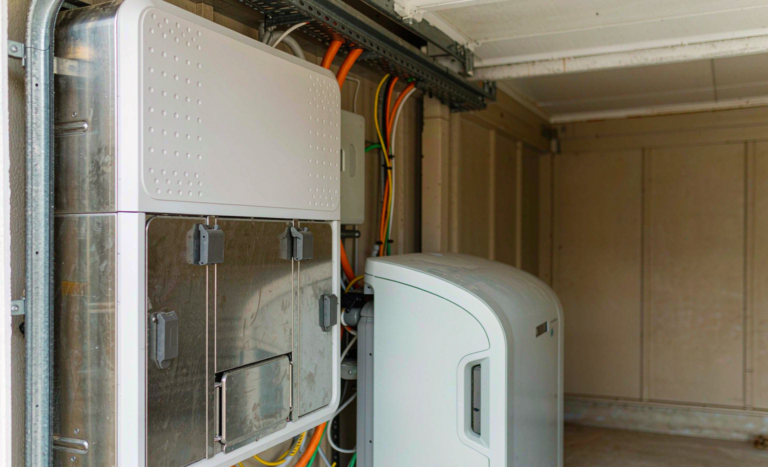
Installation: siting, enclosure and the things that chew cables
Most of what goes wrong physically at a cabin has nothing to do with electrochemistry.
Enclosure rating and placement
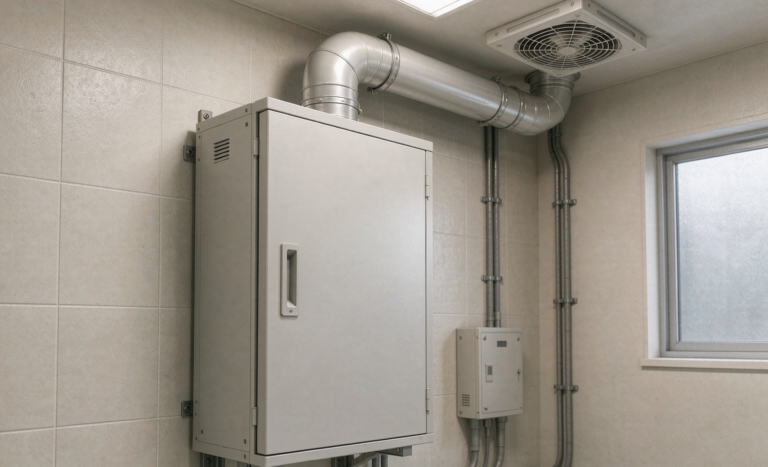
Specify the enclosure by its real environment, not its marketing number. A sheltered porch and an exposed north wall are different worlds. IEC 60529 IP ratings are the shared language, and for outdoor or damp locations I start at IP54 and move to IP65 where wind-driven rain or wash-down is plausible. Above all, keep the pack out of direct sun. A black enclosure in July sun is a purely calendar-aging oven: internal temperatures of 55–70°C are unremarkable in a dark box on a hot afternoon, and at those temperatures the pack is aging hard while producing nothing.
Surge, lightning and grounding
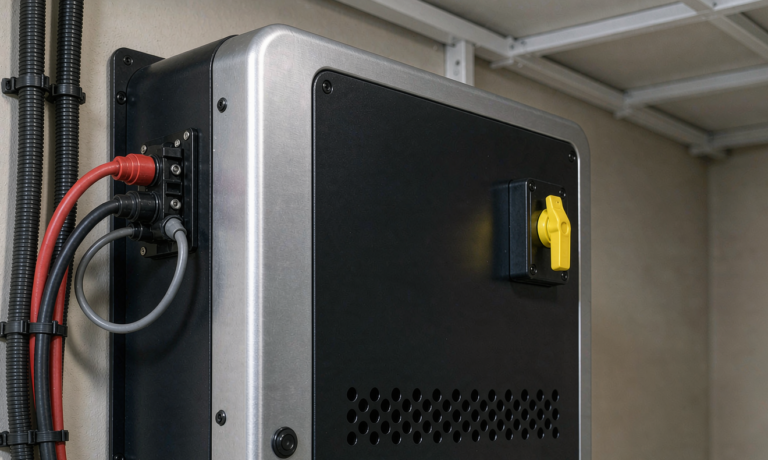
Remote sites are exposed sites. Exposed arrays and long DC runs invite induced transients, and a lightning season can take out an inverter that never had a fault in its design. Surge protection on both the DC and AC sides, correct bonding, and a grounding electrode arrangement done to code are not upsells at a cabin. Neither is a quality DC disconnect that a visiting neighbour can operate.
Condensation, rodents and freeze-thaw
A cold pack brought into warm humid air condenses on its own terminals. If you have ever moved a pack indoors for service, let it acclimate before you energise anything. Rodents nest on warm inverters and chew cable jackets; fine mesh over vents helps, but only if it does not become an airflow restriction, and every conduit entry wants sealing. And the foundation matters: put the pad above frost depth or on piers, and bury conduit below local frost depth, or the first three winters will slowly tear your cable entries out.
Surge loads deserve their own sentence
Well pumps, power tools and compressors all present inrush two to five times running current. Size the inverter for the surge, not the running load, and where a pump is involved, a soft starter or variable-speed pump is often a cheaper fix than a bigger inverter. Check the split-phase requirement too: a North American cabin with 240 V loads needs a split-phase output, and this is a specification issue that is very expensive to discover on site.
Commissioning: what to set before you drive away
The commissioning visit is the highest-leverage day in the life of the system, and I treat it as a formal procedure with a written baseline.
Record a Day-0 baseline in absolute numbers
Five measurements, recorded before you leave: controlled discharge capacity as a percentage of beginning-of-life, standardised DC internal resistance, cell-to-cell voltage deviation in millivolts after rest, insulation resistance of each pole to the enclosure, and a torque audit with witness marks on every power connection. “Looks balanced” is not a baseline. A number is. Without that Day-0 record, the capacity reading you take in three years is uninformative, and any warranty conversation becomes an argument about opinion.
Set the state-of-charge window deliberately
For a regularly occupied cabin I commission a 15–85% daily window with the top reserved for genuine need. For a cabin closing up for the season, departure state of charge is the decision that protects the pack. Leave it at roughly 50–60% if the array will keep feeding it, and think through the parasitic math: a 15 kWh pack at 50% holds 7.5 kWh, BMS and inverter quiescent draw of around 3 W is roughly 2.2 kWh per month, so you have about two and a half months of darkness before you reach a 10% floor. That is the number that tells you whether an unattended winter is safe at your site or whether you need a periodic check.
Write down the winterisation and the low-SoC behaviour
The pack should have a defined protective low-state-of-charge shutdown with hysteresis, and the owner should know what it looks like and how to recover from it. Load-shedding priority should be set so non-essential circuits drop first. And someone who is not you must be able to find the disconnect: I label it, photograph it and put the photograph in the handover document.
Make sure the data survives without the network
Set the system to retain local logs — I want at least 30 days and prefer 90 — so you can download the history on arrival even if the satellite terminal was down all season. The same discipline we apply to a remote drone battery fleet applies exactly here: if the telemetry pipeline is the only record, you have no record. The specific variables worth keeping are daily throughput, depth-of-discharge histogram, hours below 0°C and above 40°C, and any over-temperature or over-current events with a parameter snapshot. The temperature-time histogram is the most valuable artefact in the whole set and the one almost nobody keeps, even though it is what lets you prove that three hundred hours above 45°C did more damage than the cycle counter suggests.
Documents and standards you will be asked for
Cabin installations attract scrutiny precisely when they are remote, because the fire service knows response time is long. Collect the paperwork before you need it.
- UL 1973 and UL 9540 / UL 9540A for the battery, the system, and thermal runaway propagation testing respectively. In many jurisdictions a listed system is the difference between a permit and a refusal.
- NFPA 855 for installation of stationary energy storage, covering separation distances and limits. Requirements vary by edition and by jurisdiction, and attached structures are treated differently from detached ones. Get the authority having jurisdiction’s position in writing before you buy, not after.
- Electrical code references for your region — NEC Articles 690 and 706 in the United States for PV and energy storage, or the applicable national wiring rules elsewhere.
- IEC 62619 for industrial and stationary secondary cells and batteries, and IEC 62133-2 where cells are within the portable scope.
- UN38.3 test summary for every shipment, because remote delivery is a transport event and the carrier is entitled to ask.
- IEC 60529 ingress rating for the enclosure, and environmental test evidence such as IEC 60068-2 series for vibration and thermal cycling where the site is genuinely rough.
For context on where stationary storage cost and deployment trends are heading, the U.S. Department of Energy maintains accessible material through energy.gov, and the primary literature on degradation mechanisms is well covered in Nature’s energy materials collection.
Maintenance you can do twice a year
Cabin maintenance should be a short, repeatable ritual, not an engineering project.
Spring opening and autumn closing
Twice a year: visual inspection of enclosure seals and cable glands for water staining and rodent evidence, a torque check on power terminations with witness marks intact, a vent and filter check, a controlled capacity check using the same procedure as the Day-0 baseline, a standardised DCIR pulse, and a log download. Standardise the conditions — rest time, ambient temperature, state-of-charge window, current and duration — or your trend line is fiction.
The three numbers that matter
Capacity as a percentage of beginning-of-life: two to three percent loss per year is healthy service, six to ten percent suggests hard duty or a thermal problem. DC internal resistance normalised to 25°C: 1.15 times baseline means investigate, 1.3 times means plan replacement, 1.5 times means retire it. And cell deviation in millivolts after rest — record the number, not the judgement of “balanced”. Alongside those, an infrared scan under load is worth doing annually; read temperature differences across a current path rather than absolute values, since a connection running 15 K hotter than its identical neighbour is a finding even when nothing is over a limit.
Store the record
Keep the baseline, the seasonal readings, any fault codes with parameter snapshots, and the temperature-time histogram. When the pack eventually retires, that file is what decides whether it can be reused at all. A pack with a documented history can be graded and reused at lower C-rate duty; a pack without one is an unknown, and unknowns do not get second lives.
When a cabin justifies a custom battery pack
Catalogue products cover most cabins. I recommend a custom battery solution when two or more of these are true:
- The installation envelope or the mounting points are dictated by the structure — a specific closet, a stud bay, a wall that cannot carry the load.
- Sustained C-rate exceeds the catalogue product’s thermal capability, typically on sites with large pumps or shop tools.
- The temperature window is permanently outside the normal range and you need an engineered thermal path rather than a heater pad.
- The environment is corrosive, humid or dusty — coastal salt air is a real and specific case.
- The BMS must integrate with a particular generator autostart controller, remote telematics link or load-shedding scheme.
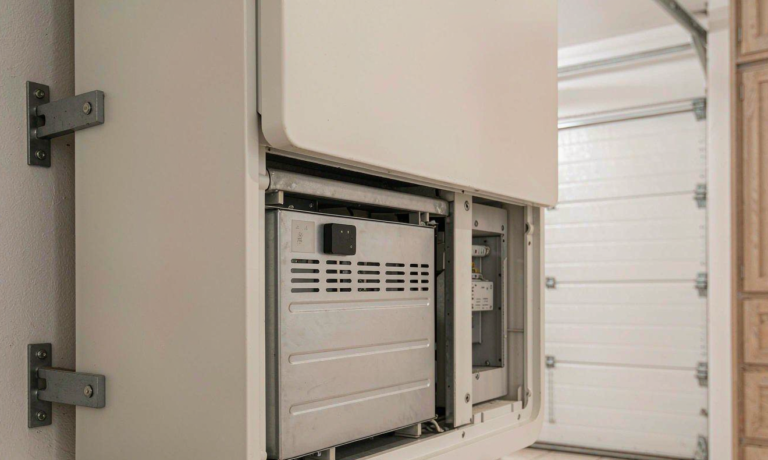
- Maintainability is contractual: module weight, handle geometry, connector orientation and reaching the service disconnect without dismantling anything else.
Two clauses belong in any custom contract: the number of years the module and its firmware will be supported, and the last-time-buy notification period. The second-worst outcome in this industry is waiting eleven weeks for a discontinued module while a cabin sits dark. The worst is discovering in year eight that nobody can service what you installed.
FAQ
How many days of autonomy should a cabin battery actually have?
Three days is my default for a cabin that people sleep in, because snow cover plus three overcast days is an ordinary week rather than an emergency. Move to four or five if the site is heavily shaded, if the array cannot be steeply tilted for winter, or if a generator outage would be genuinely dangerous. You can go to two days if a generator is reliable and you are comfortable with the fuel logistics.
Can I charge the battery in winter, or will the cold destroy it?
Charging a standard lithium-ion pack below about 0°C causes lithium plating, which is permanent capacity loss and a dendrite risk. Discharging when cold is safe, just derated. The practical answer is a pack with cell-temperature-gated charge permission, plus either insulation and thermal mass to keep cells above the threshold or a controlled heater. Budget realistically: a single warm-up of a mid-size pack costs roughly 0.8–1.2 kWh.
Is LFP still the right chemistry, or should I wait for sodium-ion or semi-solid?
For the great majority of cabins, LFP is the right answer today on cost per kWh, cycle life and supply maturity. Choose a sodium-ion battery for a genuinely unheated site where low-temperature charging matters and space is not constrained. Choose a semi-solid state battery when the pack must fit a tight volume, accepting that stack-pressure retention and cold-soak power need real engineering attention.
My generator is 7 kW. Is that enough to charge a 15 kWh pack?
Yes, and it is close to ideal. About 6.3 kW reaches the DC bus after conversion, against a typical 0.5C charge acceptance of roughly 7.5 kW for that pack size. Run the set in the 60–80% band for around two hours rather than idling for eight, stop the charge at 85–90% to avoid the slow taper, and let solar finish the top.
How much solar do I need to keep the battery alive through winter?
Size for the solstice, not the annual average. A steeply tilted array at high latitude delivers roughly 1.8–2.2 kWh per kW installed on a clear winter day, and close to nothing under snow cover. For a 4 kWh/day winter load, a 4 kW winter-tilted array is a reasonable starting point, with the battery sized to cover the gap when it does not deliver.
What state of charge should I leave the system at when I close the cabin for winter?
Around 50–60% if the array will continue to feed it, higher if the site is fully shut down and you cannot return. Do the arithmetic on parasitic draw first: at roughly 3 W of quiescent load, a 15 kWh pack parked at 50% has about two and a half months before it reaches a 10% floor. If you cannot check it within that window, either raise the departure state of charge or arrange a periodic visit.
Do I need a permit and a fire-safety review for a remote cabin?
Often yes, and the answer is jurisdiction-specific. Indoor and attached installations are treated more strictly than detached ones, and separation distances and capacity limits vary by code edition. Obtain the authority having jurisdiction’s position in writing before purchasing, and carry UL 1973, UL 9540 and UL 9540A documentation for the system.
Can I add storage to a cabin that already has solar and a generator?
Usually, and it is the most common upgrade I do. Three checks decide it: whether the existing inverter is a battery-capable hybrid or needs replacing, whether the array voltage and configuration suit the new battery’s input window, and whether the generator’s autostart and charge control can actually talk to the new BMS. That third one causes more callbacks than the other two combined.
What is the single highest-return maintenance task?
Thermal management. Arrhenius behaviour means calendar aging roughly doubles for every 10 K rise, so the hottest few hundred hours of a pack’s life can matter more than thousands of temperate ones. Keep the enclosure out of direct sun, keep vents clear, and watch the temperature spread across identical current paths during your seasonal infrared scan. A spread that has drifted from 3 K to 9 K is a finding even when no absolute limit has been exceeded.
How long will a cabin battery last, and what happens at end of life?
With a sane state-of-charge window and decent thermal conditions, expect a service life measured in many years with two to three percent capacity loss annually. End of life is a pack judgement, not a single capacity number: retire on capacity below roughly 70–80% of beginning-of-life, on DCIR beyond about 1.5 times baseline, on rising cell deviation, on an insulation trend heading down, or on any history of water ingress, impact or thermal event. Packs with complete records can be reused at low C-rate duty; packs without them cannot be graded at all.